
The cart is empty!
Corrosion Around Us
Submitted by: Stephen Tate, Immediate Past President.
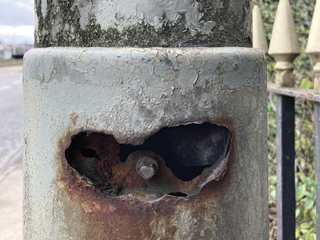
Photos: Failure of Lamppost Cover Around a Non-Carbon Steel Fastener Spotted in Inverness Scotland.
Submitted by: Stephen Tate, Immediate Past President.
Photos: Failure of Lamppost Cover Around a Non-Carbon Steel Fastener Spotted in Inverness Scotland.
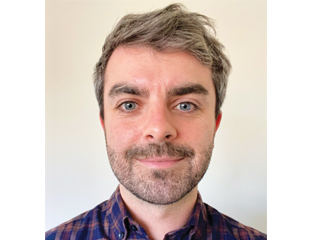
ICorr is delighted to introduce Dr. Joshua Owen as the newly appointed Interim Chair of the Yorkshire and Humber branch. An AGM to endorse the full committee will follow in the near future.
Stepping into this leadership role, Dr. Owen brings a wealth of expertise and a strong commitment to advancing corrosion science and engineering in the region. Learn more about him in his own words below.
“I am Josh, a lecturer in the School of Mechanical Engineering at the University of Leeds. I have a PhD from the University of Leeds, focused on the erosion-corrosion of carbon steel. Having previously been part of the Young ICorr committee, I now chair the Yorkshire and Humber branch of ICorr.
At the University of Leeds, we host the Institute of Functional Surfaces research group, dedicated to the study of corrosion and material degradation. We have over 20 active PhD and postdoctoral researchers tackling various corrosion challenges, from flow accelerated corrosion to corrosion challenges faced in the energy transition, with a strong focus on addressing industry needs.
As Chair, I am excited to establish a committee and organise events for the Yorkshire and Humber corrosion community in the coming months. My vision for the branch is to create a vibrant community within the region that bridges leading academic research and industry expertise through a series of events”.
If you are interested in joining the committee or participating in our events, please contact yorkshirechair@icorr.org
On 20th February 2025, the newly established Wales and South-West of England regional branch held its inaugural event in Pembroke, marking a significant milestone in bringing together professionals from across the region. The event, hosted at Insite Technical Services, was a collaborative effort with the Institute of Chemical Engineers (IChemE) and featured insightful presentations from experts in the field.
The first presentation was delivered by Adeeba Zachary and Sabrina Gregory from Valero Energy. Adeeba, the Corrosion and Materials Engineer at Valero’s Pembroke Refinery, has a Master’s in Mechanical Engineering from Swansea University and is also the current Vice Chair of the Wales and South-West Branch of ICORR. Adeeba has experience in multiple areas of mechanical integrity, including being a registered American Petroleum Institute (API) piping and pressure vessels inspector. Sabrina Gregory, a Process Engineer working on the Reformer Unit at Valero’s Pembroke Refinery, has a Master’s in Chemical Engineering from Swansea University. Sabrina has experience in daily operations of the Reformer Unit as well as during a major unit turnaround/upgrade.
Adeeba and Sabrina’s presentation titled “Where process and corrosion engineering meet: Implementing a material operating envelope at a refining facility,” provided insight into the concept of Material Operating Envelopes (MOEs) and the multidisciplinary collaboration required for their effective implementation in a refinery setting. They explored the critical considerations needed to complete an MOE study, including materials selection, operational changes, and contaminant control. A key part of their presentation was a case study on implementing an MOE for a Catalytic Reformer Unit, detailing how such frameworks ensure the longevity and safety of complex industrial equipment. Their expertise illustrated how blending process engineering with corrosion and materials engineering can help mitigate potential operational risks, minimise turnaround times and optimise performance in refining operations.
The second presentation was given by Sahana Cooper, a Senior Process Engineer at Insite Technical Services. With five years of experience in process design, Sahana has worked on a diverse range of projects, from surge analysis to distillation column replacements and co-processing renewable feedstocks. Sahana’s academic background includes a degree in Chemical Engineering from Loughborough University, complemented by an industrial placement at Valero’s Pembroke Refinery and a research project at Chalmers University in Gothenburg, Sweden.
The presentation, “Corrosion mechanisms in hydrotreaters during co-processing of renewable feeds.” delved into the challenges faced when co-processing renewable feedstocks in diesel hydrotreaters. Her talk focused on a specific project where a client sought to co-process up to 5% by weight renewable feedstock in their diesel hydrotreater. The process posed unique corrosion challenges, particularly related to managing salt deposits and adhering to the high temperature hydrogen attack (HTHA) limits, which are crucial for ensuring the integrity and safety of refinery operations.
The event saw an excellent level of interaction from the audience, with many questions and plenty of further discussions following each presentation. The delegates were highly engaged, seeking deeper insights into the technical aspects of the topics covered and exchanging ideas on how to apply the learnings in their own work. The lively discussions highlighted the thirst for knowledge and collaboration among professionals in the region. With 45 delegates in attendance, the first Pembroke event was deemed a resounding success! The positive feedback from participants and the high level of engagement with branch activities to date bode very well for the future of the Wales and South-West regional branch, which plans to continue providing such events for professionals to connect, learn, and grow.
The next event is due to take place at Cardiff University on 9th April. For more information, contact: swchair@icorr.org
You can also keep up to date on events by visiting our LinkedIn page; https://www.linkedin.com/groups/12992293/.
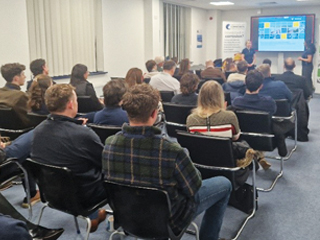
Photo: Delegates Observing Adeeba Zachary and Sabrina Gregory Presentations.
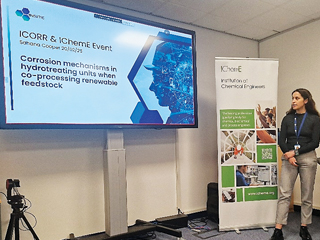
Photo: Sahana Cooper from Insite Technical Services.
A fantastic afternoon of knowledge-sharing took place at the joint Institute of Corrosion North-West Branch on 19th February 2025. Young ICorr and The University of Manchester event at the Henry Royce Institute in Manchester!
The event brought together ICorr members, students, industry experts, and early-career professionals for an engaging session featuring real-world case study discussion by Roger Francis (RFmaterials limited) and Ben Hudson (Premtech Ltd), one of the Young Engineer Programme 2024 winners, who shared his team’s approach to tackling the case study.
Danny Burkle (LBBC Baskerville), ICorr Corrosion Engineering Division Chair, highlighted the value of joining ICorr and the Young Engineer Programme, inspiring the next generation of corrosion professionals.
Attendees also explored cutting-edge research from postgraduate students at Leeds and Manchester Universities, covering topics such as:
Mild steel corrosion in oxygenated water – Finlay Spence
Salinity effects on carbon steel corrosion and inhibitors – Harry Tookey
Computational approaches to corrosion inhibitor performance – James Osbiston
Laser-induced hydrogen measurement in steels – Tom Hillman
The level of engagement, insightful discussions, and thought-provoking questions made this event a huge success! We look forward to future collaborations with The University of Manchester, including the Henry Royce Institute!
A big thank you to everyone who participated and contributed to such a dynamic event, and to Yunnan Gau, ICorr President, for opening the meeting.
Further events are coming up, with the planned joint Institute of Asset Management Event focussing on managing infrastructure and the UK-China Corrosion Summit on 3rd-4th September.
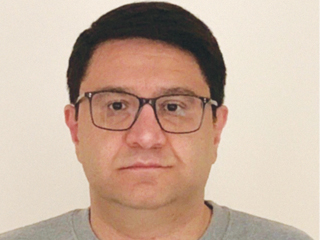
The North-West (NW) committee is excited to welcome Dr Reza Tohid as its newest member. Dr Reza holds a PhD and is a Corrosion and Integrity Management Expert, and an AMPP Corrosion Specialist. We are very excited to welcome him following his relocation to the NW after several years as an active member in the Aberdeen Branch.
Photo (right): New NW Committee Member Reza Tohid
The Annual CED Day and Corrosion
Awareness Event
ICorr NE Branch will be supporting the Annual CED Day and Corrosion Awareness Event to be held in Teesside on 24th April 2025 and look forward to seeing you on that very special occasion for our Industry.
ICorr NE Branch supporting Annual CED Day and Corrosion Awareness Event in Teesside, 24th April 2025
The NE Branch aims to provide a very full technical programme of both in-person and online events.
Further information about the NE Branch and its past presentations may be found on their website page: North-East Branch – Institute of Corrosion www.icorr.org/northeast/ under Local Technical Programme.
New Branch Sponsorships
Some reputed companies in corrosion industry have agreed in principle to be branch sponsors, these include: Zerust UK, Abyss Solutions, CorrosionRADAR Ltd.
Please visit the following links if you wish to help grow the Midlands Branch: Branch Sponsorship – Institute of Corrosion and https://www.icorr.org/branch-sponsorship-registration/
Volunteer Committee Recruitment
The ICorr Midlands Branch is actively seeking volunteers to join the committee in key roles, including Webinar Coordinator, Social Media Coordinator, Branch Sponsorships, Finance Coordinator, and Secretary. This initiative aims to strengthen our activities and engagement within the corrosion community.
AGM and DNV Industrial Visit
Joint ‘face to face’ event and AGM with DNV Loughbrough on 28th April 2025. The event will focus on innovations in corrosion monitoring especially in AI, bringing together industry experts to share insights and advancements in the field.
Call for Webinar Speakers
We are looking for subject matter experts to present on topics including:
Strengthening Regional Engagement
Efforts to expand collaboration with academia continue, with a recent meeting held at Cranfield University. Discussions with lecturers explored opportunities for student and researcher engagement, leading to the agreement to host a research seminar day later this year.
Committee Volunteers: We are very pleased to welcome: Bill Whittaker – Past Midlands Chair Ali Oskuie (Worley) – Branch Secretary Uzma Anjum (DNV) – Online Events, Webinars Louise Ramdall (Premtech) – Member Ben Knight (Premtech) – Member
Thank you for your support.
Contact: For further information on all upcoming Midlands Branch Activities or to join its committee, please contact the Midlands Chair – Prafull Sharma at: midlandschair@icorr.org