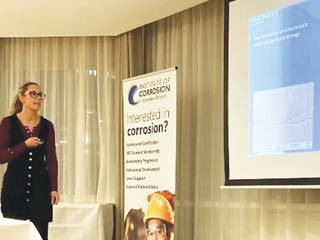
On Tuesday, 26th November 2024, at the Palm Court Hotel, the Institute of Corrosion (ICorr) Aberdeen Branch held its annual joint event with IOM3/MIS (The Mining Institute of Scotland). Sarah Bagnall, of R-TECH Materials and Branch Chair of Wales and South-West, gave an excellent presentation on Failure Analysis—An Insight into Forensic Investigation, Failure Mechanisms and Prevention.
Presenter: Sarah Bagnall
Sarah is both a Materials Engineer and Chartered Engineer specialising in failure analysis, particularly for the petrochemical, oil & gas, and power generation industries. With over 700 failure investigations conducted to date.She has broad experience of a wide range of engineering components, metallic and non-metallic materials, and industries. Over the last 10 years, Sarah has developed specialist expertise in the corrosion and thermal degradation of austenitic stainless steels. She is also the Chair of the recently formed Wales and South-West England branch committee for the Institute of Corrosion.
Presentation Outline
When engineering plant, equipment or components fail in service, the consequences can have the potential to be catastrophic for human safety and well-being, the environment and/or continuity of operations. On a lower level, the effect of such occurrences can include the requirement to reschedule production, the execution of emergency repairs, and missed customer deliveries. The impact of plant failures is undoubtedly negative for plant operators; however, determining the root cause of such failures presents an opportunity to learn from the experience. Adopting such a philosophy is critical to the continual improvement of global plant safety, performance, availability, and reliability while reducing maintenance costs.
Conducting an effective Root Cause Analysis (RCA) investigation provides the opportunity to understand and critically analyse all of the factors that have contributed towards a plant failure. Failure analysis is an essential tool that can be used within an RCA investigation to characterise defects that have caused or contributed to a plant failure event. Determining and understanding the failure mode and prevailing circumstances is critical to being able to deduce the root cause of the failure. When a material fails, it leaves behind a trail of evidence, which can be pieced together to determine the cause of failure. R-Tech Materials have a range of qualified experts, investigative equipment, and services for materials failure analysis which identify failure mechanisms encountered within the oil and gas industry. The range of study techniques and equipment required will be demonstrated through some case studies relevant to the industry.
Gathering the Evidence
To gather evidence for a failure investigation, it may be required to perform site visits if the components or structures are in situ. Detailed information would be gathered through dimensional checks, photography and sometimes it may be required to perform on-site testing such as cutting samples, NDT or replicates of fractures. Otherwise, if components are shipped to a laboratory more extensive analysis techniques can be used using chemical analysis, microscopy, sample sectioning or performing hardness testing and cutting tensile or other test samples from items for evaluation. In certain situations, it may be necessary to carry out corrosion testing, impact testing, or fatigue testing on prepared samples to establish site materials performance versus expected materials.
A significant part of the failure analysis exercise is the gathering of information from site about the conditions of service’ This involves studying:
Type of plant and operational mode (e.g. continuous, cyclic, intermittent)
Material grades used
The process conditions (i.e. flow rates, temperature, pressure, process fluids composition and general operating environment)
Any specific circumstances surrounding failure
Inspection intervals and servicing
Service length of component vs expected life
Materials failure can be due to one of a range of factors, some basic, such as overloading or incorrect specification of materials, and others more complex, such as stress corrosion cracking (SCC), which involves loading in combination with surrounding media or environment.
Specific Case Studies
Failures investigations were demonstrated through a series of 5 most interesting case studies. Case 1 – Fractured flange of 304 Grade Stainless Steel bolts on oil tanker fuel transfer line.
The failure mechanism was identified as polythionic acid stress corrosion cracking. This occurs due to the formation of sulphide scales in the presence of sulphur compounds, which then react with air and moisture during start-up and shutdown to form sulphur acids (polythionic acid). The sulphur is thought to have formed due to exposure. to an environment containing hydrogen sulphide. In the presence of a tensile stress within the bolts, the acid attacked the sensitised austenitic stainless steels adjacent to the chromium-depleted grain boundaries, producing intergranular cracking.
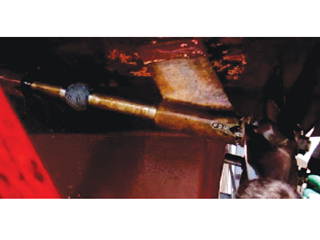
Case Study 2 – Investigation was conducted on a failed propeller shaft from a Pilot Vessel made of duplex stainless steel.
In this instance, Zinc anodes in form of shaft bracelets had been employed as cathodic protection (CP) system.
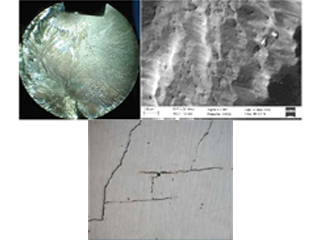
The shaft fracture showed river lines radiating from the Keyway this being a brittle fracture mechanism with advancing crack-front and multiple cracks radiating. Deposits from within the cracking zone contained significant levels of chlorine and sulphur.
Further analysis of the mechanism showed fatigue crack growth, but the fracture was mainly put down to hydrogen-induced stress cracking (HISC) due to the presence of over-protection of the duplex stainless with localised zinc anodes.
Hydrogen atoms can often form as a consequence of CP over-protection voltage of -1050 mV vs. the lower required ~ -550 mV for DSS against a Silver/Silver Chloride reference electrode. Protection limits for duplex stainless steels (DSS) had therefore been considerably exceeded, and atomic hydrogen had been absorbed in the metal matrix, leading to hydrogen cracking.
Detail of the 3 other case studies can be found in the slide upload to members site https://sites.google.com/site/icorrabz/resource-center
The Aberdeen Branch provides a very full technical program of both in-person and online events. Abstracts of potential papers for the Aberdeen Technical Programme are always welcome for consideration, and anyone wishing to present should correspond soonest with the 2024/2025 Chair and Technical Programme Co-ordinator: meilingcheah@gmail.com
Further information about the Aberdeen Branch and other past presentations may be found on their website page: Aberdeen Branch – Institute of Corrosion. https://www.icorr.org/aberdeen/ under Local Technical Programme and to join the Aberdeen Branch mailing list, please contact: icorrabz@gmail.com
Photo: Sarah Bagnall, of R-TECH Materials.
Presenter: Sarah Bagnall
Sarah is both a Materials Engineer and Chartered Engineer specialising in failure analysis, particularly for the petrochemical, oil & gas, and power generation industries. With over 700 failure investigations conducted to date.She has broad experience of a wide range of engineering components, metallic and non-metallic materials, and industries. Over the last 10 years, Sarah has developed specialist expertise in the corrosion and thermal degradation of austenitic stainless steels. She is also the Chair of the recently formed Wales and South-West England branch committee for the Institute of Corrosion.
Presentation Outline
When engineering plant, equipment or components fail in service, the consequences can have the potential to be catastrophic for human safety and well-being, the environment and/or continuity of operations. On a lower level, the effect of such occurrences can include the requirement to reschedule production, the execution of emergency repairs, and missed customer deliveries. The impact of plant failures is undoubtedly negative for plant operators; however, determining the root cause of such failures presents an opportunity to learn from the experience. Adopting such a philosophy is critical to the continual improvement of global plant safety, performance, availability, and reliability while reducing maintenance costs.
Conducting an effective Root Cause Analysis (RCA) investigation provides the opportunity to understand and critically analyse all of the factors that have contributed towards a plant failure. Failure analysis is an essential tool that can be used within an RCA investigation to characterise defects that have caused or contributed to a plant failure event. Determining and understanding the failure mode and prevailing circumstances is critical to being able to deduce the root cause of the failure. When a material fails, it leaves behind a trail of evidence, which can be pieced together to determine the cause of failure. R-Tech Materials have a range of qualified experts, investigative equipment, and services for materials failure analysis which identify failure mechanisms encountered within the oil and gas industry. The range of study techniques and equipment required will be demonstrated through some case studies relevant to the industry.
Gathering the Evidence
To gather evidence for a failure investigation, it may be required to perform site visits if the components or structures are in situ. Detailed information would be gathered through dimensional checks, photography and sometimes it may be required to perform on-site testing such as cutting samples, NDT or replicates of fractures. Otherwise, if components are shipped to a laboratory more extensive analysis techniques can be used using chemical analysis, microscopy, sample sectioning or performing hardness testing and cutting tensile or other test samples from items for evaluation. In certain situations, it may be necessary to carry out corrosion testing, impact testing, or fatigue testing on prepared samples to establish site materials performance versus expected materials.
A significant part of the failure analysis exercise is the gathering of information from site about the conditions of service’ This involves studying:
Type of plant and operational mode (e.g. continuous, cyclic, intermittent)
Material grades used
The process conditions (i.e. flow rates, temperature, pressure, process fluids composition and general operating environment)
Any specific circumstances surrounding failure
Inspection intervals and servicing
Service length of component vs expected life
Materials failure can be due to one of a range of factors, some basic, such as overloading or incorrect specification of materials, and others more complex, such as stress corrosion cracking (SCC), which involves loading in combination with surrounding media or environment.
Specific Case Studies
Failures investigations were demonstrated through a series of 5 most interesting case studies. Case 1 – Fractured flange of 304 Grade Stainless Steel bolts on oil tanker fuel transfer line.
The failure mechanism was identified as polythionic acid stress corrosion cracking. This occurs due to the formation of sulphide scales in the presence of sulphur compounds, which then react with air and moisture during start-up and shutdown to form sulphur acids (polythionic acid). The sulphur is thought to have formed due to exposure. to an environment containing hydrogen sulphide. In the presence of a tensile stress within the bolts, the acid attacked the sensitised austenitic stainless steels adjacent to the chromium-depleted grain boundaries, producing intergranular cracking.
Case Study 2 – Investigation was conducted on a failed propeller shaft from a Pilot Vessel made of duplex stainless steel.
In this instance, Zinc anodes in form of shaft bracelets had been employed as cathodic protection (CP) system.
The shaft fracture showed river lines radiating from the Keyway this being a brittle fracture mechanism with advancing crack-front and multiple cracks radiating. Deposits from within the cracking zone contained significant levels of chlorine and sulphur.
Further analysis of the mechanism showed fatigue crack growth, but the fracture was mainly put down to hydrogen-induced stress cracking (HISC) due to the presence of over-protection of the duplex stainless with localised zinc anodes.
Hydrogen atoms can often form as a consequence of CP over-protection voltage of -1050 mV vs. the lower required ~ -550 mV for DSS against a Silver/Silver Chloride reference electrode. Protection limits for duplex stainless steels (DSS) had therefore been considerably exceeded, and atomic hydrogen had been absorbed in the metal matrix, leading to hydrogen cracking.
Detail of the 3 other case studies can be found in the slide upload to members site https://sites.google.com/site/icorrabz/resource-center
The Aberdeen Branch provides a very full technical program of both in-person and online events. Abstracts of potential papers for the Aberdeen Technical Programme are always welcome for consideration, and anyone wishing to present should correspond soonest with the 2024/2025 Chair and Technical Programme Co-ordinator: meilingcheah@gmail.com
Further information about the Aberdeen Branch and other past presentations may be found on their website page: Aberdeen Branch – Institute of Corrosion. https://www.icorr.org/aberdeen/ under Local Technical Programme and to join the Aberdeen Branch mailing list, please contact: icorrabz@gmail.com
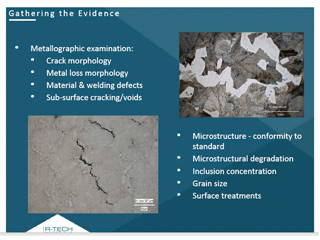
Photos: Metallograghic Examination of Materials by Sectioning for Grain Structure and Crack Presence. Fracture Surface Study by Stereographic and Scanning Electron Microscopy (SEM).
Photo: The Most Common Root Causes of Failure.
Photo: Duplex SS Propeller Shaft in-Situ with Zinc Bracelet Anode.
Photos: Stereographic Image of Fracture, SEM Image for Surface with XRF Analysis and a Metallographic Section Showing Crack Character.
The Institute of Corrosion (ICorr) is glad to formally launch the ‘ICorr India Branch’ effective from 28th January 2025.
Meet the ICorr India Team
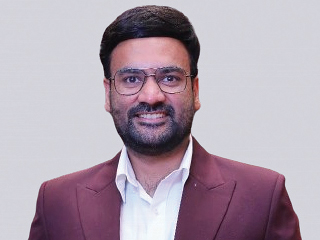
Dr. Arpit Goyal
Dr. Arpit is Chair of the ICorr India branch. He is serving as an Assistant Professor in the Civil Engineering Department at the Thapar Institute of Technology. He has extensive research experience in the area of the durability of concrete, novel cementitious materials, corrosion protection, electrochemical techniques, and cathodic protection of steel in concrete. He has successfully patented a new conductive anode paint for impressed current cathodic protection of reinforced concrete structures during his Ph.D. and post-doctoral fellowship.
He has also worked on various consultancy projects related to the testing of corrosion inhibitors and conductive paints for preventing corrosion of steel in concrete. At present, he has published more than 12 journal articles, various national and international conference papers and book chapters.
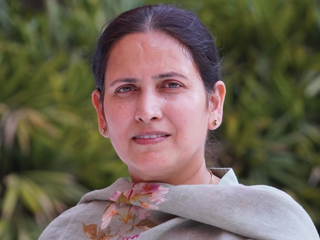
Dr. Shweta Goyal
Dr. Shweta Goyal is Vice-Chair of the ICorr India Branch. She is a professor in the Civil Engineering Department at the Thapar Institute of Technology. She earned an M.E. and PhD in Structures and Civil Engineering from Thapar University, Patiala, India. She was awarded Gold Medal during B.E. (Civil Engineering) and M.E. (Structural Engineering). She has handled various research projects sponsored by Govt. of India agencies like DST (Department of Science and Technology) and UGC (University Grants Commission) and industry-sponsored research projects amounting to more than INR 400 lakhs. Her research is oriented towards sustainability of reinforced concrete structures. She is the co-convener of the working group for revision of BIS 12594. She has more than 100 publications to her credit.
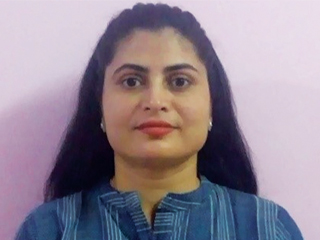
Dr Shagufta Khan, Editor CMJ
Dr. Shagufta Khan is Secretary – External of ICorr India branch. She holds a PhD from Homi Bhabha National Institute, DAE (Department of Atomic Energy), India. She is a Fellow of the Institute of Corrosion and an AMPP-certified Corrosion Specialist, with 17 years of experience in research, academia, and training. Dr. Khan has published 18 research papers in international journals and conference proceedings and has presented her work at numerous international conferences. She is the Guest Editor for MDPI’s Sustainability Special Issue, “Sustainable Materials, Manufacturing and Design,” and the Technical Editor of the Corrosion Management Magazine, published by the UK Institute of Corrosion. She specialises in electrochemical corrosion, stress corrosion cracking, corrosion failure analysis, corrosion protection techniques (Inhibitors and coatings).
Dr. Prasanna Kumar Behera
Dr. Prasanna Kumar Behera is currently working as Assistant Professor in the Civil and Environmental Engineering at IIT Tirupati. He is Secretory Internal of ICorr India branch. He holds a PhD, M. Tech., and B. Tech. in Civil Engineering. His primary research interest is durability and condition assessment of concrete structures, and he works in reinforcement corrosion in concrete. He worked on understanding the importance of government schemes in promoting urban infrastructure and economic growth, and as part of this, he worked in the ministry of road transport and highways (MoRTH)-funded project titled “Employment creating effects of highway construction” at IIT Kanpur. Dr. Prasanna has academic merit awards like ‘Outstanding PhD thesis award from IIT Kanpur’, and also has regularity awards in his credit, and is an active reviewer in international Journals of ACI, ASCE etc.
J N Agrawal
N. Agrawal holds B. Tech in Electrical Engineering and MBA in Marketing Management. He has a long and varied experience of 40 years in oil and gas industry in pipeline projects and operation and maintenance. He specialises in corrosion management of oil and gas pipelines including Cathodic Prorection. He superannuated from service in 2015 after an active engagement of 33 years. Presently he is doing independent work in the field of corrosion management of pipeline. He is CEO of Corrsol Tech. He has presented several papers on different topics on corrosion control in AMPP and ASME conferences. He has been awarded in 2023 for his contribution in the field of corrosion science and technology in industrial organisation by AMPP India Chapter. He is CP4 from ICorr UK. He is event coordinator of ICorr India. He is author of books on Cathodic Protection and pipeline integrity management. He conducts training on Cathodic Protection and pipeline integrity management as well.
Amarjeet Singh
Amarjeet Singh is a Research Scholar in the Metallurgical and Materials Engineering Department at Punjab Engineering College, Chandigarh, the current research focus involves investigating the development of magnesium alloy for both orthopaedic and structural applications utilising casting methods. Furthermore, heat treatment is conducted on magnesium-based alloys to enhance their serviceability. Mg and its alloys are known to exhibit early corrosion resistance issues, and as part of this research, the surface modification of Mg alloys using both organic and inorganic materials is explored to improve their corrosion resistance. He is University Liaison and CPD Officer at ICorr India.
ICorr India-Technical Event
With an intention to provide an academic-industry outlook to the researchers and other working professionals working on corrosion, an online lecture series by specialised subject experts is being organised by the Branch. The first lecture of the series “200 years of CP and OPC” was presented by Prof. Paul Lambert, on January 28th, 2025.
Prof. Paul Lambert has over 40 years of experience in the investigation of structural durability and degradation and in the development of novel remedial techniques for civil and building structures, most recently as Head of Materials and Corrosion at Mott MacDonald. He became one of the three inaugural Mott MacDonald Fellows in 2023. Paul is Visiting Professor at the Centre for Infrastructure Management at Sheffield Hallam University where he carries out research into novel materials and repair technologies.
Additional Information
For Continuing Professional Development (CPD) or to join ICorr India mailing list, request by Email to: arpit.goyal@thapar.edu
The Institute is continuing its drive started in 2024 to expand its membership overseas and to increase its Branch Profile.
We have set up country-specific working agreements for the provision of member services and collaboration, especially in the area of training provision, reported elsewhere in the magazine.
Local branch committees are currently being established in India and Saudi Arabia.
There are also a number of joint events starting to emerge, such as the ICorr-China Summit in Manchester to be held on the 3rd and 4th of September this year.
These initiatives are starting to bear fruit, as readers will have seen from our recent announcements, and we are now well placed to better serve our significant overseas membership going forward.
Our HQ ICorr office team, managed by Geraldine Blomley, has kindly provided us with a breakdown (by country of applicant) for the most recent 52x ICorr membership applications (for the period ending 20th December 2024).
This is very significant for our membership direction and future branches. We shall monitor these trends closely.
30% UK (15)
70% Overseas (37)
There are of course some additional applications expected for China from the recent President / Vice President visits to that country that are pending, and these will be processed soon for approval and ratification by ICorr Council.
The Institute welcomes all suggestions for improvement to its membership services. Please send any suggestions for improvement to: president@ICorr.org
Members are also invited to represent their country via submission of good quality technical articles. Please send these to editor@ICorr.org for consideration for publication.
Breakdown by Country for the most recent 52x ICorr Membership Applications (Period ending 20th December 2024).
It is with great sadness that we announce the untimely death of Brian A. Martin in Sydney from mesothelioma on Monday, 2nd September 2024. Brian had been a member of ICorr since 1972 and was made an Honorary Member in 2017, whereby the presentation made to him in Australia read as follows:
“The Institute of Corrosion (ICorr) recognises the considerable contribution that Brian A. Martin has made to the science and practice of cathodic protection, in particular to buried pipelines, both in Australia and internationally. Brian has been a long-term professional member and then Fellow of ICorr in the UK; we know that he has been a strong supporter of the ACA and a strong contributor to Standards Australia, to International Standards and to the Training and Professional Development of Cathodic Protection Engineers in Australasia. He has pushed our practice of CP forward and he has given back his time and his enthusiasm and has fully shared his knowledge with others to the benefit of the entire corrosion protection community. He has earned this Honorary Fellowship of ICorr.”
Brian came to the UK in 1970 to study at Sir John Cass for his MSc under Prof. Lionel Shrier, who had just moved from Battersea/Surrey to Cass. Brian worked part-time at ‘Spencers’ during his MSc studies, with a desk in a dimensionally challenged office with a tiny window overlooking the Buckingham Palace gardens.
His contributions to Australian and International Standards will not be forgotten. Brian Wyatt and Markus Buchler much appreciated his contribution to the European supposed controversy over the impacts of concentration polarisation on CP (in all environments). This is still rumbling along in Germany due to folk who manage to misread some of the wonderful work done there in the 1960s and 1970s. Brian participated in the wide and open discussion on this in the CEOCOR Congress in Stockholm in 2016 and was a coauthor of the paper ‘Cathodic protection of soil-buried steel pipelines—a critical discussion of protection criteria and threshold values,’ which resulted from this. Despite one of the authors being H.-G. Schöneich, considered the leading pipeline CP specialist in Germany at that time, this paper still offends a segment of the German CP fraternity. Brian had been a member of the Australasian Corrosion Association (ACA) since 1969 and was an Honorary Life member, holder of the Corrosion Medal, Australasian President as well as active in the Electrolysis Committee as President and Secretary for over 30 years. In addition, Brian was a P. F. Thompson lecturer as well as an internationally recognised expert in cathodic protection of pipelines.
He was passionate and intense about his profession, martial arts and very fast cars. Few people who have been a passenger in a Brian Martin driven car would forget the experience. Or wish to repeat it. More than that, he was a warm and engaging friend who will be sorely missed. Typical of Brian, he held a farewell Wake a few days before his demise to which all invited could see that, despite his illness, he had lost none of his essential spirit. Anecdotes about Brian are endless. from driving up an English motorway shoulder on a motorbike at 160 km/hour to see if it could be done, to surfing inadvertently on a Nudist beach. He really did land by helicopter in remote Papua New Guinea for a week’s unaccompanied trek to do a resistivity survey.
He was a lovable mad bugger in cars, boats, and sports. Always striving for excellence and pushing boundaries. These attributes carried over more safely into his professional life.
Brian is survived by his wife of nearly 50 years, Cheryl, and daughter Tara and grandchildren. In his memory, his friends have suggested that the first paper delivered to the Cathodic protection stream of each Annual ACA Conference be named ‘The Brian Martin Lecture’, and that it ought to contain some controversial issues! That will be a perfect memorial.
Corrosion Engineering Division – Corrosion Awareness and Working Day 2025: Join Us at the Net Zero Centre in Teesside
The Corrosion Engineering Division (CED) is delighted to announce an exciting event for Corrosion Awareness Day 2025. Hosted at the prestigious Net Zero Centre in Teesside on 24th April 2025, this event promises a day of insightful talks and collaboration focused on the theme of “Innovations in Corrosion Engineering for Sustainable Energy Systems.”
In addition to the day’s engaging content, we are offering sponsorship opportunities for organisations looking to showcase their commitment to corrosion engineering and sustainable energy solutions. Sponsors will gain visibility among industry professionals at this event. This event promises to deliver valuable insights, foster collaboration across sectors, and provide inspiration for tackling corrosion challenges in a sustainable world.
To register, learn more, or discuss sponsorship opportunities, please contact me at danny.burkle@lbbcbaskerville.co.uk Spaces are limited, so act quickly to secure your place!
Highlights of the programme include:
Industry Talks from leading experts in sectors such as All Energy, Nuclear, Coatings, and Cathodic Protection.
Insights from a Young ICorr Representative, sharing fresh perspectives and emerging trends.
The Presentation of the 2024 Paul McIntyre Award Winner, recognising excellence in corrosion engineering.
A Guided Tour of the Net Zero Centre, providing a first-hand look at cutting-edge facilities supporting sustainable energy solutions
We use cookies to optimize our website and our service.
Functional
Always active
The technical storage or access is strictly necessary for the legitimate purpose of enabling the use of a specific service explicitly requested by the subscriber or user, or for the sole purpose of carrying out the transmission of a communication over an electronic communications network.
Preferences
The technical storage or access is necessary for the legitimate purpose of storing preferences that are not requested by the subscriber or user.
Statistics
The technical storage or access that is used exclusively for statistical purposes.The technical storage or access that is used exclusively for anonymous statistical purposes. Without a subpoena, voluntary compliance on the part of your Internet Service Provider, or additional records from a third party, information stored or retrieved for this purpose alone cannot usually be used to identify you.
Marketing
The technical storage or access is required to create user profiles to send advertising, or to track the user on a website or across several websites for similar marketing purposes.