2024 saw a very successful year for CORREX, with each person playing their part in the running and implementation of ICATS (Industrial Coating Applicator Training Scheme) courses.
We were able to assist people and companies using social value principles, which will have positive effects as we go into 2025.
At the end of 2024, past president Bill Hedges retired from ICorr and CORREX as a CORREX board member. Bill has been an amazing person to work with. His enthusiasm and ideas will be very much missed as he will be. I have been lucky enough to work with Bill for the last 6 years during his presidential journey.
The CORREX board also lost Stephen Barke (Steve) in 2024 as he also retired from the board.
Steve was the CORREX Managing Director before me and instrumental in its development for many years. His hard work and dedication were an inspiration to us all. Steve was also instrumental in engaging me as the ICATS courses creator, demonstrating his trust and faith in me at every turn. We will miss Steve very much from our discussions during the year.
We also lost Anthony Collins due to retirement from the CORREX board in 2024. Tony was our most fantastic honorary treasurer, working tirelessly on the CORREX and ICorr accounts for more than 30 years.
Although a hard act to follow, we were lucky enough to have George Winning of WOOD plc step into the role seamlessly.
It is the CORREX boards intention to add to the board during 2025.
With 2025 now very much in progress our suite of courses remains strong and now feature in every industry.
There will be some additions to our ICATS courses during 2025, updates where needed, guidance that may have changed, and some re vamping of photos and videos.
Work has also started on additional courses for 2025, so watch this space.
Best wishes for a wonderful 2025, and a warm welcome to the first issue of the year.
The overall theme for this issue is our Science in Parliament (Special Edition) Reuse, Renew or Replace? The first technical article entitled “Raising awareness of corrosion for a more sustainable world” is contributed by Prof. Gareth Hinds. It emphasises the importance of corrosion management strategies in reducing maintenance costs, improving asset longevity, and supporting sustainability goals such as the UN Sustainable Development Goals (SDGs). The article also discusses efforts by the Institute of Corrosion (ICorr) and the World Corrosion Organisation (WCO) to increase public awareness and influence policy decisions to incorporate corrosion prevention in infrastructure projects.
David Parker has written technical article the “Value retention processes – valuable contributors to product longevity, net zero, and the circular economy” This article explores Value Retention Processes (VRPs), such as reuse, repair, refurbishment, and remanufacturing, as sustainable alternatives to traditional manufacturing and recycling. The study underscores the need for policy interventions, skills development, and industry collaboration to enhance the adoption of VRPs in various sectors, contributing to a circular economy and net-zero goals.
Third technical article, “Mentoring the next generation towards better corrosion prevention” is contributed by our YICorr member Izabela Gajewska. This article explains the critical role of knowledge transfer in combating corrosion-related challenges. The article advocates for structured mentoring programmes, university education to bridge the skills gap in corrosion engineering. It also highlights effective learning models and strategies to ensure that industry expertise is passed on to future generations, enhancing corrosion prevention practices.
Christian Stone has contributed “Advanced corrosion management techniques to reduce cost and risk in our built environment”. Focusing on reinforced concrete structures, this article discusses the role of corrosion management and the adoption of specialist technologies in extending infrastructure lifespan and minimising costs.
We warmly invite you to contribute to our upcoming issues and share your knowledge with the community. Whether it’s industry news, technical articles, or striking images for our “Corrosion Around Us” feature, your submissions are always welcome. Additionally, we would be delighted to receive entries for our “Corrosion Morphologies” column and “Fellow’s Corner.” Your contributions play a vital role in enriching our publication, and we truly appreciate your support.
With kindest regards,Dr Shagufta Khan, FICorr Consulting Editor, editor@icorr.org
Welcome to our first Corrosion Management Journal of 2025. This is also my first “The President Writes” since I took over ICorr Presidency from my predecessor, Stephen Tate, on 13th November 2024.
As I write up this article as the New President of ICorr, I am both humbled and inspired by the responsibility entrusted to me. First and foremost, I would like to extend my heartfelt gratitude to my predecessors for their steadfast dedication and impactful leadership. Their tireless efforts have laid a strong foundation that continues to empower ICorr as a beacon of excellence in the global fight against corrosion. It is with immense respect for their work that I take on this role, commit to building upon their achievements and advancing the mission of ICorr.
As we navigate the evolving landscape of corrosion management, my vision for the Institute is focusing on simplifying and proceduralising of our practices. We can enhance the efficiency and effectiveness of our activities, reduce barriers to engagement, and provide greater clarity for all our members and the whole community. A key priority for me from the onset of the new year is to foster greater collaboration and knowledge sharing between our existing branches in the UK. By increasing engagement and dialogue, we can ensure that members from every corner of the UK feel connected and empowered to contribute.
The Institute of Corrosion has valued the importance of international collaboration. ICorr has successfully signed off the MoU with AMPP (Association for Materials Protection and Performance) in the US and CSCP (Chinese Society for Corrosion and Protection) in China in September 2024. This year, ICorr are set to organise the First UK-China Corrosion Summit in the UK in September 2025, bringing together leading minds from around the globe to share knowledge, ideas, and best practices. This event can also represent a unique opportunity to position the UK as a global hub for corrosion management excellence while fostering deeper connections between international experts and organisations.
Another exciting development for the Institute is the establishment of new international branches. I am thrilled to announce that our India Branch has been successfully launched, with its inaugural event of 28th January. This marks a significant milestone for the Institute, and I am confident that the branch will play a vital role in strengthening our presence and influence in the region, which is already home to our Journal Editor. Beyond India, we are making active and positive progress in other regions, including China, Qatar, Saudi Arabia, and the UAE. These developments highlight ICorr’s growing role as a global leader in corrosion management and training provision. I look forward to supporting these efforts as we continue to expand our reach and impact and will keep you updated with the latest developments in my future “The President Writes”. The year ahead is filled with promise, and I am eager to work alongside all of you – our members, branches, and partners – to achieve our shared goals. Together, we will promote the vital importance of corrosion management in safeguarding the future of our infrastructure and environment.
As we embark on this journey, I invite you to share your ideas, insights, and aspirations for the Institute via my email address as president@icorr.org . Your voices and contributions are invaluable to our success, and I am committed to ensuring that they are heard and acted upon.Please do get involved in our upcoming activities and keep an eye on the ICorr Events Calendar at https://www.icorr.org/events/
Thank you for your trust and support. Let us work together to make 2025 a year of growth, collaboration, and achievement for the Institute of Corrosion.
With best regards,
Dr. Yunnan Gao, President: Institute of Corrosionemail: president@icorr.org
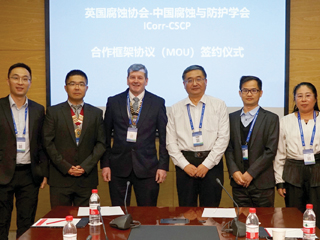
In a significant step toward advancing global collaboration in corrosion science and engineering, the Institute of Corrosion (ICorr) and the Chinese Society for CorrosionProtection (CSCP) signed a Memorandum of Understanding (MoU) during the 22nd International Corrosion Congress held in Xi’an, China.
The agreement was formalised by then ICorr President Stephen Tate and Vice President Dr. Yunnan Gao, alongside CSCP counterparts President Professor Xiaogang Li and General Secretary Professor Xuequn Cheng, in a ceremonial signing event attended by industry and academic leaders and corrosion experts on 23rd October 2024.
This agreement marked the culmination of 12 months of dialogue and numerous rounds of collaborative discussions between ICorr and CSCP. Both organisations demonstrated unwavering commitment to fostering a global partnership that supports the advancement of corrosion science and engineering.
The MoU reflects the mutual efforts of ICorr and CSCP to create a framework for collaboration, facilitating knowledge exchange, joint activities, and professional development initiatives. The agreement was achieved through great determination and shared aspirations, emphasising the importance of addressing corrosion challenges on a global scale.
By leveraging their combined expertise, the two societies aim to enhance their contributions to the international corrosion community.
This milestone agreement sets the stage for a robust and dynamic partnership between ICorr and CSCP. It paves the way for collaborative activities, workshops, and technological advancements that address pressing industry needs. The signing of the MoU represents not just a formal agreement but also a shared vision for the future of sustainable corrosion solutions and innovation across borders.
Our successful interaction has indeed already commenced with our Joint CSCP/ICorr Webinar series held between 11th and 25th November 2024, attracting over 500 registrants and this will be reported in our Jan-Feb issue of Corrosion Management Journal.
Please look out for further ICorr Events by regularly checking www.icorr.org/events/ where you will see activities from all our branches and divisions.
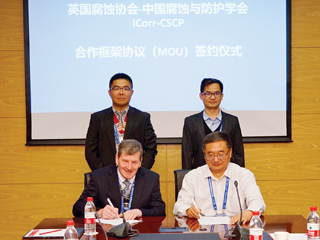
Photo: ICorr-CSCP MoU Signing Ceremony in Xi’an China on 23rd October 2024. Left front: ICorr President Stephen Tate; Left back: ICorr Vice President Dr. Yunnan Gao, Right front: CSCP President Professor Xiaogang Li
Right back: CSCP General Secretary Professor Xuequn Cheng.
Photo: ICorr-CSCP MoU Signing Ceremony in Xi’an China on 23rd October 2024. Left front: ICorr President Stephen Tate; Left back: ICorr Vice President Dr. Yunnan Gao, Right front: CSCP President Professor Xiaogang Li
Right back: CSCP General Secretary Professor Xuequn Cheng.
The Significance of PREN for the Corrosion Resistance of Stainless Steel by Sarah Bagnall
Sarah Bagnall, Director Consultancy Services at R-TECH Materials, CEng. MSc, BSc
Sarah is a materials engineer specialising in failure analysis, for the petrochemical, process, and power generation industries. Currently, she is Director of Consultancy Services at R-TECH Materials. With over 600 failure investigations conducted to date, Sarah has broad experience with a wide range of engineering components, metallic and non-metallic materials, and industries. Sarah has extensive expertise in the corrosion of a wide range of materials, particularly for the chemical processing and petrochemical industries.
What is the Significance of PREN for the Corrosion Resistance of Stainless Steel?
Calculating PREN and How to Apply it Stainless steels are well known for their superior corrosion resistance, which is primarily a consequence of the significant chromium addition. When exposed to oxygen, stainless steel forms a passive film due to its 10.5% (or more) chromium content. This film protects the material from rusting and even has self-healing properties. Other elements can be added to further improve the corrosion performance, such as Nickel, Molybdenum, and Nitrogen.
Not all stainless steels are created equal. Different grades exist, and their corrosion resistance can vary significantly. The corrosion resistance between grades can be compared by using the Pitting Resistance Equivalent Number (PREN). The calculation used for PREN is as follows:
PREN = Cr% + 3.3 x (Mo% + 0.5 x W%) + 16 x N%
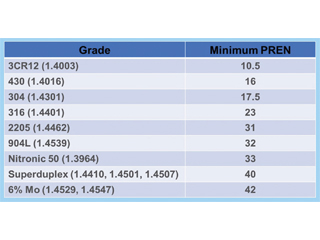
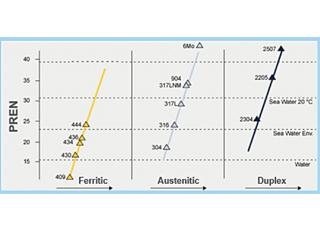
Examples of stainless steel grades and the calculated PREN numbers are given in Table 1 and Figure 1 below.
Performance in Service While the PREN is useful for ranking and comparing the different grades for relative resistance to corrosion, it cannot be used to predict whether a particular grade will be suitable for a specific application, where pitting corrosion may be a hazard. All environmental and operating conditions must be taken into consideration.In some industries, notably the oil and gas sector, specifications may place tighter restrictions on the PREN for specific grades than that implied by the minimum composition of the grade defined in EN or ASTM Standards.
In practice, the vast majority of stainless steels deployed across industry are of the 300 series type with lower PREN values, where external pitting is actually quite common in service at ambient temperatures.
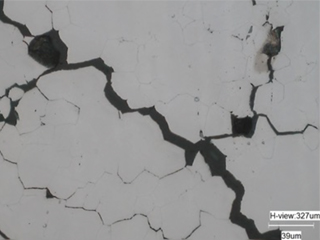
Corrosion resistance is not only affected by the chemical composition of the material but also by the heat treatment condition. If the material is heat treated incorrectly during manufacture or welding, microstructural changes can occur which effectively means that the material is no longer a stainless steel in a localised area. Exposure to temperatures in the range 370-815oC allows the precipitation of chromium rich carbides/nitrides along the grain boundaries. These precipitates are rich in chromium and deplete the area directly adjacent to the boundary of chromium, thereby increasing the likelihood of localised corrosion in the form of intergranular attack, pitting or stress corrosion cracking in a corrosive environment.
Further Guidance The British Stainless Steel Association (BSSA) exists to promote and develop the manufacture and use of stainless steel across the UK and Ireland. Based in Sheffield, the Association provides technical advice, information, training, and education in all aspects of stainless-steel usage. They may be contacted at: www.bssa.org.uk
Table 1: Comparison of Stainless-Steel Grades Based on the PREN.
Figure 1. Comparison of Stainless-Steel Grades Based on the PREN
Figure 2. Cracking of a Sensitised Stainless Steel Bolt Which Had Been Heat Treated Incorrectly During Manufacture.
We use cookies to optimize our website and our service.
Functional
Always active
The technical storage or access is strictly necessary for the legitimate purpose of enabling the use of a specific service explicitly requested by the subscriber or user, or for the sole purpose of carrying out the transmission of a communication over an electronic communications network.
Preferences
The technical storage or access is necessary for the legitimate purpose of storing preferences that are not requested by the subscriber or user.
Statistics
The technical storage or access that is used exclusively for statistical purposes.The technical storage or access that is used exclusively for anonymous statistical purposes. Without a subpoena, voluntary compliance on the part of your Internet Service Provider, or additional records from a third party, information stored or retrieved for this purpose alone cannot usually be used to identify you.
Marketing
The technical storage or access is required to create user profiles to send advertising, or to track the user on a website or across several websites for similar marketing purposes.