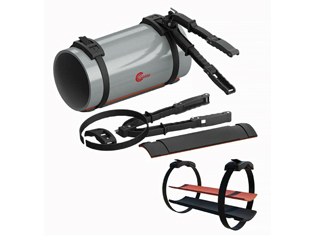
The RedLineIPS SmartPad System, from Cogbill Construction of Texas U.S.A., is a patent-pending Fiber-Reinforced Plastic (FRP) solution specifically engineered to address Corrosion Under Pipe Supports (CUPS) at coastal and offshore facilities in the petrochemical and gas sectors. Designed for above-ground piping systems, the SmartPad System offers a revolutionary approach to external corrosion protection at pipe support points. The system combines tried-and-true materials and components, a saddle-shaped design, and an innovative watertight sealing mechanism to provide durable, efficient, and cost-effective protection for industrial pipes.
Unlike traditional solutions, the RedLineIPS SmartPad System eliminates the need for fixing methods such as epoxy or welding, allowing installation, removal, and reinstallation in minutes. This capability facilitates rapid visual corrosion inspections, reducing reliance on expensive methods such as radiography and ultrasound, and thus reducing the overall cost of ownership.
The SmartPad System: An Alternative Solution to CUPS
The RedLineIPS SmartPad System is a potential breakthrough in external corrosion protection, offering the following key benefits:
Cost-Effective Maintenance: SmartPads allow rapid visual inspections, reducing reliance on expensive and time-consuming methods like ultrasound or X-ray.
Moisture Barrier: The integrated closed-cell Hydroseal gasket creates a NEMA-4-rated watertight seal when installed, preventing moisture accumulation.
Non-Metallic Construction: The FRP material eliminates metal-to-metal contact, preventing galvanic corrosion.
Quick Installation: The system can be installed, removed, and reinstalled in seconds without welding, epoxy, or line shutdowns.
Saddle-Shaped Design: This innovative shape evenly distributes stress, prevents point loading, and protects the pipe’s coating.
Reusable components promote sustainability and green initiatives.
Suitable for extreme temperatures (-60°F to 400°F). convert to Centigrade.
Applications and Industry Adoption
The SmartPad System is suitable across industries, including:
Oil & Gas: Offshore platforms, pipelines, and refineries.
Petrochemicals: Chemical processing plants.
Power Generation: High-pressure, high-temperature piping systems.
Water Treatment: Corrosion protection for water and wastewater facilities.
Early adopters include major industry players such as Chevron, Formosa Plastics, and Nutrien – all at coastal facilities and offshore platforms at the Gulf of Mexico. They have successfully implemented the SmartPad System in challenging environments, achieving significant reductions in maintenance costs and improved pipeline longevity.
A new set of best practices created specifically for the Oil, Gas and Petrochemical industries has been released on 18th December 2024, giving guidance on the deployment, usage, inspection strategies and maintenance of Corrosion Under Insulation (CUI) monitoring systems.
The Recommended Practice document, which is referred to as CUI RP 101 Issue 1 and includes contributions from experienced users throughout the industry, including Aramco, Dow, INEOS and Chevron, contains best practices from asset selection to the use of maintenance management systems, inspection strategies and economic justification principles. It has been developed to enable Asset Owners to optimise inspection and repair strategies and enhance CUI management processes with continuous monitoring systems in the arsenal.
CUI costs the industry billions of dollars every year to mitigate the risk and repair the damage it causes to assets. Unmanaged CUI can result in leaks, leading to process safety incidents, severe harm to the environment, high unexpected repair costs and operational downtime.
Continuous monitoring systems for CUI offer remote detection of localised corrosion and moisture on an asset, while also providing corrosion rates. This empowers Asset Owners to make informed decisions on where and when to conduct repairs, leading to significant cost savings, reduced safety hazards, and minimised environmental risks across the industry.
The key principles outlined in the guidance include:
Asset selection criterion.
Organisational recommendations.
The process to be used for technical justification, validation and qualification.
The technology behind a CUI monitoring system.
Use of remote monitoring in different inspection strategies.
For further information, visit www.corrosionradar.com or email info@corrosionradar.com
London − Equinor UK Ltd and Shell U.K. Limited are to combine their UK offshore oil and gas assets and expertise to form a new company which will be the UK North Sea’s biggest independent producer. The incorporated joint venture (IJV) will be set up to sustain domestic oil and gas production and security of energy supply in the UK.
On deal completion, the new independent producer will be jointly owned by Equinor (50%) and Shell (50%), two leading global energy companies with decades of experience operating in the UK North Sea. With the once prolific basin now maturing and production naturally declining, the combination of portfolios and expertise will allow continued economic recovery of this vital UK resource. The new company will be more agile, focused, cost-competitive, and strategically well positioned to maximise the value of its combined portfolios on the UK Continental Shelf.
Aramco, one of the world’s leading integrated energy and chemicals companies, has signed a shareholders’ agreement with Linde and SLB, paving the way for development of a Carbon Capture and Storage (CCS) hub that is expected to become one of the largest globally. Under the terms of the shareholders’ agreement Aramco will take a 60% equity interest in the CCS hub, with Linde and SLB each owning a 20% stake. The project will support the company’s ambition to achieve net-zero Scope 1 and Scope 2 greenhouse gas emissions across its wholly-owned operated assets by 2050.
It represents a significant milestone for the project and is a key component in Aramco’s emission mitigation strategy. With the support of the Ministry of Energy, phase one of the new CCS hub in Jubail, in the Kingdom of Saudi Arabia’s Eastern Province, is expected to capture and store up to nine million metric tons of CO2 annually, and construction is expected to be completed by the end of 2027. Later phases are expected to further expand its capacity.
For more information contact media.inquiries@aramco.com
This year marks a momentous milestone for the corrosion science community—the centenary of the publication of The Corrosion of Metals by Ulick Richardson Evans in 1924. This pioneering work laid the foundation for modern corrosion science, transforming it from a fragmented collection of empirical observations into a rigorous, quantitative discipline. As we celebrate this historic achievement, it is fitting to reflect on Evans’ profound contributions and the enduring impact of his groundbreaking research.
U.R. Evans: A Visionary in Corrosion Science
Ulick Richardson Evans was described in the Biographical Memoirs of Fellows of the Royal Society as the “Father of the modern science of corrosion and protection of metals”. Evans was born in Wimbledon and received his education at Marlborough College (1902–1907) and King’s College, Cambridge (1907–1911), where he pursued the Natural Sciences Tripos, specializing in chemistry in Part II. Following his studies, he began research on electrochemistry in Wiesbaden and London, but his work was interrupted by the outbreak of the First World War.
He served in the army from August 1914 until 1919. After the war, he returned to Cambridge, where he dedicated the remainder of his life to research and prolific writing on the corrosion and oxidation of metals.
His keen intellect, innovative experiments, and commitment to advancing the field quickly earned him international recognition.
Published at a time when the scientific understanding of corrosion was in its infancy, The Corrosion of Metals was revolutionary. It was the first textbook to comprehensively explain the mechanisms of corrosion, with a particular focus on the electrochemical nature of metal deterioration. Evans’ insights provided engineers and scientists with the tools to address real-world corrosion challenges systematically, heralding a new era of research and practical applications.
The Impact of The Corrosion of Metals
Evans’ book was not only an academic milestone but also a practical guide that addressed the pressing needs of industries reliant on metals. Its immediate translation into German, French, and Russian underscored its global importance. The book introduced concepts such as passivity, electrochemical corrosion mechanisms, and methods of protection that remain central to the field today.
Over the next five decades, Evans continued to expand and refine his work, publishing additional seminal texts, including Metallic Corrosion, Passivity, and Protection (1937) and An Introduction to Metallic Corrosion (1948). His ability to elucidate complex scientific principles with clarity and rigor inspired generations of corrosion scientists and engineers.
A Legacy that Lives On
Evans’ contributions extended beyond his publications. He was an influential mentor, guiding researchers from around the world in their pursuit of corrosion science. His work provided the foundation for many of the engineering advancements that now enable us to protect critical infrastructure, transportation systems, and industrial equipment from the damaging effects of corrosion.
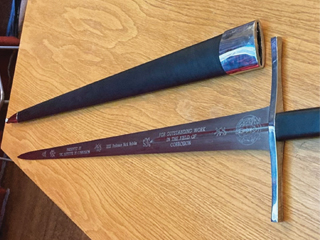
His legacy is perpetuated through the U.R. Evans Award, established by the Institute of Corrosion in 1976. This prestigious award, symbolized by an engraved sword, honors outstanding achievements in corrosion science, continuing Evans’ mission to foster collaboration and innovation in the field.
Photo: Professor Nick Birbilis UR Evans Award Presentation on 11th September 2023.
Cortec® Corporation is pleased to announce a new addition to its line of concrete surface treatments. MCI®-2019 X is a 40% silane penetrating water repellent minus the typical Migrating Corrosion Inhibitors of MCI®-2019. The reason for not including MCI® is the same reason that Cortec® released MCI®-2018 X without MCI® in early 2024: some contractors need more options to adapt to specific project budgets and parameters. Here is a closer look at how MCI®-2019 X might fit into the picture.
Redundant or Complementary Protection
MCI®-2019 X provides water repellency by chemically reacting with the alkaline environment of concrete and creating a hydrophobic layer to reduce the ingress of water and other corrosives. This water repellency offers standalone benefit and is even better paired with a penetrating surface applied corrosion inhibitor (SACI). Historically, this combination has been available with MCI®-2018 and MCI®-2019, two silane water repellents that contain Migrating Corrosion Inhibitors. However, to get the highest concentration of SACIs on the market, users must opt for MCI®-2020, which contains a higher dose of MCI® without water repellent. While applying MCI®-2020 with either MCI®-2018 or MCI®-2019 on top would provide enhanced protection due to the presence of MCI® in both products, some contractors may prefer to apply just a water repellent on top of MCI®-2020 due to budget limitations or other project parameters. For cases like these, MCI®-2018 X and MCI®-2019 X are excellent alternatives to adapt to project needs.
Is 100% or 40% Silane Better?
But why would someone choose MCI®-2019 X over MCI®-2018 X? The answer, again, goes back to project and budget needs. Using a 40% silane water repellent is naturally more budget friendly than a 100% silane water repellent because of the lower concentration of a commodity in high demand. Yet that is not the only advantage. Contractors applying water repellent to previously treated concrete surfaces must think about ensuring good penetration and compatibility. This usually requires the thorough removal of water repellent residue before another product can be applied. However, MCI®-2019 X is one water repellent that may be applied over residue from previously worn-off treatments, thus replenishing the water repellency that the concrete has lost. This low-labor benefit is especially helpful in maintenance applications where a water repellent is reapplied every 5 to 10 years. Slippage and Appearance
As a silane water repellent, MCI®-2019 X is a good choice for concrete structures where slippage is a concern. Since silane molecules are so small, they tend to penetrate deeper than other types of water repellents, making them less likely to cause water puddling or slippage. They also do not darken or change the appearance of concrete, an ideal characteristic for protecting historical structures.
More Flexibility for Contractors
With this new addition to Cortec’s MCI® portfolio, contractors have greater flexibility to tailor a surface protection system to their concrete repair or maintenance project. Whether they want a two-in-one MCI® water repellent (MCI®-2019), a doubled-up protection system of SACI + SACI water repellent (MCI®-2020 plus MCI®-2019), a simple water repellent (MCI®-2019 X) on top of high concentration SACI (MCI®-2020), or a 40% silane water repellent (MCI®-2019 X) alone, contractors can make their pick on what seems to be the best choice for their jobs.
We use cookies to optimize our website and our service.
Functional
Always active
The technical storage or access is strictly necessary for the legitimate purpose of enabling the use of a specific service explicitly requested by the subscriber or user, or for the sole purpose of carrying out the transmission of a communication over an electronic communications network.
Preferences
The technical storage or access is necessary for the legitimate purpose of storing preferences that are not requested by the subscriber or user.
Statistics
The technical storage or access that is used exclusively for statistical purposes.The technical storage or access that is used exclusively for anonymous statistical purposes. Without a subpoena, voluntary compliance on the part of your Internet Service Provider, or additional records from a third party, information stored or retrieved for this purpose alone cannot usually be used to identify you.
Marketing
The technical storage or access is required to create user profiles to send advertising, or to track the user on a website or across several websites for similar marketing purposes.