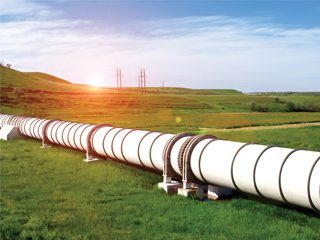
According to the company, Heat-Flex ACE is a next-generation ultra-high solids advanced novolac epoxy for CUI. Developed with a functional chemical enhancement, surpassing performance capabilities of traditional solvent-based epoxy phenolic and novolac coatings. This advanced CUI epoxy technology is unique and different from other epoxy chemistries, as it gives unrivalled performance and application properties through the robustness of the resin system, rather than through pigmentation. Heat-Flex ACE provides external protection of process pipes, valves, and vessels operating between temperatures from -196°C to 232°C, and is suitable for use in new construction and maintenance projects of both carbon and stainless-steel substrates in insulated and uninsulated service. Source: https://industrial.sherwin-williams.com
The most recent TÜV Austria approved industrially compostable Eco-Corr Film is the result of Cortec’s long-standing interest in researching biodegradable technology. It is a type of commercially available biodegradable VCI (vapour corrosion inhibitor) packaging that does not endanger plant growth with ecotoxicity. Eco-Corr Film meets German TL-8135-002 and NACE TM0208-2018 standards for corrosion protection. These films can be used to protect a wide variety of metals, including carbon steel, aluminum, galvanized steel, stainless steel, copper, and brass during domestic and overseas shipments. After use, Eco-Corr Film can be disposed in an industrial composting environment. Metal parts packaged in Eco-Corr Film gets protection against salt, excessive humidity, condensation, moisture, and aggressive industrial atmospheres. In addition to serving as a physical barrier to the elements and inhibiting corrosion on metals in direct contact with the film, Eco-Corr Film also contains Vapor phase Corrosion Inhibitors that vaporise and then condense on all accessible metal surfaces within the enclosed package to prevent corrosion reaction between metal, oxygen, and an electrolyte.
For More information visit: www.cortecpackaging.com
Denmark and Germany have agreed to build a hydrogen pipeline between the two countries, which is expected to be operational by 2028. The pipeline is anticipated to both meet Germany’s anticipated 90 TWh hydrogen demand by the same year, as well as Denmark’s goal of producing 20 TWh of hydrogen from 4-6 GW of electrolyser capabilities. Denmark will be able to export excess hydrogen production under the deal to nations like Belgium, Germany, and the Netherlands, who have already indicated a desire to import green hydrogen as part of their ambitions for a green transition.
INTEGRA Technologies, a market leader in controlled bolting, field machining, leak detection and prevention, engineered products, and ASME training, has been acquired by Flexitallic. According to the company, by acquiring INTEGRA, Flexitallic’s business will transform from a “Sealing Solutions” provider to a “Total Joint Integrity” provider. INTEGRA was formed over 30 years ago, and operates in Canada and the USA. The two businesses have a similar culture that is based on safety, quality, and exceeding client expectations.
Biofouling and corrosion are two of the major challenges that the maritime industry has faced throughout history. Biological fouling is the accumulation of microorganisms, plants, algae, or small animals on surfaces such as ship hulls and submarine hulls where they are not wanted. Water-immersed metal surfaces are prone to corrosion due to biofouling. Self-polishing tributyltin antifouling coatings (TBT-SPC) were the most widely used and most successful antifouling coatings. Due to its high toxicity, TBT-SPC has caused serious ecological and environmental damage to the ocean, and has been banned by the International Maritime Organization since 2008. Typically, marine antifouling is achieved through the release of biocides or foul-release coatings. Antifouling coatings that integrate several antifouling strategies can be beneficial because a single antifouling strategy is limited in its effectiveness. A related idea is to create green marine antifouling coatings from natural ingredients by combining the synergistic effects of both antifoulant release and fouling release. Jipeng Chen et al prepared a new composite coating by compounding natural polymerised tung oil (PTO) and urushiol-based benzoxazine copper polymers (UBCP). In the development of this coating eco-friendly and sustainable natural products were used as main raw materials. This coating has low surface energy. The antifouling performance of the composite coatings was tested with three different bacteria (E. coli, S. aureus and V. alginolyticus) and two microalgae (N. closterium and P. tricornutum), all of which were easily released from the composite coatings.
More information regarding producing eco-friendly and economical antifouling coating can be obtained from following article.
https://doi.org/10.1016/j.porgcoat.2023.107411
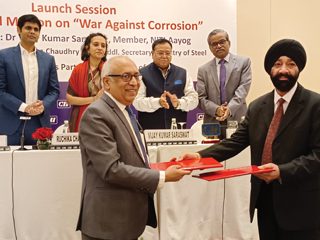
Jindal Stainless has recently signed a Memorandum of Understanding (MoU) with the Confederation of India Industry (CII) about the CII’s National Mission on Corrosion Management, in an effort to combat corrosion and raise awareness of its impacts. The main objectives of this MoU are training, capacity development, and skill development, with assistance from governmental organisations and educational institutions; consulting and advisory, which will include technology gap assessment; projects and research, which will include survey and infrastructure analysis; and, finally, stakeholder engagement to raise awareness of the issue.
Source: https://www.jindalstainless.com/
Picture (right): Director, Jindal Stainless, Mr Vijay Sharma and Executive Director, Confederation of Indian Industry & Head, CII – Centre of Excellence for Competitiveness, Mr Pikender Pal Singh sign an MoU on National Mission on Corrosion Management in the presence of other dignitaries.
We use cookies to optimize our website and our service.
Functional
Always active
The technical storage or access is strictly necessary for the legitimate purpose of enabling the use of a specific service explicitly requested by the subscriber or user, or for the sole purpose of carrying out the transmission of a communication over an electronic communications network.
Preferences
The technical storage or access is necessary for the legitimate purpose of storing preferences that are not requested by the subscriber or user.
Statistics
The technical storage or access that is used exclusively for statistical purposes.The technical storage or access that is used exclusively for anonymous statistical purposes. Without a subpoena, voluntary compliance on the part of your Internet Service Provider, or additional records from a third party, information stored or retrieved for this purpose alone cannot usually be used to identify you.
Marketing
The technical storage or access is required to create user profiles to send advertising, or to track the user on a website or across several websites for similar marketing purposes.