EFC Honorary Fellow Award to long standing ICorr member

EFC Honorary Fellow Award to long standing ICorr member

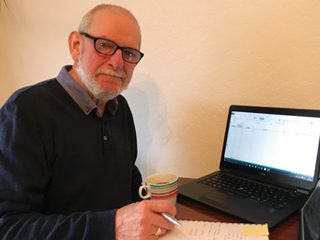
The European Federation of Corrosion has made an Honorary Fellow Award to Dr Douglas Mills, well known to members of ICorr (he was Technical Secretary 1999-2017).

The EFC jury recognised his outstanding accomplishment in the field of interpretation of electrochemical response of coatings on metals using techniques such as Electrochemical Impedance Spectroscopy (EIS) and particularly Electrochemical Noise (EN). He has also had a positive and long-term devotion to the EFC, with active involvement in a wide range of EFC Working Parties, in particular WP 14 (Coatings), but also WP 8 (Physico-chemical Methods of Corrosion Testing), WP 21 (Corrosion of Archaeological and Historical Artefacts), WP 1 (Corrosion & Scale Inhibition) and WP 11 (Corrosion of Steel in Concrete). He has submitted papers to all of these working party sessions at EUROCORR at various times. He has also attended and presented papers at most of AETOC (Advances in electrochemical techniques for organic Coatings) workshops /conferences that arose from the EFC coatings working party. He has supported EFC activities by being Editor of the EFC Newsletter from 2016 to 2022, and by providing regular scientific EUROCORR reports in the Corrosion Engineering Science and Technology journal.

This award is a nice recognition of Douglas Mills’s contribution, not only to the EFC, but more generally to corrosion science and technology. He will receive it in person at the opening ceremony of EUROCORR 2022 which will be held in Berlin on August 29th.

Apprentice End Point Assessment  – ICATS/CORREX

Apprentice End Point Assessment – ICATS/CORREX

The most recent ICorr, ICATS apprentices have been deeply affected by Covid over the last 18 months. With college staff being unwell leading to eventual loss of staff and students unable to attend college and other factors, the final End Point Assessment was carried out on the 20th July with one student only.

That student, Rory Voulgar, was a credit to himself and the Jack Tighe organisation for seeing it through to completion.
The day started with the professional discussion between myself, John Moody, BINDT, and ICATS senior trainer Robert Hurley and of course Rory.

Rory’s answers were clear and concise, and he remained so for the hour duration discussion.

This was followed by the practical session to test Rory’s preparation and application skills. Once more he was able to demonstrate all the skills necessary to become a fully trained ICATS apprentice.
After completion of the EPA, we were very proud to announce to Rory he had achieved the grade of ‘distinction’.

Other news
With all Covid restrictions removed our work at the larger asset owners and projects has resumed once more, and this is particularly true of the nuclear facility Sellafield in Cumbria. I recently visited Sellafield to see Eddie Blackmore, Jacobs Coatings Manager, who will be teaching all of the ICATS courses from the Jacobs main office at Sellafield. This is an amazing development for ICATS and we look forward to working with Eddie on his quest to progress all things paint and quality.

I have started travelling once more to visit our clients and further develop ICATS. I am also being helped in this by David Mobbs and senior ICATS trainer Robert Hurley.

KevinHarold,
CORREX Managing Director

World Corrosion Awareness Day 2022 Activities in Qatar

World Corrosion Awareness Day 2022 Activities in Qatar


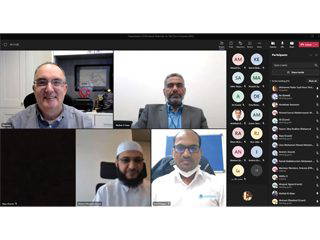
In commemoration of the world corrosion awareness day held annually on the 24th of April, The Gas Processing Centre (GPC) at Qatar University, in collaboration with ICorr, organised an informative technical seminar titled “Degradation of Structure Material for Net- Zero Emissions.”

The seminar was part of a series of technical events that the GPC arranges collaboratively with international corrosion associations. Due to COVID-19 preventative measures, the seminar was held virtually. It focused on reviewing corrosion challenges associated with developing technologies targeting net-zero carbon emissions.

The seminar opening speech was delivered by Prof. Muftah El-Naas, who thanked the organisers, and gave a brief overview of the capabilities and role of GPC in supporting student’s education, and addressing the challenges and opportunities facing the state of Qatar’s gas processing industry. Following that, Muhsen Elhadddad, Material and Corrosion subject matter expert, thanked the Gas Processing Centre at Qatar University for the continuous support of the corrosion community in Qatar, and for the commitment made in hosting technical seminars on corrosion related topics.

Bill Hedges ICorr President highlighted the importance of effective corrosion management for reducing costs and ensuring safe and reliable facility operations, in his technical presentation. He also briefed the audience on the objective and outcome of a research study performed by one of the leading research institutes in the UK to support smooth energy transition and net-zero carbon emissions by 2050.

He emphasized that corrosion is still one of the leading causes for facility releases. He also indicated that more efforts are indeed required to mitigate the risks of corrosion and bring down its cost. Bill also discussed with the audience the approach taken, and the focus of the survey question that involved leading energy operators in the UK. Different elements of corrosion management and the role of every individual in the organisation to strengthen corrosion barriers were also discussed.

The technical seminar closed with an open question-and-answer session moderated by Prof. Muftah El-Naas. This interactive session offered a great opportunity for GPC members, students, corrosion experts to engage in a question-and-answer session related to this important topic.

Bill’s presentation can be found at
https://www.icorr.org/qatar-presentation-24-april-2022/.

How the Institute of Corrosion operates

How the Institute of Corrosion operates

Members often ask what the organisational structure of the Institute is, and to answer this, a series of articles has been planned, starting with an overview of the Institute’s structure.

The Institute of Corrosion is a not-for-profit organisation, dedicated to putting its members at the heart of the global corrosion prevention community and ensuring that all that is done is aligned to its core values:

• Trust and respect
• Experts and leaders in the field
• Innovative and forward-thinking
• Supportive and inclusive

The organisational structure is the framework that enables this, and in which many talented and hard-working corrosion professionals help us to achieve our goals. The Head Office, Corrosion House, is where all the admin work is conducted, and is located in Northampton, where the staff of three work tirelessly to ensure the smooth running of ICorr.

The Council of the Institute of Corrosion
The Council is like the Board of Directors of a large company. It is the Institute’s highest decision-making body, and every branch, division, and committee, reports to the Council, which is made up of the following members:
• The four trustees/directors
• Branch and division chairs
• Committee chairs
• The chair of Young ICorr
• The technical Editor of Corrosion Management magazine
• Various co-opted members

The Trustees of the Institute of Corrosion
There are four trustees, and these form the ‘committee’ that oversees the routine running of the Institute between Council meetings. The trustees are the following Institute members:
• The President
• The Vice President
• The Immediate Past President
• The Honorary Secretary
Beneath the Council, the structure allows information and operations to flow freely in all directions.

The Branches of the Institute of Corrosion
The eight regional UK branches let us reach deep into the heart of the corrosion community in the UK:
• Aberdeen
• Central Scotland
• London
• Midlands
• Northeast
• Northwest
• Yorkshire
• Wales and South-West

In addition, we now have two new international branches – India and UAE.

The work they do, and the networking opportunities they present to our members is vital. The branches have a great deal of autonomy, and run various events, including technical meetings/webinars, workshops, and social events.
Every event within the branches is a networking opportunity, and a chance for members to learn and share ideas, experience, and best practices.

The Two Divisions of the Institute of Corrosion
The two divisions stretch across every part of ICorr.
The Corrosion Engineering Division (CED) is made up of five working groups which look at specific aspects of our industry. The CED runs an annual Working Day and Symposium to tie-in with the Global Corrosion Awareness Day.

The Corrosion Science Division (CSD)
This division consists of representatives from the corrosion research community – primarily academia and research – and runs the annual Corrosion Science Symposium.

Young ICorr
While the experience of senior corrosion professionals is crucial to our industry and to the Institute, equally important are the younger engineers and scientists who are entering and progressing in their careers in corrosion control.
Young ICorr is a vibrant and forward-looking group, through which many initiatives and early-career networks are formed, and from which the corrosion industry leaders of tomorrow will develop.

The Committees of the Institute of Corrosion
Finally, to the committees – without which the Institute could not function effectively. This is where much of the day-to-day work is managed. These teams meet when needed, collaborate with other teams, and ensure that actions agreed are carried out.

The Awards Committee
Responsible for overseeing the portfolio of ICorr awards, and for the nomination of members for external awards. The recognition of excellence both internally and externally helps us to demonstrate the authority with which the Institute operates and the professionalism, knowledge, and expertise of our members.

The Building Management Committee
This committee is responsible for the maintenance and upkeep of our Head Office, Corrosion House. They may not get their hands dirty with building work, but without them we might not have a home!

The Course Approval Boards
The education of the corrosion community, at whatever stage of their individual careers, is crucial to the future of our industry, and, indeed, the future of our world. 

The Cathodic Protection Governing Board (CPGB), responsible for cathodic
protection courses.

The Engineering Training Governing Board (ETGB), responsible for all engineering
level courses

All boards report monthly to ICorr Trustees and quarterly to ICorr Council.

The Digital Strategy Committee
In our digital world, it is easier to connect, build networks, and share expertise than ever before. However, to do this effectively, it is essential to develop and follow a strategy that aligns with the goals of the Institute. This is the remit of the Digital Strategy Committee.

The Membership Development Committee
The real strength of the Institute lies in its membership. The broader and deeper our membership is, the more we can offer and provide to them and the global corrosion community.
The Membership Development Committee is responsible for initiatives to increase our membership and highlight the benefits for members.

The Professional Assessment Committee (PAC)
While the Membership Development Committee is responsible for driving up membership applications, it is the PAC that handles membership and upgrade applications.

Correx Limited
Although the Institute is a not-for-profit organisation, our commercial activities are key to the present and future sustainability. However, it is also crucial that the operation of these is kept at arm’s length to satisfy the requirements of the Charity Commission. To ensure this is the case, we registered Correx Limited in 2003 (the name was derived from “Corrosion” and “Exhibitions”). Correx organises all of our commercial activities, and especially the administration of ICATS (Industrial Coating Applicators Training Scheme), which is mandated by the Highways Agency and Network Rail for all coating applicators – and it is also a requirement for many other major structure owners including Oil Companies, Power Generators, and Infrastructure Owners.

It is intended to explore each element of the organisation structure of ICorr in more detail in future articles, to help our members and the wider corrosion community to have a greater understanding of all parts of the Institute and the tremendous amount of work that goes on behind the scenes. If you’re interested in getting involved in any of these activities, please get in touch with us.
From the Editor

From the Editor

Welcome to the summer issue of the magazine. I hope you have all had a good holiday break, or that you have one planned soon.

This issue has the usual columns and technical articles, except for “Ask the Expert”. All our panel have been on holiday, but don’t worry they will be back to answer your technical questions in the next issue.

The three technical articles have complementary themes relating to fabric maintenance and inspection. Simon Hope describes a methodology for the control of fabric maintenance of offshore structures. Ali Morshed discusses how to reduce corrosion failures, by maintaining a leak register of an asset, and Chukwuma Onuoha explains the use of external corrosion direct assessment in relation to pipelines.

As always, I welcome readers comments about the magazine, and remind you to send in your technical questions for answer by our panel of experts.


Brian Goldie, Consulting Editor
Email: brianpce@aol.com