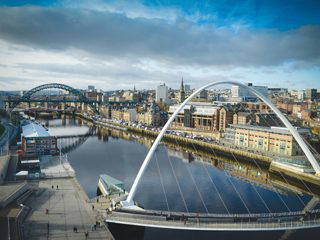
The branch is hosting a presentation on advancements in PFP technology at the IMME offices in Newcastle at 18.00 hrs on the 15th of December. The speaker will Britt Gevaert, project engineer, Acotec NV, Belgium, and who are also sponsoring the event.
The presentation will feature the new Humidur Char range of PFP from Acotec NV, who have made some exceptional and innovative, technological advances.
The branch welcomes four new committee members to help the running and organising of meetings/events to improve what is offered for members.
Jessica Tjandra, a PhD student at Imperial College, London, who will be supporting the events officer, Paul Brooks. Kabir Raheem, bp, who will be acting as engagement officer, and two overseas members, Gani Sultanov, Oceaneering, Oman, and Doaa Sallam, bp, Egypt, who will be on a working group looking at web-based involvement and marketing.
The November presentation is by Roland Anderson, Axcess Corrosion, who will focus on new solutions to problems related to intrusive corrosion monitoring systems. This will be an opportunity to learn about and to evaluate innovations relating to the safety of intrusive corrosion monitoring devices.
The talk will cover some examples of incidents ranging in severity from loss of containment to fatality and look at the design changes that can provide new layers of protection and prevent reoccurrence. The specific products covered includes retrieval equipment for monitoring devices changeouts under pressure as well as the access fittings that house the devices. The potential for repurposing access fittings and how to deal with them if they are no longer required for a monitoring programme will also be discussed.
This will be an in-person event at the usual venue, the Lancaster Hall Hotel, Bayswater, London.
Young ICorr joined the London Branch meeting on Thursday 13th October, 2022 for a technical talk and networking session followed by a social late into the evening. The meeting welcomed both ICorr members and non-members. The technical talk featured Dr Anthony Setiadi, FICorr, talking about corrosion protection considerations for offshore wind foundations, a very important topic as the offshore wind industry growth is accelerating with the global shift towards renewable energy sources.
Following the technical talk, Dr Danny Burkle provided a brief insight into the benefits of Young ICorr and the initiatives on offer for our members. Then, there was an opportunity to enjoy some free refreshments whilst networking with like-minded early career corrosion professionals and the more
experienced members.
This evening was a great opportunity for Young ICorr to join members from the largest community of corrosion scientists and engineers in the UK and network
to learn about opportunities they need to develop their career.
To become part of the Young ICorr community, or for more information about what they do, and how they can help you, contact, James McGladdery or Danny Burkle on
James.McGladdery@uknnl.com and d.burkle@lbbcbaskerville.co.uk, respectively.
The YEP programme continues well at Aberdeen, with the seventh session, “Introduction to Fitness for Service Assessments” with Pieter Van Der Vyver from Oceaneering being held on 15th September, which was followed by George Winning, on Thursday 6th October 2022 on the topic of “Corrosion aspects of O&G Production Chemistry.”
During July (26/07/22) and August (24/08/22) respectively, there were excellent talks given by Clare Watt of KAEFER on “Corrosion Under Insulation and Fire Protection” and Jim McNab of Oceaneering entitled “Non-Destructive Testing and Corrosion Monitoring.”
The YEP participants are now in the final stages of their Case Study with the date of Thursday 24th November set for the YEP case study competition presentation evening, to be held at Aberdeen Palm Court Hotel. The Case Study set for the participants, who were divided into teams for this, was “Corrosion management of mature offshore platform facilities”, and Steve Paterson – Case Study Leader, gave the following essential information for the teams, so that they can analyse the data and perform a high-level corrosion risk assessment, in order to propose an integrity management plan. Also included in the case study is a subsea tie-back with H2S so that the teams can also do a materials selection for the pipeline and a sour service assessment for the platform facilities. The study is based on an actual N. Sea platform.
Brief: Each YEP team is assumed to have been engaged by an integrity services contractor to advise an international company that is a newcomer to the operation of production facilities in the UK sector of the North Sea. Capercaille Energy, which is an affiliate of Grouse Capital International, is considering the acquisition of an existing platform and associated subsea facilities that have been in operation for 15 years. End of field life is currently estimated to be 2032. There is an 8” subsea pipeline from the oil rim of a near field reservoir and a 10” subsea pipeline from the gas cap. Configuration of the subsea wells and manifolds means that individual well tests are not straightforward. As part of the purchase there is also an opportunity to develop another gas/condensate reservoir 10km from the platform. The reservoir is known to contain up to 50 ppm H2S. Initial studies suggest an 8” pipeline will be installed for the possible initial gas production of 50 MMscf/d. It has already been identified that the existing owner has not managed the integrity of the “Solaire” platform in an optimal way in the past, and there have been several significant corrosion related hydrocarbon leaks in recent years. The teams have also been made aware that inspection has been primarily time-based and many vessels have not been inspected since start of operation. Corrosion management has been the responsibility of a contractor who has not been helpful so far, and administration of the inspection database has been poor. Capercaille Energy is a demanding and sometimes difficult client with high expectations of its contractors. A more innovative approach to corrosion management of the platform is anticipated by the client. Run on shoe-string budget the company does not have the resources to chase the existing owner for anything but essential technical information about the platform and associated facilities. Each team will need to carefully consider what questions are asked to get a sensible and timely response. The integrity services contractor, Bala Integrity, has a habit of playing its sub-contractors off against each other and there may be other companies that have been engaged to provide advice. Each team should present their proposed solution to the management team of Bala Integrity prior to presenting to Capercaille Energy.
Platform details: Solaire is a six-legged steel jacket platform in the Central North Sea positioned in 90 metres of water. Current production is 40,000 bpd oil (API 40), 100 MMscf/d gas and 50,000 bpd produced water. It has two HP three phase sand separators, three further stages of oil/water/gas separation, plus two vertical 1st stage gas separators. There are multiple stages of gas compression, with a (TEG) glycol contactor for gas dehydration, and coolers for export gas.
There are produced water handling facilities for overboard discharge. Oil export (max 2% water) to shore is via a 16” pipeline and dry gas export to a 3rd party pipeline system is via an 18” pipeline. Personnel on board for the platform is limited to 80, which restricts the ability to do non-routine maintenance and inspection.
The exercise involves, 1. Identify what further information or data that you need for the other tasks in the exercise and request from your mentor. 2. Analyse/discuss the information and data that you are provided with. Identify any gaps in information and any assumptions you may need to make. 3. Perform a high-level risk assessment to identify key threats to the mechanical integrity of the pressurised systems (i.e. structural integrity is excluded). 4. Propose a systematic approach to manage the key threats including mitigation measures, corrosion control requirements, performance monitoring, the resources required to manage the process, and any specific strategies needed. 5. Propose materials of construction for a pipeline including welding consumables and any testing requirements to tie-back the new reservoir to the platform and explain the basis for the materials selection and how any corrosion threats will be mitigated. 6. Identify what needs to be done for the existing facilities should the new slightly sour reservoir be produced back to the platform. 7. Propose a strategy for convincing Capercaille Energy that your team’s approach is the optimal solution and that you are the right team to do the job.
The following documents have obtained substantial support during the past two months and have been submitted to the ISO member bodies for formal approval.
ISO/FDIS 3079 Two-electrode method using acetic acid to measure pitting potential of aluminium and aluminium alloys in chloride solutions
ISO/FDIS 9227 Corrosion tests in artificial atmospheres — Salt spray tests 2022-10-11 (Revision of 2017 standard)
ISO/FDIS 4628-5 Paints and varnishes — Evaluation of quantity and size of defects, and of intensity of uniform changes in appearance — Part 5: Assessment of degree of flaking 2022-10-12 (Revision of 2016 standard)
ISO/PRF 7784-3 Paints and varnishes — Determination of resistance to abrasion — Part 3: Method with abrasive paper covered wheel and linearly reciprocating test specimen (Revision of 2016 standard)
ISO/FDIS 10062 Corrosion tests in artificial atmosphere at very low concentrations of polluting gas(es) 2022-10-12 (Revision of 2006 standard)
ISO/PRF 11127-6 Preparation of steel substrates before application of paints and related products — Test methods for non-metallic blast-cleaning abrasives — Part 6: Determination of water-soluble contaminants by conductivity measurement (Revision 2011 standard)
ISO/FDIS 11127-7 Preparation of steel substrates before application of paints and related products — Test methods for non-metallic blast-cleaning abrasives — Part 7: Determination of water-soluble chlorides 2022-10-26 (Revision of 2011 standard)
ISO/DIS 22974 Petroleum and natural gas industry — Pipeline transportation systems — Pipeline integrity assessment specification
ISO/FDIS 23669 Corrosion of metals and alloys — Requirements for localised corrosion and environmentally assisted cracking testing of additively manufactured metals and alloys
New International standards published in the past two months
ISO 8504-4:2022 e Preparation of steel substrates before application of paints and related products — Surface preparation methods — Part 4: Acid pickling
ISO 1461:2022 Hot dip galvanized coatings on fabricated iron and steel articles — Specifications and test methods
ISO 11997-3:2022 Paints and varnishes — Determination of resistance to cyclic corrosion conditions — Part 3: Testing of coating systems on materials and components in automotive construction
We use cookies to optimize our website and our service.
Functional
Always active
The technical storage or access is strictly necessary for the legitimate purpose of enabling the use of a specific service explicitly requested by the subscriber or user, or for the sole purpose of carrying out the transmission of a communication over an electronic communications network.
Preferences
The technical storage or access is necessary for the legitimate purpose of storing preferences that are not requested by the subscriber or user.
Statistics
The technical storage or access that is used exclusively for statistical purposes.The technical storage or access that is used exclusively for anonymous statistical purposes. Without a subpoena, voluntary compliance on the part of your Internet Service Provider, or additional records from a third party, information stored or retrieved for this purpose alone cannot usually be used to identify you.
Marketing
The technical storage or access is required to create user profiles to send advertising, or to track the user on a website or across several websites for similar marketing purposes.