Corroless Eastern are a distributor of Corroless anticorrosion materials and a multi-disciplined coatings and repair contractor. The business was founded by Andy Hunt in 1992, initially focusing on the distribution of Corroless coatings materials, but branching out into the application of protective coatings.
A particular area of focus for the business has always been the application of tank linings, initially using Corroless materials but now also other manufacturers.
Over the last 20 years, another area of expertise has been the application of fast set polyurea coatings and membranes, with a particular focus on training adhering to the Polyurea Development Association standards.
Training and development of their team is core to the business, including 7 ICorr trained paint inspectors. They also have their own in house ICATS trainer.
Recent investments in the business include the purchase of two Hammelman Ultra high-pressure water jetting units used for both surface preparation and hyrdodemolition. Using this new equipment has allowed them to extend the scope of refurbishment works they can undertake, facilitating larger concrete repair contracts prior to the application of protective linings.
As a diverse contractor they also undertake significant resin flooring contracts, which is often considered an industry in itself. This includes sub floor repairs where required and the application of trowel applied resin screeds.
Some of the areas the company works in include, defence, utilities, food production and general industry. Based in East Anglia but working across the UK exposes them to a variety of projects and challenges.
In 2022 they celebrated 30 years of business and look forward to being members of the ICorr community.
The question in this issue looks at the role of an inspector.
Question: What makes a good coating inspector? CM
Answer: This is an interesting question and has numerous answers in my opinion. Having worked in industry for some 40 odd years, and been on all sides of the fence including sitting on it, I feel I am able to give the following judgements. The first and foremost criterion to be met is that an inspector needs to be completely independent and must not have their judgement swayed by allegiances or obligations. Until the advent of the ISO 9001, inspectors were employed by clients to provide objective and impartial viewpoints from an unbiased stand point, providing accurate and valid reports on the performance of a contractor’s work. They were generally put on site to act as a ‘Jiminy Cricket’ to witness, observe, and report back, as to what was going on, this, if done well would ensure that the contractor would be less likely to cut corners and use improper practices.
Up until 1987, BS5750 had been the governing system in the UK for business management but the arrival of ISO 9001 saw this coming to an end and the introduction of self-certification for contractors, this effectively destroyed the impartial third party inspection in the UK with an overnight hammer blow. Inspection in an instant became the domain of the contractor and many unscrupulous contractors immediately saw this as a license to print money as the poacher became both poacher and gamekeeper overnight. This led to the demise of many of the highly reputable inspection companies over the next few years.
It wasn’t until several years later when the clients started to actually look at, and audit, the works being undertaken under the ISO 9001 banner did they start to realise that things were not all that they seemed. From this a drive started to push forwards to try to put in place mitigation to prevent this from happening again.
The other major stumbling block that has often prevailed is the attitude of individuals who see inspection as unnecessary and a cost best avoided, how often do we hear the fateful words ’how difficult is it to paint a bit of steel? My wife manages to paint the house so it can’t be difficult at all!’ WRONG! Our business is highly technical and calling it painting is a huge mistake, paint is cosmetic and decorative! What we are involved in is the application of high-performance protective coatings and so we need people with a high level of technical knowledge to administer, as well as a well-trained and understanding workforce.
A properly constructed specification and contract is now seen as the best way forward to ensure contractor inspection is fit for purpose and that the personnel are properly trained and certified via a recognised body as competent.
From this we need to look at what the inspector’s role should be today, and what makes a good inspector. Inspection needs to be stand alone, you cannot blast or coat a piece of steel then inspect it and certify it yourself, as unfortunately still so often happens.
Many coating inspectors have worked their way up through the ranks and prove to be highly suitable and capable to undertake the coal face inspections. With the aid of quality training and access to all the right equipment, these people provide a solid and reliable backbone to the industry. What they do need is a proper and competent system of support, both from more highly qualified and experienced inspectors controlling and monitoring them, and with a management team that appreciates the true ramifications and the importance of inspection.
A good basic inspector should therefore be someone who is truly enthusiastic about his role and understands that he must at all times be an observer and not try to run the job, his role is the duty to collect and collate information, and report back to line management with his findings, and not get involved in front line confrontation. That does not mean to say that he cannot be authorised to discuss what he finds with the foreman or other management on the project but telling a worker what to do by bypassing the chain of command generally ends up badly. A basic inspector is not a basic person, he needs to have a large amount of experience and understanding of how the jobs are undertaken and the limitations of what is trying to be achieved. A good technical grounding is essential as well as the ability to communicate clearly, concisely, and correctly. One of the absolute essentials is training by a recognised training body with certification stating that the inspector has been trained and assessed to a given level and what they are competent to undertake and what level of supervision they require. For example the ICorr Coating Inspector training courses delivered by Argyll Ruane.
The knowledge required as an inspector moves further up the hierarchy, and becomes more varied and more technical. Ideally when the levels of dealing with contracts, documentation, auditing and failure analysis are reached, very comprehensive inspection training is needed as well as other technical qualifications such as degrees in chemistry, organic chemistry, metallurgy and materials, or process engineering. This gives the necessary level of understanding and authority to state the case when decisions need to be made and if necessary enforced. An inspector’s life is not a simple one, and having an open mind, unbiased view point, an inquisitive nature, a strong, unwavering sense of right and wrong, a good sound training background along with something resembling a sense of humour and the hide of a rhinoceros, all go a long way to making a good inspector.
PCS painting coating services, founded in Egypt, was established 13 years ago, working in the painting, insulation, fire proofing fields, equipment rental, manpower supply and scaffolding services. Its owner and MD is Ali Hassan, BSc in petroleum engineering, and certified BGSCSWIP grade 1 painting inspector.
The company uses the latest technology in painting and coating services, to maintain the integrity and safety of customer assets, working to achieve the best quality in accordance with international standards
Recent PCS success stories include, the paint application to 120,000m2 on a double-swing rail bridge across the new Suez Canal with Egyptian Ministry of Defence (this bridge ensures the convenient travel between the two sides of the canal without interfering the daily passage of vessels along the canal), and supervision of the existing coating, hot/cold insulation, and fire proofing maintenance at the United Gas Derivatives, PS and Damietta Plants.
Following a successful event in December 2022 that re-started the activities of the branch in the North East, further events are planned for 2023. Atmospheric Plasma Solutions will present their cold plasma technology which can be used to remove coatings and contamination from substrates, on 13th April. Used by the US Navy, this technology offers an interesting alternative to tradition preparation methods. The evening will be held at Metec’s facilities in South Shields, and will include a presentation and live demonstration of the technology followed by refreshments and networking opportunities. Metec is located near to the Bede Metro Station for easy access by public transport and there is ample parking.
On 22nd and 23rd June 2023, the branch will host the “Integrity Engineering for a Sustainable Future” conference, featuring a day of presentations on sustainable technology and solutions at Neville Hall in the centre of Newcastle upon Tyne, followed by a second (optional) day of site visits to sustainable businesses in the area. There will also be a gala dinner held at Neville Hall on the evening of the 22nd. Tickets will be released soon for what will be a popular event, keynote speaker is Jon Gluyas from Durham university, as well as presentations from BP and ESR Technology amongst others. There will also be an exhibition area for businesses wishing to promote their services (please contact nechair@icorr.org for further details). Anyone who has not visited Neville Hall will be in for a treat as it is one of the finest buildings in Newcastle upon Tyne and used by the Mining Institute. It is a Victorian building built at the time when high-Gothic architecture was coming into fashion, and a unique place to hold a conference like this.
On 9th February 2023, the branch hosted a very successful 1-day hybrid technical conference with 35 attendees, around 90% of these attending in person and the remaining electing to attend online, including representatives from AMPP. This was a special ICorr award-winner’s themed event covering 4 main themes, electrochemistry, cathodic protection, production chemistry and protective coatings, and the venue was the Birmingham Council House, located in the centre of Birmingham, a ‘stunning’ setting for the event.
It was clear that many enjoyed the network opportunities provided by this ‘face to face’ experience, which is still a bit a novelty after extended COVID restrictions of recent years. The event was priced accordingly to attract such participation. Many thanks are due to the team at HQ who handled our registrations and to the staff of the Council House who put on a ‘more than generous lunchtime spread. Bill Whittaker kindly assisted with the event planning and George Winning skilfully managed communications.
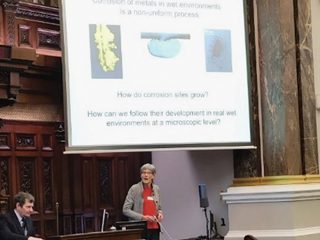
The day started with a presentation from Professor Alison Davenport, University of Birmingham School of Metallurgy and Materials, and the UR Evans Award winner. Alison developed an interest in synchrotron methods after her PhD at Cambridge, at Brookhaven National Laboratory in the USA, before returning to the UK to the Universities of Manchester and then Birmingham. She was awarded an OBE for services to corrosion and electrochemistry in 2018. Alison gave an extremely well-illustrated and cleverly animated talk entitled “Pitting: The delicate balance between dissolution and passivation.” The processes of corrosion pit development were explained very clearly, and it was very impactful presentation.
Chris Lynch, Senior Engineering Manager of Corrpro Europe followed this with a heartfelt talk on “Cathodic Protection Standards Making”, and of his personal journey in standards development, clearly laying out all the procedural processes and interfaces involved.
After lunch, Ken Lax Technical Director at Corroconsult UK Ltd., gave a very comprehensive summary of BS EN ISO 21857:2021 “Prevention of corrosion on pipeline systems influenced by stray currents.” He covered many aspects in his talk including, shortcomings in CP training and certification, relevance of pipe-to-soil potentials, sources of CP system interference (obvious and not so obvious), measurement techniques, circuit and data analysis, along an outline of the standard itself.
This preceded an excellent talk by George Winning of Corrosion and Chemical Consulting Ltd, who explained in detail the importance of production chemistry to the Energy Sector in all its various stages of development, and implementation, for a particular asset / production zone. George then went on to discuss the forthcoming ICorr production chemistry for corrosion engineers – PC4CE course, the contents of which have been kindly donated to ICorr by BP.
The final session took us further into coatings and coatings Standards. Chris Googan, Materials & Corrosion Engineer at Anticorrosion Engineering Ltd, provided some detailed insights into ‘Why do Protective Coatings Fail? and the various points of intervention to prevent this. Chris is a Corrosion Specialist with more than 30years experience, not only in hydrocarbon production, refining, chemicals, and petrochemicals, but also in also shipping, automotive, defence, power generation, water, civil engineering, legal and insurance sectors. Simon Daly, a consultant for the Safinah Group in Gateshead, then went on to describe some unique challenges for selecting coatings for the fixed and floating offshore wind industry. He considered the various types of structures, corrosion categories, corrosion protection methods, coating specifications, influences, and possible improvements. Malcolm Morris, Technical Manager with the Protective & Marine Coatings division of Sherwin-Williams, closed this very informative session with an ‘Update on International Standards Activity within the Protective Coatings Sector’, carefully explaining the hierarchy of standards and all recent updates.
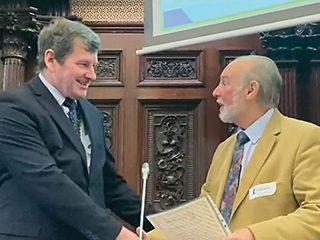
As part of the day’s proceedings, a Certificate of Appreciation was given to Winston Shepherd in recognition of a lifetime contribution to the Corrosion Industry and Standards Development.
The combined presentations for this event can be found at Midlands Branch – Institute of Corrosion (icorr.org) Local Technical Programme.
This extensive programme raised many interesting and thought-provoking questions by Attendees on the day, if fact too many to list in detail here.
Q&A Feedback
We wish to offer a clarification on behalf of AMPP to our event attendees in connection with a question raised in the context of standards development, that NACE/AMPP ‘standards’ are not Standards as such, because they are not issued by a national standards body, e.g. BSI in UK.AMPP have supplied the following clarification to us:
• AMPP (Association of Materials Protection and Performance) is an ANSI (American National Standards Institute) accredited Standards Development Organisation (SDO). ANSI is a non-profit organisation that administers and coordinates the U.S. voluntary standards, and conformity assessment system. Founded in 1918, the Institute works in close collaboration with stakeholders from industry and government to identify and develop standards and conformance-based solutions to national and global priorities. ANSI is the sole U.S. representative and full member of ISO, and, as a founding member, plays an active role in ISO’s governance and technical work. Thus, AMPP’s standards development process is therefore accredited by ISO through ANSI.
• AMPP, like ASTM, SAE, and many others, develop consensus standards as an accredited SDO, and as such the TM (Test Method), SP (Standard Practice) and MR (Materials Recommendations) published by AMPP are Standards which can be, and are, deployed globally. AMPP Standards are available for use internationally and can be cited in regulatory requirements. The subject matter experts developing the standards, and those on the consensus body are international, and indeed some standards have been inaugurated from SMEs outside the USA e.g. China, which have then developed with global participation. ANSI undertook a thorough audit of
AMPP’s procedures in their SDO activities soon after the formation of the Association, maintaining their accredited standards developer status.
• In the USA, ANSI oversees SDO’s who issue the standards. For any additional clarification required, please contact Brad Wilder, Director – Standards brad.wilder@ampp.org
For additional clarification, AMPP have the following active document types:
Standard Practices (SP)
SPs define the requirements and recommendations for the selection, design, installation, or operation of a material or system and provide detailed descriptions of requirements for quality of a product or process that can be incorporated into a procurement document. Standard Test Methods (TM)
TMs contain procedures for conducting tests to ascertain the characteristics of a material, design, or operation. TMs do not include pass/fail criteria for the material, design, or operation being evaluated by the TM; these criteria may be provided in SPs or MRs. Standard Material Requirements (MR)
MRs define the required or recommended characteristics of a material. MRs may include requirements for chemical composition, mechanical properties, physical properties, performance properties, and other aspects of the material’s manufacture and use. Guides (GUIDE)
Guides present the user with information about alternative procedures, materials, or technologies that enable the user to select the best option for a specific use. They may contain recommendations to assist the user to make an informed decision based on the desired outcome. Technical Reports (TR)
TRs document practices, procedures, and technologies. They may include compilations of reference data, historical information, surveys of common practices, bibliographies on special subjects, educational material, and information on health, safety, and environmental protection
We apologise to AMPP for any misunderstandings in this regard and thank them for their valued input.
Following on from the event we are pleased to announce a new Midlands Branch chair Bill Whittaker has become the chair of the Midlands Branch, and he brings a wealth of experience to the role and will be a great asset to our Organisation. He is currently a Cathodic Protection Engineer with Cathodic Protection Engineering Ltd (CPEL). He started in the corrosion industry in 2005 as a technician, and over time progressed into engineering.
Following a brief stint offshore, Bill’s expertise is with Cathodic Protection of onshore pipelines and near shore structures. He has an active involvement in ICORR CP training activities being a member of the CP governing board and the training CP scheme manager.
He holds an MSc in Corrosion Control Engineering from Manchester University, is ICorr CP Level 4 certified (buried and marine sectors), and is also AMPP (formally NACE) CP4 certified.
The branch committee, and recent past chairs Ashley Ingram and Paul Segers, should be thanked for giving their time freely to ICorr, and for their ongoing support to our AGMs. Bill may be contacted at: midlandschair@icorr.org
Birmingham Council chamber.
Professor Alison Davenport opening proceeding.
Lunchtime networking in the Chamberlain room.
Presentation to Winston Shepherd by ICorr President Stephen Tate.
A very welcome ‘face to face’ meeting opportunity after Covid-19 impacts.
We use cookies to optimize our website and our service.
Functional
Always active
The technical storage or access is strictly necessary for the legitimate purpose of enabling the use of a specific service explicitly requested by the subscriber or user, or for the sole purpose of carrying out the transmission of a communication over an electronic communications network.
Preferences
The technical storage or access is necessary for the legitimate purpose of storing preferences that are not requested by the subscriber or user.
Statistics
The technical storage or access that is used exclusively for statistical purposes.The technical storage or access that is used exclusively for anonymous statistical purposes. Without a subpoena, voluntary compliance on the part of your Internet Service Provider, or additional records from a third party, information stored or retrieved for this purpose alone cannot usually be used to identify you.
Marketing
The technical storage or access is required to create user profiles to send advertising, or to track the user on a website or across several websites for similar marketing purposes.