







Fellow’s Corner – Nov/ Dec 25

Fellow’s Corner – Nov/ Dec 25

This series of articles is intended to highlight industry-wide engineering experience, guidance and focussed advice to practising technologists. It is written by ICorr Fellows who have made significant contributions to the field of Corrosion Management.

Can Corrosion Be a Help Rather Than a Hindrance?

Gareth Hinds, PhD, FICorr, EFC President, ICorr Past President

Meet the Author

Gareth Hinds

Dr Gareth Hinds is Senior NPL Fellow and Fellow of the Institute of Corrosion. He is Science Area Leader in the Electrochemistry Group at the National Physical Laboratory in Teddington, United Kingdom. His primary expertise is in the development of novel in situ diagnostic techniques and standard test methods for assessment of corrosion and material degradation in energy applications. Gareth is a Fellow of the Royal Academy of Engineering and holds visiting professorships at UCL, the University of Strathclyde, Harbin Institute of Technology and the Institute of Corrosion Science & Technology, Guangzhou. He is the author of over 200 publications and is currently
President of the European Federation of Corrosion.

Corrosion is often viewed in a negative light. It can lead to premature failure of metallic components and infrastructure, with significant economic, environmental and safety-related consequences. As ICorr members, we’re only too familiar with the need to combat this ever-present threat. However, in the right circumstances corrosion can also be exploited as a force for good! This Fellows Corner article takes a closer look at some examples.

Galvanic Cells

Corrosion is an electrochemical phenomenon involving the transfer of electrons and ions between conducting surfaces in contact with an electrolyte. It can therefore be harnessed in a controlled way to produce electrical power. When a battery is discharging, it acts as a galvanic cell, analogous to galvanic corrosion of two dissimilar metals, with the negative electrode acting as the anode and the positive electrode as the cathode. Control is achieved by isolating the electrodes from each other using an insulating porous separator, typically a polymer or ceramic. When the battery terminals are connected to an electrical load, usable DC current will flow. The first battery was the Voltaic pile [1], which was invented by Alessandro Volta in 1800. This consisted of alternating discs of zinc and copper separated by strips of cloth soaked in brine. The anodic reaction was corrosion of zinc, with hydrogen evolution on copper as the cathodic reaction. The Voltaic pile played a central role in the discovery of water electrolysis by Carlisle and Nicholson [2] in 1800 (only a few months after its invention) and in the isolation of chemical elements (Na, K, Ca, B, Ba, Sr and Mg) by Humphry Davy [3] in the early 1800s.

Figure 1: Statue of Alessandro Volta In His Birthplace of Como, Italy, Featuring His Voltaic Pile [1], The Forerunner of The Modern Battery.

Please Note: this article considers only spontaneous (galvanic) reactions in order to be consistent with real corrosion processes. Electrolytic processes are excluded. The scope is also restricted to electrochemical corrosion of metals to keep things relatively simple.

Volta mistakenly thought that the operation of his battery was a consequence of static electricity and seems to have used it mainly to deliver electric shocks to unsuspecting volunteers. It wasn’t until the 1830s that Michael Faraday demonstrated the electrochemical basis of its operation. Nevertheless, Volta’s invention and its subsequent evolution formed the basis for electricity generation throughout most of the 19th century, until the discovery of the electrical generator in 1870.

Today, batteries are playing a vital role in decarbonisation of our energy system, most notably in electric vehicles and grid storage. Unlike most forms of corrosion, the electrochemical reactions in some batteries are reversible. Examples include lithium-ion and lead-acid batteries, which can be charged and discharged many times over their lifetime. If only all corrosion reactions behaved in the same way!

Another well-established electrochemical technology that operates under the same galvanic principle is the use of sacrificial anodes to prevent corrosion. Anodic dissolution of the more active metal (usually an alloy of magnesium, aluminium or zinc) allows the more noble metal (normally steel) to remain protected under conditions in which it would otherwise freely corrode. This is the basis for cathodic protection of a wide range of infrastructure, including pipelines, storage tanks, marine structures and reinforced concrete.

Like batteries, cathodic protection has a long history, dating back to 1824 when Humphry Davy used iron anodes to protect copper sheathing on the hull of HMS Samarang [4]. While this did prove highly effective in preventing the copper from corroding, it was soon observed that marine biofouling had increased dramatically, as copper ions were no longer being released in sufficient quantity to kill the microorganisms. Since biofouling creates drag that slows down the ship, the Royal Navy decided that on balance it was better just to let the copper corrode, highlighting yet another beneficial effect of corrosion!

Surface Modification

Corrosion of a metal surface can be advantageous if it leads to the formation of a highly protective film. This is the case with weathering steels used in the construction industry. When exposed to atmospheric conditions, these steels initially corrode like mild steel but over time a dense, stable, patina forms that effectively prevents any further corrosion and is self-healing if damaged. This leads to huge cost savings in that no painting is required and maintenance costs are minimal.

Weathering steel was introduced in 1933 by US Steel as a high strength material for coal wagons in the railway industry. The steel composition had been developed by trial and error over many decades and it was entirely by chance that its corrosion resistant properties emerged. It was trademarked as ‘Corten’ steel – ‘Cor’ for ‘corrosion resistance’ and ‘ten’ for ‘tensile strength’. The mechanism behind the establishment of a corrosion-resistant patina is still not fully understood but it’s clear that wetting and drying cycles are required and that copper is the most important alloying element. Of course, care should be taken not to use weathering steels in environments where a protective patina does not form. This will often be the case if the steel remains continuously wet or is exposed to high levels of chloride. Similarly, service experience shows that the patina forms more effectively in industrial and urban environments than in rural environments where atmospheric corrosion rates are much lower.

The most famous example of the use of weathering steels in the UK is probably the Angel of the North statue in Gateshead, which is seen by an estimated 33 million people every year due to its elevated position close to major North-East road and rail arteries [5]. Erected in February 1998, it was designed by sculptor Anthony Gormley and stands 20m tall with a wingspan of 54m. Most of Gormley’s work is in bronze, but in this case weathering steel had to be used to provide sufficient strength to withstand periods of high wind.


Figure 2: The Angel of The North Statue In Gateshead [5] Was Constructed From Weathering Steel Due To Its Combination of Mechanical Strength And Corrosion Resistance. Image Source: Saw2th CC BY SA 2.0.

The widespread use of aluminium, stainless steel and other corrosion resistant alloys also depends on the formation and self-healing properties of a protective oxide layer in a range of aqueous environments. Here, the balance between metal ion dissolution and oxide formation governs the level of protection offered by the passive film. Passivation is a direct consequence of corrosion; without this critical phenomenon many engineering alloys would be completely useless!

Another advantageous surface modification that can arise from corrosion is crack tip blunting. Stress corrosion cracking, where stress and a corrosive environment combine with a susceptible microstructure to generate fracture well below the yield stress of the material, is a common failure mechanism in many industrial applications. Initiation and propagation of stress corrosion cracks depends on the presence of stress raisers such as corrosion pits and crack tips. However, when the corrosion rate is sufficiently high, dissolution of the metal can round off the sharp edges of the crack tip, significantly reducing the stress concentration factor and arresting crack growth. This can be useful as a means of mitigating crack development, but a balance is clearly needed as if the corrosion rate is too high other issues will emerge.

Selective Material Removal

Chemical etching is a well-established manufacturing process whereby corrosion is actively employed to achieve selective removal of material from a metallic component to realise the desired final shape. A masking material is often used to protect areas of the surface where material removal is not desired.

Very precise control of component shape can be achieved through the application of a photo-resistive material, a light-sensitive polymer that is stable in the etchant, to the entire surface. Prior to the etching step, exposure to light through a patterned mask can either weaken or strengthen the photoresist material, allowing removal of selected areas with an appropriate solvent.

The etching process can be used to manufacture highly intricate and complex shapes for a range of important applications, including aerospace, automotive, medical, microelectronics and energy conversion and storage devices. This avoids the issues of burrs and residual stresses that can be introduced by mechanical milling.

The earliest known application of chemical etching comes from ancient Egypt, where it was used to inscribe jewellery with hieroglyphs and images of deities. This was carried out in a relatively crude manner using rudimentary acids and abrasion. The process became more sophisticated over time with the invention of acid baths in the 15th century and modern etchants developed during the Industrial Revolution.

In metallography, acid etching is a well-established technique for microstructural characterisation of metals and alloys. A common etchant is nitric acid, which tends to remove material in the grain boundaries more rapidly than the grains themselves, making the microstructure easier to see in an optical microscope. This allows visualisation of grain size, phase segregation and inclusions that can be linked to the properties of the material.

Aesthetics

The products of corrosion can display a wide range of pleasing colours due to the optical properties of metal oxides. Energy is absorbed and released by electrons as they transition between energy states in the metal atom when interacting with light. Every metal oxide exhibits a distinctive colour that depends on the metal, its oxidation state and the surrounding chemical environment. For example, iron oxides are mostly reddish-brown, cobalt oxide is blue and magnesium oxide is white.

The green-blue patina that forms over time when copper is exposed to atmospheric corrosion is copper carbonate. This patina is not only visually attractive but also highly protective of the underlying metal. Famous landmarks incorporating this feature include the Statue of Liberty, the Kremlin Palace and Berlin Cathedral. However, one of the major drawbacks of the use of copper in less high-profile structures is that it is often targeted by thieves for its high resale value. In February 2017 for example, St Peter’s Church in Kirby Bellars near Melton Mowbray, Leicestershire, faced a £70k repair bill after the theft of a large amount of copper from its roof [6]. Sadly, this is becoming an increasingly common issue, particularly in rural communities.

Figure 3: The Striking Colour of The Domes on Berlin Cathedral is A Result of Prolonged Atmospheric Corrosion of Copper.

Pigments are products of corrosion that exhibit colour and have been used in art since antiquity. Use of pigments dates back 400,000 years to early humans who used yellow ochre (hydrous iron oxide) for ritual painting. Red ochre (anhydrous iron oxide) features heavily in cave paintings from the Neolithic period, such as those found at Lascaux in France. Early pigments used by artists were based on minerals and clays, although these have now been largely supplanted by modern synthetic variants.

Corrosion can even be an art form in itself. Jean Kittel, a researcher at IFP Energie Nouvelles in Lyon, France, has created a collection of artwork based on corroded metal, including copper, bronze and iron [7]. This impressive work was highlighted recently when two of his pieces were selected as prizes for a scavenger hunt that took place to mark 2025 World Corrosion Awareness Day [8].

Figure 4: Artwork By Jean Kittel [7] In Which A Corroded Polishing Disc is Printed With Prussian Blue And Sanguine Inks. Image Provided By Jean Kittel.

Material Functionality

The presence of a corrosion reaction can add considerable value if it leads to an improvement in the functionality of a material. Often the corrosion process is intentionally incorporated into the material or component design for maximum benefit.

Biodegradable medical implants are designed to be dissolved completely via corrosion once their primary function has been completed, thereby avoiding the need for a second surgery to remove them. The majority of these are organic or polymer-based but this is not possible for orthopaedic implants, where metals are required due to their higher load-bearing capacity.

In contrast to their well-established corrosion-resistant counterparts, such as titanium and cobalt-based alloys, metallic biodegradable implants are typically based on magnesium and zinc alloys that are much more susceptible to corrosion in the environment of the human body [9]. This is still an emerging area, with further research required to optimise design and implementation.

Just a small amount of corrosion of the steel reinforcement bars (rebars) in reinforced concrete enhances adherence of the concrete to the steel [10]. This is due to a combination of increased surface area and the expansion of the iron oxide to fill voids between the steel and the concrete. Of course, all benefit is lost at higher corrosion rates as the expansion of the oxide then creates stresses that lead to debonding and cracking of the concrete.

In alkaline water electrolysis, stainless steel catalysts can become activated by corrosion, leading to higher rates of hydrogen production [11]. Selective etching of the surface, particularly of chromium, leads to the formation of a nanostructured, porous surface layer that is rich in catalytically-active nickel and iron oxides. Again, caution is required as there is a trade-off between activity and stability that can be challenging to manage.

More generally, corrosion accelerates nutrient cycling in ecosystems by breaking down minerals in rocks and making them available to living organisms. So it’s also a vital component in keeping us alive and healthy.

Summary

It’s clear that there are many positive aspects of corrosion that, when used and controlled in the right way, are highly beneficial in a range of important applications. As always, there’s a balance, and care needs to be taken that any downsides are well mitigated.

However, there’s one additional major benefit that shouldn’t be overlooked. Let’s not forget that corrosion keeps most people reading this in business! Metals will always revert to their oxides if we do not intervene judiciously. For this I guess we ought to be thankful!

References

[1] A. Volta, On the Electricity of the Pile, Philosophical Transactions of the Royal Society, September 1800.

[2] T. Smolinka et al., Chapter 4 – The History of water electrolysis from its beginnings to the present, Electrochemical Power Sources: Fundamentals, Systems, and Applications 83, 2022.

[3] J.L. Marshall, Humphry Davy and the Voltaic Pile, Chem 13 News Magazine, April 2019.

[4] H. Davy, Additional experiments and observations on the application of electrical combinations to the preservation of the copper sheathing of ships and to other purposes, Philosophical Transactions of the Royal Society, January 1824.

[5] P.J. Nicholson, Antony Gormley, The Angel of the North, 1998, Occupational Medicine 68, 352, 2018.

[6] https://www.meltontimes.co.uk/news/crime/raiders-make-off-with-copper-sheeting-from-kirby-bellars-church-roof-2105331.

[7] https://www.jean-kittel-estampes.com/.

[8] https://www.ampp.org/blogs/
webmasternaceorg/2025/04/14/ampp-joins-global-effort-of-corrosion-prevention.

[9] B. Xia, Y. Liu, Y. Xing, Z. Shi, X. Pan, Biodegradable medical implants: reshaping future medical practice, Advanced Science 12, e08014, 2025.

[10] A. Ouglova et al., The influence of crrosion on bond properties between concrete and reinforcement in concrete structures, Materials and Structures 41, 969, 2007.

[11] Y. Zuo et al., Stainless steel activation for efficient alkaline oxygen evolution in advanced electrolyzers, Advanced Materials 36, 2312071, 2024.

Fellow’s Corner

Fellow’s Corner

This series of articles is intended to highlight industry-wide engineering experience, guidance and focussed advice to practising technologists. It is written by ICorr Fellows  who have made significant contributions to the field of Corrosion Management.

B S Wyatt is an ICorr Past President, a member of the CP Governing Board (CPGB) and CEOCOR Immediate Past President. Brian is an independent Consulting Corrosion Engineer, a CP specialist in applications for steel in soils, waters and concrete. Experienced in design, performance assessment, detailed survey techniques and remedial work for:

• Onshore buried and offshore pipelines
• Offshore new build and retrofit CP for oil, gas and renewables structures
• Internal and external surfaces
• Coastal and port/harbour structures
• Steel in concrete for bridges, tunnels and buildings.

Brian is an expert witness in multiple sectors of CP, he has carried out technical consulting and project management of large and complex CP systems. He is a UK Nominated Expert by BSI for CEN/TC219 and ISO TC156/WG10. He is active in the ICorr Training, Examination and Certification of CP personnel in accordance with BS EN ISO 15257. Brian has competence Certification to ISO 15257 Level 4 in all 4 Sectors: Buried, Steel in Concrete, Marine and Internals and Certification to Level 5.

The Role of an Expert Witness

Introduction

I have been requested by the Editor to submit a paper on the role of an expert witness. For reasons I will explain below, this is quite a difficult task, but I will do my best within the necessary confidentiality of cases in which I have been appointed to this role.

There are several other Fellows of ICorr working as expert witnesses. Some, like me, only occasionally undertake such work, others have chosen this activity as a major part of their fee earning activities. One is resident in and very active in the USA.

I explain below, how I assess approaches from legal teams and determine if I think I am suitable for, and if I am prepared to act as an expert, in the case in which they are involved.

For those readers who have not experienced technical or construction disputes, and whose exposure to the actions of expert witnesses may be limited to newspaper reports of criticisms of expert witnesses, or the reported inadequate understanding of expert witness testimony by the courts, for example in UK medical negligence cases, or to fictional US cases in criminal cases, please be ready to be disabused.

General Rules

Firstly, the rules for expert witnesses are quite different in the UK and the USA. I have taken guidance in the summary below from the Global Arbitration Review1 and from Bond Salon2.

England and Wales have established the Civil Procedure Rules: Rules and Directions, Part 35 (CPR Part 35)3, which set out the requirements for expert evidence, specifically requiring that an expert witness has an overriding duty to the court to be independent and impartial. As a result, ‘experts should constantly remind themselves through the litigation process that they are not part of the Claimant’s or Defendant’s “team” with their role being the securing and maximising, or avoiding or minimising, a claim for damages. Although experts always owe a duty to exercise reasonable skill and care to those instructing them, and to comply with any relevant professional code, as CPR 35.3 expressly states, the experts have at all times, an overriding duty to help the court on matters within their expertise. That they have a particular expertise and the court and parties do not (save in some professional negligence claims) mean that significant reliance may be placed on their analysis, which must be objective and non-partisan if a just outcome is to be achieved in the litigation.4

From Ref 1 ‘The UK judiciary has made criticisms of expert evidence in, for example, ICI v. Merit,[15] Riva v. Fosters,[16] Energy Solutions v. NDA[17] and Russell and Anor v. Stone,[18] which highlighted that a ‘hired gun’ who pretends to be independent is of little help to a tribunal and may damage the position of the instructing party. It may cause the parties to incur higher expenses in the whole proceedings, prevent any settlements or render the expert evidence of little assistance to the tribunal. An expert must maintain objectivity and independence. The English courts have given many judgments regarding the bias of experts; for instance, in Jones v. Kaney,[19] the Supreme Court of the United Kingdom removed the immunity of an expert witness from lawsuits for negligence.’

Expert witness reports are required to contain a ‘statement of truth’ which would typically be in the following form:

‘I confirm that I have made clear which facts and matters referred to in this report are within my own knowledge and which are not. Those that are within my own knowledge I confirm to be true.

The opinions I have expressed represent my true and complete professional opinions on the matters to which they refer.

I understand that proceedings for contempt of court may be brought against anyone who makes, or causes to be made, a false statement in a document verified by a statement of truth without an honest belief in its truth.’

In one case in which I was involved, I was asked to attend chambers of the leading barrister who would be putting the case for the party who had appointed me. One of the expert witnesses for the other party had made claims that I considered to be spurious and that were directly contradicted by a published document that the expert had previously written; I had identified this in my opinion report. The barrister [many of whom can be quite robust] described the expert as a ‘man of straw’ and said that he would ‘enjoy picking the wings off this fly’. The case was settled before the hearing.

In the United States, Federal Rules of Evidence (US FRE) Article VII sets out the requirements governing the rules for opinion and expert testimony, which are less prescriptive. The conduct of expert witnesses, and their overriding duty to serve and assist the court, is not established under the US FRE. I am advised by my expert fellow colleague that there are differing rules in different states.

Corrosion expert witnesses in the USA and elsewhere, must be experienced and have specialized knowledge or skills to offer unbiased opinions to help attorneys, judges, mediators and juries understand complex corrosion issues.  The Daubert Standard5  is now the law in federal court and in other courts over half of the states.   Related to Daubert, attorneys may question expert witnesses if they are knowledgeable in the Scientific Principle6 7, which is intended to eliminate bias.

In the USA, a corrosion expert – before testifying – must stipulate that their scientific or engineering knowledge will assist the court or tribunal understand the facts in issue.  These responsibilities should ensure that expert witnesses are able to play a crucial role in ensuring fair and informed decision making in legal cases.

In international disputes the contract terms will normally have defined the rules and jurisdiction under which any dispute will be subject to arbitration or settlement, if the latter, often by an expert tribunal. In all in which I have been involved the CPR Part 35.3 rules have been applied either formally as these rules by name or by direct copying of their requirements. In large international construction contracts, the parties may have agreed to use a particular form of arbitration to address any disputes; one such is prepared by the United Nations Commission on International Trade Law (UNCITRAL).

With all this being said, the reality is that once appointed, all the information related to the case that the expert requires to properly execute his or her work comes from the instructing party’s legal team, and it is normal for there to be meetings with the legal team and with the instructing party’s personnel who have information on the matters in dispute. Eventually, some of these personnel with intimate knowledge of the matters in dispute will present their own witness statements. During the process there will be a need for legal advice for the expert in respect of procedures for the hearings in court or before a tribunal. Draft expert reports may be commented on by the instructing party’s legal team and barrister(s); however, at no time should the expert be prepared to receive or act on instruction to change his or her expressed opinion. During a long preparation for a hearing there is a risk that a ‘team spirit’ is developed, particularly if there are multiple experts with interlocking expertise; hence the emphasis in Ref. 4 above: ‘Experts should constantly remind themselves through the litigation process that they are not part of the claimant’s or defendant’s “team”, with their role being the securing and maximising, or avoiding or minimising, a claim for damages.’

In all of the expert witness cases in which I have been involved, before tribunals or an arbitration expert, the evidence and the outcome, where it has become known to me, have been strictly confidential. The details remain so. Therefore, my description of the process is necessarily restricted. In cases that are heard in the Technology and Construction Courts  , the CPR Part 35 rules apply, however, the judgements are published.

In my experience a typical process has been:

1. The Initial Contact

A phone call or e-mail, out of the blue, often from a legal professional, but occasionally from a technical or scientific professional with expertise in a related or unrelated field, typically asking guarded

questions regarding expertise, availability and, very soon, regarding conflicts of interests.

This might proceed to the exchange of limited documents regarding the dispute and the parties, under a confidentiality agreement. It is at this point where, historically, I have sometimes declined to be involved, either because I am not comfortable acting for the ‘instructing party’, or I think from the limited information available the instructing party’s case is likely ill-founded or indefensible, or I consider that my expertise is not appropriate for the scope of the case. Where I can, I have pointed the enquirer towards people, often also Fellows of ICorr, who I think are either more competent than I am in that field or more likely to wish to work on the particular case.

If I am interested and available and the key issues are within my expertise and still under confidentiality agreements, there are exchanges of more technical details, sometimes preliminary timetables and suggested fees. It is at this stage, before any appointment that I detail, that I describe, I hope honestly and self-critically, my relevant technical strengths and weaknesses.

2. The Appointment

Typically, quite quickly, a draft engagement letter will be sent by the instructing legal team, detailing who they act for, who are the parties to the dispute, and the jurisdiction which will hear the details of the dispute by way of the claims and counter claims, which may be an Arbitration Board, Tribunal or a Court. The engagement letter may also detail other experts already appointed, providing other expertise [e.g., coating, testing, etc.], and it may outline in more detail the provisional timetable. The legal team will have obtained approval from the court or tribunal for the appointment of experts and their anticipated costs.

The engagement letter will require confidentiality and ‘legal privilege’; likely all documents to and from the expert will be marked ‘Privileged and Confidential – prepared for use in XYZ proceedings. It will require disclosure of any conflicts of interest [which will likely exclude the expert from the proceedings] and either directly or indirectly, compliance with the CPR Part 35 rules. In all such cases, the workload and the attention to detail required are abnormal. I have had multiple boxes of small print A5 files of evidence arrive by courier on a Friday evening with a requirement for initial comments the following Monday morning. Every word on the page of an expert witness report, or ppt. presentation to be used in evidence should be 100% accurate and impossible to be misinterpreted.

In one of the largest cases in which I was involved, I gave evidence for a day and a half and ‘suffered interrogation’ from the most aggressive barrister I have ever met. My expert technical report, which I had worked on for many, many hours, was hardly addressed. I was advised afterwards that he could find nothing of substance in it to challenge, and his challenges were primarily of me and my expertise. Before this long tribunal hearing, I was grateful to have taken part in some expert training in how to deal with such questioning and how to react in front of the tribunal.

3. The Work Process

The overall Work scope typically falls into 4 stages:

• Outline and Scheduling

• Assessment

• Review and Final presentation

• Proceedings

Outline and Scheduling

Initially the expert will be presented with the claims and counter claims from the parties in the dispute, the claimant and the respondent.

At a relatively early stage in the process a draft timetable will be published advising when expert reports are to be submitted, if an ‘experts meeting’ is required, and when court or tribunal hearings are planned. At around the same time a list of experts will be exchanged between the claimant and respondent. This may result in an

assessment of particular areas of expertise being brought to bear on the evidence by one party and the need for the other party to strengthen the expert witness team in this area. It is critical at this time for any appointed experts to be realistic in respect of the limits of their expertise and experience. I have advised a legal team that a particular expert in the team for the other party had expertise beyond mine in what could be a relevant sector, and that the legal team should consider adding another expert in order to competently address matters within this sector.

Assessment

Then the real work begins, with a thorough review of all the available evidence, possibly requesting additional information if any is available, or suggesting additional testing in order to better inform if there is any ‘fault’ or to better determine the impact of any such fault on the required performance of the asset at the core of the dispute. All such requests and any additional data or site visits and their outcomes must be openly shared between all of the parties.

Depending upon the complexity of the dispute there may be many hundreds of relevant documents. Different legal firms have different methods of presenting these to experts, some largely in hard copy bound documents, some in well-constructed and easy to access electronic systems and some in less easy to use systems.

Review and Final presentation

I have been involved in a number of cases as an expert where I have been required to prepare power point presentations for the tribunal or arbitration board. The purpose is to present an accurate summary of the previously prepared expert opinion report which can be presented before the tribunal. Draft expert reports or opinions are presented, and questions can be submitted between claimant and respondent, in order to seek clarity.

It may also be required that experts appointed by both claimant and respondent meet, in what is termed an ‘experts meeting’ with the intention of determining what, if any, matters in dispute can be agreed between the experts, and thus to be removed from,  or closed off in, the later revisions of the expert opinion reports and the eventual proceedings. The intention is to simplify and reduce the costs of the process, whilst retaining the key issues in the dispute to be assessed by the court or tribunal without the distraction of matters that can be agreed. These meetings between experts are normally ‘without prejudice’ and the legal teams for the claimant and respondent may determine not to accept removing the agreed items from the dispute.

Proceedings

Experts should be prepared for the parties to a dispute to reach a compromise agreement in the weeks or even days before the planned court or tribunal hearing. This has happened to me in several cases.In one particularly complex overseas case I had been to the job site for some weeks, collecting more information and, in parallel, preparing the final version of my expert opinion report, along with a power point presentation to be used in the hearing. On the day before my planned time before the tribunal, for which I considered I was well prepared, I was phoned and told to go home; the matter had been settled. At the time I was disappointed, thinking that part of my work was incomplete; on reflection on this and other disputes settled before the planned court or tribunal hearing, the appropriate conclusion is that the expert has, to the best of his or her’s ability, clarified the matters in dispute for the parties and the court/tribunal in order to facilitate an agreed settlement. Job done.

Personal Experiences

Over the years I have been appointed as an expert in cases related to CP failures on sheet steel piles in seawater and saline infills, hot oil pipelines, to district heating schemes, to pipelines in swamps with disputed field joint coating quality, a buried pipeline with disputed field joint coating quality and disputed CP system adequacy, offshore wind farm monopile foundations, ship hull coatings and related CP performance and others. The Figures to the right are NOT from expert witness cases in which I have been appointed [due to confidentiality issues] but examples of some of the sectors in which I work.

External Corrosion on Buried Gas Transmission Pipeline:

The Thames Barrier London (not a dispute but a success where independent experts were assessing the corrosion protection performance)

A project on which I was involved for many hours alongside another Past President of ICorr, David Deacon. David was a respected coating expert, but not a believer in CP. He was persuaded of the efficacy of CP on this project, which was well designed by our mutual expert predecessors and we had the pleasure of assessing their success:

In my non-dispute related experience, often with colleagues, I have investigated and assisted in developing and executing remedies for failed corrosion protection schemes [CP, coatings and other related matters] or as independent technical expert(s) advising employers in complex CP related schemes being designed and executed by others. Much of the same rigour and obligations mandated to be applied in technical or construction dispute resolution outlined above are applicable to these activities. From my personal experience, expert witness work can be significantly disruptive to other professional activities and to personal life, but I have enjoyed the intellectual challenge of attempting to make the evidence to the court, or tribunal, complete, clear, detailed and as far as possible, difficult for a barrister whose role is to demolish my evidence or credibility to the benefit of his or her client, to misinterpret. In all of this, the evidence is not for the barristers, it is for the judge or tribunal panel and is intended to make what can be quite complex and subtle technical matters clear to all.

References

1. https://globalarbitrationreview.com/guide/the-guide-construction-arbitration-archived/fifth-edition/article/expert-evidence-in-construction-disputes-expert-witness-perspective .

2. https://www.bondsolon.com/expert-witness/expert-witness-training/

3. https://www.justice.gov.uk/courts/procedure-rules/civil/rules/part35

Quotation from a Bond Salon briefing note regarding a 2022 dispute.

4. https://www.bailii.org/ew/cases/EWHC/KB/2022/2648.html

5. https://www.law.cornell.edu/wex/daubert_standard.

6. https://legalclarity.org/what-is-an-example-of-the-frye-standard-in-court/

7. Scientific principles give foundation to definitive expert opinions evaluating hypotheses for causation and feasibility for extraordinary claims.

8. https://www.judiciary.uk/courts-and-tribunals/high-court/technology-and-construction-court/


Fellow’s Corner

Fellow’s Corner

This series of articles is intended to highlight industry-wide engineering experience, guidance and focused advice to practising technologists. It is written by ICorr Fellows who have made significant contributions to the field of corrosion management.

1824 and All That – A Celebration of The Bicentenaries of CP and PC

Paul Lambert, Head of Materials and Corrosion Technology at Mottmac

On January 22, 1824, the Philosophical Transactions of the Royal Society in London received a paper entitled ‘On the corrosion of copper sheeting by sea water, and on methods of preventing this effect, and on their application to ships of war and other ships’. The author was Sir Humphry Davy, and it describes a study with his colleague Michael Faraday into what we now know as cathodic protection, which celebrates its 200-year anniversary in 2024. It was many years later before the true value of cathodic protection was recognised for the protection of buried and submerged steel structures. It was championed by the formation of the Texas-based Mid-Continent Cathodic Protection Association in 1938, which by 1943 had evolved into the National Association of Corrosion Engineers (now AMPP) in the USA.

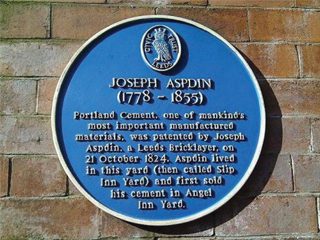
But that is only half the tale. On October 21st 1824, a bricklayer in Leeds patented a new formulation of hydraulic binder for mortar and concrete which he called Portland cement due to its similarity to the popular structural stone, especially when mixed with beach sand. Portland cement eventually dominated the manufacture of all concrete worldwide.

200 years on, the long-term durability limitations of Portland cement concrete are regularly made good by the application of cathodic protection, making 2024 a very important year for those involved in reinforced concrete and its remediation.

Happy 200th birthday to Cathodic Protection and Portland Cement.

Sir Humphry Davy of Penzance (1778 – 1829).

Photo courtesy of Pen with Local History Group

https://corrosion-doctors.org/Corrosion-History/CP-History.htm

Fellow’s Corner – Douglas Mills

Fellow’s Corner – Douglas Mills

Douglas Mills undertook PhD research on anti-corrosive coatings at Cambridge University and has worked on and off in this field since. After spells at the BNF Metals Technology Centre and the Nuclear Power Company, in recent times he has worked in academia, and apart from teaching materials, he has continued to conduct and supervise research in the field of electrochemical methods for application to coatings, particularly studying and developing the electrochemical noise method. He was for fifteen years the Technical Secretary of the Institute of Corrosion and is also involved in standards development.

Douglas Now Lays Down His Story:
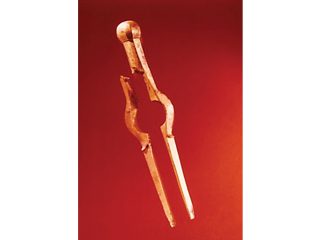
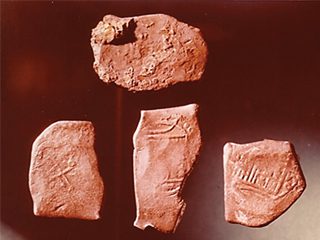
I have had an interest in archaeological corrosion ever since I did work in this area many years ago at the British Non-Ferrous (BNF) Metals Technology Centre in Wantage. This was “An examination of artefacts brought up from the seabed after 262 years”. In 1707 several ships of the line from a fleet of twenty one under the command of Sir Cloudesley Shovell, hit the rocks of the Scilly Isles during a fierce storm and sank. This included the flagship HMS Association. In 1969 a team of divers under the overall control of Roland Morris recovered many artefacts. The BNF was given a Royal Society grant to examine these, and it fell to me to carry out much of the work. Conducting chemical analysis as well as metallographic studies, enabled us to find out (and comment on) the type of corrosion, the nature of the corrosion product and the extent of corrosion. Also, the composition and metallurgical structure of the metals/alloys were compared with similar alloys used today. The items included, brass dividers a bronze cutlass handle lead musket balls and silver pieces of eight as well as lead pipe, pewter platters, a copper spike, and (bronze) ship’s bells. (There was also bronze cannon although my work did not extend to examination of these).

I did this work under the direction of Hector Campbell. one time editor of the British Corrosion Journal, with whom the 70page report was written.

Much later I became involved with the Maritime Museum in Gdansk.

I was able to pass this report over to Kasia (their corrosion expert). The museum had bits from two ships (“Copper Ship” and “Solen”) which sank in the Baltic a similar length of time ago). On the metallurgical side, the composition of many of the alloys used was surprisingly close to what might be used today and many were also reasonably pure for example.

Lead musket balls: afforded an interesting comparison with musket balls from the Swedish warship Wasa, visible in its entirety in museum in Stockholm, which sank some 60 years earlier in the Harbour there. This was possible because the original size and weight of musket balls was known and hence (assuming linear) we could work out the corrosion rate and compare them. What was found was that sea water conditions in the Scilly Isles (clean and turbulent) afforded a less aggressive environment than Stockholm harbour (polluted) led to about half the rate of corrosion.

Brass dividers: These had undergone hardly any corrosion; the points made of iron had rusted away completely (bimetallic corrosion), and maybe they provided galvanic protection in the early stages. But it was the fact that the brass was single phase and contained some arsenic (a useful inhibitor of dezincification) that probably saved the dividers.

• Bells: one from HMS Romney (probably!) and one from HMS Association. These, despite similar composition (two phase: one copper rich and one tin rich), had corroded in quite different ways with one phase being attacked in one bell and the other phase in the other. Interesting polarisation / potentiostatic work done in the lab revealed that the two bells had probably been subjected to different environmental conditions – half of one bell having been buried in mud while the other bell was freely exposed to sea water.

Pieces of eight: The interest here was in developing a more efficient cleaning method compared with the normal one which was lengthy and removed significant amount of silver, achieved partly by using an electrochemical method.

Protective Coatings and Electrochemical
Assessment Methods

This kind of research i.e., towards understanding long term corrosion and its prevention, has relevance today to both the storage of nuclear waste and conservation. The afore mentioned Kasia and I have collaborated in developing an electrochemical assessment method for corrosion protective coatings. The specific interest here is in how do you keep things in the museum environment from continuing to corrode? But there are also ancient artefacts outside like statues. The most common approach is application of

thin, invisible organic coatings. Getting the right coating is quite a challenge as the appearance must not to be altered. The Museum at Gdansk had a bell and bowls which had been protected by these thin transparent coatings. How do you assess such coatings? One approach is to use Electrochemical measurement techniques like DC resistance or Electrochemical Noise. Some recent work done in Northampton University tested four such coatings and concluded that Paraloid (conservation grade acrylic lacquer) coatings were the best. But only if you applied two thin (typically
10-20mm) coats.

Other Discoveries
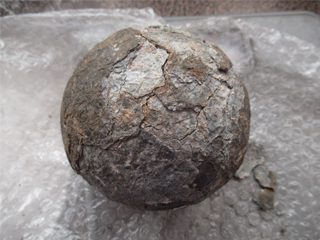
Moving back to the discovery phase on a more local level i.e., people discovering archaeological items in the earth, the father of a friend found a large cannon ball in the south of England which I was invited to have a look at. It had a thickish layer on the outside and this interestingly was not iron based but contained large amounts of lead.
The inside of the cannon ball was very likely cast iron, based on its hardness and the calculation of density (between 6.8 gm/cc and 7.5 gm/cc. Cast Iron has a density of 7.3 gm/cc.)
Outer lead casing – why was the outer lead put on? Was it a corrosion protective layer? What was the environment that caused the more noble lead to corrode so extensively? (apparently faster than the musket balls in the sea, as all the lead exterior was destroyed). Was it pure lead or some lead alloy which was more corrodible? Maybe the smoother lead surface assisted in the firing (that seems very plausible). One possibility is that it was never used in anger but was lost while being transported. Such cannon balls were used on big ships (even as early as the Mary Rose, Henry VIII’s flagship, from the early 16tH century) So it could have been travelling between the Arsenal and Portsmouth when it “fell off a cart!”
In summary lots of questions raised and only speculative answers! This is the fascination with any investigation of archaeological corrosion. It leaves plenty of room for the Imagination!

References:
1. H. S. Campbell and D. J. Mills Marine Treasure Trove – A Metallurgical Examination Metallurgist & Materials Technologist October 551 (1977).
2. Mills, D.J.; Schaefer, K.; Wityk, T. In-Situ Evaluation of the Protectivity of Coatings Applied to Metal Cultural Artefacts using Non-Destructive Electrochemical Measurements. Corros. Mater. Degrad. 2021, 2, 120–132. https://doi.org/10.3390/cmd2010007.
3. Schaefer, K.; Mills, D.J. The application of organic coatings in conservation of archaeological objects excavated from the sea. Progress in Organic Coatings Volume 102, Part A, January 2017, Pages 99-106.

Brass dividers
(almost no corrosion).

Lead musket balls with varying rates of corrosion according to submersion condition.

Pieces of eight after electrochemical cleaning.

Cannon Ball (weight 4 kG (9 lbs) Diameter 11cm (density 6.8-7.5) with Corrosion Product about 1-2 mm thick.

Fellow’s Corner

Fellow’s Corner

This series of articles is intended to highlight industry-wide engineering experience, guidance, and focussed advice to practising technologists. It is written by ICorr Fellows who have made significant contributions to the field of corrosion management.  This issue features The Corrosion Resistant Properties of novel cements, concretes, and reinforcement by John Broomfield of Corrosion Engineering Solutions Ltd.
The Corrosion Resistant Properties of Novel Cements, Concretes, and Reinforcement
We use more concrete than any other material other than water.  However, each tonne of concrete has a significant carbon footprint and the technical press is full of articles on new ways of reducing that carbon footprint by modifying its constituents.  There are many ways of doing this, most of which involve changes in the internal chemistry of the finished product.

Concrete is made from cement, fine and coarse aggregates, and water. To this may be added other materials or admixtures, such as superplasticisers to increase workability during placement on site, set retarders or accelerants for hot or cold climate work, or even corrosion inhibitors for aggressive conditions where the steel reinforcement needs extra protection. The cement itself can be Portland cement or, more commonly these days, a blend of Portland cement and other cementitious materials such as pulverised fuel ash (pfa), ground granulated blast furnace slag, microsilica or metakaolin. The perceptive reader will note that some of these materials are going through their own changes and availability issues in response to the need to reduce carbon emissions. There are reports in the press of applications to mine deposits of pfa from ash pits as the supply of material direct from operating coal fires plants is diminishing.

The methods of achieving the required performance and durability of blended cements are covered in UK and European standards BS EN 206 parts 1 and 2, and BS 8500 parts 1 and 2. The latter gives tables of exposure conditions along with the necessary mix design, and minimum cover requirements to achieve a required minimum design life for a given exposure condition. There is also BS EN 197-1:2011 Cement Composition, specifications and conformity criteria for common cements, which gives the specifications of 27 distinct common cements, 7 sulphate resisting common cements as well as 3 distinct low early strength blast furnace cements and 2 sulphate resisting low early strength blast furnace cements and their constituents.

Portland cement based concretes provide corrosion protection to reinforcement in two ways, as a semi permeable coating and as a corrosion inhibitor.  Concrete is permeable to water and oxygen.  The reason that reinforcing steel embedded in concrete does not corrode is that the pores in concrete contain an excess of calcium hydroxide and other hydroxides, maintaining a pH of 12 to 14 [1].  The upper level is carefully controlled because some aggregates are at risk of alkali aggregate reaction which leads to the creation of an expansive gel which will damage the concrete.

However, in order to prevent corrosion, the pH must stay above 11, which is the threshold for corrosion.  There are two mechanisms for inducing corrosion in reinforced concrete structures without physical damage to the concrete cover to the steel. One is carbonation; the process where atmospheric carbon dioxide reacts with pore water to form carbonic acid and neutralise the excess calcium hydroxide in the pores. This leads to a carbonation front which progresses through the cover. Once it reaches the steel, the pH drops below 11 and corrosion can occur.  The other process is chloride attack. The chloride ions in solution (usually from sea water or deicing salts) diffuse through the concrete cover to the steel. Once the concentration at the surface exceeds a threshold level, the passive layer on the steel breaks down and corrosion ensues.

Over the years since the 1970s, much work has been done to understand these mechanisms in Portland cement based concretes. We have a simple equation to estimate the rate of carbonation of the form, x = kt½ here x is the carbonation depth, t is time and k is a constant which can be measured or estimated on a structure by structure and microclimate basis.

For chloride ingress the equation is more complicated, as Fick’s second law of diffusion applies and the threshold concentration must be estimated.  However, there is much guidance now available on the parameters for predicting chloride diffusion rates into Portland cement and blended concretes [1].

However, this type of guidance has not been developed for non-Portland cement based concretes.  While civil engineers have great expertise and applicable useful standards and test methods for determining the physical characteristics of new concrete, when it comes to the more chemically based properties, such as corrosion resistance and durability, there is far less guidance and often less in-house or externally available expertise.

When blended cements were used with high levels of alterative cementitious materials, there was concern that the alkali reserves would be depleted, increasing the rate of carbonation and possibly also chloride diffusion. However, since these blends were less porous than ordinary Portland cement concrete, testing and experience soon showed that there was no loss of durability.  In fact, durability increased. However, there are new alternatives to Portland cement itself such as alkali activated cementitious materials (AACM). Because AACM has no Portland cement, it is outside EN 197-1, EN 206 and BS 8500. To prove a candidate new AACM is durable, EN 197-2 and EN 206 permit users to demonstrate equivalence and show the material has the required structural and durability properties.

As might be expected, AACM initially has a pH that is higher than conventional Portland cement and concrete (14 or so), but the alkali reacts during the setting process. There is therefore a concern that this cement free, lower carbon concrete does not have the same reserve of solid Ca(OH)2 to buffer carbonation, so it would carbonate faster than an equivalent convention Portland or blended cement concrete mix.
Recent testing suggests something else is going on. It seems the initial carbonation rate is higher, but a pore blocking process then seems to start, blocking CO2 ingress, and the rate of carbonation slows right down. The steel therefore remains in a dense, high pH matrix. However, this good performance may be product and mix specific. This suggests that the carbonation rate equation above is not applicable to AACM concretes, or that the constant k may be harder to determine over the long term.

RILEM (The International Union of Laboratories and Experts in Construction Materials, Systems and Structures) have produced a  State of the Art Report on Alkali Activated Materials [2], which is a comprehensive review of these materials, their formulations, chemistry and performance.  It discusses the durability of the material and of structures made with it, as well as the testing of the materials during production and casting and also field testing of existing structures.  It found considerable variability in performance and test results, particularly with regard to transport properties, corrosion performance and durability. The lack of specifically applicable performance standards was a concern.
Another major contribution to the field is “The Field Performance of Geopolymer Concrete Structures report” by the Cooperative Research Centre (CRC) for Low Carbon Living Ltd in Australia [3]. The report describes in-situ testing and core sampling of geopolymer (alkali activated) concrete at four sites across Australia and long-term performance monitoring of two geopolymer concrete structures. The field test results found extremely variable resistance to carbonation and to chloride ingress and the authors stated that this confirms the necessity of developing performance based specifications for Geopolymer concretes
Like the RILEM report, the CRC report concludes that suitable testing methods are required to assess the performance of concrete in order to assist engineers to specify Geopolymer concrete conservatively and confidently, particularly in more aggressive environments.
Unlike the physical testing of concrete for properties such as cube strength, the durability testing is more complex. We need to understand the chemistry of the material and how it changes over long periods of time if it is to be used with conventional steel reinforcement.  We already have examples of unsuitable use of specialised concretes most recently reinforced autoclaved aerated concrete leading to failures and expensive repairs or rebuilding.
The obvious corrosion related tests for novel concretes are for the alkali reserves in concrete to be measured and its resistance to chloride and carbonation.  There are tests for these under BS EN 205 and BS EN 1504.  However, we know that these properties can be very variable for alkali activated materials and change over the long term so a full understanding of the chemistry and its changes over time are required before we can develop prescriptive tests.
As one of the concluding statements of the RILEM Report states. “These issues are by no means limited to the area of AAMs – these points are relevant across many areas of non-traditional cement and concrete development and commercialisation”. The replacement of Ordinary Portland cement based concretes with new materials expected to perform and be durable for many decades is a challenge for engineers in the construction industry.
Of course, one solution to the corrosion risks of reinforced concrete is to use alternative reinforcement.  There have been corrosion resistant reinforcement materials available for many decades.  For ferrous materials these include galvanised steel reinforcement, fusion bonded epoxy coated reinforcement, a range of stainless steels and low alloy steels.  These are reviewed in the AMPP/NACE State of the Art Report on Corrosion Resistant Reinforcement [4].  Some of the ferrous materials can on the whole be treated by conventional testing both in the laboratory and on site, the coated ferrous reinforcing bars, less so.

However, there is now a range of non-metallic reinforcements, including glass and carbon fibre reinforced polymers and more recently basalt.  These are polymers with fibre reinforcement.  While we can detect ferrous reinforcement in a structure with electro-magnetic based cover meters, we have no simple way of detecting these materials. Will we be using more ground penetrating radar to detect non-metallic reinforcement?  Has any work been done on detecting these alternative reinforcement materials once they are cast into a structure?
Do we understand the deterioration mechanism for these products?  The failures of fusion bonded epoxy coated reinforcing bars in Florida were partly due to the softening and debonding of the epoxy in a saturated environment, particularly where the coating was stressed on the outer radius of bends. These failures happened over a few years. Could similar degradation of polymer-based reinforcement occur in concrete over the decades?  If so, how will we detect it?  We have NDT techniques such as reference electrodes, resistivity meters and linear polarisation to provide information of the corrosion condition of ferrous reinforcement.  We have no equivalent tests for polymer-based reinforcement.  If we start putting alternative reinforcement materials in alternative concretes will we understand their interactions in the short and long term?

It is obviously important to innovate to reduce the carbon footprint of the construction industry and improve the durability of the built environment.  However, we need a deep understanding of the materials we are using as well as suitable standards and test methods and equipment to ensure the products we use can perform in the environment they are exposed to and can be assessed and maintained throughout their lives which will last for many decades. Corrosion engineers have a major role to play in the understanding, testing and developing performance-based specifications and tests for the new wave of low carbon and corrosion resistant materials in the construction industry.

The author would like to acknowledge the help of Professor Peter Robery for his advice on alkali activated concretes and the RILEM and CRC reports.
References
1.  Broomfield, J.P. Corrosion of Steel in Concrete, 3rd Ed. Publ.  CRC Press London, 2023.
2.  John L. Provis, Jannie S.J. van Deventer Editors, Alkali Activated Materials State-of-the-Art Report, RILEM TC 224-AAM Publ. Spinger, 2014.
3. Stephen Foster et al. The Field Performance of Geopolymer Concrete Structures report RP 1020 by Cooperative Research Centre (CRC) for Low Carbon Living Ltd in Australia, 2018.
4. NACE Publication 21429-2018-SG – State of the Art Report on Corrosion-Resistant Reinforcement Publ. AMPP, Houston TX.
CAPTIONS:
Hilti Ferroscan, a scanning cover meter, can identify the size and depth of steel reinforcement.  New techniques will need to be developed for detecting and locating non ferrous reinforcement.
Fellow’s Corner

Fellow’s Corner

This series of articles is intended to highlight industry-wide engineering experience, guidance, and focussed advice to practising technologists. It is written by ICorr Fellows who have made significant contributions to the field of corrosion management. This issue features an introduction to intumescent coatings, by Brian Goldie.

Passive Fire Protection – Intumescent coatings
Today most buildings and structures have some degree of fire protection in order to protect lives, delay possible structural collapse allowing for evacuation, provide areas of temporary refuge in the case of fire, and ensure the integrity of escape routes, by preventing or delaying the escalation of a fire and protecting high-value assets.
There are two basic types of fire protection: active and passive. Active fire protection includes alarms and detection systems, sprinklers and water deluge systems, firefighting equipment and foam and powder extinguishers. Passive fire protection involves materials such as concrete, mineral fibre boards, vermiculite, cements, and intumescent coatings. This article will describe how intumescent coatings can achieve passive fire protection in many structure types including offshore platforms or floating facilities, such as FPSOs and FLNGs, and commercial buildings.
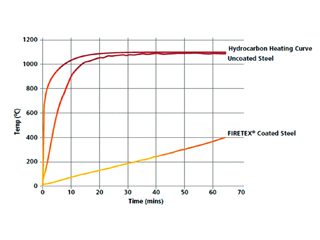
Intumescent coatings have been used to protect the steelwork in buildings and other structures from fire for approximately 40 years. These coatings work by swelling up in the event of fire and physically creating a barrier between the steel and the fire for as much as 4 hours in some cases. Steel begins to lose its structural strength at about 400 C, and these coatings can delay the time it takes to reach this temperature (Figure 1). Intumescents are often referred to as thin- film or thick-film coatings.

Thin-film intumescents are typically single component solvent or waterbased products, and have dry film thicknesses (DFTs) of less than 5 millimetres. In the last few years new technologies, such as multi-component methacrylate, or “hybrid” products, have been brought to the market, offering specific advantages over the traditional products.

Thick-film coatings are typically solvent-free, epoxy-based with DFTs of up to 25 millimetres.
The acceptance and use of intumescent coatings increased dramatically in Europe in the 1980s as the major oil companies learned of their ability to protect structural steel from the extreme heat caused by hydrocarbon fires, including jet fires caused by leaking hydrocarbons. Also, exposed steel was used more prevalently in the design of commercial structures and high-rise buildings, increasing the use of thin-film intumescents, which looked more like conventional paint and therefore could meet the aesthetic requirements of architects.

How Do Intumescent Coatings Work?
Intumescent coatings react to fire by expanding to form a carbon “char” with low thermal conductivity, which essentially forms an insulating layer reducing the rate of heat transfer and extending the time necessary to reach the critical failure temperature of the underlying steel.

It’s a complex chemistry incorporating the organic binder resin (coating) — typically an epoxy (hydrocarbon fire) or acrylic (cellulosic fire), and an acid catalyst, for example ammonium polyphosphate, which decomposes to yield a mineral acid. This acid reacts with a carbonific source, for example, pentaerythritol, to produce a carbon char. A spumific (foam-producing) agent, such as melamine, reacts with the acid source and decomposes, evolving into an inert gas which then expands the char. These are the basic reactions taking place, although more complex interactions also occur. Reinforcing mesh can be used to support the formed char.

Cellulosic vs. Hydrocarbon Fires
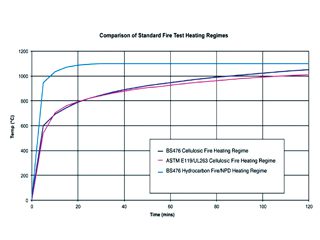
A cellulosic fire has a fuel source composed mainly of cellulose — for example, wood, cardboard, or paper. Hydrocarbon fires are fuelled by hydrocarbon compounds and ignite and grow exceedingly fast, achieving high temperature almost immediately after ignition, greater than 1,000C in less than five minutes (Figure 2). Cellulosic fires are slower to reach maximum temperature but may eventually reach or surpass the temperature of a hydrocarbon fire.

A hydrocarbon pool fire is defined as a turbulent diffusion fire burning above a horizontal pool of vapourising hydrocarbon fuel, where the fuel has zero or low initial momentum. A jet fire is a turbulent diffusion fire resulting from the combustion of a fuel continuously released with high pressure.

Testing Intumescent Coatings
No two fires are the same. The conditions depend on the type and quantity of fuel, the availability of oxygen and ambient conditions. For reproducible product testing. “standardised” fires have been defined, for example, BS 476 (parts 20 and 21) “Fire tests on building materials and structures” and EN 13381 (part 8), “Test methods for determining the contribution to the fire resistance of structural members” describe how intumescent coatings are tested with cellulosic fire exposure. Performance depends on coating thicknesses, the types of steel section, I-section, hollow section, and the section orientation, i.e., beam or column.

Other test standards include UL 1709, “Rapid Rise Fire Tests of Protection Materials for Structural Steel” for hydrocarbon fire exposure, ISO 22899-1, “Determination of the resistance to jet fires of passive fire protection materials”. Different standards apply to marine applications. It is not possible to test every variation, so the test results are analysed to produce an assessment of performance.

Ensuring Durability
To protect steel in a fire, a coating must be resistant to the environment and be intact at the time of the fire. Poor durability can lead to ineffective fire protection resulting in structural failure during a fire and expensive restoration afterwards. Poor durability can also lead to corrosion of the substrate, compromising structural integrity. To ensure durability of intumescent coatings the key ingredients — ammonium polyphosphate, melamine and pentaerythritol — are all sensitive to moisture, and must be formulated carefully.

Different resins are used to prepare intumescent coatings for different applications. Water-based acrylic materials are formulated for use in mainly dry, internal locations. Solvent- based acrylic materials are used to formulate intumescent coatings for use in internal or sheltered external locations.

Solvent-based or solvent-free epoxy materials are used to formulate intumescents that can be used in any location. These resins have different weathering performance, and therefore, protection capabilities.

To test the durability of an intumescent coating, standard coating test procedures are used, such as NORSOK M 501, “Surface preparation and protective coating,” Underwriters Laboratory, UL 2431, “Rapid Rise Fire Tests of Protection Materials for Structural Steel”, European Technical Approval Guidance, EAD350402-00-1106, “Reactive Coatings for Fire Protection of Steel Elements”, and/or EN16623, “Reactive coatings for fire protection of metallic substrates. Definitions, requirements, characteristics and marking.”

In addition, the intumescent coating should not spall or crack in use, be resistant to atmospheric and chemical attack and be re-coatable with itself — even after prolonged curing. There should also be excellent bonding between substrate, primers and the intumescent to combat the problems of under-film corrosion.

Specifying Fire Protection
Firstly, the item to be protected must be identified, whether it is structural steel, vessels, or divisions such as fire-resistant bulkheads, or decks, on petrochemical facilities. The general rule is, the thicker the coating, the longer the protection – up to a limit. The thickness of the intumescent used will depend on the weight and type of the steel member being protected. As the weight of steel decreases, the thickness of the intumescent should increase. Lightweight steel sections will heat up faster than heavier sections and will therefore need more protection for a given time.

Rather than just figuring the weight of the steel, specific calculations must be made in order to determine the appropriate thickness of the coating, taking into consideration the shape, or shapes, of the steel and accounting for any cut-outs or irregularities in the beams. The critical steel temperature which must be protected against should be defined — for example, structural steel between 200 and 750 C, and vessels between 200 and 350 C.
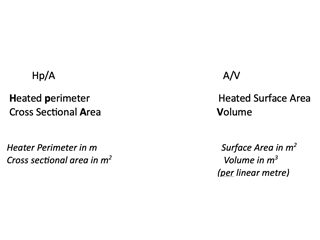
Next the section factor must be considered, as well as the fire protection period of between 30 minutes and four hours. The section factor (Hp/A) is the ratio of the fire exposed perimeter to the cross-sectional area of the steel (Table 1).

Most intumescent coating suppliers provide guidance in calculating the thickness of the coating required for a specific use and some have dedicated departments staffed with trained fire engineers who will do the calculations for you. For cellulosic fires, the products will have 3rd party certification to national or international standards (BS 5476 or EN13381). For hydrocarbon fires, the products will have certification from bodies such as Lloyd’s Register, Det Norske Veritas, or Underwriters Laboratories.

Consideration must also be given to the service environment the structure or vessel will be exposed to, as well as any special requirements such as blast resistance, high or low substrate temperature or cryogenic spill protection.

Conclusion
In addition to offering fire protection for up to four hours, intumescent coatings offer speed of application, shop or field application, aesthetic appearance and ease of inspection and maintenance.

Intumescents can protect a variety of steel surfaces from structural columns and cellular beams, to building components, vessels, and complex shapes. They can be formulated to protect against cellulosic and hydrocarbon fires including jet fires and fires resulting from explosions.

I would like to acknowledge the assistance of colleagues at JPCL, and Rick Perkins, Global Technical Manager – Fire, Sherwin-Williams Protective Marine Coatings, in compiling this article.
Brian Goldie


Table 1. Ratio of surface exposed to the fire, and “heat sink”.


Fig. 1: This graph illustrates the effect of intumescent coating on steel temperature in a hydrocarbon fire.


Fig. 2: This graph compares the heat-up rate of cellulosic and hydrocarbon fires.