

Fellow’s Corner

Fellow’s Corner

This series of features in Corrosion Management intends to highlight industry wide engineering experiences, practical opinions, and guidance, to give improved awareness for the wider public, and focused advice to practicing technologists. The series is written by ICorr Fellows who have made significant contributions to the field of corrosion protection through past industry involvements. Corrosion Management is pleased to publish this month’s contribution by Bijan Kermani, FICorr.

Metallic Materials for Hydrocarbon Production
Several categories of alloy are used in the energy sector, and in particular, in hydrocarbon production facilities, to enable successful and trouble free operations. The majority of the components of these facilities are manufactured from metallic materials, commonly carbon and low alloy steels (CLASs), which are readily available in the volumes required and able to meet many of the mechanical, structural, fabrication and cost requirements. However, the inherent corrosion resistance of CLASs is relatively low, and their successful application requires combination with one or more whole-life forms of corrosion mitigation against both internal and external exposure conditions, and/or the use of corrosion resistant alloys (CRAs).

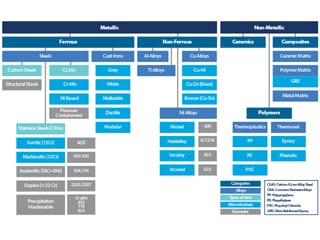
The main materials used in hydrocarbon production fall broadly into three categories, ferrous, non-ferrous and non-metallic materials, in which ferrous materials covers three types, carbon steels, CLASs and CRAs, broad details of which are summarised in Table 1. This article briefly addresses only the ferrous materials, which are the essential materials of construction for CAPEX intensive items (tubular and pipeline), their ranges, examples, related standards and their resistance to principal types of corrosion threat in hydrocarbon production (metal loss CO2 corrosion. and resistance to sulphide stress cracking, SSC, in the presence of H2S). These are summarised and characterised briefly in Table 2 and are as follows:

CLASs: A wide variety of CLAS grades are used across this industry sector and are the principal materials of construction and the first, optimum, and base-case choice for many applications. They normally have low metal loss corrosion resistance. The most notable categories of CLAS according to the application include, structural services and pressure containment.

Structural Services
These commonly utilise “structural” steel products in the form of rolled plate, various sectional shapes and tubular sections, although cast or forged products may also be used. Typical applications include offshore structures, sub-sea module support frames, pipe racks, process equipment saddles and, in some instances, low criticality storage tanks. They contain Mn (typically 0.5 – 1.5%) and limited quantities of other alloying elements such as Nb, Ti and V. Structural Steels generally have adequate properties over a range of temperatures lying between approximately -50°C to +50°C, depending on the local environmental conditions, e.g. in arctic, temperate or tropical conditions. They are normally weldable and have a yield strength not exceeding 350 MPa.

Pressure Containment
C/Mn or lean alloy steels may be used for process plant, vessels, pipe work, pipe fittings and valve bodies requiring pressure containment. However, steels with an increased alloy content of Cr, Ni, Mo, so called low alloy steels, are employed to give mechanical properties suitable for a temperature range lying within the limits of approximately -80°C (characteristic of Joule Thompson cooling) to approaching 600°C (characteristic of a number of refining processes). Typical applications requiring pressure containment include drill pipe, casing and tubing, linepipe, process pipework, pressure vessels and heat exchangers. Generally CLAS has low resistance to metal loss corrosion while sour service grades have good tolerance to SSC.

While metallic materials used for subsurface applications (wells) are seamless with relatively high strengths (normally yield strength >500 MPa) and have no requirement for welding (threaded connections are used), other applications including, flowlines, topside/surface facilities and pipeline/trunklines require materials with the ability to be welded and normally have lower yield strength (not exceeding 700 MPa).

Table 1. Range of metallic and non-metallic materials used in the construction of hydrocarbon production facilities.
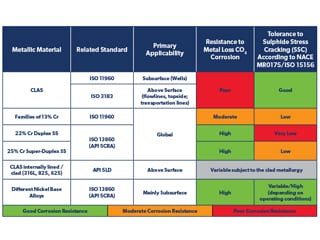
Table 1. Range of metallic and non-metallic materials used in the construction of hydrocarbon production facilities.

Table 2. Range of CAPEX intensive metallic materials (tubing and pipelines) and their relative corrosion performance.

Table 2. Range of CAPEX intensive metallic materials (tubing and pipelines) and their relative corrosion performance.

The new generation of low Cr containing steels with 1 to 5%Cr offer slightly improved metal loss corrosion resistance, optimality for well completion applications.

CRAs: While CLASs, or in combination with corrosion prevention systems, may offer suitability for some applications, corrosion resistant alloys (CRAs) containing amongst other elements, Cr, Mo, N, W, Nb, Ni, Co have emerged as alternative more corrosion resistance choices. Increasing alloying elements invariably leads to increasing costs. Even though CRAs are more costly to procure in terms of CAPEX, they may offer more favourable whole life cost with lowering risk in terms of corrosion threats.
CRAs are primarily restricted for use in subsurface (well completion) and as internal cladding of manifolds and internal cladding of risers due to their relative cost. However, based on whole life cost comparison they may become economical for specific applications.
There are many categories of CRAs. These are generally divided into groups or families of alloys that have common characteristics or microstructures. These are summarised in Table 1 and include: 13Cr Steels. The family of 13Cr stainless steel (SS) exhibit good metal loss corrosion resistance with good strength. They contain 13%Cr and some other minor elements. A new generation of this family contains 15-17Cr, or alloyed 13Cr containing Ni and Mo, have improved metal loss corrosion and top temperature limit. They are primarily for subsurface applications, although weldable/lean grades are considered for infield flowline/pipeline applications. Generally, they have low resistance to sulphide stress cracking (SSC).

Duplex Stainless Steels
Duplex and super duplex SS derive their properties from the balance of phases between ferrite and austenite by the addition of Cr, Ni and Mo. They are designed to provide better corrosion resistance than the 13Cr families, particularly resistance against chloride pitting corrosion and they have higher strengths, although their tolerance to environmental cracking (EC) in the presence of H2S is low.

Other CRA
Other types of CRA include several categories of alloy containing varying amounts of Cr, Ni, Mo and other alloying elements, and also Ti alloys some of which do not fall into the ferrous category. These offer superior metal loss, corrosion, as well as tolerance to environmental cracking (EC) in the presence of H2S, chloride, and also when elemental sulphur is present. While some grades of Ti alloys have been successfully used in well completion (sub-surface), these are not covered in the present article.

Additional reading: B Kermani and D Harrop, Corrosion and Materials in Hydrocarbon Production; A Compendium of Operational and Engineering Aspects, Wiley, 2019.

Fellow’s Corner

Fellow’s Corner

The latest article from ICorr Fellows who have made a significant contribution in the field of corrosion control is by Dr Sadegh Parvisi, Senior Principal Materials Engineer, McDermott, who describes the role of a Corrosion, Materials and Metallurgy Engineer. With some decades of professional engineering experience in engineering companies, operations and R&D, the author now shares this experience with fellow workers in ICorr.

The role of the Corrosion, Materials and Metallurgy Engineer in the integrity of Oil and Gas projects

This brief article is intended to highlight some strategic ideas to enhance the interaction of the Corrosion, Materials and Metallurgical (CMM) discipline with other fields, to improve the integrity of a project and enhance the reliability of the plants. It also aims to show the workflow, and identify the mechanism of interaction between all the disciplines engaged in the execution of a project.

Why CMM ?
Today’s corrosion engineers cannot produce meaningful and reliable outputs without having a proper relevant knowledge of Materials and Metallurgy. For instance, for a corrosion engineer it is not sufficient to only know the electrochemical processes well, but it would also be necessary for him/her to have a clear idea of the difference between PVC and CPVC. The CMM engineer should also understand, for example, the role of molybdenum on pitting and crevice corrosion of stainless steels, and to assess that even if this is not an issue, it is still vital to be aware of the huge cost impact of selecting between SS304 and SS316 steels in a LNG project. Hence this being considered as a single discipline which is named CMM.

Why is this subject important?
Consistency between the engineering project specification documents has a significant effect in the integrity of a project. This consistency cannot be achieved unless a dynamic interaction is built between the engineering disciplines. Quite often, it has been experienced that the final version 
of the Piping and Instrumentation Diagram (P&ID) is not compatible with the material selection specification or report. Piping classes specifying the material of construction’s corrosion allowance divert from the 
as-built P&IDs etc. The root cause of these discrepancies lies in the lack of 
proper communication between relevant engineers, in particular in the CMM discipline.

Phases of Project
Any project can go through different phases before it reaches a ‘live’ production. For example:

  • Conceptual
    FEED
    Detailed Engineering
    Procurement
    Fabrication & Inspection
    Installation
    Pre-commissioning
    Commissioning
    Trial Period
    Operation
    Maintenance
    Mothballing
    Extension/Revamping
    Conceptual
    Front End Engineering Design (FEED)
    Detailed Engineering
    Procurement
    Fabrication & Inspection
    Installation
    Pre-commissioning
    Commissioning
    Trial Period
    Operation
    Maintenance
    Mothballing
    Extension/Revamping

This article intends to briefly address some of the key activities in each phase.

Conceptual Phase
The most fundamental phase in which preliminary materials selection and 
 corrosion control, based on Statement of Requirement (SOR), and in line 
 with process design parameters, are made.

  • Innovation, discussion meetings with reputed vendors
    Risk of employing new technologies should not be ignored
    Optimisation and cost savings to be looked at carefully
    Discussion and agreement with the client on any software to be utilised 
 before it gets too late
    Site visit by CMM engineer can be very useful, if not crucial

FEED Phase

  • The project statement of requirements should detail scope of work for 
 this discipline
    Optimisation process, i.e. risk analysis and economic analysis should 
 be conducted


Detailed Engineering comprises

  • FEED endorsement
    Endorsement correction, HAZOP, licensor, etc. Corrosion control check-
 ups, Approved changes
    Full definition of materials (e.g. exact grade of titanium, etc., for example)
    Basis of material selection to be consistent with FEED
    Materials requisition and any technical deviation
    Critical review of package material, request for compliance
    Setting and finalising materials selection, as built
    Material selection control manual


Procurement and Construction

  • CMM to ensure compliance to specifications, and ensure that an exotic 
 material choice is not necessarily fit for service.
    Vendors technical bid and Concession Request (CR) document
    Upgrade requests from vendor should be assessed carefully
    Participate in pre-production meeting
    Materials selection change request during construction on CP, painting, 
 storage, etc.
    Issuing close-out report for as built condition
    No compromise to be made if it could affect integrity

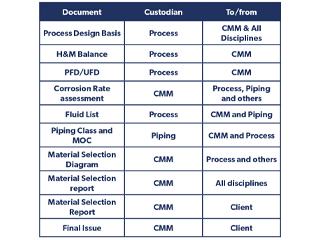
Typical workflow for issuing a corrosion control material selection table/report.

Table of typical workflow for issuing a corrosion control material selection table/report.

Pre-commissioning

The CMM engineers to be alert to some of the procedures in the manual, such as hydro testing, and that they are practiced carefully.

The Interaction mechanisms

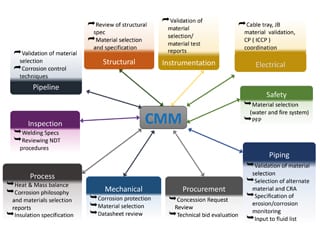
The simple diagram shows the relationship between the CMM engineer and the other disciplines, and the table summarises the links between a process engineer and a piping engineer, as the main disciplines interacting with the CMM engineer in any oil and gas project, in order to have a robust and solid material selection philosophy. Similar tables can be produced to include other disciplines’ scope of activities, for instance in applying a corrosion mitigation technique by ICCP, the interaction between CMM, pipeline, civil and electrical engineers should be clearly defined.

Summary

It is important to note that a continuous and integrated input and engagement of the CMM engineer is vital throughout all stages of a project, since the integrity, reliability and safety of the plant depends significantly on the degradation mechanisms and materials selection strategy – the backbone of a CMM engineer’s expertise.
The Oil & Gas company should ensure active participation of the CMM engineer and appropriate interaction of them with other disciplines throughout the project.

It is recommended that

  • The engineering director/company should ensure that there is a 
 continuous active participation, and appropriate interaction, of the 
 CMM engineer with other disciplines. It is also important that a proper 
 organisational chart is developed before the start of the project, and 
 the position and the work scope of the CMM engineer is defined for the 
 project, without any budget constraints for this important discipline.
    The harmful misconceptions that “Nothing Can Be Done About 
 Corrosion!” are avoided
    There is increased awareness of the large cost of corrosion and potential 
 savings that can be made
    A sound Corrosion Management strategy should be set-up by changing 
 policies, regulations, standards, management practices and attitudes, to 
 increase corrosion mitigation savings
    The education and training of staff in recognition of corrosion control 
 should be improved