A new study focused on the investigation of the fire protection of steel using inorganic intumescent alkali silicate and geopolymer (alkali aluminosilicate) coatings at temperatures relevant for hydrocarbon fires, as described in the UL1709 standard.
Pure alkali silicate coatings based on Na, K, or a mixture of these with Li, exhibited high initial expansion followed by melting. In comparison, Li-silicate coatings expanded less but demonstrated significantly higher thermal stability. Increasing the SiO2/Na2O molar ratio prolonged the fire protection time, explained by the lower melt formation proposed by global equilibrium calculations. The presence of melting in the high expanding alkali silicate systems limits their use in hydrocarbon fire conditions. In comparison to pure alkali silicates, geopolymer coatings with kaolin, metakaolin, and fly ash, and additional CaCO3 displayed a higher thermal stability confirmed by global equilibrium calculations.
An examination of the influence of the CaCO3 and kaolin content, suggested that an optimum exists for the kaolin coatings in terms of expansion, fire protection, and thermal stability. The best performing kaolin coating (37.6 min) had a lower fire protection compared to a state-of-the-art commercial organic hydrocarbon coating (44.2 min), caused by their differences in internal structure. The commercial coating expanded to a more compact microporous solid, while the kaolin coating qualitatively displayed a higher proportion of macropores. This in turn suggested that future work needed to be carried out to further improve the internal structure of the kaolin-based coatings to ensure good fire protection.
The study was published in Journal of Coatings Technology and Research, Volume 20, Issue 1, January 2023.
Zinc-rich epoxy coatings are widely used to protect steel against corrosion, due to their excellent corrosion resistance. However, these coatings usually use a large amount of Zn powder and organic solvents, which not only wastes resources, but also produce a high level of volatile organic compounds (VOC).
In a new study, three different flake metal powders (Zn, ZnAl alloy and ZnAlMg alloy) were used to replace the spherical Zn powder, to develop environmentally friendly coatings with low pigment content. The coatings were evaluated by salt spray test and electrochemical tests, and the results showed that the use of flake metal powders instead of spherical zinc pigments can enhance the electrical connection between metal particles, prolong the path of corrosive medium infiltration into the coatings, enhance the physical shielding effect of the coatings, and reduce the pigment content by one third. Among them, the ZnAl coatings displayed the best anti-corrosion performance, resisting salt fog corrosion for 28 days.
This study was published in Progress in Organic Coatings, Volume 175, February 2023.
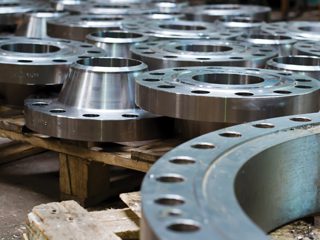
Piping is everywhere in process industries such as chemical and petroleum production, and the flange faces on the end of almost every pipe segment form a critical connection for pressure containment. Any deterioration of these surfaces could diminish the integrity of that connection during storage and installation, making preservation imperative for safety and performance concerns. Removable coatings are an ideal way to ensure faster installation and less downtime by preventing corrosion on the flange face.
Cortec® have developed two removable coatings for flange face protection. VpCI®-391, a water-based temporary coating with low VOC (48 g/l]), it provides protection in harsh, outdoor, unsheltered applications, has excellent UV resistance, and can be easily removed with alkaline cleaners. For the most extreme conditions, VpCI®-368 offers even heavier duty protection. This fast-drying solvent-based coating leaves a slightly brown waxy finish, which again can be removed prior to flange installation using an alkaline cleaner.
ABRAFATI is the most important event of its kind in Latin America. Combining the International Coatings Congress, and the International Exhibition of Coatings Industry Suppliers, it has been around since 1989 and has gained recognition for the quality of its programme and for bringing together thousands of business people and industry-leading companies, and having positive effects on the industry in Brazil and Latin America over time, in terms of both business and technological development.
The CEOCOR congress will be held this year in Bratislava, Slovakia, from May 30th to June 2nd. This is the first live congress after three years of restraint due to covid, and will allow the crucial direct and open personal exchange in the technical Work Groups and open conference sessions, between established experts and young engineers.
The programme this year covers relevant aspects related to AC as well as DC interference and mitigation strategies, coatings, shielding conditions, MIC, and new integrity assessment technologies along with reports of real-world field experience. The Keynote lecture is “Shining Light on Localised Corrosion”, by Professor Alison Davenport, who has been a leading researcher on passivity and the processes related to pitting corrosion for many years. She was recently awarded our prestigious U R Evans award at a meeting in Birmingham in February this year.
As usual the congress will feature a dinner and a cocktail party. There will also be an accompanying person’s programme. Full details, and a registration form, can be found on the congress website, www.ceocor2023.com
The following documents have obtained substantial support during the past two months, and have been submitted to the ISO member bodies for voting, or formal approval.
ISO/FDIS 4624 Paints and varnishes — Pull-off test for adhesion (Revision of 2016 standard) ISO/DIS 3549 Zinc dust pigments for paints —Specifications and test methods ISO/DIS 14919 Thermal spraying — Wires, rods and cords for flame and arc spraying — Classification — Technical supply conditions (Revision of 2015 standard) ISO/DTS 16774-2,3,4 Test methods for repair materials for water-leakage cracks in underground concrete structures — Part 2: Test method for chemical resistance, Part 3: Test method for water (wash out) resistance, Part 4: Test method for adhesion on wet concrete surface (Revision of 2016 standards) ISO/FDIS 24131-1,2 Internal protection by polymeric lining for ductile iron pipes — Requirements and test methods — Part 1: Polyurethane lining, Part 2: epoxy lining ISO/DIS 24489 Non-destructive testing — Acoustic emission testing — Detection of corrosion at atmospheric and low-pressure metallic storage tank floors
New International standards published in the past two months.
ISO 1518-1:2023 Paints and varnishes — Determination of scratch resistance — Part 1: Constant loading method
ISO 4212:2023 Corrosion of metals and alloys — Method of oxalic acid etching test for intergranular corrosion of austenitic stainless steel
ISO 4618:2023 Paints and varnishes — Vocabulary
ISO 4905:2023 Corrosion of metals and alloys — Electrochemical test methods for high-temperature corrosion testing of metallic materials in molten salts
ISO 7142:2023 Binders for paints and varnishes — Epoxy resins — General methods of test
ISO 7784-1,2:2023 Paints and varnishes — Determination of resistance to abrasion — Part 1: Method with abrasive-paper covered wheels and rotating test specimen, Part 2: Method with abrasive rubber wheels and rotating test specimen
ISO/TS 19392-6:2023 Paints and varnishes — Coating systems for wind-turbine rotor blades — Part 6: Determination and evaluation of ice adhesion using centrifuge
ISO 24647:2023 Non-destructive testing — Robotic ultrasonic test systems — General requirements
We use cookies to optimize our website and our service.
Functional
Always active
The technical storage or access is strictly necessary for the legitimate purpose of enabling the use of a specific service explicitly requested by the subscriber or user, or for the sole purpose of carrying out the transmission of a communication over an electronic communications network.
Preferences
The technical storage or access is necessary for the legitimate purpose of storing preferences that are not requested by the subscriber or user.
Statistics
The technical storage or access that is used exclusively for statistical purposes.The technical storage or access that is used exclusively for anonymous statistical purposes. Without a subpoena, voluntary compliance on the part of your Internet Service Provider, or additional records from a third party, information stored or retrieved for this purpose alone cannot usually be used to identify you.
Marketing
The technical storage or access is required to create user profiles to send advertising, or to track the user on a website or across several websites for similar marketing purposes.