

Meet the Author
Hans has built his career on a strong practical background and a natural curiosity, leading him to a wide range of roles in materials and corrosion across operations, engineering, research, and technology. He is committed to developing and applying deep technical knowledge to deliver practical and effective solutions.
Hans is currently the global expert for Materials and Corrosion in Carbon Capture and Storage (CCS) at Shell, where he provides guidance and support to many CCS projects worldwide. To address specific corrosion challenges, he is actively involved in research collaborations with several institutes and universities. In recent years, his work has focused particularly on the effect of CO2 purity on corrosion behaviour. Hans has published extensively on corrosion issues related to oil and gas production as well as CCS. He is also actively involved in standardisation work, including serving as Chair of SC 20 / SC 26 and a TCI for CCS at AMPP.
Introduction
To mitigate CO2 emissions from a wide range of industries, Carbon Capture and Storage (CCS) projects have been initiated to process, transport and inject CO2 captured from multiple emitters. These CO2 sources have a wide variety of compositions, and it has been discovered through testing in recent years that mixing the CO2 streams can cause their impurities to react and cause precipitation of a highly corrosive acidic phase well below the water dewpoint. It was found that a group of impurities (H2O, H2S, SO2, NOx and O2) can react to form products that include H2SO4 , HNO3 as well as elemental sulphur1-3,, which with their low solubility4 can trigger precipitation that causes severe corrosion6,7.
Figure 1 presents a schematic overview of these so-called CCS hub projects with a wide range of industry CO2 sources.
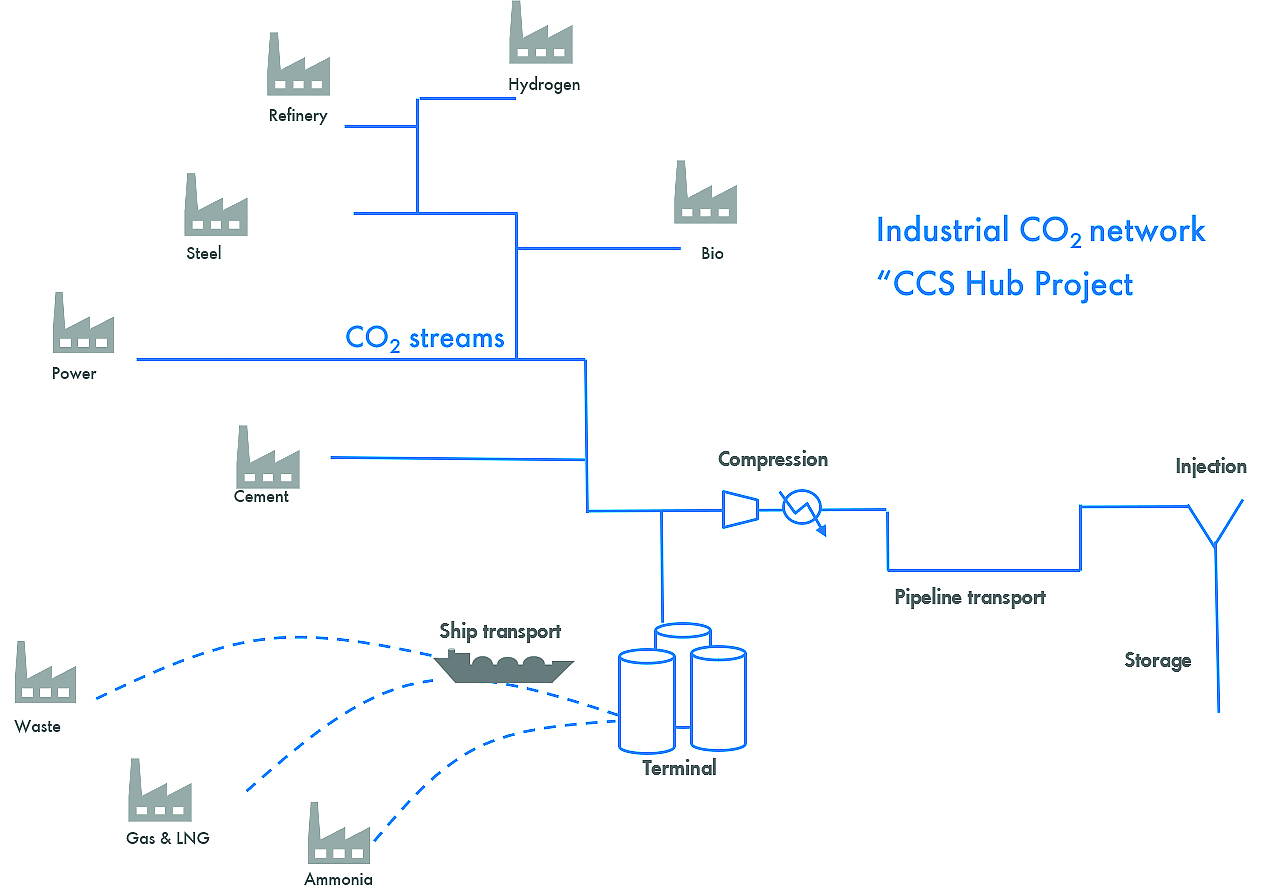
Figure 1: Schematic Overview of a Possible CCS Hub Project that Gathers,
With the tight economics of CCS projects, it is inevitable that carbon steel will be selected for the long pipeline networks required to connect the CO2 emitters to the storage location. This makes the management of corrosion a critical factor for the commercial viability of these projects. Corrosion control starts with setting of limits for impurities in a defined CO2 specification. To safeguard long term integrity, control of both CO2 composition and process conditions, in combination with highly sensitive monitoring, will be required. As new energy transition technologies like CCS are developed, diligence is needed in identifying new potential corrosion threats to avoid in-service surprises.
A standard practice has been developed by AMPP (AMPP SP 21632-2025)8 that outlines the basic requirements for corrosion control for CCS projects. These include:
- Prevention of precipitation/drop-out of strong acids present due to interaction between impurities in transported CO2 streams by validation of impurity limits for H2O, H2S, SOx, NOx, and O2.
- Continuous monitoring to control the levels below the validated conditions for liquid precipitation for all operating scenario’s,
- Assessment of the risk of potential off-spec scenario’s,
- Incorporating the worst-case for combinations of these impurities and conditions.
The generic guidance provided by AMPP SP 21632-2025 and recent literature needs to be addressed in detail during project design and operations.
Corrosion control starts with understanding the corrosion mechanisms, including the main triggers for corrosion to occur in practice. When these are identified, the worst-case compositions and conditions can be identified and tested, leading to the development and implementation of an appropriate corrosion management strategy.
This article outlines the basic principles of the corrosion mechanism associated with acid formation and precipitation and the critical factors that need to be controlled to enable effective corrosion management, and to offer guidance for tackling the challenges associated with managing newly recognised corrosion mechanisms in CCS.
Corrosion Mechanism “Reactive Phase Behaviour”
The corrosion mechanism caused by chemical reactions and precipitation in CCS is complex and uncertain. The initial reaction can form a separate phase contributing to or leading to further reactions within that phase known as “reactive phase behaviour”. In some cases (reaction) products adsorbed on metal surfaces cause corrosion before precipitation occurs.
The corrosion mechanism is visualised in Figure 2.
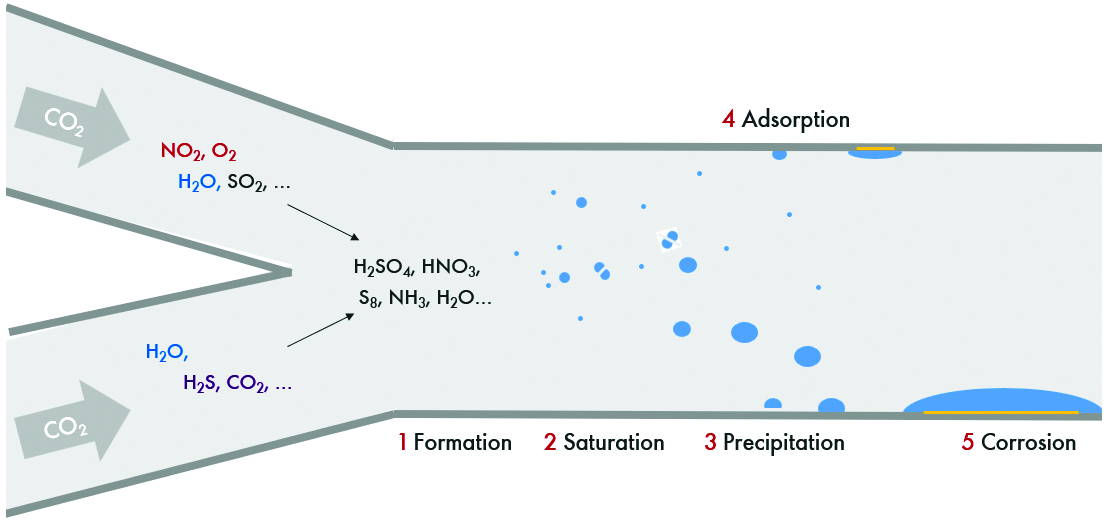
Figure 2: Corrosion Mechanism Caused by Mixing of Impure CO2 Streams Leading to Formation of Reaction Products that Can Adsorb or Coalesce and Precipitate as a Corrosive Phase.
The corrosion mechanism is initiated when two impure CO2 compositions, containing H2O, H2S, SOx, NOx, and O2., interact, allowing their respective impurities to react and generate various reaction products.
The observed reactions appear to be triggered primarily by the presence of H2S which acts as a strong reducing agent, and NO2, which can initiate a radical chain reaction, With sufficient oxygen, these reactions can result in the formation of H2SO4 and HNO3 formation 1,2,3. Chemical equilibrium calculations (CEC) can be used to determine the likely reaction products, which can be illustrated in a stability diagram that maps hydration and oxidising strengths as shown in Figure 3. Acid formation is anticipated only when sufficient oxidising and hydration strength is present,6,7,9,10
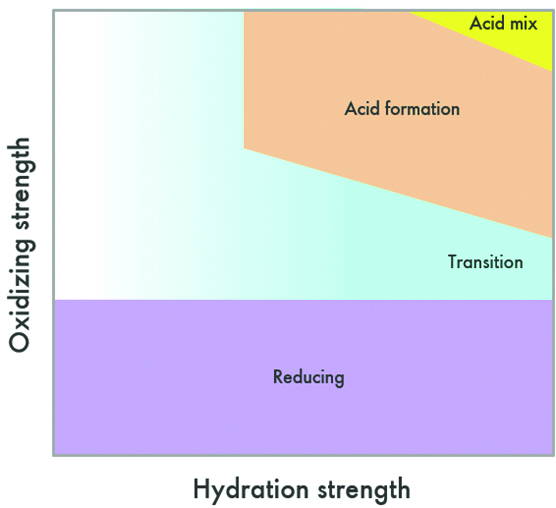
Figure 3: Visual representation of chemical reactivity as a “stability diagram” for speciation of reaction products based on the presence of different concentrations of impurities. Acids can be formed – in the orange area typically H2SO4 and in the yellow area both H2SO4 and HNO3. The blue area indicates water saturation, and the purple area covers reducing conditions where for e.g. elemental sulfur can form.
Reaction products can coalesce to form a separate phase that can grow until the point of saturation. Due to the very low solubility of H2SO4 n CO2 precipitation can be expected4, even at low concentrations, however, discrepancies between precipitation by this mechanism and solubility measured by H2SO4 uptake have been identified7. Reasons for this include incomplete conversion of reaction products due to blocking of some chemical reactions, chemical kinetics and supersaturation before precipitation. The separate phase likely contains not only pure H2SO4 but also a combination of acids and water that have a strong affinity to each other potentially creating a highly corrosive phase.
Comprehensive understanding of this process is currently lacking. Once acid precipitation occurs it can settle at the bottom and cause corrosion. Continuous accumulation by replenishment significantly increases corrosion rates, while discontinuous acid formation may be less severe but is unpredictable due to uncertainty around composition of precipitants, location, and duration.6,7.
Recent findings also show that corrosion can sometimes be initiated via adsorption prior to precipitation, particularly when NOX predominates and there is an excess of H2O. This effect has been demonstrated in particular in gas phase CO2.7,9 In these situations corrosion is likely to occur around the full circumference of the pipe and affect a larger area. The process appears to result from direct adsorption and salt formation rather than strong acid formation, which may not significantly influence this mechanism. Consequently, the corrosion rate is likely to be lower, although this has not yet been fully investigated.
Condition Driving Corrosion
Effective control of corrosion requires an understanding of the triggers and critical aspects that drive the corrosion mechanism. By managing these main triggers, it is possible to prevent corrosion and develop effective mitigation strategies. The primary factors for this corrosion process include:
- Chemistry of reaction between H2O, H2S, SOx, NOx, and O2
- Chemical reactions initiate mainly due to the presence of NO2 asa radical and H2S (and to a lesser extent SO2) as a strong reducing agent; radical chain reactions are initiated at low concentrations when these both are 1,2,3,6,7.
- The presence of oxygen (O2) promotes acid formation, and excessO2 further pushes the equilibrium towards acid formation with an increase in conversion Sufficient oxidising strength is essential for acid formation and minimal levels can lead to precipitation.7,9
- While water is required for acid formation, it is not needed for H2SO4 Even at very low concentrations, water does not appear to control this process if other hydrogen donors are available. However, too much water, even below the dewpoint, can encourage precipitation or early-stage corrosion especially when NOx is prevalent or in gas phase.9 Therefore, strict control over water content is critical.
- Phase behaviour
- Lower temperatures result in the lowest solubility for acids and even at low temperatures reaction kinetics are not sufficiently slowed to prevent acid formation reactions from taking
- There is a considerable difference between the thresholds for acid formation and precipitation compared to acid solubility from uptake, likely due to chemical kinetics and coalescence. The effect of flow remains understudied, and all these uncertainties create unpredictability in this mechanism.
- Corrosion
- High rates of continuous acid formation and precipitation can lead to severe corrosion (and possibly loss of containment) with observed rates exceeding 100 mm/year 6,7. This level of corrosion is unacceptable, so to prevent such events requires stringent control measures, real-time CO2 composition monitoring, and alarms that immediately trigger shutdown of the source of the problem.
- Nevertheless, many uncertainties In some cases, salts may form before acids, or corrosion may precede acid formation9, typically across larger areas, with significantly lower corrosion rates. Such scenarios might be acceptable during specific upset conditions, but then a more detailed understanding is required.
Corrosion Control
To effectively manage corrosion the following actions can be taken:
- Identifynon-corrosive CO2 compositions by determining threshold concentrations for precipitation, considering all impurities and lowest operating Chemical Equilibrium Calculation (CEC) can be used to assess reaction tendencies, oxidising/hydration strength7,9,10. and equivalent sulphuric acid concentration Cacid . These help identify worst case scenarios for acid formation and precipitation that can be tested to verify that no precipitation occurs under all operating scenario’s11.
- Composition controls should include alarms to critical impurities at the emitter side source before acids form, as dissolved acids are hard to This requires special techniques for control since the limits can be low and stringent. Collaboration with emitters will help anticipate possible effects of upsets and enable early intervention.
- Exceedance of individual limits may be acceptable during an upset if outside the acid formation and precipitation ranges. CEC can be used for assessment of these incidences, and acceptance may be provided H2S and NOx are not present at the same time.
- If an upset causes acid formation and precipitation, the impact on integrity can be evaluated based on oxidising/hydration strength and sources like H2S and NOx, also considering the consequence of possible delayed reactions if one impurity increases after mixing.
- Inspection and corrosion monitoring using automated and highly sensitive probes (e.g. UT) should target low temperature areas prone to precipitation, such as a gas sphere, low-point of a vessel or pipework, considering a CRA (Corrosion resistant alloy) or cladding for such sections is For pipelines this is often too complex or costly to address fully, and it is recommended to keep conditions in dense phase with shut-in during upset scenarios and keep phase transitions to the minimum (since acid solubility seems much lower in gas phase than in dense phase).
Summary and Conclusions
Progression towards the energy transition and the development of an emerging industry, such as CCS-Hub facilities, introduces distinct corrosion challenges. Due to the rapid expansion of this sector, prompt and effective measures are essential to mitigate excessive corrosion.
To safeguard asset integrity and prevent premature failures that may adversely affect the industry’s reputation.
Effective corrosion control requires active management of the composition of the CO2 during its capture, transport and storage, especially with respect to purification and process controls. As part of a comprehensive corrosion management strategy the following steps are recommended:
- Understand and continuously review the composition of the sources of CO2 feeding into the project to identify a possible risk of chemical reactions that can cause acid precipitation and corrosion.
- As carbon steel is usually the most cost-effective it is necessary to establish and enforce an IOW (Integrity Operating Window) that requires inclusion and clear definition of composition and impurity thresholds that avoid corrosive conditions.
- Consider using CRAs in areas where a high acid precipitation risk may exist, since corrosion rates due to continuous acid precipitation can be
- Maintain operations within the non-corrosive conditions through strict automated monitoring and control of composition.
- Develop upset management protocols, identifying scenarios where deviations may be acceptable as long as they are not resulting in significant acid precipitation
- Implement broader corrosion management initiatives such as:
- Review of compositional upsets, especially individual components to evaluate their potential impact and determine locations for inspection.
- Perform focussed automated inspection and corrosion monitoring at critical locations (e.g. tank bottoms or cold sections).
- Develop mitigation strategies, including possible closely monitored composition to prevent acid formation and precipitation, recognising that this is currently a largely unexplored topic.
Due to the numerous unknowns associated with this corrosion mechanism due to reactive phase behavior, ongoing research is being conducted to identify its key triggers. To date, only a limited range of non-corrosive composition thresholds have been established for specific conditions.
References
- A Dugstad, M Halseid, B H Morland, “Testing of CO2 specifications with respect to corrosion and bulk phase reactions,” Energy Procedia 63 (2014) 2547-2556. https://doi.org/10.1016/j.egypro.2014.11.277.
- B H Morland, Tjelta, T Norby and G Svenningsen, “Acid reactions in hub systems consisting of separate non-reactive CO2 transport lines,” International Journal of Greenhouse Gas Control 87 (2019) p. 246-255. https://doi.org/10.1016/j.ijggc.2019.05.017.
- B H Morland, A Dugstad, G Svenningsen, “Experimental based CO2 transport specification ensuring material integrity,” International Journal of Greenhouse Gas Control, 119 (2022) https://doi. org/10.1016/j.ijggc.2022.103697.
- B H Morland, A Tadesse, G Svenningsen, D. Springer and A. Anderko, “Nitric and Sulfuric Acid Solubility in Dense Phase CO2,” Industrial & Engineering Chemistry Research, 2019. 58(51): p. 22924- https://pubs.acs.org/doi/10.1021/acs.iecr.9b04957.
- J Sonke, W M Bos, S J Paterson, “Materials Challenges with CO2 Transport and Injection for Carbon Capture and Storage,” International Journal for Greenhouse Gas Control 114 (2022): 103601. https://doi. org/10.1016/j.ijggc.2022.103601
- J Sonke, B H Morland, G Moulie, M S Franke, Corrosion and Chemical Reactions in Impure CO2, International Journal for Greenhouse Gas Control 113 (2024) 104075. https://doi.org/10.1016/j. ijggc.2024.104075.
- J Sonke, Y Zheng, R I Slavchov R Walker, S M Clarke,, B H Morland, Impurity threshold definition for non-corrosive CO2 transport – chemical equilibrium calculations and laboratory testing, International Journal of Greenhouse Gas Control,. 153 (2026) 104672. https://doi. org/10.1016/j.ijggc.2026.104672
- AMPP SP 21632-2025 “Standard Practice for Materials Selection and Corrosion Control for Carbon Capture & Storage (CCS) Projects, 2025 https://doi.org/10.1016/j.ijggc.2026.104672 .
- J Sonke B H Morland, G Svenningsen, Chemistry Theory and Threshold Definition for Reactions and Precipitation in Impure CO2 Transport AMPP Conference 2026 C2026-00022 https://doi.org/10.5006/C2026-
- R I Slavchov, M H Iqbal, S Faraji, D Madden, J Sonke, S Clarke, Corrosion maps: stability and composition diagrams for corrosion problems in CO2 transport Corrosion Science 236, (2024) https://doi.org/10.1016/j.corsci.2024.112204.
- J Sonke, T De Cazenove, L Galliot, J Zwart, S De Kruijf, H. Morland, Svenningsen, Corrosion Control Based CO2 Specification, A project approach, Eurocorr 2025 ref. 54592.