
Article by Stephen Tate, Immediate Past President of ICorr
Introduction
It is not very often that such a well-documented corrosion repair project becomes available, but this key infrastructure link has made national news due to the extent of repairs required and, of course,
its huge cost!
On this same theme – ‘Reuse, Renew, or Replace?’ – Corrosion Management recently published several infrastructure-related articles presented to the Parliamentary and Science Committee, refer to https://www.icorr.org/wp-content/uploads/2025/03/CORROSION_MANAGEMENT_Issue183_48-pgs_LowRes.pdf
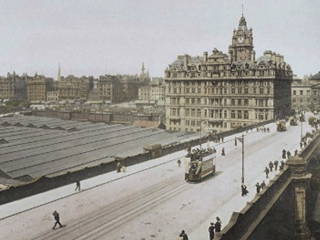 Photo 1: The North Bridge in Edinburgh c. 1905.
.Background
It is one of Edinburgh’s most historically significant structures, a key transport link connecting the Old and New Towns and a vantage point to take in views of the capital’s iconic skyline – but for more than seven years now the North Bridge has been something of an eyesore, surrounded in scaffolding.
The North Bridge was originally constructed by Sir William Arrol between 1894 and 1897 after he completed both the Forth Bridge and Tower Bridge in London.
Since 2018 bridge has been concealed by over 300km of scaffolding tubes and partially closed to traffic and pedestrians after the Victorian structure was found to require significant corrosion-related repairs to ensure its continued use for future generations.
A repair project was initiated as a response to cast iron, spalled concrete and masonry falling onto the railway lines and the
street below.
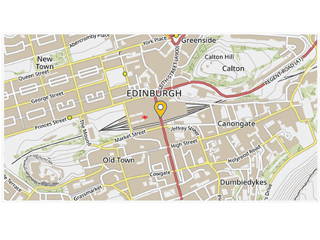 Map: Location of North Bridge by Edinburgh Waverley Railway Station.
Structural Investigations
The bridge has three spans, each approximately 53 metres, with each span comprising six steel main arch girders with a reinforced concrete deck, masonry piers and abutments, and a decorative cast iron façade.
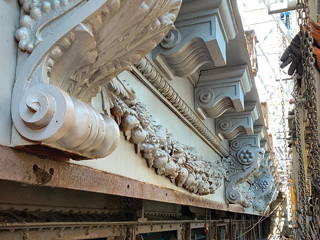 Photo 2: After Removal of Cast Iron Non-Structural Fascia.
Main contractor Balfour Beatty worked with Atkins Realis, who created a dynamic 3D model of the structure to assist all work scopes.
It became clear as the work progressed that more repairs and work were required. The paint on the bridge designed and constructed by Sir William Arrol, who created Forth Bridge and Tower Bridge, has been grit blasted and repainted – a job which has not been done since 1933, except for repainting of the decorative facings in the early 1990s.
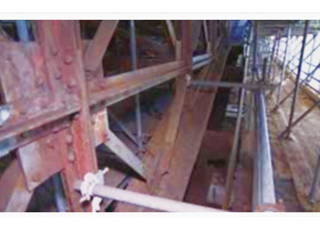 Photo 3: Steel Under-Structure with Areas of Localised Corrosion Requiring Repair.
Investigations identified lots of Bimetallic Corrosion, Corrosion Traps between components, Water ingress and general Inadequate corrosion protection.
The huge complexity of bringing a Victorian structure up to 21st Century standards, without compromising its historic integrity, has proven challenging, technically and logistically.
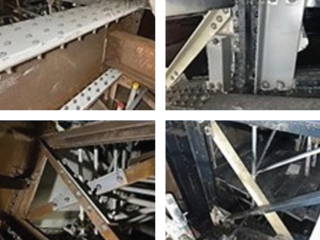 Photo 4: Examples of Steelwork Repairs.
Costs
The work was supposed to take around two years and cost an estimated £22m, but as engineers took a closer look, often at sections not properly inspected in over 100 years, it became clear the job would be even more of a mammoth task than was first envisaged.
It is now expected to be finally completed in 2026 – six years behind schedule – and with an expected cost of £86m, nearly four times the initial estimate, but now magnificently restored!
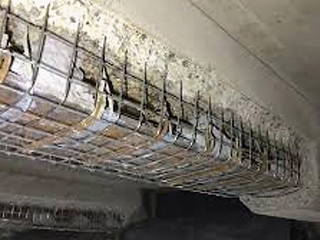 Photo 5: Localised Reinforced Concrete Inspection/Repairs Including CP Installation and Structural Health Monitoring System – Reinforced Concrete Supports.
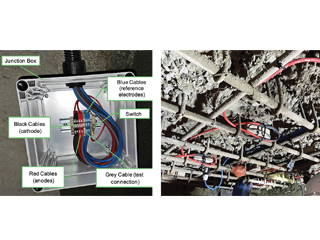 Photo 6: Cathodic Protection Junction Box and Site Connections.
Repairs Completed
There are 6,300 steel sections under the bridge, many of which were corroded, but now behind the extensive scaffolding have been repaired or replaced, approximately 2,000 components in total at a cost of £10m, due to complex logistics.
The wide scope of work has included:
•Contained wet blast/removal of existing coating – bituminous asbestos paint with arsenic, chromium and lead contaminants by licensed contractor. Asbestos was added to enhance durability, heat resistance, and fire resistance. The risks associated with asbestos exposure/removal are well-documented.
•Profile grit blasting and repainting of all structural steelwork, last renovated in 1933, 150 sqm to ST3 standard with 7-stage coating.
•Apply primer/stripe coat/mid coat/line gap/2nd stripe coat/topcoats and decorative colours/anti-graffiti finish.
•Repairing and refurbishing structural steelwork and cast-iron springer bearings.
•Refurbishing historic cast iron bridge façades, including the redesign of façade fixings, allowing for sectional movement and easier future repairs.
• Grit blasting, repair, sealing and repainting of parapets.
•Repairing the bridge’s concrete deck and installing cathodic protection and structural health monitoring systems.
o 6,500 Galvashield XP2 Anodes – subcontractor (Freyssinet)
o 40,778 Continuity Wires and Checks
• Repair and improve pavements and drainage.
• New waterproof membrane on bridge deck.
• New lighting and road surface.
•Remove all redundant utility pipes and ducts and rationalise those services that remain.
•Repair and repoint masonry in areas most susceptible to deterioration.
•Restore and repair the King’s Own Scottish Borderers War Memorial.
•Installing permanent platforms to improve access for future inspection and minor maintenance.
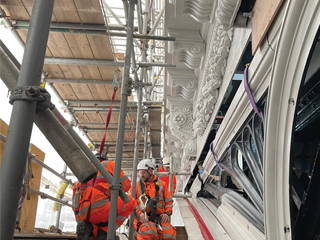 Photo 7: Process of Façade Reassembly.
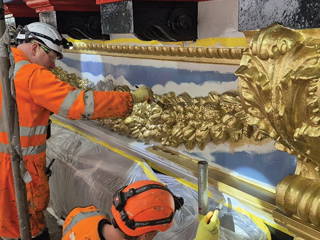 Photo 7: Process of Façade Reassembly.
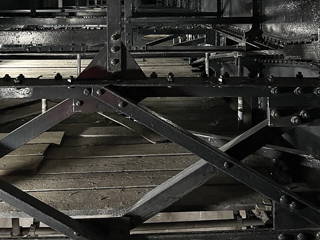 Photo 8: Reinstated North Bridge Façade and Final Touches.
Very complex scaffolding was required. Traditional scaffolding that relies on ground support could not be used and due to the interface with Edinburgh’s key railway station (Waverley) and the low capacity of the roof, scaffolding had to be suspended from the bridge itself. This required multiple stages of design and checks.
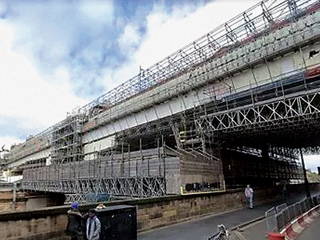 Photo 9: Steel Under-Structure After Repair / Recoating.
Reopening Plans
Major work is expected to be completed by spring 2026 with full completion in summer 2026.
Summary
This was a reactive project due to ongoing safety concerns and dropped objects from the decaying bridge that was mostly inaccessible for regular inspection, despite being directly above a busy main railway station.
A range of corrosion mechanisms was identified and eliminated by different corrosion prevention techniques.
A key part of the renovation was providing permanent access for future inspection by bridge engineers.
The need for removal of original toxic coatings complicated the repair and recoating processes.
Novel solutions, including widespread use of galvanic anodes, were incorporated into the refurbishment of reinforced concrete components.
An advanced Structural Health Monitoring System has been now
been installed.
A critical piece of infrastructure has now been rescued for future generations to enjoy.
Sources
1. https://www.bbc.co.uk/news/uk-scotland
2. https://news.stv.tv/west-central/
3. https://theedinburghreporter.co.uk/
4. https://www.edinburghinquirer.co.uk/
5. https://www.edinburghlive.co.uk/
6. https://x.com/balfourbeatty/status/1918298520047571249
7. (21) Post | https://www.linkedin.com/posts/zaynah-khalil
8. https://www.edinburgh.gov.uk/
9.https://talesofonecity.wordpress.com/2025/02/04/the-north-bridge/
10. https://canmore.org.uk/
11. https://www.capitalcollections.org.uk/
12.Thesis Jan.2024 – A Critical Review of Cathodic Protection as a Repair Strategy for the Edinburgh North Bridge Refurbishment by Zaynah Khalil, MEng Student at University of Glasgow and Graduate Civil Engineer at Balfour Beatty.
13. Cathodic Protection – FreyssinetUK
14.https://www.vector-corrosion.com/technologies/view/3/galvashield-xp/
15.https://www.ice.org.uk/events/recorded-lectures/north-bridge-refurbishment
This complex project will be further presented at the forthcoming Aberdeen Branch 2025 Corrosion Awareness Day: An Introduction to Corrosion and Cathodic Protection at the Palm Court Hotel, Aberdeen on 26th August 2025.
See: https://www.icorr.org/event/2025-corrosion-awareness-day-introduction-to-corrosion/