
The cart is empty!
The President Writes
Happy New Year! I trust you all had a relaxing and enjoyable Christmas break. As incoming President this is my first bash at this column so please excuse me if I ramble on a bit!
For those of you who don’t know me, I’m an electrochemist based at the National Physical Laboratory (NPL) in Teddington, southwest London. Over the years my involvement with the Institute has mainly been through the Corrosion Science Division, although I have picked up a reasonable understanding of the broader range of ICorr activities during my 10+ years on Council.
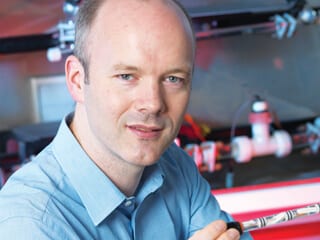
Our esteemed editor, Brian Goldie, was keen to include a photo of me so that you will be able to recognise me – or more likely cross to the other side of the road when you see me coming! The only thing vaguely suitable that I could find was this promotional shot taken recently by the NPL photographer. I feel I must point out that the item I am holding is a reference electrode…and not a pregnancy test as some wags have suggested.
I would like to thank our outgoing President, Sarah Vasey, for the excellent job she has done over the past two years. Sarah has worked tirelessly on behalf of the Institute to oversee a number of important initiatives, most notably the ongoing improvements to our training courses, the appointment of a new Business Development Manager, the increase in our student membership and (with significant input from Trevor Osborne) the successful purchase of our new home at Saxon Court in Northampton. All this on top of one of the busiest day jobs I have ever seen!
It is an honour to assume the role of President and I am very much looking forward to the challenge of building on the achievements of Sarah and previous Presidents. Completing the overhaul of our training course offering will obviously be a major priority. This is by no means a trivial task but is critical to our financial sustainability. Equally important will be the continued drive to recruit younger members, who after all represent the future of the Institute. As Young ICorr Chair, Chris Bridge has done an outstanding job in growing student members (over 100 at the latest count) and I will be working closely with his successor, Simon Bowcock, to maintain this upward momentum.
Right now the Institute is in pretty good shape, thanks mainly to the unstinting efforts of enthusiastic volunteers and committees. However, there is always room for improvement and we as Trustees and Council members are continually looking for new ways to enhance our offering to members. I am keen to meet as many of you as possible during my two year term to hear your views and am looking forward to attending a wide range of local branch activities and events. If you have any ideas for future initiatives I would love to hear them. The key thing is to get involved!