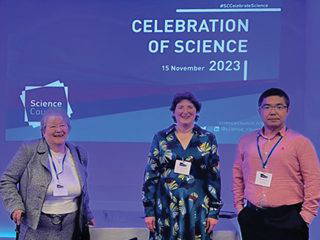
On 15th November 2023 and on behalf of the Institute, Dr Yunnan Gao, Vice President of ICorr and Brenda Peters, (past ICorr President and Council Member) attended the Celebration of Science Event, combined with its annual Prizegiving Celebrations organised by the Science Council and held at Thinktank, Birmingham Science Museum.
With around 80 attendees, we felt privileged to be part of this event to celebrate the achievements of CPD Award winners, recognise volunteer contributions and applaud apprentices and their journey.
A highlight of these celebrations was an opportunity to meet with the newly appointed Chief Executive of the Science Council, Profession Della Freeth, and express ICorr’s continuous dedicated support to collaborate with the Science Council to bring the utmost benefits to both sides—to ICorr existing members and the whole science community.
From the keynote talk given by Dr. Becky Smethurst, who is an astrophysicist, author, science communicator, and Royal Astronomical Society Research Fellow at the University of Oxford, they learned a unique perspective on combining being a science communicator with being an active researcher. Other presenters included Tom Cheek (Apprenticeship Programme Manager), Adam Donnan (Board of Trustees), and Jane Banks (External Relationships Manager).
Following the awards and presentations, they used the opportunity at the networking reception to connect with fellow registrants from across the science disciplines, as well as individuals from the professional body community, industry, academia, and government.
Note: ICorr is licenced by the Science Council to award Chartered Scientist (CSci), and many professionals working in the industry have achieved CSci through ICorr.
• Details of all Award winners may be found at: www.sciencecouncil.org/blog/2023/11/15/celebration-of-science-2023-announcement/
• To find out more about future events held by the Science Council and its professional body Members see their website: www.sciencecouncil.org/news-blog-events/
Chartered Scientist Awards.
CAPTION:
Brenda Peters (ICorr past president and ICorr Science Council representative) with Science Council Chief Executive Professor Della Freeth and Dr Yunnan Gao (ICorr Vice President).
As Chief Corrosion Engineer with European Energy Birit Buhr says, “After intensive work from the truly global working group under ISO TC 156 WG10 jointly with CEN TC219 WG3, we now have a Draft International Standard (DIS) out for comments.”
In this article, and with the help of Brian Wyatt, Director of Corrosion Control Ltd., certificated to Level 5 in accordance with ISO 15257 by ICorr, we discuss why there was a need for a new standard, the process involved, and how you can now have your say on the final international standard that will emerge from all the work done to date.
The Why of ISO/DIS 9351
BS EN ISO 9351 has been developed from BS EN 12496.
“Many people from outside Europe who were involved in ISO 15589-2 (with the snappy title of ‘Oil and gas industries including lower carbon energy — Cathodic protection of pipeline transportation systems — Part 2: Offshore pipelines’) specifically requested that a new international standard be developed to provide greater availability globally,” says Brian. There was also pressure from within the experts preparing BS EN ISO 24656:2022 ‘Cathodic protection of offshore wind structures’ for this development.
The Process of Developing Standards in the Corrosion Industry
Developing standards is never a simple process. It’s not a straightforward renaming or cut-and-paste exercise. ISO says that the process from first proposal to final publication takes an average of three years, and likens it to a symphony, in which many people work together to develop a standard with ISO in the role of conductor.
The first crucial step in developing standards is to create a group of technical experts nominated by National Standards bodies. It is this team that then takes on the responsibility of creating a draft standard that meets the market need and is technically secure.
From EN 12496 to What We Hope Will become EN ISO 9351
Under the guidance of project manager Birit Buhr, a global team of experts has taken the bull by the horns, and shared their expertise to develop the new standard from the good start provided by EN 12496.
“The outcome of this parallel work by ISO and CEN is a significant improvement from what is currently EN 12496 to this final comment stage, DIS, of what will become EN ISO 9351,” says Brian.
There are some significant changes from EN 12496, which can be summarised as follows:
Removal of some ambiguities in the definitions and permitted limits on physical properties
Ensuring convergence of data and properties between this galvanic anode standard and the important ISO DIS 15589-2 (which is also out for vote now)
Updated and increased range of aluminium anode alloys reflecting developments and needs
Greater clarity on the known variations in magnesium anode alloy performance
More extensive requirements and advice in respect of anode performance testing
More extensive references to support the above data
A new chapter, supported by Annex E, on environmental impacts providing guidance and recommendations
“The new standard also provides greater clarity in respect of performance variations within the generic composition limits and that optimum performance, in particular for aluminium alloys, may not be delivered within the entire generic alloy range,” explains Brian.
“For clarity, this is likely to mean that if a purchaser states they wish their supplier to deliver, say, alloy A2 and they expect to get the performance in the standard for any composition within the limits given in the standard, they may be disappointed.
“Optimised alloys, within the range but with tighter limits than the range, are required to deliver the optimum performance. Often these alloys will have been subject to patent protection, following extensive testing by their international developer – and the manufacturers may have kept (and may still keep) the production compositions confidential.”
You Are Important in Developing Standards for the Corrosion Industry
The proposed Standard will set basic requirements and give advice for the chemical makeup, electrochemical characteristics, size accuracy, and methods for testing and inspecting cast galvanic anodes made from aluminium, magnesium, and zinc alloys for use in marine applications.
These anodes are used for cathodic protection in sea water and saline sediments, and the proposed Standard covers most types of galvanic anodes used in these environments, specifically cast anodes of trapezoidal, ‘D’, circular cross-section, and bracelet types. It might also apply to other anode shapes like half-spherical or button, which are occasionally used in sea water.
This Standard will be relevant for offshore renewable energy, flood defences, offshore oil and gas industries, submarine pipelines, ports, harbours, ships, and any other situation where galvanic anodes are used for corrosion protection in sea water and saline sediments.
Developing this Standard has been a joint effort between ISO TC 156 WG 10 and CEN TC 219 WG3, led by ISO as per the Vienna Convention between ISO and EN.
With the scope agreed by both parties, and the Draft International Standard written, all those who use the current applicable Standards in their work – and those with expertise in the manufacture and design/use of galvanic anodes in marine applications – are invited to comment on the proposed Standard through their National Standards body (e.g. BSI, AFNOR, SA, DS, AFNOR, DIN, UNI, JSA, SN, ANSI, etc. – we apologise to all key bodies we have not mentioned here).
You can access the full ISO/DIS 9351 either through your national body, or via the ISO portal here.
The official deadline for comments on this standard is 5th January 2024. However, national deadlines will expire before this – so check with your national body when your comments must be entered to them.
Before You Comment on ISO/DIS 9351, Take Note!
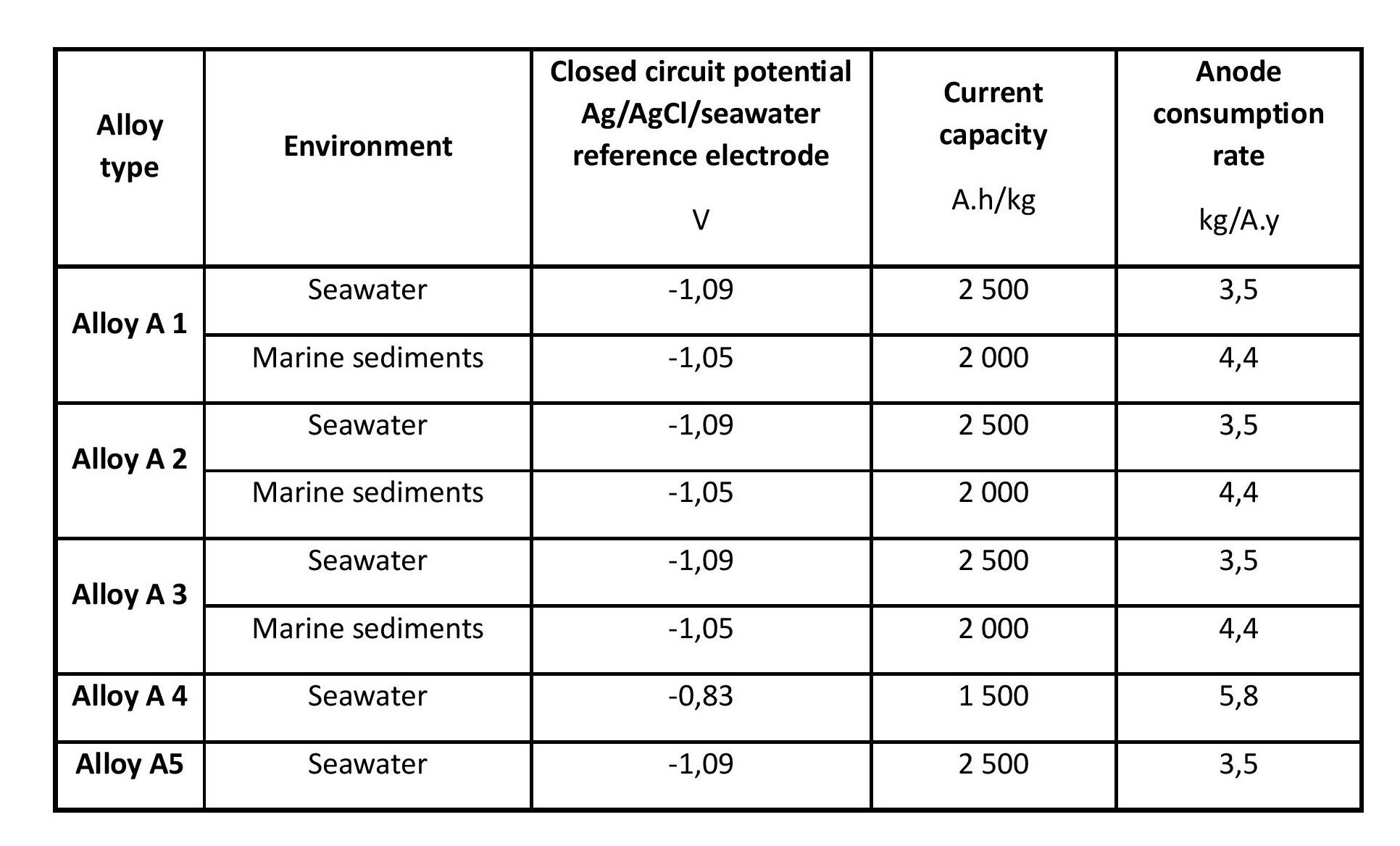
Within the Draft Standard, there is a compilation error in Table C.1.2. This error will be corrected by the Task Group when all comments and votes have been placed and received, for the table to read as follows:
Table C.1.2 — Typical properties of aluminium anodes in normal operation conditions
This is your industry. We urge you to get involved.
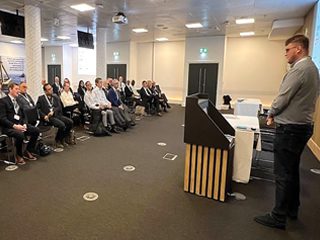
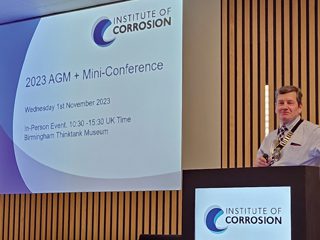
On 1st November 2023 the Institute held its first in-person AGM since 2021, due to the prevailing COVID pandemic. We were hosted by the Birmingham Science Museum (Thinktank). ICorr greatly appreciates all those who travelled to help make the event a success and, of course, offers its thanks to the staff of Thinktank, that provided some magnificent catering on the day.
In support of the AGM, the Midlands Branch organised a very well received, multi-subject corrosion awareness event covering automated CUI monitoring case studies, corrosion control solutions for reinforced concrete and steel, holistic corrosion data management and recent advances in NDT and corrosion training by our key training partners Corrodere and Argyll Ruane. This followed on from a similar successful mini-conference held by the Midlands Branch in February 2023 at the Birmingham Council Chambers.
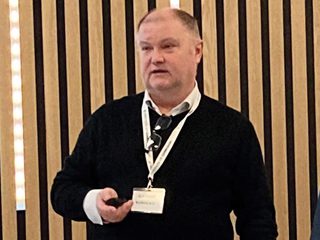
Our keynote speaker was Ryan Finlayson, discussing Holistic Data Management. The founder of Rysco Corrosion Services Inc. and the Rysco Group of Companies, a corrosion-focused set of businesses with international operations, services, and manufacturing. From their humble beginnings, working from his garage in 2007, Ryan and his growing team have continued to pursue technical innovation and value-added solutions for all their worldwide clients. Prior to Rysco Corrosion, Ryan worked for 7 years with Baker Hughes in their production chemistry division, learning about applied field techniques for many applications, including corrosion prevention. These experiences helped him prepare the solid foundations of Rysco by placing an emphasis on the importance of continuing education, knowledge sharing, and employee development.
Rysco are a long-time contributor to international corrosion associations, and champions these to evolve and improve the corrosion industry. With a formal education in engineering and business, Ryan is a promoter of skill acquisition within his companies and a firm believer that supporting educational initiatives build strength. The company recently hosted the Aberdeen Corrosion Awareness Event in August 2023, attended by more than 50 delegates.
Prafull Sharma then spoke to us on Automated CUI Monitoring Case Studies with examples from around the Globe, including UK upstream and downstream applications. Prafull is an inventor and the Chief Technology Officer of Corrosion Radar, with core expertise in Industry 4.0, Industrial IOT, Predictive Analytics and Sensing Technologies. Prafull obtained his PhD from Cranfield University UK. He has over fifteen years’ experience in industrial automation and sensing technology development, particularly for the Energy, Aviation and Chemical industry. He is also credited with over fifteen international patents and innovations. Corrosion Radar’s sensor technologies are now being widely adopted with support funding from Saudi Aramco Energy Ventures (SAEV) and NZTC (formerly OGTC – Oil and Gas Technology Centre) in the UK.
Christian Stone later joined us from Concrete Preservation Technologies (CP Tech).
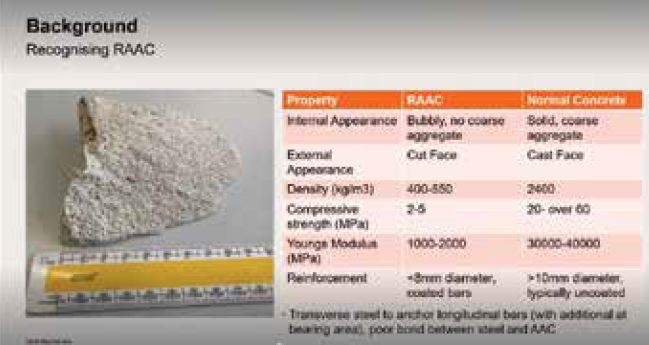
Christian’s time has focused on the research and development of Corrosion Management Systems, working on surveying and corrosion in RAAC as a part of the University of Loughborough RAAC Research Team, and supporting teams all over the world to manage the corrosion risks of their structures. Christian has published on many aspects of corrosion and leads research to support the NHS in their issues with corrosion in RAAC.
His most informative talk focused on concrete repairs using galvanic anodes, consideration of their performance, and acceptance in reference to MCHW 5700 (Specification for Highway Works), and in particular, understanding the science around patch repairs.
In the afternoon, it was the turn of our two key external training partners – Corrodere and Argyll Ruane to update us on their recent activities. Both organisations have long-term relationships with ICorr and provide training to many hundreds of applicants every year, leading to formal certification by ICorr assessors following periods of industrial experience.
Lucy gave a great insight into the world of a training partner and how it interfaces with industry, the community, prospective course attendees, and its relationship with ICorr, particularly with regard to online training provision, which has grown enormously with the COVID pandemic. Lucy has worked with the Corrodere Academy for many years and is involved with its daily operations, development, and global growth.
She was instrumental in the expansion of the Train the Painter’ programme around the world. Dale from Argyll Ruane then closed our AGM technical programme with a very informative talk on recent advances in corrosion and NDT training, describing their excellent classroom teaching facilities at their Sheffield and Fife operations.Argyll Ruane now provides NDT and coatings training, examinations, and NDT consultancy services around the world.
As ICorr Manager, he now supports all ICorr-related training development, providing secure IT systems for their new online training options and their day-to-day training centre operations. Dale is a driven and passionate individual who is keen to ensure training-related projects are delivered on schedule and within agreed budgets. He has been working closely with ICorr since 2020, with his involvement ramping up in 2021 and 2022, leading to him taking on the ICorr Manager role earlier this year from Chris Kirby, (now a Business Coach and Strategic Business Developer at REBLADE of Denmark).
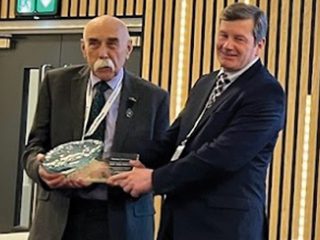
Each year, the Institute of Corrosion bestows a range of internationally renowned awards in recognition of excellence in corrosion science and engineering and to reward outstanding service to the Institute and the wider corrosion community. Our Institute was extremely proud to announce the selection of Trevor Osborne FICorr (Hon), NACE Corrosion Specialist, for this year’s H.G. Cole Award and presented at the AGM. The most prestigious award is made in recognition of exceptional services to the development of the institute.
It is only awarded on an occasional basis, reflecting the highest possible level of commitment of the recipient to the activities of the institute. The inaugural H.G. Cole Award (in the form of a poignard) was presented to Charles Booker in 1997 by Gwen Cole (wife of the late Henry Cole) in recognition of his many years of service as Honorary Secretary of the Institute. The modern form of the award is a plaque whose design captures the essence of the original poignard. Trevor is a Past President of the Institute of Corrosion and long-standing Chair of the Board of its commercial arm, Correx Ltd. He is Managing Director of Deepwater Corrosion Services (UK) Ltd and has worked in the Energy Industry for over 43 years, with very wide experience of corrosion control and project execution.The institute offers its sincere congratulations to Trevor on this magnificent achievement.
Following some excellent presentations and the awards ceremony, the day’s events closed with our formal institute AGM presented by current President Stephen Tate along with George Winning, our new ICorr Treasurer.
This part of the days programme included a detailed update of our account’s status, along with the latest updates to our re-organisation and growth plans, to be presented formally to ICorr Council in February 2024.
Our congratulations were also offered to our Lionel Shreir, Paul McIntyre and U. R. Evans Award winners for 2023, along with our thanks for special contributions made to the Institute by: Bill Hedges, Brian Goldie, David Harvey, Gareth Hinds and Tony Collins – Council Members who have all offered exceptional service and helped make it an outstanding year in terms of taking the Institute forward to the next phase of its development both internationally and within the UK.
Full details of all proceedings, discussions, and votes taken may be found in the ICorr Website Members Area at: www.icorr.org/members-area/
Thanks to all for supporting this unique event in the institute’s calendar. The relaunched Midlands Branch is planning further technical meetings for later in the session. We are pleased to welcome Prafull Sharma to this committee. For other general inquiries about events or supporting the branch, please feel free to get in touch with Bill Whittaker, Midlands Chair, at midlandschair@icorr.org All the AGM + Feb. 23 Mini-Conference technical presentations may be found at: www.icorr.org/midlands/ please scroll down to Local Technical Programme – 2023 Presentations.
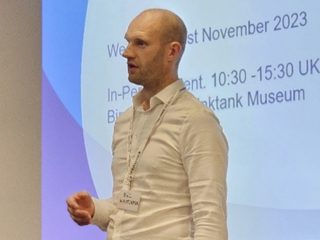
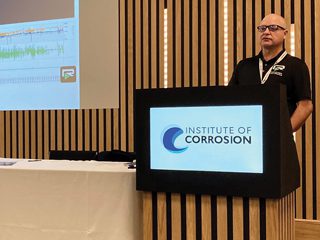
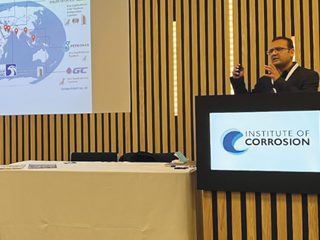
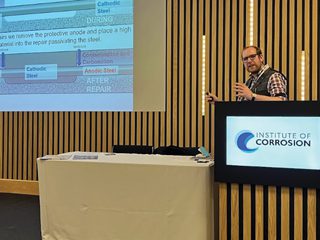
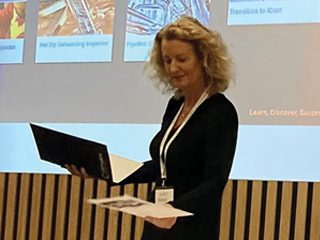
CAPTIONS: Midlands Chair Bill Whittaker and CPSM introducing the Conference and ICorr AGM. Speaker 1 – Ryan Finlayson, CEO & President, Rysco Corrosion Services, Alberta, Canada. Speaker 2 – Prafull Sharma Inventor and the Chief Technology Officer of Corrosion Radar. Speaker 3 – Christian Stone, technical consultant, Concrete Preservation Technologies. Speaker 4 – Lucy Pavia, Commercial Director of Corrodere.
Speaker 6 – Stephen Tate, ICorr President. Speaker 7 – George Winning, new ICorr treasurer. H. G. Cole Award to Trevor Osborne at AGM with President Stephen Tate.
The North West Branch held an online event on 11th October 2023 covering reinforced autoclaved aerated concrete (RAAC) – a material currently very much in the news. The talk was led by Chris Atkins of Mott MacDonald and approximately 50 people logged in and participated with a number of questions.
Chris Atkins is Technical Principal at Mott MacDonald where he has worked for over twenty years. Chris is part of a team dealing with all aspects of materials and corrosion work for clients in a range of sectors. He is a Chartered Engineer, a Fellow of the Institution of Civil Engineers, a Fellow of the Institute of Corrosion and an ISO 15257 Level 4 cathodic protection specialist.
The Branch also held an event at the University of Manchester School of Materials on 29 November focusing on ICorr career development and building a student / Young ICorr chapter.
The event also included the ICorr NW Branch end of year social event. Watch the ICorr NW Branch page for more details
https://www.icorr.org/northwest/ and get in touch with Greg.Brown@mottmac.com if you require further information.
We use cookies to optimize our website and our service.
Functional
Always active
The technical storage or access is strictly necessary for the legitimate purpose of enabling the use of a specific service explicitly requested by the subscriber or user, or for the sole purpose of carrying out the transmission of a communication over an electronic communications network.
Preferences
The technical storage or access is necessary for the legitimate purpose of storing preferences that are not requested by the subscriber or user.
Statistics
The technical storage or access that is used exclusively for statistical purposes.The technical storage or access that is used exclusively for anonymous statistical purposes. Without a subpoena, voluntary compliance on the part of your Internet Service Provider, or additional records from a third party, information stored or retrieved for this purpose alone cannot usually be used to identify you.
Marketing
The technical storage or access is required to create user profiles to send advertising, or to track the user on a website or across several websites for similar marketing purposes.