On 28th July 2025, the President of the Institute of Corrosion (ICorr), Dr. Yunnan Gao, and the President of the European Federation of Corrosion (EFC), Professor Gareth Hinds, visited Northeastern University (NEU) in Shenyang, China, as part of a collaborative engagement tour with leading Chinese academic institutions in the field of corrosion science and engineering.
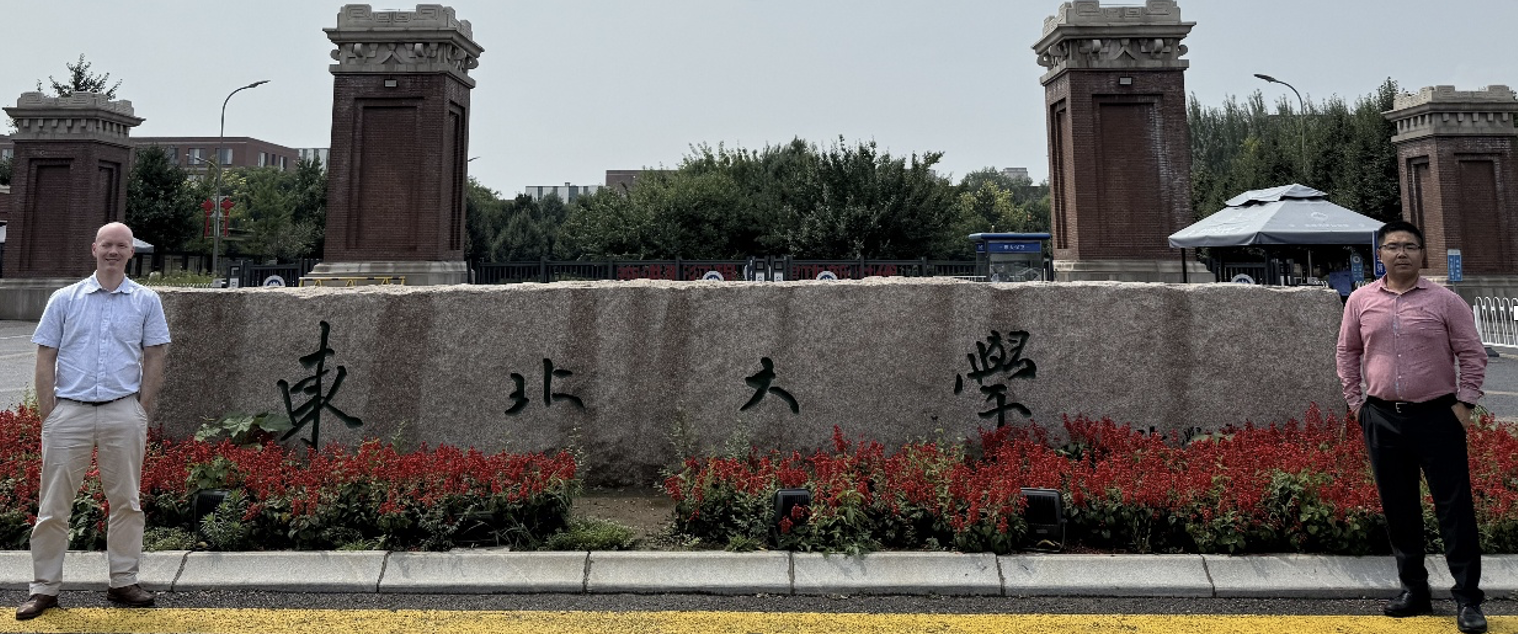
L: EFC President, Professor Gareth Hinds; R: ICorr President Dr Yunnan Gao, during Their Visit to NEU, Shenyang
During the NEU visit, Dr. Gao delivered a presentation introducing ICorr’s mission, global activities, and contributions to advancing corrosion science, followed by a technical lecture on corrosion management in oil and gas production facilities. Professor Hinds then introduced the EFC, outlining its international collaboration framework and key initiatives, and delivered a technical presentation focusing on cutting-edge developments in corrosion rate measurement of pipeline steel in dense phase CO2.
ICorr President Giving An Introduction of ICorr to Faculty and Students at NEU, Shenyang
Following the presentations, the delegation toured NEU’s advanced corrosion laboratories, gaining an in-depth view of the university’s research infrastructure, experimental capabilities, and achievements in materials protection and degradation studies. Both leaders commended NEU’s strong academic foundation, innovative approaches, and its active role in international cooperation.
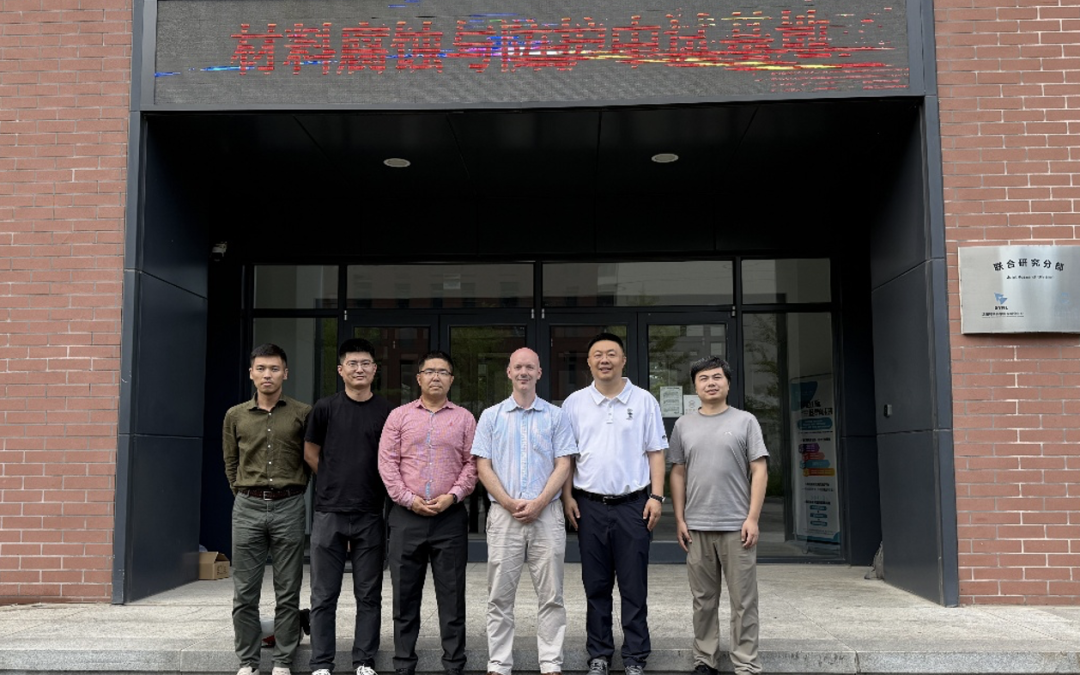
The NEU Visit Was Facilitated by Professor Dake Xu, FICorr, 2nd Right, and Associate Professor Di Wang, 2nd Left of NEU.
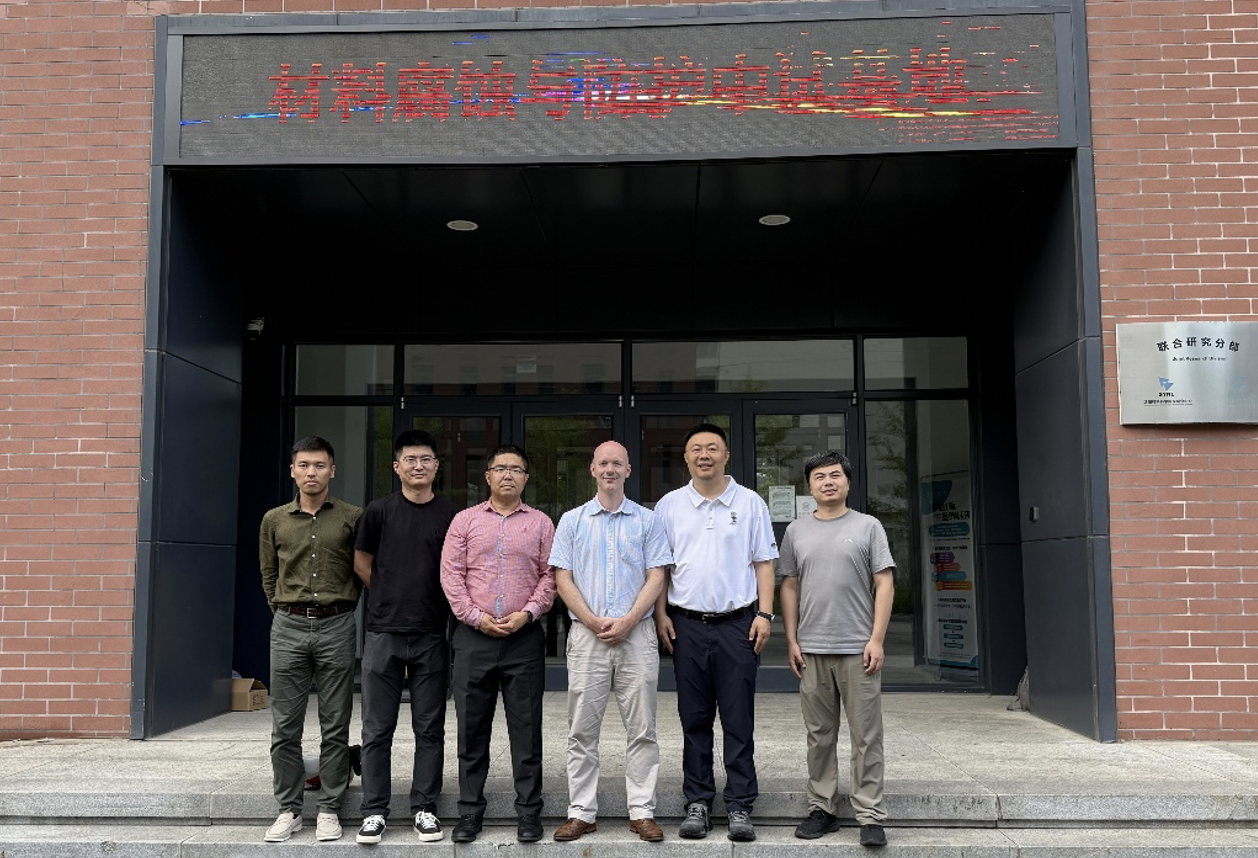
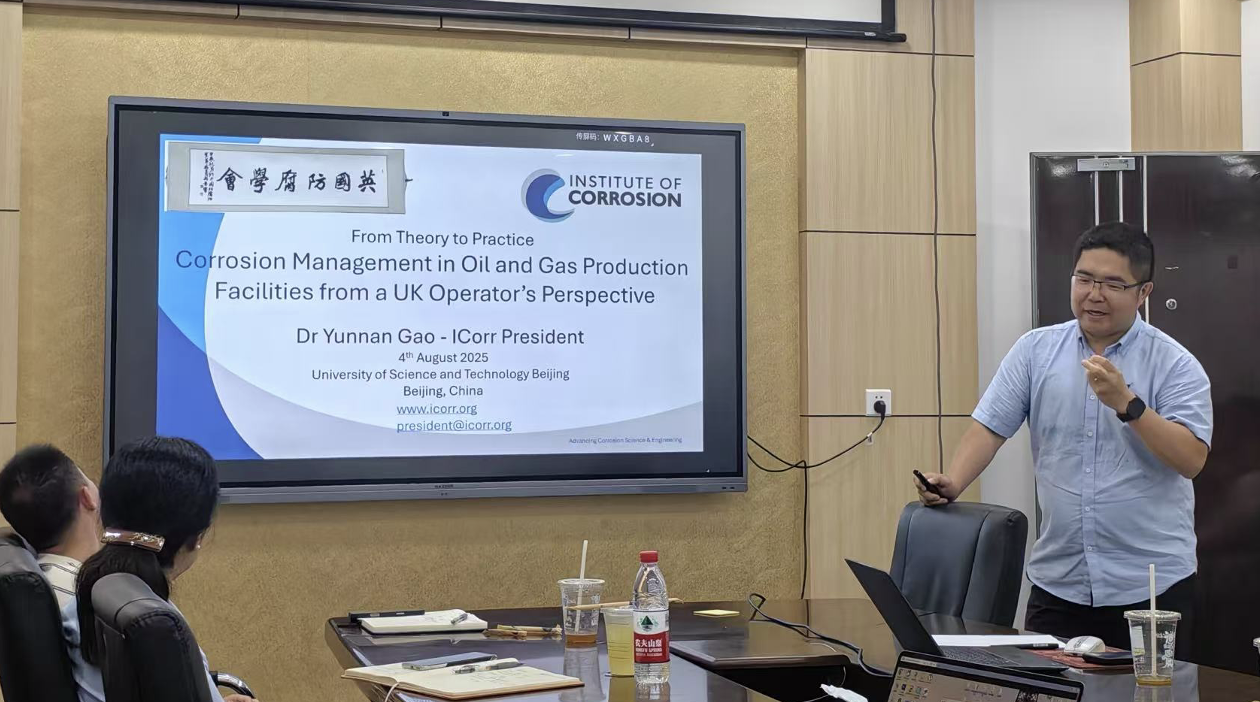
On 4th August 2025, Dr. Gao and Professor Hinds visited the University of Science and Technology Beijing (USTB), a leading institution in global corrosion research with close links to the Chinese Society of Corrosion Protection (CSCP). The visit featured the same core agenda as the NEU visit: introductory and technical presentations from both Presidents, followed by in-depth exchanges with faculty and students.
The USTB Visit Was Facilitated by Professor Xuequn Cheng, (FICorr, General Secretary of CSCP), 2nd Left, and Professor Bowei Zhang, Secretary of CSCP, 2nd Right, of the USTB.
ICorr President Giving A Technical Presentation to the USTB Audience
During the last stage of the visit, the delegation toured USTB’s world-class National Materials Corrosion and Protection Data Centre, which serves as a national digital hub for corrosion data collection, sharing, and application in industrial sectors.
USTB Academics Showcase the Digital Hub at the National Materials Corrosion and Protection Data Centre
The mainstream media in China, such as China Daily, China News, Guangming Online, ScienceNet and Science and Technology Daily, all covered the visit, highlighting it as a milestone in international academic exchange, with both sides expressing strong interest in long-term collaboration, joint research projects, and personnel development in corrosion science and engineering. The coverage also emphasised how the visit underscored China’s growing role in global corrosion research and the value of integrating domestic capabilities with international networks such as ICorr and the EFC.
The visits to NEU and USTB further cemented ties between ICorr, EFC, CSCP and China’s leading corrosion research institutions, opening new avenues for collaboration in addressing global challenges in materials durability, infrastructure resilience, and industrial sustainability.
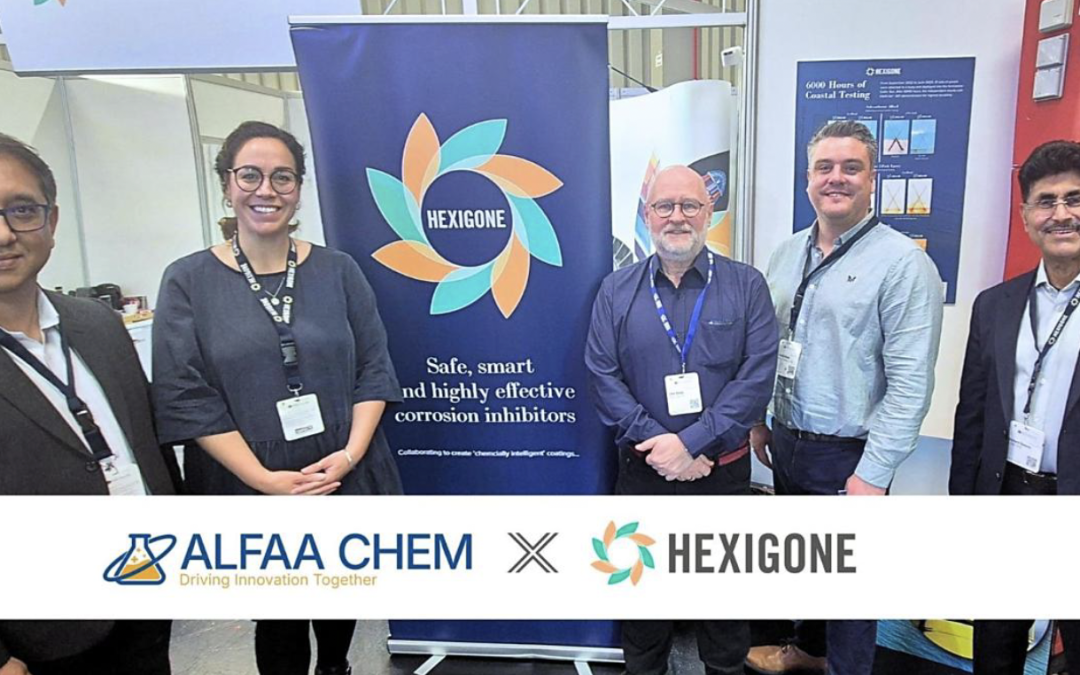
Hexigone Inhibitors Ltd, a UK-based innovator in smart corrosion inhibitors, has entered a strategic partnership with Alfaa Chem, a leading chemical distributor in the Middle East. The collaboration aims to deliver high-performance anticorrosion technologies to the Gulf Cooperation Council (GCC) region, offering coating manufacturers the ability to differentiate their products as well as reduced formulation costs.
This partnership marks a major step forward in the supply of advanced materials to the region’s anti-corrosion coatings sector, particularly targeting applications in construction, oil and gas, and infrastructure maintenance.
can be used at very low loadings alongside traditional inhibitors like zinc phosphate, significantly reducing the total inhibitor content required in a formulation. This co-blending approach maintains high corrosion protection while enabling a reduction in overall film thickness—helping to streamline application processes and, in many cases, eliminate the need for brush blasting during structural steel maintenance.
Founded in 2004, Alfaa Chem is a well-established chemical distribution company with a strong presence across the UAE, Saudi Arabia, and beyond.
“Partnering with Hexigone represents a forward-thinking move for both our companies and for the region’s coatings industry,” said Richard D’Souza, Technology Director at Alfaa Chem. “Their smart inhibitor technology addresses multiple industry challenges—ranging from performance under severe environments like C5+ conditions to improving adhesion on galvanized and thermally sprayed steel. Together, we aim to support formulators in transitioning away from zinc-rich and chromate-based systems toward more sustainable and cost-effective solutions.”
This partnership positions both companies to meet rising performance expectations while promoting safer, more environmentally conscious technologies—all while helping manufacturers achieve meaningful reductions in formulation costs.
About Alfaa Chem Headquartered in Sharjah, UAE, Alfaa Chem is an independent chemical distribution company serving the Middle East, USA, and Africa. With warehousing in Sharjah, Dubai, and Saudi Arabia, the company supplies specialty chemicals across various sectors and prides itself on its commitment to quality, innovation, and exceptional customer service.
About Hexigone Inhibitors Ltd Based in Port Talbot, UK, Hexigone is at the forefront of corrosion inhibitor technology. Their flagship products offer enhanced corrosion protection and sustainability for protective coatings, providing a compelling alternative to traditional materials.
ICorr Microbiologically Influenced Corrosion remains a Global issue.
Join our MIC Training Courses, running from 11 to 15 May 2026. Secure your spot today and gain expert insights into the industry most misdiagnosed threat.
Microbiologically Influenced Corrosion (MIC) is a complex phenomenon that silently undermines industrial and infrastructure assets across the globe. Despite its widespread impact, MIC remains one of the least understood and most frequently misdiagnosed form of corrosion.
In 2023, a relatively minor leak at the Wytch Farm oil field, United Kingdom, triggered the temporary closure of Poole Harbour, Europe’s largest natural harbour and a designated Site of Special Scientific Interest. This incident served as a stark reminder of MIC potential to cause significant environmental and economic disruption, and the urgent need for more robust understanding and control strategies.
The Institute of Corrosion (ICorr) proudly offers the only MIC training course of its kind delivered by a major professional body. This comprehensive programme is designed to meet industry demand, equip professionals with cutting-edge knowledge, and empower them to protect assets and advance their careers.
Industry-Relevant Scope
While MIC is most extensively studied in the oil and gas sector, this course also addresses its impact across:
Water treatment and filtration systems
Nuclear energy facilities
Marine structures and vessels (ships, yachts, narrowboats)
Paper and pulp industries
Infrastructure, including Accelerated Low Water Corrosion (ALWC)
Traditional and advanced monitoring and mitigation technologies
Molecular microbiology for precise microbial characterisation
Future trends in MIC modelling and predictive analytics
Expert-Led Instruction
Based on over 35 years of research and field experience
Delivered by leading experts in industrial and oilfield microbiology
Enriched with global case studies and best practices
Practical Meets Theoretical
In-depth exploration of microbial colonisation in water-prone systems
Covers both metallic and non-metallic degradation mechanisms
Actionable strategies for detection, control, and prevention
Flexible Learning Formats for Every Level
Certified MIC Technologist
A five-day intensive course focuses on developing and managing MIC control programmes, monitoring strategies, data interpretation, and risk identification. Includes a half-day certification exam. ICorr Certified MIC Technologist certificate awarded upon passing the exam.
MIC Technologist
A four-day version of the above course, without the certification exam. Certificate of attendance provided.
Awareness Level
A one-day overview designed for managers and stakeholders. Focuses on understanding MIC risks and mechanisms to support informed decision-making and cost avoidance. Certificate of attendance provided.
Who Should Attend?
This course is of significant benefits for:
Managers, consultants, and project leaders
Industrial biologists and corrosion technologists
Engineers, scientists, and students
Contractors, field management, and technical staff.
Course Fees
Course Format
Fee (excl. VAT)
One-Day Awareness Course
£800 + VAT
Four-Day MIC Technologist
£1,950 + VAT
Certification Exam (Optional)
£500 + VAT
Note: VAT is reclaimable by VAT-registered companies. Fees apply to UK-based courses.
Delivery Options
Courses are currently delivered in a classroom format and can be hosted:
At ICorr Headquarters at Northampton in the UK, or
On-site at your organisation, anywhere in the world.
Delivered by a Global Expert
The course is led by Dr. Tony Rizk, a world-renowned authority in MIC with decades of hands-on experience in industrial microbiology and corrosion control.
How do we Detect and Mitigate AC Interference in Pipelines Using Software Modelling? J N Agrawal, B Tech, MBA, ICorr CP4, FICorr, CEO of Corrsol Tech, India
Meet the Author
Jaiprakash Narain Agrawal is an expert in corrosion management and cathodic protection. He has a wide experience in pipeline integrity management and cathodic protection for 40 years. Jaiprakash has worked in projects, construction, operation and maintenance of oil and gas pipelines. Jaiprakash has presented papers in corrosion related subjects at AMPP and ASME conferences in India. He has also authored books on cathodic protection and pipeline integrity management. Jaiprakash also initiated a process for corrosion audits for gas pipelines. He has contributed to the preparation and implementation of procedures for various CP monitoring techniques. Jaiprakash received the AMPP India corrosion awareness award in 2023 for his contribution in corrosion science and technology in industry.
For the last 7 years he has been a certified ICorr Level 4 CP specialist. He is an independent consultant and CEO of Corrsol Tech and engaged in providing solutions in corrosion control, pipeline integrity management and cathodic protection. Jaiprakash has carried out pipeline integrity assessments including fitness for purpose (FFP) and remaining life assessment (RLA) of onshore and offshore pipelines. He has also been involved in conducting training and coaching in pipeline integrity management (PIM) and cathodic protection (CP).
He has published more than 30 technical papers in peer-reviewed events and journals and has provided industry training on integrity management and CO2 and H2.
Background
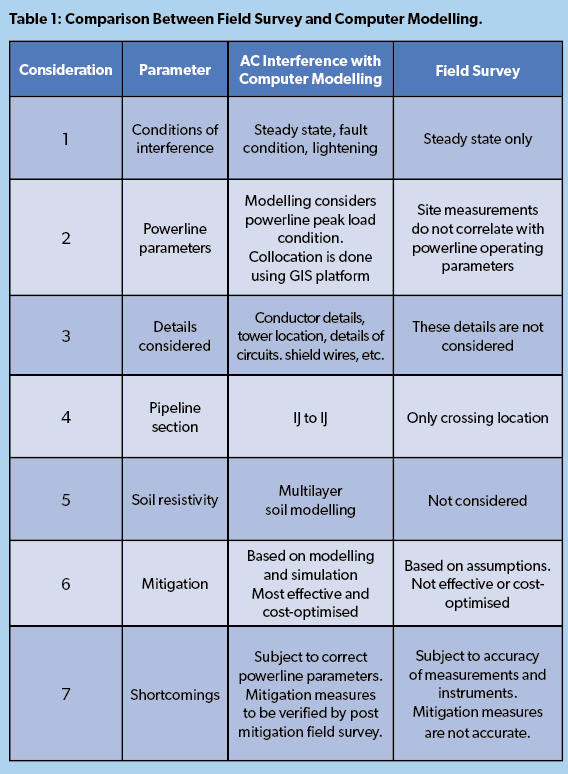
Electrical interference by alternating currents (AC) is a major consideration for oil and gas pipelines. Computer modelling can be used to assist with its mitigation. AC interference corrosion in pipelines typically occurs when alternating current (AC) from nearby power lines induces a voltage on the pipeline, leading to corrosion, especially at small coating defects. This phenomenon is a serious concern due to the potential for rapid and localised damage, even in pipelines with cathodic protection.
What is Software Modeling?
Computer modelling is based on the simulation of all field data and the assessment of AC interference based on computer modelling with the following outcomes:
• The results are usually more accurate than field surveys alone, as data simulation is assisted by computer modelling.
• Various mitigation strategies can be implemented based on computer modelling outcomes for the most effective and cost-‘optimised’ manner.
• The most important features required for effective mitigation are:
Configuration of grounding Location of grounding Selection of materials of grounding
Effectiveness can be checked after implementation of mitigation measures.
Background
Electrical interference by alternating currents (AC) is a major consideration for oil and gas pipelines. Computer modelling can be used to assist with its mitigation. AC interference corrosion in pipelines typically occurs when alternating current (AC) from nearby power lines induces a voltage on the pipeline, leading to corrosion, especially at small coating defects. This phenomenon is a serious concern due to the potential for rapid and localised damage, even in pipelines with cathodic protection.
What is Software Modeling?
Computer modelling is based on the simulation of all field data and the assessment of AC interference based on computer modelling with the following outcomes:
The results are usually more accurate than field surveys alone, as data simulation is assisted by computer modelling.
Various mitigation strategies can be implemented based on computer modelling outcomes for the most effective and cost-‘optimised’ manner.
The most important features required for effective mitigation are: Configuration of grounding Location of grounding Selection of materials of grounding
Effectiveness can be checked after implementation of mitigation measures.
Impact of Contradiction Between Field Survey and Simulation Result
•Designed mitigation measures may be ‘more or less’ compared to actual or required.In case of more than required, cost will be more.
• In case of less than actual required, effectiveness will be less.
•Pipeline will be affected in case of ineffective mitigation measures. however, simulation results can be verified by the field survey results.
•Even then, errors may happen in case of inaccurate data or interpretation of the simulation results.
Possible Reasons for Contradiction in Software Simulation Results and Field Data
• Global earthing systems.
• Local earthing systems.
•Parallel underground pipelines in the vicinity of the powerline or electric traction.
• Inadequate pipeline coating parameters.
• Influence of soil resistivity in the field and simulation software.
• Actual or real-time load current instead of maximum load current of powerline.
Computation of Induced AC Potential and AC Current Density Based on Real Time Load Current or Peak Load:
• Field survey is performed for AC induced voltage and AC current density based on real time load current while simulation is done based on peak load current.
• Hence, AC induced voltage and AC current density will vary. Simulation results are on the higher side than field surveys.
• The mitigation measures based on simulation results consider optimum conditions.
• Powerlines generally run on load, which is less than the peak load but may reach peak’ load at peak hours.
• Powerlines are designed to withstand higher load capacity.
• Actual load current data consideration will give almost similar results as simulation software provides.
Possible Solutions to Achieve More Accurate Results
• Accurate multi-layer soil resistivity data is required for software simulation.
• Reliable and accurate software with high calculation accuracy is preferred.
• Software should allow multiple input parameters and provide precise simulation results.
• The accurate and calibrated instruments should be used with recommended technique by a certified and experienced CP technician.
• Real time load data should be used instead of peak load.
•n Simulations must consider other factors such as global earthing system (GES), local earthing system (LES), pipeline coating characteristics and parallel pipelines.
• Simulation results should invariably match with field survey.
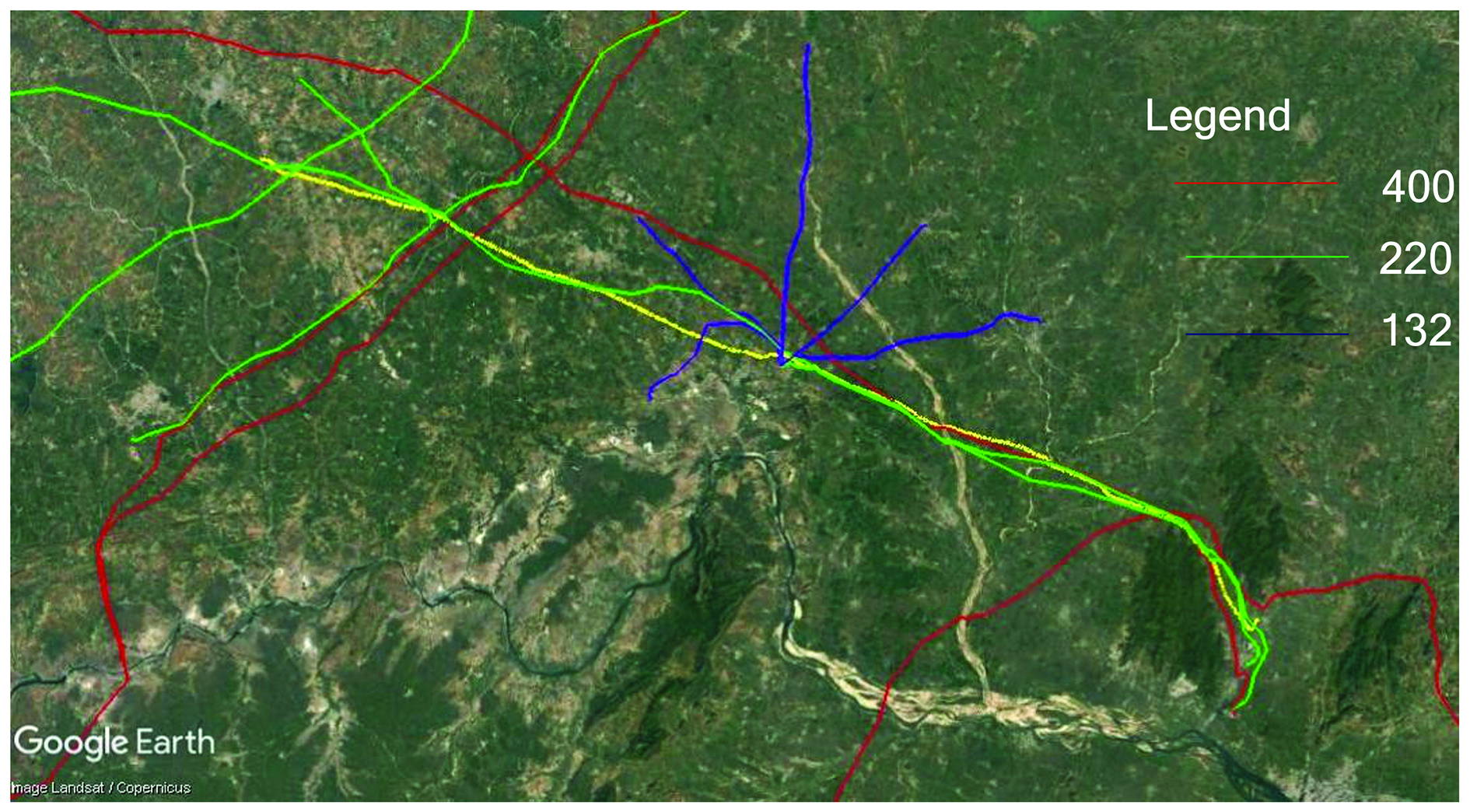
Case Study of AC Interference and Mitigation with Computer Modelling Using the Following Input Considerations
• Grounding material: Copper conductor/Zn anodes 10 Kg
• Number of transmission lines running parallel/crossing pipelines: 14
• KV rating of transmission lines: 132, 220, 400
• Normal load/peak load in A: 15 to 260/25 to 589
• Simulation done from peak load.
Figure 1: Interpolation of Transmission Line and Pipeline.
Interpretation of Results with Existing Pipeline Ground Points
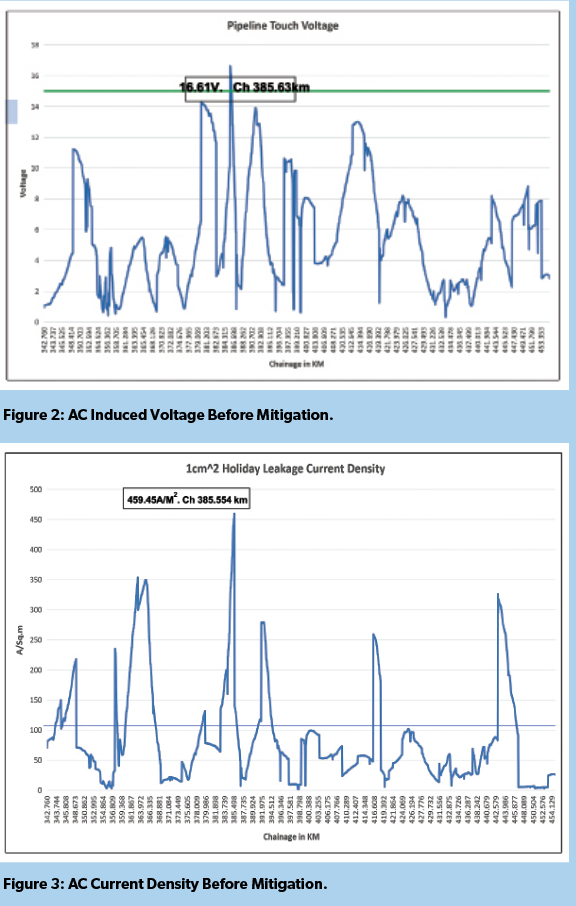
Key Observations
•Induced AC voltage in the pipeline is proportional to the load current in the transmission line as load current varies at different lines.
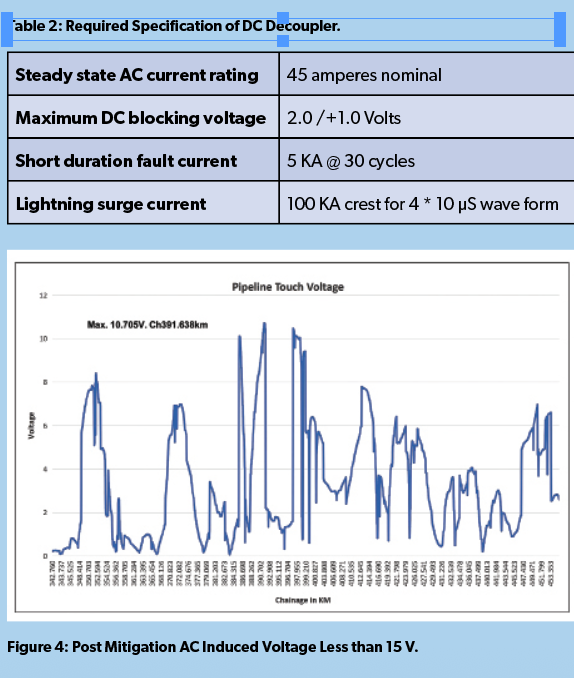
•The touch voltage on pipeline exceeds the prescribed safe limit of 15V with a maximum of 16.618 V at chainage 385.63 KM.
•High values of current density between Chainage 382.8 and 386.43 km where induced AC voltages are higher and soil resistivity is low.
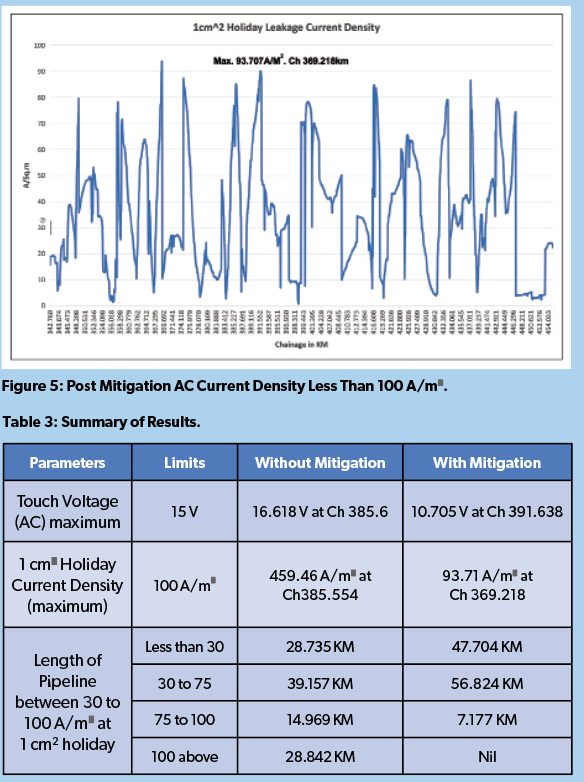
•The current density exceeds the prescribed value of 100 A/m2 for about 28.84 KM as shown in the figure.
•Induced AC voltage and AC current density can be interpolated to draw the conclusion that wherever AC current density is higher, AC induced voltage is also higher but higher induced AC potential may not cause higher AC current density if soil resistivity is higher.
•An interpolated graph of pipeline route with chainages and transmission line along with a graph showing chainages, soil resistivity, induced AC voltage and AC current density will establish relationship with multiple parameters.
Material Specification for Grounding Depending Upon AC Current Density and Length of Parallelism
A copper conductor wire of following specifications is required
• AWG No 6.
• Overall Diameter: 38 mm.
• Length: 25.4 m, 76.2 m and 152.4 m in horizontal configuration.
•To be placed at 1m from pipeline wall and at the same depth as of pipeline.
•Copper conductor shall be connected to pipeline through DC Decoupler.
Case Study Conclusion
The major observation is this case study was that existing grounding/earthing arrangements were not adequate to ground induced AC potential and limit AC current density because of wrong location or wrong grounding material. Further work would be required for this and other similar situations.
References
1.NACE SP 0177–2014: Mitigation of Alternating Current and Lightning Effects on Metallic Structures and Corrosion Control Systems.
2.NACE SP 21424:2018: Alternating Current Corrosion on Cathodically Protected Pipelines: Risk Assessment, Mitigation, and Monitoring.
3.EN 50443:2012 Effects of Electromagnetic Interference on Pipelines Caused by High Voltage.
4.BS EN 15280 – 2013 – Evaluation of AC. corrosion likelihood of buried pipelines applicable to cathodically protected pipelines.
5.Criteria for Pipelines Co-Existing with Electric Power Lines, prepared for The INGAA Foundation by DNV GL.
6.CEPA – A/C Interference Guideline Final Report – June 2014 and INGAA or CEPA for mitigation measures.
7.ISO 15589 Part I – Cathodic protection of pipeline/structure transportation systems – Part I-On land pipeline/structure, issued by the International Organisation for Standardization (ISO).
The Institute of Corrosion welcomes applications from ICorr members, for this important arising vacancy due to retirement of Jane Lomas, FICorr the existing post holder.
Job Title: Training Scheme Manager (Surface Treatments and Passive Fire Protection)
Location: Remote Working with occasional Northampton ICorr HQ Visits
Company Name: Institute of Corrosion
Job Type: Part-Time Consultancy (2 Days a week – part remunerated/part voluntary).
Remuneration:15K/Annum (Reviewed Annually)
Applications: Initially via email to admin@icorr.org attaching CV and Training Experience Record
Closing Date: 31st October 2025
Commencement Date: 1st January 2026 (with prior Handover)
Job Description:
General
To act on behalf of the Institute of Corrosion (ICorr) in all matters relating to Surface Treatment Training and Competence Assessment (the Surface Treatment Scheme).
To report to President and take instructions from the Surface Treatment Governing Board (STGB) in all activities.
To keep the President and chair of STGB advised of all significant activities and to extend this advice to the President of ICorr in respect of any issues that may have significant strategic importance or expose ICorr to risk.
To issue monthly STSM reports with dashboards to President
To liaise with the Professional Assessment Committee (PAC) in respect of Certification of personnel (Certification being the ultimate responsibility of PAC) and in respect of any complaints received.
To liaise with course providers in respect of their marketing, booking and organising of all Surface Treatment (ST) and Passive Fire Protection (PFP) courses, in accordance with the Qualification Procedure Document (QPD), using approved ICorr Tutors and ICorr Course Packages, monitoring updates where required.
To actively help promote ST and PFP courses and maintain ICorr Website information.
To attend monthly STGB meetings and contribute to STGB updates of the QPD.
To work towards progression of Iso Certification for ST courses.
To recruit, train and mentor a deputy in all aspects of the role, with a view to succession planning.
Key Requirements
Ability to manage time effectively and prioritise tasks.
Experience at senior level in the surface treatment industry
Hold membership of ICorr, preferably FICorr.
Knowledge of Institute of Corrosion training activities (or other established Corrosion Training provider)
Level 3 certification
Significant experience in training and certification management
Strong relationships with key industry stakeholders
We use cookies to optimize our website and our service.
Functional
Always active
The technical storage or access is strictly necessary for the legitimate purpose of enabling the use of a specific service explicitly requested by the subscriber or user, or for the sole purpose of carrying out the transmission of a communication over an electronic communications network.
Preferences
The technical storage or access is necessary for the legitimate purpose of storing preferences that are not requested by the subscriber or user.
Statistics
The technical storage or access that is used exclusively for statistical purposes.The technical storage or access that is used exclusively for anonymous statistical purposes. Without a subpoena, voluntary compliance on the part of your Internet Service Provider, or additional records from a third party, information stored or retrieved for this purpose alone cannot usually be used to identify you.
Marketing
The technical storage or access is required to create user profiles to send advertising, or to track the user on a website or across several websites for similar marketing purposes.