





Charting Your Career with the Cathodic Protection Certification Scheme

Charting Your Career with the Cathodic Protection Certification Scheme

Certification to Support and Enhance Your CP Career

A career in cathodic protection can be developed with an employer or as a self-employed contractor. The work is interesting, often challenging, and well paid. As industry around the world seeks to combat the environmental, safety, and financial impact of corrosion, a career in this specialisation is supported by high demand for skilled operatives at all levels.

Specialising in cathodic protection offers a career path that could take you around the world, working for diverse companies in locations that stretch from pole to pole. As you climb the career ladder – possibly to establish your own company or, perhaps, as a senior lecturer in university – your career growth must be supported by additional qualifications and certification.

In fact, the structure of ICorr’s Certification Scheme for Cathodic Protection Personnel is designed to be an enabler of career progression in this specialisation. Effectively, your career advancement can be charted by each level of certification.

Starting out – Cathodic Protection Data Collector/Tester (Level 1)

As a starter in the industry, you don’t yet have any experience in cathodic protection.

The role of data collector or cathodic protection tester is likely to be combined with other duties. For example, as an electrical .

To be classed as competent for cathodic protection data collection and testing, you will need to be certified as a Level 1 Tester/Data Collector. This is the course intended for very new entrants to the CP industry. It’s also appropriate for staff who, on a part-time basis, collect and test as part of a wider job description.

Next step – Cathodic Protection Technician (Level 2)

As you gain experience, your role will expand. To take the next step, you will need to be certified as a Level 2 Technician. You will be responsible for testing and evaluation of cathodic protection systems and data. Your technical knowledge will include different CP systems, anode types, corrosion theory, reference electrodes, corrosion prevention, and an understanding of how CP works at a scientific level.

You might undertake work with specific instruction from senior staff with higher certification levels. You may also help prepare reports and make corrections to systems as approved by supervising staff.

This is a big step up from the duties of a data collector/tester, though you don’t need any specific experience in cathodic protection to take the course that certifies your competency to perform this role. However, before being certified as a Level 2 Technician [i.e. after the course and successful examination] you will require to have a minimum of one year of approved experience.

Supervisory roles – Senior Cathodic Protection Technician (Level 3)

At this stage of your career, you will now be expected to supervise lower-level staff in their cathodic protection work. Your knowledge bank will be substantial, and your duties may include:

  • Instructing work crews on the installation of cathodic protection systems, and maintenance.
  • Inspecting technician surveys and written documentation
  • Inspecting contractor procedures for corrosion compliance
  • Identifying problems and determining corrective action
  • Testing existing CP systems
  • Overseeing and instructing corrosion team members and CP technicians in corrosion-related requirements

You may also be required to provide feedback and training to other employees, and help to maintain safety standards. You could be responsible for reviewing, maintaining, and updating records, ensuring data integrity and adherence to controls, practices, and policies.

There are several ways in which you may be qualified to take the Level 3 Senior Technician Course and examination:

  • You should have at least six years’ experience (less, if suitably academically qualified)
  • You must hold Level 2 Cathodic Protection Technician Certification for the applicable sector in which you will be working

Or:

  • You should have at least one year’s experience and have attended the Level 2 training course to satisfy the educational and experience requirements to qualify for the Level 3 training course and examination.

Experienced senior roles – Cathodic Protection Specialist (Level 4)

Your career has led you to senior and management roles. At this level, you will be designing CP systems and providing technical expertise and guidance to others – such as those working in operations and engineering – to enable efficient and effective implementation, monitoring, and troubleshooting of cathodic protection assets.

Your experience is likely to include subjects and tasks such as:

  • Corrosion control regulations
  • Assessment and repair of pipeline defects
  • Technical support, training, and evaluation of corrosion technicians
  • Working knowledge of corrosion control databases and field data collection devices
  • Ability to consistently analyse and resolve corrosion control issues involving multiple components, personnel, and operations

Currently there is no course for this level of certification. You will, however, need to demonstrate your experience and expertise when applying for certification as a Level 4 Cathodic Protection Specialist as follows:

  • If progressing from Level 3, you will need three to eight years’ experience
  • If applying directly, you will need five to 12 years’ experience
  • Examination is required
  • You will need to supply evidence of work (including detailed complex design)
  • Validation by two referees is also required

The pinnacle of your career – Level 5 Cathodic Protection Expert

To achieve this level of certification, you must already be certified at level 4 in the same sector. You will have advanced the state of CP by scientific work, and have a broad understanding (at least) of all other sectors of CP.

It is likely that you will have published peer-reviewed papers, and have an established reputation in at least one sector within the industry.

This is not presently recognised/offered in the UK and many believe it to be an honorary title.  However, BS EN ISO 15257 states that there are activities that a Level 5 is competent to undertake that a Level 4 is not.

ICorr – Leading the way in CP career development through certification

A career in cathodic protection has much to offer. You’ll work on diverse projects, with the opportunity to work in all four corners of the globe. With a high demand for your skills and experience, you should never be short of rewarding opportunities to advance your career.

To maximise the benefits of a career in CP, you should gain certification as you progress. We have developed CP certification to an internationally recognised standard (ISO 1527:2017). Your certification validates that you have the minimum skills, knowledge, and experience to be certified as competent across all the disciplines within the CP field, including survey, design, installation, testing, maintenance, and the science of cathodic protection, at each successive rung of the career ladder.

At each level as detailed above, you must apply to the Institute of Corrosion for certification. Successfully completing the course and passing the exam is not enough on its own.

In our next article discussing cathodic protection courses, examination, and certification, we examine how the CP courses are delivered.

In the meantime, to learn more about our ground-breaking CP Certification Scheme and our comprehensive Cathodic Protection Certification Courses – and discuss which is right for you – email the Institute of Corrosion at admin@icorr.org.


How Do You Help a Friend with Mental Health Problems?

How Do You Help a Friend with Mental Health Problems?

Spotting the Risks, Seeing the Symptoms, and Offering Support

Talking about your own mental health is often difficult, even today when mental wellbeing is so high on the agenda. How do you approach someone and say, “I’m feeling really low; please help me”?

That’s a tough thing to do, so most people don’t. They put on a brave face, while inside they are all twisted and torn. It’s like being a duck. Cool and calm on the surface, while underneath the waterline their feet are paddling at a hundred miles an hour. Only in the wrong direction.

Yet we know that around one in four people will experience mental health problems every year in the UK, and one in six suffer a common mental health problem in any given week (Mind 2017).

We need to change our way of thinking. If we could only  recognise the signs of mental health issues, that would be a start. Maybe then we could consider how to help someone with their mental wellbeing.

Who is at risk of mental health problems?

When life is ticking along nicely, there is little fear of hitting a wall of depression. It’s when life takes unexpected turns that our minds start to play the cruellest tricks on us. A sudden illness. Loss of a job. The death of a loved one.

Pre-existing psychiatric disorders, like depression, clearly increase the risk of mental health issues. Here are a few other situations you should watch for in others:

·       Illness or health vulnerability

Especially pertinent over the last year and more, vulnerability to ill heath, or ill health itself, is difficult to cope with. Those with pre-existing conditions may feel the pressure more than others. People who have a sudden heart attack, or learn they have a condition that will not improve are also at risk.

·       Changes at work

When changes are made at work, they affect people. Such changes may include a change of boss, change of responsibilities, or change of working environment. It could be that a decades-old process is changed, or that the person is promoted or demoted, or asked to change teams.

At work, you should also pay attention to those who have high workloads and long hours.

·       Loss or impending loss of a loved one

The news of a friend or family member’s terminal illness or death can damage a person’s normal way of thinking. This is especially true if the relationship was close. Difficult emotions can stay with us for years, with remorse triggered by the simplest things – a smell, a song, or even a word or phrase.

·       Life changes

Major life changes can trigger mental health issues. Divorce. The repossession of a home. The loss of a custody battle. The loss of a job. A new baby. A child leaving for university. If you know of a person going through such change, then watch for the signs that it is affecting them adversely.

Recognising that life is taking its toll

Mental health is unlike most physical health conditions. There may be a list of common symptoms, but they are not common to everyone. This can make it difficult to be sure that a friend or colleague has mental health issues, but if he or she is experiencing any of the following you should stay alert to the possibility:

  • Sadness or tearful
  • Pessimistic about the future
  • Detachment from friends or colleagues
  • Loss of interest in hobbies
  • Overly irritable, or acting out of character
  • Less talkative than usual
  • Easily upset
  • Lacking energy
  • Taking unnecessary risks
  • Lacking focus
  • Disinterested in their own appearance and/or personal hygiene
  • Trouble with sleeping
  • Weight gain or loss
  • Forgetfulness
  • Eating more or less than usual
  • Increased consumption of alcohol
  • Talking about feeling of emptiness, worthlessness, death, or suicide

The more of these symptoms you notice, the more likely it is that your friend or colleague is suffering from a mental health issue such as anxiety or depression.

How do you help a friend through their mental health issues?

If your friend is experiencing several of these symptoms, it’s time to talk. But how should you approach them? Here are a few tips.

·       Open a conversation

Show your friend that you’re concerned for them by asking a question that shows you’ve noticed something isn’t quite right. For example:

  • “Hey, you’ve been quiet lately. Is everything okay?”
  • “You seem a little down recently, and you’ve said you’re constantly tired. Is there something on your mind?”

Your friend may find it difficult to talk to you. Don’t force the conversation. Let them know you care, and that you are ready to listen if they need to talk.

·       Listen

When your friend starts talking, don’t interrupt. Show empathy and understanding with your body language and your words. Ask questions to avoid misunderstanding. Make sure they know you care.

·       Avoid giving advice

Ask how you can help, but don’t give advice. You shouldn’t tell your friend to try harder, or pull their socks up, or ‘man up’. Such advice trivialises the condition, and betrays a lack of empathy and understanding.

Don’t seek to justify your friend’s mental health – it’s extremely personal. And don’t try to make your friend feel better by explaining how bad you’ve had it, or what a grim time someone else has had.

Finally, don’t tell your friend that this is something he or she will get over. It’s hard for a person who is suffering mental health issues to see a future when the present is overwhelming, or the past is proving difficult to move on from.

·       Maintain confidentiality

Your friend will be sensitive about their mental health. That’s why he or she hasn’t spoken about it before. Now trust has been placed in you. Don’t destroy that trust. Maintain confidentiality.

·       Help them find the professional support they need

You are there for your friend. Your support is crucial. But to improve mental health, professional counselling is often required. Encourage your friend to seek therapy. Offer to help review therapists and make a first appointment.

·       Continue with your support

Finally, just because your friend is seeing a counsellor does not mean your support is no longer needed. Quite the opposite.

There will be days when he or she crashes. There will be times when he or she wants to give a counselling session a miss. Remind him or her how useful the last session was, and how productive staying the course will prove to be.

It’s time to change our way of thinking

Look around you now. Whether you’re at work, in a café or bar, or on a train. If there are 20 people near you, it’s likely that three of them are suffering inside right now. Five of them will have a prolonged period of mental health issues this year. Yet it’s likely that none of them will seek the help of those closest to them.

So, it’s up to us to make that first move. But we don’t, do we? We’re nervous of getting it wrong, and alienating the person about whom we are concerned. So, we say nothing, and stand by watching while someone sinks into despair, depression, and possibly worse.

It’s time to change our way of thinking. To understand the risk factors associated with mental health, the signs to watch for, and then being brave enough to make the first move. Each one of us could save someone’s life. All we need to do is take that first step, and talk.

Where to get help for mental health problems

Help is available for those with mental health problems from many sources. These include:

Finally, if you know a friend or colleague that had been suffering with their mental health, keep an eye on them. Even if they seem fine, the cracks can still appear. Check in now and again. You may not inhabit the same world as them, but you could be the world of difference.

Mental Wellbeing in Industry – Improve Your Mental Health

Mental Wellbeing in Industry – Improve Your Mental Health

Combatting the Jumbled Mind

Mental wellbeing is a big problem in industry. Depression is the leading cause of disability in the world, and mental health is the primary reason for suicide. We also know that work is a big contributor to mental health.

For example, the construction industry suffers globally more than most, with the rate of suicide of construction workers among the highest of all industrial sectors.

In the United States, research by the Centers for Disease Control & Prevention (CDC) discovered that suicide rates rose by 40% in the two decades to 2017. The most at-risk industries are mining, quarrying, oil and gas extraction, and construction.

It’s a similar story in the UK, where ONS suicide by occupation statistics show that most suicides involve people working in construction, electrical and metal trades, transport, plant and machinery, and elementary occupations.

Why are suicide rates so high in these types of industry? A study by Construction News found that major contributors to poor mental health include:

  • Long hours
  • Job uncertainty
  • Working away from home
  • High-risk environment
  • Tight deadlines
  • Poor pay and financial pressure
  • Work culture
  • Drug and alcohol abuse

Nobody deserves to become a victim of their own mental health. Here, we look at the signs to look out for, and a few strategies to improve your mental health.

12 Signs You Are Suffering From Poor Mental Health

You may not have thought before about how you cope with the challenges of your job. It’s critical you check in with yourself from time to time. Think about these following signs, and whether you are experiencing any of them:

  1. Feeling restless and anxious
  2. Strongly wishing to avoid work
  3. Unexplainable changes in eating habits
  4. Constant feelings of sadness or despair
  5. Difficulty sleeping
  6. Feeling irritable and getting easily frustrated
  7. Avoiding friends and family, or suffering relationship problems
  8. Feeling tired, unmotivated, and low
  9. Struggling to focus
  10. Feeling nauseous or suffering stomach upset
  11. Muscle aches and tension not caused by labour
  12. Feeling of dread, or panic attacks

Signs may vary from one person to another. The key to remember is, do you feel yourself? If you feel a mist or fog in your mind that is dampening how you feel, then you must act.

How You Can Combat Suicidal Thoughts

There is a way out of feeling low and depressed. Here are a few things you should do to help improve your mental health, and, consequently, your life:

1.     Talk to Someone

You’ve already taken an incredible step forward in identifying that you need to act. You need the right people to help you along.

Talk to someone you can trust. This might not be the person you’d assume. A good manager or the person you work alongside each day can help you process your thoughts.

You must also talk to your boss to ensure your working patterns are not contributing to your mental health. Long hours can cause burnout and stress. Discuss how they can accommodate time off and exceptions should you need them.

2.     Contact Your GP

Your GP will give you the information you need to ensure you can access any support you feel will help you, and guide you along the way.

3.     Volunteer

If there’s a cause that’s important to you, take some time out to help. Actively doing something – such as helping animals or local community projects – will lift your spirits and help you rediscover a positive mindset to help map out your future.

4.     Increase Your Exercise

Exercise is free medicine. It increases serotonin in the brain and reduces cortisol – both of which help to improve mental health when you are under stress.

5.     Socialise More

This doesn’t mean make yourself feel uncomfortable. Little steps. When you’re on your lunch break, have lunch with your colleagues, or meet a friend away from work. Socialising in person can help you beat suicidal thoughts.

6.     Look for the Positives

There are little positives everywhere. Like a walk in the autumn, or the smile on a loved one’s face, or the smell of birthday candles. Seek them out, and look forward to them.

7.     Pick Up the Phone

Most countries have suicide prevention lines. A number you can call, with qualified people on the other end of the phone to help you battle mental health issues.

In the United States, the National Suicide Prevention Lifeline (1-800-273-8255) is a 24-hour hotline where you can call and speak to a trained counsellor. It is available to all Americans in need of emotional support.

In the UK, there are a number of phone numbers you can call, including the Samaritans on 116 123.

Wherever you live and work in the world, help is only a phone call away when you need it.

Understand That It Is Okay to Not Be Okay

There is one crucial solution to begin feeling how every human deserves to feel – and that is to talk. It’s true what they say – you are not alone.

There is more understanding of mental health today than there has ever been. It is no longer stigmatised like it used to be. You have friends and colleagues around you who will understand you. They may even be going through what you are – one in four adults suffer with depression every year (CDC).

And if you really don’t want to approach a friend or work colleague? Pick up the phone. Call a mental health helpline. Between 80% and 90% of people who seek treatment for depression are treated successfully (TADS study).

Talking. It’s the first step to get the support you need to feel yourself again.


ISO 15257:2017 – Establishing Competence in Cathodic Protection

ISO 15257:2017 – Establishing Competence in Cathodic Protection

5 Levels of CP Certification

If you work in cathodic protection, you must be certified as competent to do so. This applies around the world, and the Institute of Corrosion (ICorr) has upgraded its courses to fully meet the requirements of the rewritten cathodic protection competence standard – BS EN ISO 15257:2017.

In this article, we introduce the standard and discuss who it applies to.

The aim of BS EN ISO 15257:2017

The standard defines five levels of competence for those working in cathodic protection (CP), and specifies a framework within which competence is established at each of these levels.

It specifies the minimum skills, knowledge, and experience a person must have to be certified as competent across each of the disciplines within the CP field, including survey, design, installation, testing, maintenance, and monitoring of CP.

The standard started as a British Standard and European Normative (BS EN) in 2006. “The rewritten ISO standard gives objective criteria and credentials that allow clients to know who is legitimate and who is selling snake oil,”, says Chris Wozencroft, Principal Engineer at Corrosion Engineering Solutions Ltd. and member of ICorr’s CP Governing Board (CPGB).

Do you need to be certified?

If you are a ‘cathodic protection person’, you should be certified as competent. The standard defines a cathodic protection person as someone ‘who devotes a regular and significant percentage of professional activity to the practical application of cathodic protection within one or more of the application sectors’.

Levels of competence

The standard sets out the five levels of competence with each step up in level including competence in the levels below. The competence levels are set out as follows:

Level 1: Cathodic Protection Data Collector (or Tester)

This certification allows you to collect CP performance data and perform other basic CP tasks requested of you by someone of Level 3 or higher. At this level, you won’t be responsible for analysing data, but you should have a good understanding of the measurements and causes of errors in them.

Level 2: Cathodic Protection Technician

When certified at Level 2, you shall be deemed competent to undertake a range of CP measurement, inspection, and supervisory activities that are delegated to you by persons at Level 3 or higher. However, you will not be responsible for determining the test method or technique to be used, or for the preparation of technical instructions and interpretation of results.

Level 3: Cathodic Protection Senior Technician

At Level 3, you will demonstrate that you have knowledge of the:

  • General principles of corrosion and CP
  • Principles of electricity
  • Significance of coatings and their influence on CP

You will also possess a detailed knowledge of CP test procedures and safety issues, and be able to prepare technical instructions for all lower-level CP persons, as well as assess all data collected from these tasks.

Level 4: Cathodic Protection Specialist

With a detailed knowledge of corrosion theory, principles of electricity, CP design, installation, commissioning, testing, and performance evaluation (including systems affected by interfering conditions), you could be certified at Level 4.

You can now design CP systems, define guidelines for monitoring them, and prepare technical instructions for all CP persons of lower levels.

Level 5: Cathodic Protection Expert

This is an honorary title for PhD qualified CP professionals, who have demonstrated all the competencies required in at lest one sector, together with a range of competencies in other sectors at the highest level, such as

  • Undertaking a range of high-level activities such as management of R&D projects
  • Publications in technical or scientific journals or books, lectures at congresses or training courses
  • Participation in standardisation or technical committees
  • Leading in the development of new technology or new applications
  • Editing scientific journals

Are you certified as competent in CP?

As you can see, ISO 12527:2017 provides a linear path of certification at specified levels of competence. This means that clients are better able to identify the person they need for specific projects and tasks, and you can prove your competency with your certification.

Under the previous standard, there were only three levels, which equate to Levels 2, 3, and 4 in the new standard.

The new scheme that has been developed based on ISO 15257:2017 has three elements:

  • Training
  • Examination
  • Certification

Certification is important because you need to prove you have experience before being certified as competent. With a discipline like CP, and a science that still holds so many uncertainties, it is unacceptable that someone should be able to leave college, take an exam, and be immediately deemed as competent.

You really do need a few years on the ground before you know what you’re doing in this game,” says Chris Wozencroft.

In our next article, we discuss the double-edged approach of certification in CP, and examine the application sectors to which the competence levels apply.

In the meantime, to learn more about the Certification Scheme for Cathodic Protection Personnel, email the Institute of Corrosion at admin@icorr.org.

Meet the Corrosion Specialist – This Month, Stephen Tate

11 Questions in 11 Minutes

Stephen TateThis month, we have been speaking to Stephen Tate, twice past Chair of the Aberdeen Branch of the Institute of Corrosion and recently elected as the Institute’s Vice President. Here is what he told us about his career to date – plus a couple of little-known facts about his personal life.

Here are the 11 questions we posed in the 11 minutes we took of Stephen’s valuable time.

1.     What did you aspire to be when you were younger?

One of the things l fancied doing at school was joining the RAF and later becoming a pilot. My eyesight let me down on that one, but l did get to fly in my teens as rear passenger in a Tiger Moth.

After that disappointment, I moved onto matters nearer the ground and studied Building and Surveying at Guildford Technical College. There I learned most of the key trades like bricklaying, joinery, and technical drawing; all of which l enjoyed very much, being a practical sort of person.

Later in life l was a member of the Caledonian Self-Build Housing Association in Scotland. There, I could put my knowledge to good use in a team of 30, and I ended up with a 4-bedroom house in Udny Green, near Aberdeen. This was great for our growing family: my wife Eleanor, children Rachel and Christopher, and, of course, our many lovely pets.

2.     So, how did you end up as a corrosion specialist?

In the 1970s, l spent quite a few years in the construction industry. This included periods with major organisations such as British Rail and British Airports, working in design departments on interesting projects such as Dover Hoverport and Heathrow re-modelling.

I also spent some time with private architects in Sussex, preparing drawings as an Architectural Technician. Again, I was involved in many interesting projects, including a Cheesery and interiors for the Rudolf Steiner School in Aberdeen.

There was a bit of a slump in the late 70s, but by good chance l picked up some fabrication and QA work in the newly developing oil and gas industry. Consequently, l spent the first part of the 1980s at the BAM HCG Schiedam Shipyard near Rotterdam, where l learned many new skills that have stayed with me for life.

One of many achievements there was that we built and land tested the first major UK North Sea Subsea Template, a 9-well Underwater Manifold Centre (UMC) for Shell Cormorant Field that went on to produce oil for the next 20 years.

3.     What was that first job like?

Absolutely fantastic! l had a great Mentor in Dr Marco Fabbri of TRW Ferranti, someone who really believed in me – and living in Holland was marvellous!

In addition to working with Dutch people every day and learning their culture and humour, l learned all about cathodic protection (CP), welding, hydraulic testing, inductive connectors, and subsea control systems. After this l studied Offshore Corrosion and Materials Engineering (OMACE) more formally at Newcastle Polytechnic and then RGU Aberdeen (at that time, RGIT).

On the downside, l distinctly remember the cold weather of the docks and my visits to hospital after falling off some very icy steelwork (HSE was its infancy at that time).

4.     You decided to stick with oil and gas. How did your career progress?

After my subsea experiences, l moved into the pipelines and CP industry. I was involved in quite a few new-build projects in Europe and Africa over the next 16 years with ACEL (Aberdeen Corrosion Engineers Ltd.) including the Trans Mediterranean Gas Pipeline, as well as offshore diving projects in the Middle East.

I later completed an MBA with Dissertation in Integrity Management and moved on to work with some major North Sea inspection and verification companies including CAN Offshore, DNV, Oceaneering, and Stork. For a lot of this time, l was seconded to major O&G operators such as British Gas, ConocoPhillips, Shell, and Talisman Energy, working in both upstream and downstream operations in the North Sea and Middle East.

Since 2016 l have been kept very busy assisting the operations and projects teams at Total E&P, a role that l enjoy very much under the leadership of Dr David Hillis, a very capable metallurgist.

5.     What have you enjoyed most about your career in corrosion?

The variety of technologies, locations, people, and cultures that l have been fortunate to learn from and witnessing some extremely difficult projects come to fruition. Total, (soon to be TotalEnergies in the new world of renewables) is very much a global company with many interesting activities.

6.     What career advice would you give to a young corrosion specialist?

Don’t lock yourself in the office.

You need to spend a lot of time at the coalface, learning what works and what doesn’t. P&IDs only really mean something when you see them in the flesh and can see them being played out in the control room with all the active alarms in operation.

7.     What is in store for corrosion professionals?

A great future. Corrosion professionals and their expertise will always be required across many industries. Ensuring corrosion control is considered at all stages of the lifecycle is an integral part of project planning and giving added value to the end user.

If anything, it is even more relevant now, as many companies try to balance both ageing assets and diversification (with new corrosion issues of the renewables sector and impacts of climate change on temperature and humidity). We all have an important role to play in sharing our knowledge on these matters.

8.     What have you gained from your membership of ICorr?

Just being a member alone is not enough. To get the full benefits of our very unique institution you must become actively involved in it. The networking opportunities, knowledge, and experiences of the ICorr branches are enormous.

Having spent nearly 10 years recently on the Aberdeen Committee, I have first-hand experience of how important ICorr is to local industry – and how respected it is as an organisation. ICorr, although growing every day, is still small enough to care and is primarily a Charity, not a business!

Finally, ICorr has brought me many new friends and opportunities and has been a big part of my life.

Let’s get personal with the corrosion professional!

We know that corrosion scientists aren’t all work and no play, so we asked Stephen three final questions to learn a little more about him personally.

9.     What’s your favourite food?

Definitely Indian. A good flavoursome curry like a Rogan Josh.

However, for UK food, roast lamb always hits the nail for me. Maybe because it reminds me of my parents (both now sadly passed). When l was a child, we often had a nice Sunday Roast after going to Church and Sunday School. That was our reward for good behaviour, l guess.

10. What do you like doing most outside of your professional life?

I do like my trees, especially the fabulous Fagus Sylvatica ‘Purpurea’. Over the years, I have acquired several acres of former Forestry Commission land that l manage near our house in rural Aberdeenshire close to the River Ythan. At the weekends l might be seen driving my JCB 3CX or Takeuchi mini digger.

I also enjoy designing and landscaping gardens, and have done quite a few projects for my colleagues in the oil and gas industry.

I collect artwork, too. Mainly watercolours by local Scottish artists, such as harbour and coastal scenes. My favourite local artist is Kanita Sim (you can find her work online at Scottish Scene and Kanita Sim Art).

11. Tell us a secret about yourself, something that might surprise fellow members (and something we can print!)

You could say l am a bit of a Beatles fanatic – I have been since the 60s. They were such an extremely talented band.

l once owned a Beatles jacket, and I saw all their movies at the local Odeon. I went inside Abbey Road Studios a few years back, and I’ve been fortunate to see Paul McCartney in concert several times.

What do you want to ask a corrosion specialist?

Family. Trees. Art. Music. Indian food. The perfect foil for the intensity of life as a corrosion specialist. Yet it may have been so different. If Stephen had been blessed with 20/20 vision, he could have had a career in the skies – though we think you’ll agree that his work has taken him to the highest levels.

Like so many other members of ICorr, Stephen has enjoyed a career that has delivered huge variety of work and, aided by his involvement with the Institute of Corrosion, a network of professional colleagues and friends around the world.

Now, over to you. Let us know what you’d like us to ask the next ICorr member we put in the hotseat for 11 questions in 11 minutes. Send us an email, and we’ll try to include your question.

Institute of Corrosion Awards: 2020 Winners and 2021 Call for Nominations

Institute of Corrosion Awards: 2020 Winners and 2021 Call for Nominations

Recognising Outstanding Achievement in Corrosion

It’s that time of year again – corrosion awards season is approaching, and the Institute of Corrosion is calling for nominations. This is your chance to tell us who you consider would be a worthy recipient of one of the Institute’s awards that recognise outstanding achievement, extreme excellence, and superior service to the Institute and wider corrosion community.

Many of these awards are open to nomination by members and non-members. Take a look at the description of each award below. If you know someone who you think deserves one of the awards, then please let us know. We include how to nominate in each description.

The Lionel Shreir Award

This corrosion award is presented to the best student presenter at the Corrosion Science Symposium. A sub-committee of the Corrosion Science Division judges the presentations, and awards the certificate and a £125 cash prize based on criteria that include:

  • Originality
  • Evidence of knowledge of corrosion science
  • Clarity
  • Rapport with the audience
  • Clarity of answering questions

2020 Winner: Christos Kousis (University of Manchester)

Christos’s presentation was titled ‘An investigation of the effect of chloride ion concentration on the localised corrosion of the E717 magnesium alloy’. His talk discussed using the in-situ scanning vibrating electrode technique (SVET), coupled with time-lapse imaging, to study magnesium corrosion behaviour.

To be considered to present, please submit a 200-word abstract that details a 10-minute talk you would like to give at this year’s symposium. We’ll let you know if yours has been selected for presentation ahead of the symposium in September 2021.

For the opportunity to be awarded the highly sought-after certificate and cash prize, send your abstract to j.a.wharton@soton.ac.uk.

The Galloway Award

The Galloway Award is presented to the student author that the judging committee decides is the best published paper that describes original research in corrosion science and engineering during the past 12 months.

The winner receives a cash prize (this year, £300) and a certificate, and a summary of the work is published in the Corrosion Management magazine. The Institute of Corrosion does not retain copyright of the material, allowing the winner to publish elsewhere.

2020 Winner: Arpit Goyal (Coventry University)

Arpit’s paper, ‘Predicting the corrosion rate of steel in cathodically protected concrete using potential shift’ was published in the Construction and Building Materials Journal. This work examined the possibility of predicting the corrosion rates using polarisation data and the Butler-Volmer equation to develop cathodic protection criterion for reinforced concrete exposed to the atmosphere.

Submissions for this year’s Galloway Award should be in the form of a paper published in the last 12 months (or a draft publication) and sent to the CSD Chair Julian Wharton by email.

The T.P. Hoar Award

This award is reserved for those authors who have papers published in Corrosion Science during the previous calendar year. A sub-committee of the Corrosion Science Division selects the winning paper, with the recipients announced by the end of the year. The winning authors receive a certificate and a cash sum of £400.

2020 Winner: Rigel Hanbury and Gary Was (University of Michigan)

Rigel and Gary jointly authored the paper titled ‘Oxide growth and dissolution on 316L stainless steel during irradiation in high temperature water’, which describes a novel approach to study 316L oxide growth and dissolution under simultaneous proton radiation and corrosion in 320 °C hydrogenated water, using a helium bubble. Helium implantation was chosen because it is chemically inert and, compared to heavier noble gases, it generates fewer radiation defects and has a greater implantation range.

The Paul McIntyre Award

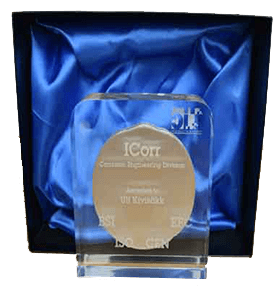
This is the premier award of the Institute of Corrosion in the field of corrosion engineering. It is presented to a senior corrosion engineer who is a leader in their field and has advanced European collaboration and the development of international standards.

The recipient of this award receives an engraved trophy of a modern design and is asked to present a brief overview of their activities as well as prepare an article for publication in the Corrosion Management magazine.

The winner of the 2020 Paul McIntyre award was Carmen Andrade. Until her retirement, Dr Carmen Andrade was a Research Professor at the Institute of Construction Sciences “Eduardo Torroja” of the Spanish National Research Council (CSIC), working in the field of concrete durability and reinforcement corrosion.

At present Dr Andrade is visiting Research Professor at the International Centre for Numerical Methods in Engineering (CIMNE). She is the author of numerous papers, has been editor of several  books, and has supervised around 30 PhD theses. She has received several awards, including the R. N. Whitney Prize 2013 by NACE, Robert L’Hermite Medal 1987 from RILEM,  “Manuel Rocha” of the Presidency of Portugal, and the “ALCONPAT  Prize” in recognition her distinguished career.

She is an honorary doctor of the University of Trondheim (Norway) and of the University Alicante (Spain).

She has participated in several standardisation committees at National, European and International level and has been President of several international organisations related to her specialty (UEAtc, RILEM, WFTAO and the Liaison Committee which brings together the Associations: CIB, FIB, IABSE, IASS, RILEM and ECCE).

At present she is also the President of ALCONPAT, the Latin American Association of Control of Quality, Pathology and Recovery of Structures. She has been General Director of Technology Policy of the Ministry of Education and Science, and advisor to the Secretary of State for Universities in the Ministry of Science and Innovation, Spain.

2021 Winner: To be announced on 28th April 28 2021

The winner is always announced at the annual Corrosion Engineering Division Working Day and Symposium. To attend this year’s Working Day, which will be held online via Zoom, on the subject of ‘Managing Corrosion in Low-Carbon Energy Technologies’ please download the information leaflet and return the registration form.

U.R. Evans Award

The premier scientific award of the Institute of Corrosion, the U.R. Evans Award is presented by the President of ICorr to an eminent researcher, corrosion scientist, academic, or industrialist as reward for outstanding achievements in pure or applied corrosion science.

The recipient is selected by a Corrosion Science Division panel and invited to give a talk at the Corrosion Science Symposium.

The recipient of this award receives a broadsword, and one that takes an edge – which has proved somewhat problematic in previous years. It can be difficult taking the sword back through airport security or displaying it in your office at university!

The sword symbolises our collective and eternal struggle against corrosion, and the U.R. Evans awardee is also recognised with the granting of an Honorary Life Fellowship of the Institute of Corrosion.

The sword’s design has been modified slightly over time, and is no longer made from stainless steel. While a proper sword, if kept in non-ideal conditions it can corrode slightly. “But clearly, the recipient should be able to deal with any corrosion, given their background,” says Dr Julian Wharton – to whom you should submit nominations via his email.

2020 Recipient: Robert Cottis (University of Manchester)

Professor Robert Cottis was appointed Professor Emeritus in Corrosion Science and Engineering on his retirement in 2011 after an exceptional career in the field of corrosion science. Here’s a potted history of his life in corrosion science:

  • Graduated in Natural Science, specialising in Metallurgy in 1967
  • Awarded a PhD in 1973 for work on electrodeposition in the fluidised electrode at the Department of Metallurgy and Materials Science at Cambridge
  • Appointed as a Project Manager, then Research Manager at the Fulmer Research Institute
  • Worked on long-term research in the general area of corrosion, especially on corrosion fatigue
  • Undertook many short-term failure investigations and other consultancy work
  • Joined the Corrosion and Protection Centre, UMIST in 1979, initially as a lecturer, then senior lecturer, reader, and professor

Active in the development of teaching in the field of corrosion, Professor Cottis was responsible for the development of a distance learning approach to the MSc in Corrosion Control Engineering.

He was the Director of the TLTP Consortium – which developed the Ecorr courseware to support corrosion teaching – and the founding editor of the open-access online Journal of Corrosion Science and Engineering.

In 2005 he was awarded the T.J. Hull Award of NACE International for services to NACE in the field of publications, and he is a NACE Fellow.

Who will be this year’s recipient of the U.R. Evans Award? Send your nominations to Dr Julian Wharton. Then watch for details of this year’s Corrosion Science Symposium to find out.