
On Tuesday, 26th November 2024, at the Palm Court Hotel, the Institute of Corrosion (ICorr) Aberdeen Branch held its annual joint event with IOM3/MIS (The Mining Institute of Scotland). Sarah Bagnall, of R-TECH Materials and Branch Chair of Wales and South-West, gave an excellent presentation on Failure Analysis—An Insight into Forensic Investigation, Failure Mechanisms and Prevention.
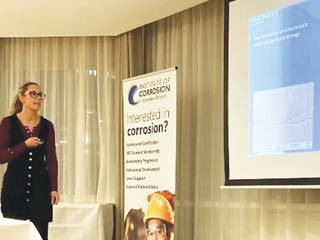
Presenter: Sarah Bagnall
Sarah is both a Materials Engineer and Chartered Engineer specialising in failure analysis, particularly for the petrochemical, oil & gas, and power generation industries. With over 700 failure investigations conducted to date.She has broad experience of a wide range of engineering components, metallic and non-metallic materials, and industries. Over the last 10 years, Sarah has developed specialist expertise in the corrosion and thermal degradation of austenitic stainless steels. She is also the Chair of the recently formed Wales and South-West England branch committee for the Institute of Corrosion.
Presentation Outline
When engineering plant, equipment or components fail in service, the consequences can have the potential to be catastrophic for human safety and well-being, the environment and/or continuity of operations. On a lower level, the effect of such occurrences can include the requirement to reschedule production, the execution of emergency repairs, and missed customer deliveries. The impact of plant failures is undoubtedly negative for plant operators; however, determining the root cause of such failures presents an opportunity to learn from the experience. Adopting such a philosophy is critical to the continual improvement of global plant safety, performance, availability, and reliability while reducing maintenance costs.
Conducting an effective Root Cause Analysis (RCA) investigation provides the opportunity to understand and critically analyse all of the factors that have contributed towards a plant failure. Failure analysis is an essential tool that can be used within an RCA investigation to characterise defects that have caused or contributed to a plant failure event. Determining and understanding the failure mode and prevailing circumstances is critical to being able to deduce the root cause of the failure. When a material fails, it leaves behind a trail of evidence, which can be pieced together to determine the cause of failure. R-Tech Materials have a range of qualified experts, investigative equipment, and services for materials failure analysis which identify failure mechanisms encountered within the oil and gas industry. The range of study techniques and equipment required will be demonstrated through some case studies relevant to the industry.
Gathering the Evidence
To gather evidence for a failure investigation, it may be required to perform site visits if the components or structures are in situ. Detailed information would be gathered through dimensional checks, photography and sometimes it may be required to perform on-site testing such as cutting samples, NDT or replicates of fractures. Otherwise, if components are shipped to a laboratory more extensive analysis techniques can be used using chemical analysis, microscopy, sample sectioning or performing hardness testing and cutting tensile or other test samples from items for evaluation. In certain situations, it may be necessary to carry out corrosion testing, impact testing, or fatigue testing on prepared samples to establish site materials performance versus expected materials.
A significant part of the failure analysis exercise is the gathering of information from site about the conditions of service’ This involves studying:
- Type of plant and operational mode (e.g. continuous, cyclic, intermittent)
- Material grades used
- The process conditions (i.e. flow rates, temperature, pressure, process fluids composition and general operating environment)
- Any specific circumstances surrounding failure
- Inspection intervals and servicing
- Service length of component vs expected life
Materials failure can be due to one of a range of factors, some basic, such as overloading or incorrect specification of materials, and others more complex, such as stress corrosion cracking (SCC), which involves loading in combination with surrounding media or environment.
Specific Case Studies
Failures investigations were demonstrated through a series of 5 most interesting case studies. Case 1 – Fractured flange of 304 Grade Stainless Steel bolts on oil tanker fuel transfer line.
The failure mechanism was identified as polythionic acid stress corrosion cracking. This occurs due to the formation of sulphide scales in the presence of sulphur compounds, which then react with air and moisture during start-up and shutdown to form sulphur acids (polythionic acid). The sulphur is thought to have formed due to exposure. to an environment containing hydrogen sulphide. In the presence of a tensile stress within the bolts, the acid attacked the sensitised austenitic stainless steels adjacent to the chromium-depleted grain boundaries, producing intergranular cracking.
Case Study 2 – Investigation was conducted on a failed propeller shaft from a Pilot Vessel made of duplex stainless steel.
In this instance, Zinc anodes in form of shaft bracelets had been employed as cathodic protection (CP) system.
The shaft fracture showed river lines radiating from the Keyway this being a brittle fracture mechanism with advancing crack-front and multiple cracks radiating. Deposits from within the cracking zone contained significant levels of chlorine and sulphur.
Further analysis of the mechanism showed fatigue crack growth, but the fracture was mainly put down to hydrogen-induced stress cracking (HISC) due to the presence of over-protection of the duplex stainless with localised zinc anodes.
Hydrogen atoms can often form as a consequence of CP over-protection voltage of -1050 mV vs. the lower required ~ -550 mV for DSS against a Silver/Silver Chloride reference electrode. Protection limits for duplex stainless steels (DSS) had therefore been considerably exceeded, and atomic hydrogen had been absorbed in the metal matrix, leading to hydrogen cracking.
Detail of the 3 other case studies can be found in the slide upload to members site https://sites.google.com/site/icorrabz/resource-center
The Aberdeen Branch provides a very full technical program of both in-person and online events. Abstracts of potential papers for the Aberdeen Technical Programme are always welcome for consideration, and anyone wishing to present should correspond soonest with the 2024/2025 Chair and Technical Programme Co-ordinator: meilingcheah@gmail.com
Further information about the Aberdeen Branch and other past presentations may be found on their website page: Aberdeen Branch – Institute of Corrosion. https://www.icorr.org/aberdeen/ under Local Technical Programme and to join the Aberdeen Branch mailing list, please contact: icorrabz@gmail.com
Photo: Sarah Bagnall, of R-TECH Materials.
Presenter: Sarah Bagnall
Sarah is both a Materials Engineer and Chartered Engineer specialising in failure analysis, particularly for the petrochemical, oil & gas, and power generation industries. With over 700 failure investigations conducted to date.She has broad experience of a wide range of engineering components, metallic and non-metallic materials, and industries. Over the last 10 years, Sarah has developed specialist expertise in the corrosion and thermal degradation of austenitic stainless steels. She is also the Chair of the recently formed Wales and South-West England branch committee for the Institute of Corrosion.
Presentation Outline
When engineering plant, equipment or components fail in service, the consequences can have the potential to be catastrophic for human safety and well-being, the environment and/or continuity of operations. On a lower level, the effect of such occurrences can include the requirement to reschedule production, the execution of emergency repairs, and missed customer deliveries. The impact of plant failures is undoubtedly negative for plant operators; however, determining the root cause of such failures presents an opportunity to learn from the experience. Adopting such a philosophy is critical to the continual improvement of global plant safety, performance, availability, and reliability while reducing maintenance costs.
Conducting an effective Root Cause Analysis (RCA) investigation provides the opportunity to understand and critically analyse all of the factors that have contributed towards a plant failure. Failure analysis is an essential tool that can be used within an RCA investigation to characterise defects that have caused or contributed to a plant failure event. Determining and understanding the failure mode and prevailing circumstances is critical to being able to deduce the root cause of the failure. When a material fails, it leaves behind a trail of evidence, which can be pieced together to determine the cause of failure. R-Tech Materials have a range of qualified experts, investigative equipment, and services for materials failure analysis which identify failure mechanisms encountered within the oil and gas industry. The range of study techniques and equipment required will be demonstrated through some case studies relevant to the industry.
Gathering the Evidence
To gather evidence for a failure investigation, it may be required to perform site visits if the components or structures are in situ. Detailed information would be gathered through dimensional checks, photography and sometimes it may be required to perform on-site testing such as cutting samples, NDT or replicates of fractures. Otherwise, if components are shipped to a laboratory more extensive analysis techniques can be used using chemical analysis, microscopy, sample sectioning or performing hardness testing and cutting tensile or other test samples from items for evaluation. In certain situations, it may be necessary to carry out corrosion testing, impact testing, or fatigue testing on prepared samples to establish site materials performance versus expected materials.
A significant part of the failure analysis exercise is the gathering of information from site about the conditions of service’ This involves studying:
- Type of plant and operational mode (e.g. continuous, cyclic, intermittent)
- Material grades used
- The process conditions (i.e. flow rates, temperature, pressure, process fluids composition and general operating environment)
- Any specific circumstances surrounding failure
- Inspection intervals and servicing
- Service length of component vs expected life
Materials failure can be due to one of a range of factors, some basic, such as overloading or incorrect specification of materials, and others more complex, such as stress corrosion cracking (SCC), which involves loading in combination with surrounding media or environment.
Specific Case Studies
Failures investigations were demonstrated through a series of 5 most interesting case studies. Case 1 – Fractured flange of 304 Grade Stainless Steel bolts on oil tanker fuel transfer line.
The failure mechanism was identified as polythionic acid stress corrosion cracking. This occurs due to the formation of sulphide scales in the presence of sulphur compounds, which then react with air and moisture during start-up and shutdown to form sulphur acids (polythionic acid). The sulphur is thought to have formed due to exposure. to an environment containing hydrogen sulphide. In the presence of a tensile stress within the bolts, the acid attacked the sensitised austenitic stainless steels adjacent to the chromium-depleted grain boundaries, producing intergranular cracking.
Case Study 2 – Investigation was conducted on a failed propeller shaft from a Pilot Vessel made of duplex stainless steel.
In this instance, Zinc anodes in form of shaft bracelets had been employed as cathodic protection (CP) system.
The shaft fracture showed river lines radiating from the Keyway this being a brittle fracture mechanism with advancing crack-front and multiple cracks radiating. Deposits from within the cracking zone contained significant levels of chlorine and sulphur.
Further analysis of the mechanism showed fatigue crack growth, but the fracture was mainly put down to hydrogen-induced stress cracking (HISC) due to the presence of over-protection of the duplex stainless with localised zinc anodes.
Hydrogen atoms can often form as a consequence of CP over-protection voltage of -1050 mV vs. the lower required ~ -550 mV for DSS against a Silver/Silver Chloride reference electrode. Protection limits for duplex stainless steels (DSS) had therefore been considerably exceeded, and atomic hydrogen had been absorbed in the metal matrix, leading to hydrogen cracking.
Detail of the 3 other case studies can be found in the slide upload to members site https://sites.google.com/site/icorrabz/resource-center
The Aberdeen Branch provides a very full technical program of both in-person and online events. Abstracts of potential papers for the Aberdeen Technical Programme are always welcome for consideration, and anyone wishing to present should correspond soonest with the 2024/2025 Chair and Technical Programme Co-ordinator: meilingcheah@gmail.com
Further information about the Aberdeen Branch and other past presentations may be found on their website page: Aberdeen Branch – Institute of Corrosion. https://www.icorr.org/aberdeen/ under Local Technical Programme and to join the Aberdeen Branch mailing list, please contact: icorrabz@gmail.com
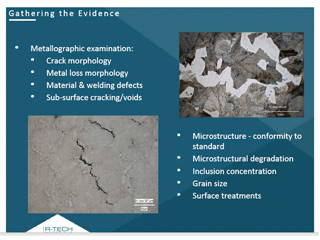

Photos: Metallograghic Examination of Materials by Sectioning for Grain Structure and Crack Presence. Fracture Surface Study by Stereographic and Scanning Electron Microscopy (SEM).

Photo: The Most Common Root Causes of Failure.
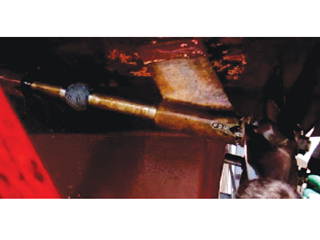
Photo: Duplex SS Propeller Shaft in-Situ with Zinc Bracelet Anode.
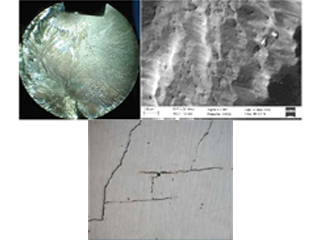
Photos: Stereographic Image of Fracture, SEM Image for Surface with XRF Analysis and a Metallographic Section Showing Crack Character.