
Editor’s Note: We are pleased to have the opportunity to publish the 3rd of our series of dairies from the YEP 24 winners.
Rochelle-Ann Holness – Materials Engineer at Genesis Energies, London
On the 21st November 2024 at the ICorr London Branch, I was recognised as being the Winning YEP Individual, for my exceptional case study contributions and presentation skills under Mentor – Chris Googan and I had the incredible opportunity to attend the 2025 Association for Materials Protection and Performance (AMPP) Annual Conference and Expo in Nashville, Tennessee. While I had high expectations, I truly had no idea just how impactful the experience would be. Here’s a look back at one of the most unforgettable weeks of my engineering journey. First Impressions and Southern Hospitality My first taste of Nashville and its legendary Southern hospitality came at the Opening Night Reception. As a first-time attendee, this relaxed and welcoming event offered the perfect way to ease into what was going to be a busy week. The secret challenge for the night pushed me out of my comfort zone and into conversations with several engineers who worked at Carboline, the night’s sponsor (who are also, a generous sponsor of ICorr UK). It was the perfect environment to connect with the YEP team winners and to meet Council members of the Institute of Corrosion (ICorr) who were also conference attendees.
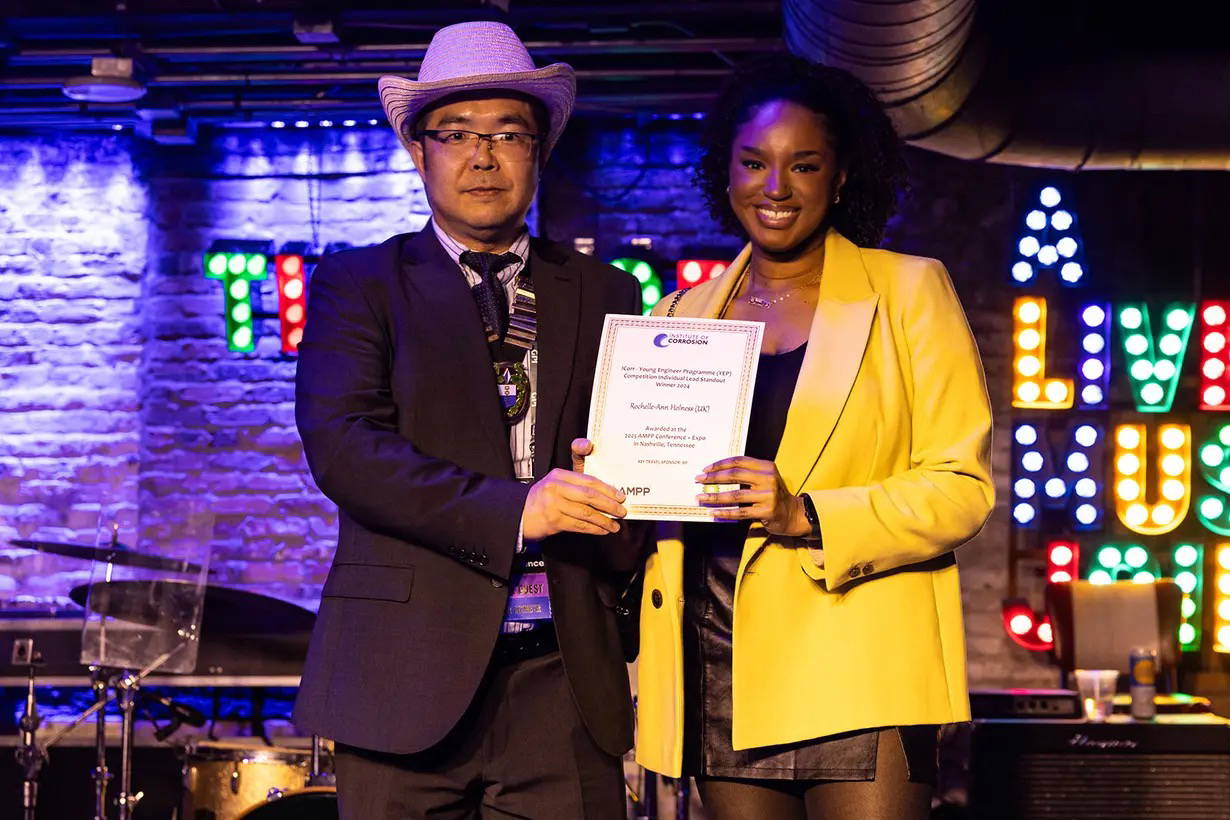
Photo: Rochelle-Ann Holness with ICorr President Dr Yunnan Gao.
Diving Into the Technical Sessions
As a materials engineer in the energy industry, I was especially drawn to technical programmes presenting the recent developments in oil and gas, energy transition, and alternative fuels.
One technical programme that stood out to me was “Chemical Interactions and Corrosion in Impure CO2 Pipeline Transport” presented by Johannes Sonke. This session discussed the challenges surrounding the gathering of CO2 from multiple industrial emitters due to the presence of impurities and their resulting impact on integrity. Sonke delved deeper into the potential chemical interactions of these impurities, which can result in the formation of highly corrosive phases. He approached the topic by first identifying the many potential sources of CO2, which included the fermentation of biomass, natural gas treating, direct air capture, the pre-combustion, post-combustion, and oxyfuel combustion of fossil fuels and biomass, as well as other industrial processes (e.g., cement making). From these CO2 sources, their associated impurities were identified, with a particular highlight on relevant water, oxygen, hydrogen sulphide, sulphur dioxide, and nitrogen dioxide contaminants. These impurities have significant impacts on corrosion due to their ability to react to form sulphur or strong acids (nitric acid and sulphuric acid). Sonke presented chemical equilibrium calculations which provided insight into worst-case compositions with respect to acid formation and drop-out. This chemical equilibration revealed compositions for acid drop-out below previously reported impurity upper limits. I found these results to be extremely useful, especially for the Carbon Capture and Storage (CCS) hub and cluster projects I am involved in. With this new data reported, I am able to provide more suitable guidance on the critical concentration of impurities to avoid acid formation and dropout, as well as quantify the corrosion phenomena in impure CO2. Sonke’s work, although insightful, is only the beginning of scratching the surface of the corrosion challenges of CCS, and I am keen to learn more about his discoveries in the future.
Another technical highlight was “Storage Area Assessment for Underground Hydrogen Storage (UHS)- Material Integrity Concerns” presented by Saba Esmaeely. One of the limiting factors for the large-scale deployment of hydrogen is the development of safe and efficient storage systems. While the underground storage of methane using geological reservoirs such as depleted oil fields, saline aquifers, and salt caverns is well-established, this type of storage is not directly transferable to UHS. The presenter highlighted the need for storage area assessment for UHS that involves hydrogen purity and microbial activity analysis. Although the various types of UHS have large storage capacities, contaminants such as water, CO2, organic acids, and other sulphur-containing compounds have the potential to cause accelerated corrosion, as well as result in the escape of hydrogen due to unwanted reactions. Saba discussed these contaminants in detail, outlining their likely sources, impacts, and potential solutions. A subsurface microbial biosphere review of native bacteria and bacteria introduced during drilling, pumping, and mining was noted to be key in understanding the storage impact due to microorganisms. Methanogenesis, acetogenesis, sulphur reduction, and aerobic hydrogen oxidation are examples of processes by microorganisms that can take place in UHS, resulting in the loss of hydrogen. With a global shift towards energy transition and alternative fuels, this presentation provided great context into the world of hydrogen and its current challenges.
Inspiration Beyond the Technical
With a week designed to promote the new technical efforts within the industry, one of my most memorable moments came from a different type of session: the keynote speech by NASA astronaut Dr Mike Massimino. Drawing from his experiences in space and his time at NASA, he reminded us that success, whether it’s in high-profile space exploration or in equally impactful industries like materials and corrosion, relies on resilience, teamwork, and innovation.Teamwork was the speech’s noteworthy theme, with “the team’s success is your success” being one of the many one-liners stressing the value of collaboration. This message resonated powerfully with many attendees, as it is not industry-specific but valuable to those who want to overcome challenges with safety, innovation, and efficiency at the forefront. Dr Massimino’s address was a powerful reminder that even the
most technical work is deeply human at its core.
A Night to Remember
The EMERGing Leaders Bash was, without question, a highlight of the week, as young engineers were recognised for their excellence across the industry. I had the honour of receiving an award for my success in the YEP alongside the members of the 2024 winning team, as well as national and international scholarship recipients. The night was filled with celebrations, as we shared our achievements and experiences with peers, mentors, and industry professionals. The EMERGing Leaders Bash served as a poignant reminder of the community I’m part of, and the dedication to supporting the next generation of engineers.
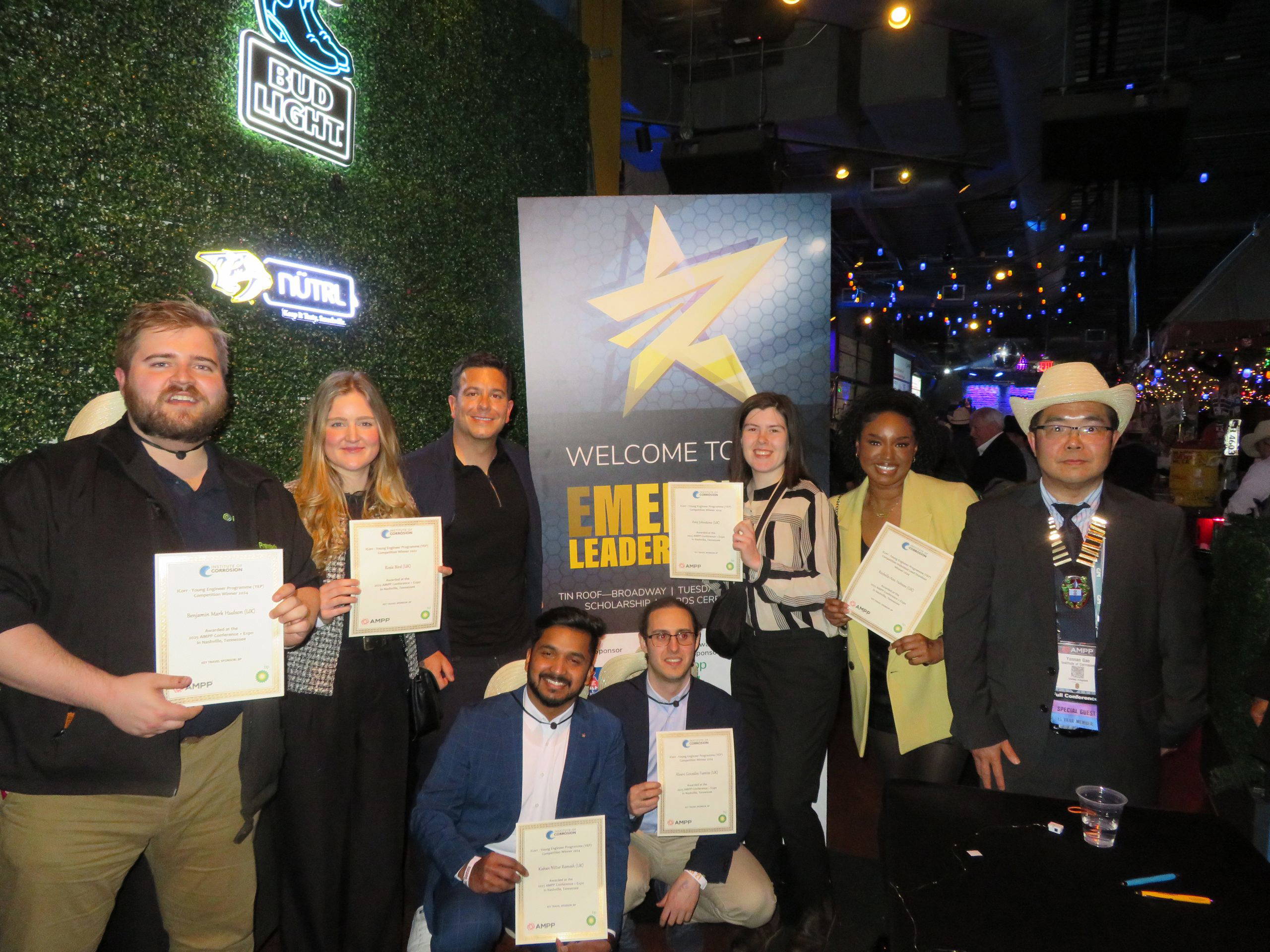
Photo: YEP Partcipants and ICorr Leaders at the EMERGing Leaders Bash.
Soaking Up the Nashville Vibes
While the conference kept me busy, I made sure to carve out some time to explore Nashville. The city’s vibrant culture provided many opportunities to experience food, history, and entertainment in an unforgettable way. I visited Broadway Street every day, each time discovering something new. My standout spots were the National Museum of African American Music, for an immersive and enlightening experience into the history of American music, and Hattie B’s Hot Chicken for some of the world’s best fried chicken. Regrettably, I left Nashville without a pair of cowboy boots from one of the many “boot barns.” However, the memories I brought home are more than enough.
Full Circle
Attending the AMPP Annual Conference and Expo felt like the perfect capstone to what was already an incredible year with ICorr and YEP. This experience not only allowed me to grow technically but also helped me connect with others across the industry, from fellow young engineers to seasoned experts. I’ve walked away feeling more inspired, better equipped, and even more excited about the road ahead.Thank you ICorr for creating such valuable opportunities for young engineers to grow, connect, and be recognised. Your continued support of emerging talent in materials and corrosion is appreciated. A special shoutout to Danny Burkle and Izabela Gajewska for their dedication in organising such a valuable experience. As Dr Massimino said, to be truly “mission-ready”, you need to trust your equipment, your training, and your team. I’m taking that mindset with me as I continue my engineering journey. An experience of this magnitude is only the beginning!