The third meeting of 2017 was held on Tuesday the 28th March, with 28 attendees representing major companies including Atkins, BP, CNR, DNV GL, Lloyds Register, Oceaneering, Subsea 7, TOTAL and Wood Group.
The event was an industrial visit to the premises of Cosasco Europe HQ in Aberdeen, to hear about the latest Advances in Probe and Coupon Monitoring and Safe Access / Retrieval of Data, with many live demonstrations being performed.
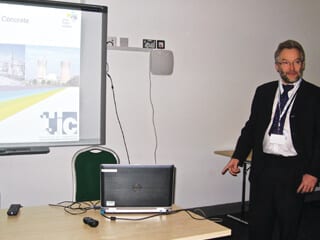
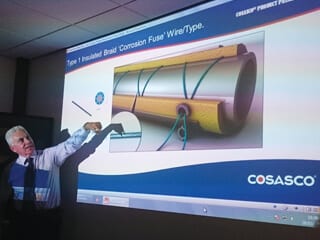
Derek Morton explains the concept of under insulation monitoring
Specialist equipment for solids erosion tracking and production well management was also illustrated.Solids determination to minimise erosion and determine the solids-free flow rate is considered essential practice for maximising equipment life. A lively debate followed the speaker presentation with many questions from the audience.
There were opportunities later to inspect at close hand, a wide range of advanced electronic sampling tools and data reporting systems, with Cosasco consultants and Engineers including, Andy Allan, Mark Maulvaney, Richard Rae, James Taylor, Sandy Tweddle and Dean Smith (Aberdeen Base Manager), all on hand to explain how such devices can be optimised to best advantage.
The activities that followed the technical presentation included informative demonstrations of pressurised retrieval operations of data logging devices, wireless monitoring technologies, probe and chemical monitoring applications and safety isolation devices. There were also a number of poster displays and the wide range of models and test rigs certainly kept the attention of the branch members throughout the evening. Advanced monitoring probes were displayed, including those intended specifically for laboratory use such LPR devices. The differing sensitivity and speed of available probes was clearly demonstrated, along with their most commonly used applications, e.g. Galvanic for water injection service and their relationship to other types of process instrumentation and to chemical injection monitoring was also explained.
The associated retrieval devices (which are either mechanical or hydraulic based tools) can work across a range of pressures up to 6000 psi with telescopic and non-elescopic options. Lower cost intrusive monitoring options, such the use of test coupons were also highlighted.
This event created a tremendous amount of interest from attendees, with an extended networking session following the event and some splendid catering provided by Cosasco staff which was very well received by all. It proved to be an excellent event in every respect.
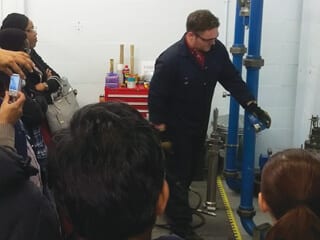
James Taylor demonstrates the High pressure mechanical retrieval tool.
The April meeting, held on Tuesday 25th, had 40 attendees from local companies, and considered advances in Cathodic Protection, looking at Simulation Techniques to help assess CP Current Output of Buried Subsea Pipeline Anodes from Field Gradient Measurements, with a most interesting presentation by Tim Froome of Beasy. The branch evening event followed the annual Aberdeen meeting of the Marine Corrosion Forum, enthusiastically chaired by Phil Dent.
Beasy based in Southampton, serve a wide industry base and focus specifically on how CP field distribution modelling can help better inform our understanding of (often very complex) cathodic protection behaviour and to help engineers assess mitigations and improve the CP design to be implemented. The application of their specialist software was very effectively demonstrated throughout the evening, showing the use of advanced 3D Graphics to illustrate CP current flows under a range of different conditions such as buried CP current sources (sacrificial anodes), local current activity occurring around pipeline coating defects, long range current flows, vertical current distributions and demonstrations of shielding effects / possible CP under-protection at some sites. The paper very usefully complemented an earlier one given by Tim on CP effects at Crevices and Voids at the afternoons MCF Event.
Tim showed how the modelling software can assist in both determining the overall CP system performance and ensuring adequate protective current distribution, as well as assisting in determining the overall CP system life and the likely relative consumption of CP system anodes.
Many questions from the audience were forthcoming including the future integration of the CP Models with established surveys methods used by major subsea survey contractors, so as to make the best use of gathered CP data and to optimize reporting for the CP Systems owners.
Modelling of CP current flowlines is clearly explained by the speaker.
The CP Flowline phenomenon aroused great interest amongst gathered delegates and the speaker explained that Beasy are intending to develop these relationships forward in the future, so as to assist the subsea industry and the extensive Marine CP markets.
For information about the Aberdeen branch activities please contact our branch secretary, Frances Chalmers, ICorrABZ@gmail.com, alternatively a calendar of local events of interest to corrosion professionals in the Aberdeen area and the opportunity to sign up to the branch mailing list is available at https://sites.google.com/site/icorrabz/home
Aberdeen Branch have also established their new Media Centre, which can be found at https://www.linkedin.com/in/aberdeen-icorr/recent-activity/
The 2017 CEOCOR Congress in Luxembourg was a great success, both technically and socially. The venue was excellent, and the superb Congress dinner was held on the Princess Marie-Astrid boat on the Moselle river, famous for the signing ceremony of the EU Schengen agreement! Thanks must go to our friends in Luxembourg.
Planning for the 2018 CEOCOR Congress in Stratford-upon-Avon, is well underway.In addition to the technical presentations and exhibition, there will be a Partner’s Programme, including visits to Shakespeare’s birthplace, Anne Hathaway’s Cottage, behind the scenes at the Royal Shakespeare Theatre, and to a nearby stately home.
A sponsorship programme has been developed which offers a significant opportunity for the UK (and elsewhere) buried pipeline community to participate. The principal
or Platinum Sponsorship has already been taken up by National Grid, the sole owner and operator of the high pressure gas transmission infrastructure in the UK. Cathodic Protection Co. Ltd. from Grantham has taken one of the Gold Sponsorships, and will also sponsor the BBQ and Jazz evening. Other sponsorship packages are also available and details of these can be found on the conference website, www.ceocor2018.com.Those companies wishing to secure sponsorship at the 2018 CEOCOR Congress need to be quick, as places are filling-up fast.
Conference programme, registration details, hotel package, partner’s programme and news will all be available on the website, which will be regularly updated.
The first Young ICorr Social was held on the 20th April at the Prince of Wales Feathers Pub in London, and a very enjoyable evening was had by all. This was planned as a networking event to help launch Young ICorr in London, and was attended by both members and non-members of the Institute of Corrosion. Young ICorr is aimed at young professionals (35 and under) who are interested in, or working in, the field of corrosion.
To hear about future networking and speaking events, please join the Young ICorr LinkedIn page at tinyurl.com/youngicorr (or search for “Young ICorr”). For those who do not use LinkedIn, but wish to be kept updated with Young ICorr news and events, please send an email to Chris.Bridge@uk.bp.com t
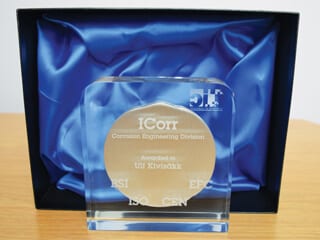
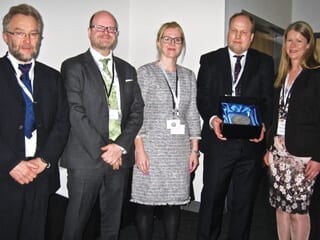
The first Paul McIntyre Award was also presented at the CED working day to Ulf Kivisäkk of Sandvik Materials Technology R & D, Sweden, by the ICorr President, Sarah Vasey. Paul’s son, Gerald and daughter, Anthea, were also in attendance and said some kind words about Paul. Ulf then gave a short talk summarising his contribution to the EU-funded programme on developing an ISO standard test method for assessing crevice corrosion of 316L stainless steel in marine environments (“CREVICORR”), and also his investigations into HISC of duplex stainless steels.
With Ulf Kivisäkk are Sarah Vasey, Nick Smart and Paul’s children, Gerald and Anthea.
A CED Working day and Symposium on Corrosion Engineering and Concrete was held on Thursday, 27 April at Argyll Ruane Engineering Training Centre, Sheffield. The meeting was sponsored by the Institute of Concrete Technology.Some sixty delegates were welcomed by the Chair of CED, Nick Smart (Amec Foster Wheeler), who introduced the Division for the benefit of those who were not members and also outlined the programme for the day. This was followed by an ‘Introduction to the Institute of Concrete Technology’, given by the President, Raman Mangabhai.
Chris Atkins (Mott MacDonald) addressed, ‘The trouble with concrete’.He outlined the origin of the problems with concrete caused by shrinkage and the means of overcoming its poor compressive strength by inserting reinforcement.Settlement cracking was capable of giving rise to 2 mm wide cracks, which could penetrate right up to the rebar. Other aspects of steel corrosion in concrete were then discussed including the electrochemical mechanisms of corrosion, forms of chemical attack that can occur during use, repairing chloride-induced corrosion, cathodic protection, and decisions to repair (covered by BS EN 1504), with BS EN ISO 12696 providing further guidance on conformity.
Next, David Simmons (BAM Nuttall) outlined, ‘The use of coatings to manage corrosion in concrete’. “Getting it right first time” is a phrase that is often used in construction. This applies equally to reinforced concrete if it is to be durable and provide the service life as specified by the end-user. The problem with reinforced concrete is that while engineers fully appreciate the importance of including the reinforcing steel, not much consideration is given to the low-cost, easy-to-use, void filling material that surrounds it. In effect, the concrete cover should be regarded as a protective coating, and must be properly specified, batched and used, which can only be achieved by proper exchange of information between the designer, user, and producer of the concrete.
‘Impressed current cathodic prevention of steel in concrete’ was the subject of the lecture by Hugue Bois (SAPIEM SA, France). Theoretically, steel in concrete should not experience corrosion. The concrete pH is around 13 and this alkaline environment stabilises the iron oxide or hydroxide film, thereby passivating the embedded steel. The concrete layer also presents a low permeability barrier vs. external aggressive species, e.g. chloride ions or carbon dioxide. However, in some cases, ingress of these species reduces the pH to 8 or 9, thus impairing the passive film. Examples of field experience were given, including reinforced concrete steel piles, the use of Mn/MnO2 reference electrodes, and the importance of identifying the various at-risk zones, for example of a sea wall, viz. immersed wall, buried wall, atmospheric, splash and tidal zones.
The final presentation entitled, ‘Latest understanding of the corrosion of Magnox, aluminium and uranium metal wastes in cement’ was given by Hugh Godfrey (National Nuclear Laboratory). An overview of the work that has been carried out in the nuclear industry on the corrosion of Magnox (magnesium/aluminium alloy), uranium and aluminium wastes encapsulated in cements was presented under the following headings: the origin of the waste; how the waste is encapsulated in cement; how the corrosion rates were measured and a comparison of the corrosion behaviour of the three metals. Uranium has the simplest corrosion behaviour – an initial incubation period followed by continuous corrosion and a steady rate. Magnox behaviour is more complex, with the corrosion rate gradually decreasing to a fixed long-term rate.This contrasts with the corrosion rate for aluminium which continually decreases without appearing to reach a steady rate.
The technical talks from this meeting are available (in pdf form) on the members area of the ICorr website.
After the presentations, the delegates were afforded the opportunity of visiting the concrete and corrosion laboratories at Sheffield Hallam University, and to participate in CED Working Group Meetings. The concrete and CP, nuclear and coatings work groups all had successful sessions.
We use cookies to optimize our website and our service.
Functional
Always active
The technical storage or access is strictly necessary for the legitimate purpose of enabling the use of a specific service explicitly requested by the subscriber or user, or for the sole purpose of carrying out the transmission of a communication over an electronic communications network.
Preferences
The technical storage or access is necessary for the legitimate purpose of storing preferences that are not requested by the subscriber or user.
Statistics
The technical storage or access that is used exclusively for statistical purposes.The technical storage or access that is used exclusively for anonymous statistical purposes. Without a subpoena, voluntary compliance on the part of your Internet Service Provider, or additional records from a third party, information stored or retrieved for this purpose alone cannot usually be used to identify you.
Marketing
The technical storage or access is required to create user profiles to send advertising, or to track the user on a website or across several websites for similar marketing purposes.