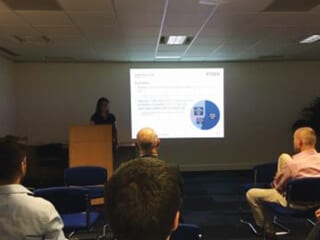
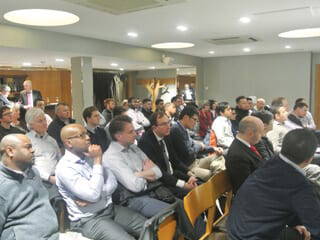
The first meeting of 2017 was held on Tuesday the 31st January, with 49 attendees from local Aberdeen based companies. The first guest speaker of the evening was Sarah Vasey, the new ICorr President.
Sarah enthusiastically explained the Institute’s plans for improvement of the bi-monthly journal – Corrosion Management (CM), which is being re-launched in a new format with greater technical content and extended papers, together with improvements to the ICorr website. Sarah made it clear that training would become a key focus for the Institute, with improved professional development for members towards Chartered Engineer status. At the end of the evening, Sarah met with all the members of the Aberdeen Committee, many of whom have more than 5 years’ service with the branch.
The technical presentation followed with, Dr Nadimul Faisal and Dr Ghazi Droubi, both lecturers at the School of Engineering, Robert Gordon University (RGU) in Aberdeen, who outlined the main goals of their current research programme into the potential for Acoustic Emission (AE) to detect both cracking and corrosion activity.
Acoustic emission is essentially a non-destructive technique where a test sample is subjected to a stress condition, under which, crack growth, local yielding and corrosion product fracture may occur, resulting in a sudden release of energy that can be detected by transducers.
The speakers described their recent findings from a range of RGU experiments, including those on thin aluminium and steel plates in different corrosive environments.
It is important to note that the AE from corrosion usually releases much less energy than emission from crack growth, and so is more difficult to detect in the field, however the results present a trend (as an exponential curve) between the concentration of the corrosive environment and the energy of the acoustic emission signal.
AE only occurs when corrosion scales fracture and corrosion needs to be active, although the presence of inactive / previous corrosion may be found by causing the scale to fracture by changing the strain sufficiently in the base material.
An extensive range of questions followed from the large audience during which the practical application of AE within the energy sector was further explored. Generally the role of AE was perceived as being in support of other NDT technologies and for specialised applications such as inspection of tank floors, and occasionally for critical components of high value, or high production impact.
The February meeting, held on Tuesday 28th, had over 50 attendees from local companies, and the guest speakers were, Dr Jake Davies of Permasense HQ, and his Aberdeen based Technical Support colleague Gary Wallace, who had recently joined from ConocoPhillips UK Production Well Integrity Division.
This most informative evening was entitled “Monitoring High Temperature Corrosion Attack: Correlation between Corrosiveness and results from Online Corrosion Monitoring”.
The speakers presented a wide range of successful Permasense wall thickness monitoring applications, from Upstream, Midstream and Downstream Energy Sector Operations, developed over a period of more than 10 years in partnership with BP and Imperial College London.
They emphasized the need to continuously gather quality real-time data to allow accurate determination of the rate of internal damage to key production components, operating under high temperature, high pressure and variable flow conditions.
It was pointed out that more traditional and less automated methods may provide over-cautious and sometimes unreliable information, owing to their reduced sampling frequency, manual nature and limitations on safe access. The availability of enhanced pipe wall data from all sources, can raise confidence levels, facilitate longer service intervals, and minimize production losses. A large number of case studies were used to illustrate these points and the potential gains from such systems.
It was emphasised however that all truly holistic inspection regimes utilize a full range of intrusive and non-intrusive devices for fluids and solids management to ensure continued safe operation of ageing assets. As with other complimentary monitoring devices, a recent key change in the application of such technologies has been the huge advances in wireless data transmission, greatly improved battery life and much improved integration with plant control systems, to provide ‘side by side’ data that is now much more meaningful to integrity specialists.
The closing question and answer session covered many diverse topics that truly demonstrated the value of evening, the level of interest and its excellent speakers. A wide range of Clamped and Magnetic wall thickness monitors were then made available for the audience to inspect.
For information about the Aberdeen branch activities please contact the branch secretary, Frances Chalmers, ICorrABZ@gmail.com, alternatively a calendar of local events of interest to corrosion professionals in the Aberdeen area, and the opportunity to sign-up to the branch mailing list, is available at https://sites.google.com/site/icorrabz/home.
The January branch meeting was held at the Aberdeen Palm Court Hotel on Tuesday the 31st January, 2017, with 49 attendees from local Aberdeen based companies. After a formal safety announcement, the branch Chair Stephen Tate introduced the first guest speaker of the evening, Sarah Vasey, the new ICorr President for 2017 and 2018.
The November branch meeting was a joint session with IOM3 and was held at Palm Court hotel on Tuesday the 29th of November, 2016. There were two topics presented during the meeting.
North East Branch – The branch held its first event in 2017 on 21 February, which was hosted by ROSEN UK at its offices at Quorum Business Park, Newcastle upon Tyne. About 20 people attended the event and had an opportunity to learn about Flow Modelling and Flow Assurance through two presentations.
The first presentation, titled “Introduction to Flow modelling and Flow Assurance in Oil and Gas Industry” was delivered by a senior flow assurance engineer at ROSEN UK, Mr. Ashwin Pinto. His presentation discussed the basic concepts and methodology behind the
flow assurance, whilst also highlighting advantages of undertaking flow analyses to better understand performance of production systems, optimize oil and gas operations, and improve system designs.
The second presentation was given by Marguerite Forde, a senior engineer at ROSEN UK, entitled “Optimization and Validation of Internal Corrosion Direct Assessment – Prediction vs. Reality”.Ms Forde presented a case study focused on (i) demonstrating the accuracy of predicted corrosion rates vs. those rates experienced by pipeline assets in reality and (ii) utilization of available direct inspection results to fine-tune corrosion models to predict the condition of sections of the pipeline which cannot be inspected directly.
This year, the branch will hold a summer event on 6th July 2016 at Hatfield College, Durham University, when Professor Jon Glyuas, Durham University, will give a presentation on “Energy past, present and future”. The talk will examine the national picture for energy supply and demand, identify the risks, and then comment on what the UK can do to improve its energy security in the long term.
The evening starts at 17.00, with a tour of Durham Castle at 17.30, followed by the presentation, and a buffet and drinks from 19.30, together with time for networking.The costs are £5 for members and the first 10 students registered, and £10 for non-members. A Registration form will be available on the ICorr website, and as there are limited spaces, early booking is advised.
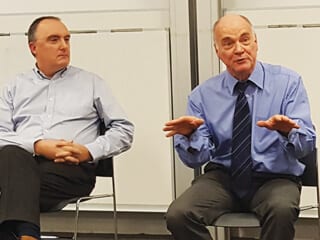
London Branch – The Branch began the New Year by welcoming the “Three Wise Men”, Alan Denny, AKD Materials Consulting, Bill Hedges, BP, Corrosion Engineering Technical Authority and Steve Paterson, Shell (Amsterdam), Principal Technical Expert Upstream Materials, who gave a presentation entitled ‘The Past, Present and Future of Corrosion’.
Alan Denney illustrated his past experience with numerous and far reaching projects and corrosion problems, including reinforcement corrosion in buildings, graphitic corrosion of cast iron, the use and misuseof Cor-Ten steel, the use of duplex stainless steels in architectural demanding buildings together with a number of issues in the oil and gas industry. Bill Hedges then looked at what the corrosion industry was doing well, such as technical development, networking and training, risk assessments, corrosion modelling, effective corrosion barriers and management systems. He then stated that opportunities for improvement existed in, attracting the next generation of engineers, project cost control, corrosion monitoring and inspection, sharing of knowledge across the industry, and the adoption of common standards. Steve Paterson detailed key future challenges including an ageing infrastructure, marginal field development, dealing with high pressures and temperatures, extreme environmental conditions, materials for sustainable energy together with the development of artificial intelligence, commercial acumen and a greater awareness of risk/probability.
Following the presentations, the 45+ attendees participated in a question and answer session which particularly discussed the way to attract young people into the industry who will be innovative and creative and use good judgement in the use of corrosion protection. On 9th February, the Branch met to enjoy a technical presentation entitled ‘Corrosion Inhibitor Testing – The Journey’ given by George Winning; corrosion specialist for Element Materials Technology.
George began his presentation with a quick review of the 70 year history and development of chemical products, the study of the inhibitor mechanisms, together with some of the key characteristics an inhibitor should have, to ensure that they will work for a particular oil and gas system. The presentation looked at the many tests that are needed to be carried out to identify the correct product for a system, and how a set of tests may vary between an application in low oil cut systems through to high water cut systems, and the different tests required for gas systems.George made particular reference to the problems associated with the effects of flow, the difficulty of achieving full inhibition where ‘under deposit corrosion’ (UDC) is occurring, the problem in combating ‘preferential weld corrosion’ (PWC) and the specific techniques required to combat ‘top of line corrosion’ (TOLC).
He then summarised ‘The Journey’ to be made for success, including review of the application, design of the test program, the selection of performance tests, field testing, re-evaluation and performance monitoring. After negotiating a question and answer session with the attendees, Committee Member, Polina Zabelina thanked George for his comprehensive review on all that needs to be considered, and invited all present to enjoy the traditional hospitality of the London Branch.
Details of forthcoming Branch technical meetings can be found on the ICorr website and in the Diary Date page of Corrosion Management, and are held at Imperial College Skempton Building, at 18.00 for an 18.30 start. Enquiries can also be sent to icorrlondon@gmail.com
We use cookies to optimize our website and our service.
Functional
Always active
The technical storage or access is strictly necessary for the legitimate purpose of enabling the use of a specific service explicitly requested by the subscriber or user, or for the sole purpose of carrying out the transmission of a communication over an electronic communications network.
Preferences
The technical storage or access is necessary for the legitimate purpose of storing preferences that are not requested by the subscriber or user.
Statistics
The technical storage or access that is used exclusively for statistical purposes.The technical storage or access that is used exclusively for anonymous statistical purposes. Without a subpoena, voluntary compliance on the part of your Internet Service Provider, or additional records from a third party, information stored or retrieved for this purpose alone cannot usually be used to identify you.
Marketing
The technical storage or access is required to create user profiles to send advertising, or to track the user on a website or across several websites for similar marketing purposes.