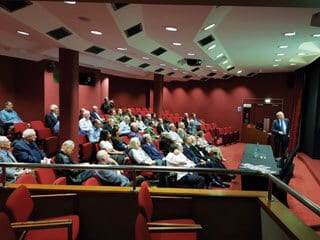
The Branch had a good start to the 2017-18 season, and whilst there were only had 40 people at the October meeting, the guests were from the major offshore operators, and about 30% were below the age of 40, which was the audience targeted.
Simon Bowcock of BP discussed the corrosion challenges and the considerations to be taken into account in the design and installation of 316 stainless steel clad subsea flowlines.
Material selection decisions are typically based on a compromise between cost, schedule, and meeting the specified engineering requirements. However, these decisions can often have wider, yet significant, impact on different stages of a project. Simon’s presentation looked to identify and explore some of these wider considerations in more detail, specifically with respect to the use of 316 stainless steel clad subsea flowlines in the oil and gas industry. He also did a fantastic job with a very interesting topic and went to the bother of explaining in detail the complexity of the installation of a clad subsea pipeline
Simon was presented with his ICorr pen and a vote of thanks from Ben Moorhouse.
The Branch also held a joint meeting with SCI (Society of Chemical Industry) at their premises on Belgrave Square, on 19th October. The evening was chaired by Dr Nicholas Bourne of SCI who introduced the two evening presentations. Coincidentally, the SCI was the home for the Institute of Corrosion from 1965 to 1980, when it moved to the IMF in Birmingham.
The first presentation was by Dr Fred Parrett, who has over 50 years’ experience in business, industry and academia. Fred’s presentation was a comprehensive look at the life and works of businessman, scientist, inventor and politician, Benjamin Franklin. Fred developed a timeline to show the developments in the study of electricity that were sweeping through Europe in 1740’s. Franklin wanted to find answers to a number of fundamental questions, what is electricity, how is it distributed in nature, are there two kinds of electricity, and why are materials conductors or non-conductors?
In 1751, he published his book ‘Experiments and Observations on Electricity”. The famous ‘Kite Experiment’ where Franklin showed that lightning did produce electricity, followed in 1752. In 1756 he was nominated for Fellow of The Royal Society of London, being described as ‘a gentleman, who has very eminently distinguished himself in various discoveries in natural philosophy and who first suggested the experiments to prove the analogy between lightening and electricity’. Following this award, Franklin moved to London as a diplomat and politician for Pennsylvania and became involved with the move to make America independent, predicting this would happen long before the war began. Eventually, around 1772 he returned to the colonies to help draft the Declaration of Independence and become one of the Founding Fathers of the United States.
The second presentation was by Dr David Eyre, an independent consultant, specialising in corrosion management and the integrity of buried pipelines, with over 35 years’ experience on UK and overseas projects.
David continued the theme of electricity but moved away from DC and introduced the problems created by modern high voltage AC transmission systems on oil and gas pipelines. David described the policy of routing AC transmission systems in the same corridor as pipelines. The magnetic field created around each AC phase wire running from tower to tower can induce AC voltages and currents in the wall of the buried steel pipelines, under both normal load and fault conditions on the transmission system. These effects can, on the one hand, create unsafe conditions for personnel working on the pipeline and secondly can induce significant AC currents which can cause corrosion on the external surface of the pipeline leading to full wall penetration in extreme conditions.
David indicated that the magnitude of the induced effects depended on many factors, including the transmission system voltage and current loading, the length of parallelism and separation distance of the pipeline from the transmission system, the pipeline characteristics and resistivity of the soil in which the pipeline is buried.
It is now generally recognised that pipelines can suffer AC corrosion despite satisfying the conventional cathodic protection (CP) criteria based on pipe to soil potentials. New CP criteria have been developed based on measured AC current density values, which can be used to minimise the risk, and these details are contained in the latest standard, BS ISO 18086 (see standards section below). It was emphasised that monitoring and data logging was essential to assess the ‘persistency’ of the problem and that the longer this monitoring is conducted the better the assessment of risk. Mitigation methods were described and David admitted that the mechanisms of AC corrosion on pipelines are still to be fully understood.
The Vote of Thanks was given by John O’Shea, a past President of ICorr. He started by thanking Dr Parrett, Chairman of the SCI London Group for initially floating the idea of the Joint Meeting and for all his support in organising this successful event. John also gave a brief eulogy for the late David Deacon, who had done so much for the Institute, worked at this Belgravia address and whose birthday was on the following Tuesday.
Simon Bowcock.
Fred Parrett.
David Eyre.