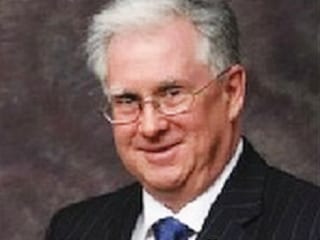
William Michael (Bill) Cox (14 Apr 1950 – 3 Dec 2019)
I first met Bill shortly after I joined the UMIST Corrosion and Protection Centre in 1983. I had been interested in corrosion sensors for detection of hydrogen, and had several discussions with him about the feasibility of the various available corrosion detection methods (mine was useless!). He always focussed on the argument that there was no point knowing whether corrosion was happening unless you also were prepared to intervene to manage the corrosion process. However, at the time industry was more interested in repair after failure rather than management of the processes leading to failure. Of course, being 10-15 years’ ahead of the game Bill was exactly right and over his career he became one of the leading figures in risk and asset management of plant where corrosion is generally the dominant failure process.
Born in Keithley in Yorkshire, Bill was a boy soprano and chorister, he played the piano and the guitar, he was a keen motorcyclist and owner of a vintage BMW K100RS, a very devoted family man, and a serial speeder in either of his two elderly Audis.He completed his undergraduate studies in metallurgy on a sandwich course at the University of Aston in Birmingham in 1975 during which time he met the ‘girl’ who was later to become his wife.On completion of the programme he went to work at the copper-nickel smelter in Selebi Phikwe in Botswana.He loved working with hot metal and the problem solving involved with developing the plant in harsh working conditions.
In 1978 he moved back to the UK to study for an MSc in Corrosion Science and Engineering at the University of Manchester Institute of Science and Technology (UMIST) and in the same year married Anna. After completing his MSc he stayed on to undertake a PhD with John Dawson on “Acid Dewpoint Corrosion”, a problem that was beginning to become of significant commercial concern particularly in power generation and steam-raising plant. Graduating in 1981, he linked up with the Corrosion and Protection Centre Industrial Service (CAPCIS) to develop expertise in, and to market, the on-line electrochemically based corrosion monitoring methods that he had pioneered during his PhD. Working with John Dawson, Steve Turgoose, Graham Wood and Howard Stott from the academic side and, from CAPCIS and industry, with Dave Geary, Dave Eden, Jim Palmer, Bob Eden, Karel Hladky, Les Woolf, Dave Farrell, Paul Bottomley, Barry Meadowcroft, Kevin Lawson, Wai Him, Wai Yeung Mok, and many others. He rapidly developed a significant business based on electrochemical noise instrumentation and sensors that enabled tight process control to be introduced to minimise the conditions leading to corrosion damage. This business eventually become Capcis-March Ltd., for which Bill was managing and operations director – one of the first successful companies to be spun out of UMIST. After 16 years at Manchester he left to found Corrosion Management Ltd, promoting his expertise in the application of advanced corrosion monitoring with risk-based inspection and risk based maintenance technologies for the process industries, as well as general failure investigation and litigation work. His client base was worldwide with projects in Europe, North America and Pacific East Asia.
A strong supporter of ICorr (as Member of Council and of the Training and Certification Board for 20 years and President from 1996-98), IOM3 (as Member of Council from 1993-2003), BINDT (as member of the PCN Certification Board) and NACE (as both Member and Chair of its International Relations Strategy Operations Committee) and was a Fellow of all of these Institutions, the last being a singular Honour. As well as attending (and organising) many conferences, seminars and publishing more than 32 papers, Bill also found time to act as Technical Advisory Editor for Anti-Corrosion Methods and Materials for over 10 years, significantly increasing the journal’s profile.
Well known for his eponymous number plate “B111 COX”, acquired after a nudge from Les Woolf, Bill directly launched and influenced the careers of many people now in senior positions in the corrosion industry. He was always generous with his time and was ever willing to provide advice and mentoring to anyone who asked. Creditably, he always did what he said he would do with energy and enthusiasm, he was straight talking and importantly also straight doing. He is a huge loss and we shall all miss him. The corrosion community has lost one of its great characters.
Bill is survived by his wife Anna and daughter Ella.
With thanks to former colleagues, friends and family who corrected the detail and supplied anecdotes too numerous to mention.
Following a very successful half day event and AGM in 2019, the branch plans to start 2020 with a meeting at the end of Feb (date and venue to be confirmed), with Prafull Sharma from corrosion radar presenting ‘Corrosion Under Insulation online monitoring with Electro-Magnetic Guided Radar (EMGR)’. CUI is a big issue for the corrosion industry therefore any innovative monitoring system will be very beneficial in the goal to mitigate corrosion. It is therefore likely to be a well-attended meeting.
For any branch queries, please contact Bill Whittaker, bwhittaker@cathodicengineering.co.uk, or Paul Segers, paul.segers@segcorr.com
The 2019 branch luncheon proved to be another great success, as the audience was bowled over by an enthralling guest appearance from legendary cricket commentator Henry Blofeld OBE. The unmistakable voice of the Test Match Special, regaled the crowd at the Royal Overseas League in Mayfair with stories from his 45-year career behind the mic, and his two books, which he happily signed for guests after the lunch.
Before the 170 guests settled in the Hall of India and Pakistan for the afternoon, the branch team of diligent raffle sellers had time to mingle and raise an approximate £1,650, which will help fund the future branch series of evening lectures. The contribution from Henry was greatly appreciated, as was the involvement of the event’s sponsors, which this year included Winn and Coles, DuraPol, Corrosion Integrity Management, Correx, and CTS.
The annual event also gave guests the opportunity to reflect on those that the industry lost this year, and in particular the passing of Bill Cox. Tributes to him were led by Institute President Gareth Hinds, who gave a superb account of the excellent work that Bill had done for the Institute during many years of service, which culminated in a rousing applause that Bill would have undoubtedly appreciated.
Preparation has already begun for the 2020 Luncheon, as well as a possible summer ball in London 2021, which will celebrate the 25th anniversary of the of the change of name of the Institute from the British Association of Corrosion Engineers (BACE) in 1966 to the Institute of Corrosion Science & Technology , which was the forerunner of the current Institute of Corrosion.
The first meeting of the branch on Wednesday 8th January had 40 attendees and started with an introduction to the new branding concepts for the Institute, which will be launched in February this year, given by Marc Desmeules, who gave a fascinating insight into the process behind designing a new logo which was the start of the rebranding exercise.
The main technical meeting followed which was a panel discussion on the complexities of internal linings, the selection variables and the link to design standards. The first presentation was from Dr Nasa Miskin from DuraPol who gave a presentation on “Corrosion Prevention in Acid Gas Treating Units”, an extremely difficult and complex environment for any lining system. This was followed by a presentation from Simon Daly of Hempel on “Internal Linings; Selection Variables and Link to Design Standards” which culminated in a discussion on the requirements for the new ISO standard for the internal lining of process vessels.
Both presentations are available to view on the Institute of Corrosion website. It was a successful evening and fantastic to see both the young engineers and branch members in discussion over refreshments afterwards.
The March meeting will be the branch AGM, followed bythe chairman’s talk. Please note the date, Tuesday 10th March.
The Institute of Corrosion continues to follow the official UK government guidelines on how to mitigate the spread of coronavirus (COVID-19).
Our major priority is the safety and welfare of our members, officers and staff. Our main office at Corrosion House is open, with appropriate social distancing and safety measures in place for our staff and visitors.
Our training course providers will provide regular updates via their websites.
We appreciate the patience and support of our members in these challenging circumstances.
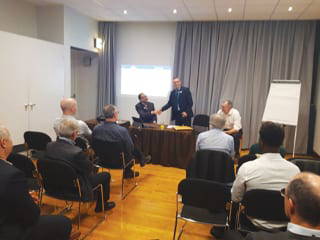
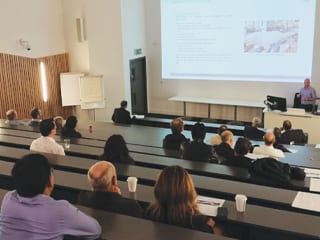
The branch held its 4th event of the 2019/2020 session at its usual venue, RGU, with a presentation on “The Application of bismuth based alloys to address Oilfield challenges” by, Paul Carragher (BiSN), Lance Underwood (BiSN) and Angus MacLeod (BP).
This was a highly successful joint presentation with IOM3 – The Institute of Materials, Metals and Mining, which has recently celebrated its 150 year anniversary. The BiSN speakers discussed in detail their Wel-Lok sealing technology which utilises a unique combination of a thermite powered chemical heater and a bismuth based alloy to deliver an efficient down hole sealing capability, using standard oilfield deployment methods.
The thermite heater provides the energy to melt the bismuth alloy in situ, allowing the heavy liquid alloy to flow by gravity to the desired location. As the bismuth alloy cools, it expands on solidification to provide a seal. Paul Carragher started BiSN in 2010 with the insight to develop new and innovative sealing solutions for the oil & gas industry, and explained the use of bismuth in downhole sealing applications
Lance Underwood, Principal Engineer at BiSN Oil Tools, who has has over 30 years of experience in the industry, then provided further insights into the development of new technologies for plugs for oil wells, covering materials selection, downhole corrosion control and long-term corrosion testing programmes. He illustrated some of the rigorous testing requirements for downhole oilfield tools including bits, mud-motors, turbo-drills, under-reamers, hammers, and laser drilling.
Angus MacLeod (Senior Intervention Engineer with BP), with 22 years Oil and Gas industry experience, then followed this up with some actual case histories from BP operations worldwide, where this technology has been applied offshore, to shut off water production in open-hole gravel pack completions, as well as the work being done to qualify the alloys, as a permanent well abandonment material. In his current role, Angus is responsible for developing new welltechnology as part of BP’s Upstream Technology Group, primarily focussed on “Life of Well Surveillance” and “Plug & Abandonment”. The event generated a huge level of interest and many questions were asked, which can be found, together with the answers, on the branch website.
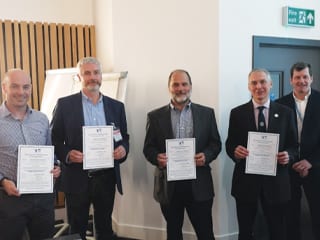
At the close of the meeting, the branch chairman, presented all speakers with a Certificate of Appreciation from the branch.
Full details of future branch events can be found on the diary page of this magazine and on the website, or by contacting: ICorrABZ@gmail.com.
Copies of the majority of past branch presentations can be found at: https://sites.google.com/site/icorrabz/resource-center and a photo gallery for these events is at, https://sites.google.com/site/icorrabz/event-gallery
Particular attention is drawn to the 2020 Corrosion Awareness Day to be held on Tuesday 25thAugust at, Petrofac Training Centre, Forties Road, Montrose, Angus, DD10 9ET. The day will include several practical demonstrations with teaching, this year themed on fabrication and external corrosion management.Further Details about this can be obtained from the branch Chair: Stephen Tate, email: Stephen.Tate@external.total.com
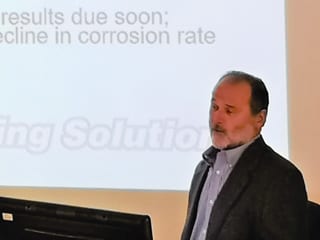
Angus MacLeod highlighted the many practical applications for this new Downhole Sealing Technology.
The Aberdeen Chair Stephen Tate, presented all speakers with Certificates of Appreciation.
We use cookies to optimize our website and our service.
Functional
Always active
The technical storage or access is strictly necessary for the legitimate purpose of enabling the use of a specific service explicitly requested by the subscriber or user, or for the sole purpose of carrying out the transmission of a communication over an electronic communications network.
Preferences
The technical storage or access is necessary for the legitimate purpose of storing preferences that are not requested by the subscriber or user.
Statistics
The technical storage or access that is used exclusively for statistical purposes.The technical storage or access that is used exclusively for anonymous statistical purposes. Without a subpoena, voluntary compliance on the part of your Internet Service Provider, or additional records from a third party, information stored or retrieved for this purpose alone cannot usually be used to identify you.
Marketing
The technical storage or access is required to create user profiles to send advertising, or to track the user on a website or across several websites for similar marketing purposes.