The Welding institute meeting on Materials, Welding and Integrity issues in Offshore Wind
ICorr members are invited to attend a meeting on the theme of Offshore Wind Energy structures and their issues of materials, welding and integrity and will be held at TWI, Granta Park, Cambridge CB21 6AL on Thursday 15th March.
The line up of speakers, including:
Ben Wysome, Head of Department, Offshore Wind team, Ramboll UK,
Mons Hauge, Chief Engineer Materials Technology, Statoil
Dr Stephan Brauser, Mannesmann and Dr Andreas Pittner, Federal Institute for Materials Research, Germany
Professor Michael Havro-Faber, Aalborg Universitet, Denmark
Professor Feargal Brennan, Cranfield University
Steve Marson, James Fisher Testing Services
Alan Denney, AKD Materials Consulting Ltd.
For full details of the meeting please access this link;
Time: 17:30 – 20:00 – Food and light refreshment provided
Topics: Branch AGM Meeting, follow by three presentations detailing advancements in Galvanic Anode systems for use in reinforced concrete structures by Senior Corrosion Specialists from Mapei, CPT Ltd and Vector Corrosion Technologies Ltd.
Date: 10th April 2018 and will include the branch AGM
Topics: Midland Branch AGM Meeting
Detailing advancements in Galvanic Anode systems for use in reinforced concrete structures. The presentation will be provided by senior corrosion specialists from Mapei, CPT Ltd and Vector Corrosion Technologies Ltd.
The venue: Amey International Design Hub,
20 Colmore Circus Queensway
Birmingham B4 6AT
Time: 17.30 to 20.00 – food and light refreshment provided
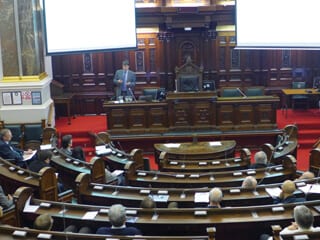
The Branch half-day event and ICorr AGM took place in the Chamberlain Room & Main Chamber of the Birmingham Council House on Wednesday 29th November 2017.
The event was well attended and after lunch and refreshments attendees were welcomed to the council chamber by Trevor Box, Midland Branch Chair. The first presentation was on the “Hammersmith Flyover Strengthening – Repairing the Effects of Corrosion” by Graham Stanford of Freyssinet. Graham’s interesting presentation covered the damage caused to the post tensioned structure and remarkable repair techniques employed to strengthen and repair this critical piece of London’s infrastructure.
The second presentation of the day covered an Innovative Solution for the Prevention of Crevice Corrosion at Pipe Supports by Clive Evans of Deepwater EU Ltd. Clive’s presentation dealt with Deepwater’s pipe support system to deal with crevice corrosion and the problems caused by crevice corrosion to pipes across a range of industrial sectors.
The next presentation dealt with the Cable Impregnation Technique for Corrosion Protection of Grouted Post-Tensioned Tendons by Peter McCloskey of Vector Corrosion Technologies. Peter explained this relatively new technique which has been developed by Vector in North America to deal with corrosion of tendons in grouted ducts of existing post tensioned structures.
The final presentation was an overview of “Cathodic Protection Training and Certification: The ISO Requirements” by Jim Preston, Corrosion Prevention Limited. Jim covered in detail the recent changes to the ISO standard and the implications of future training and certification requirements.
At the end of the presentations a lively panel discussion took place with some excellent questions from the attendees and much discussion between the attendees and the presenters.
The day was brought to a close by the ICorr AGM which included the financial report for the year.
Midland Branch has a new sustaining member, SegCorr Ltd, Independent Consultants Specialising in cathodic protection and corrosion management (more details can be found in preceding section).
The second presentation of the 17/18 season was a joint meeting with TWI, and James Hesketh of the National Physical Laboratory gave a presentation on the Influence of H2S on the Pit to Crack Transition in Sour Testing of Corrosion Resistant Alloys.
James Hesketh received a vote of thanks from Stephen Shapcott of TWI on an excellent presentation and received gifts from both TWI and ICorr.
James highlighted that stable pitting is a precursor to sulphide stress corrosion cracking (SSCC), which is one of the main causes of failure of stainless steel pipelines used in sour Oil and Gas production. Despite this, the underlying mechanism governing the growth of such pits is poorly understood, and hence materials selection for sour service is dependent upon costly and time consuming environmental exposure and SSCC test programmes.
In the study at NPL, the role of hydrogen sulphide (H2S) in pit propagation was investigated as a first step towards the development of accelerated test methods for SSCC resistance. Novel electrochemical techniques were employed to determine the relationship between bulk solution chemistry and the critical pit chemistry required to induce stable pitting in sour environments. James stressed that electrochemical measurements are correlated with results obtained from standard SSCC tests and are rationalised in terms of the balance between H2S diffusion through the pit mouth, H2S consumption within the pit and the role of the external cathode.
He also explained that there was a systematic decrease in pit size with increasing H2S concentration. Also that a greater peak current was measured at higher H2S concentrations and repassivation was slower.
The 29th London Branch Lunch, held at The Royal Overseas League in early December, was another huge success with 177 people attending the event in Mayfair London.
Guests started to arrive at 11.30 for a pre-lunchdrink and were seated by 12.30 for the first of two acts by The Sirens a group of three singing performers, which was really well received and set the scene for the afternoon. The meal was yet again excellent and congratulations to the ROSL who never disappoint. After the lunch the Chair of London Branch thanked the luncheon organising committee ad the branch committee, who continue to drive the Institute in London forward.
The President then addressed the guests to a rapturous applause once again thanking everyone for their support and explaining that the Institute has exciting plans that will start in Q1 2018.
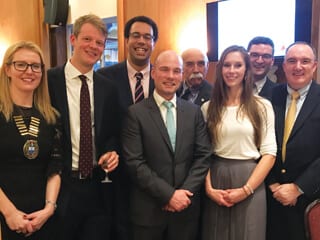
From left – right, Sarah Vasey, Chris Bridge Simon Bowcock, Trevor Osborne, Charlotte Vie, David Mobbs and Bill Hedges.
After the raffle, two guests were honoured with a small gift in recognition of them receiving the Tallow Chandlers Award for their work in materials and corrosion, a tremendous achievement by Charlotte Vie in 2016 and Simon Bowcock in 2017.
The timing for the event this year was slightly different allowing guests to socialise and network at the ROSL until 7.00pm which appeared to be extremely popular with lots of notes being taken and exchanging of business cards.
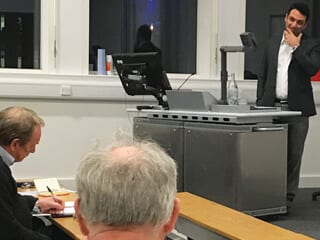
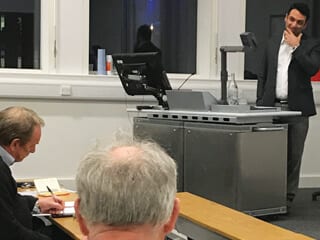
Thanks go again to all those that assisted in the organisation of the event and we look forward to another exciting event in December 2018. Hamed Habibi, Technical Director of Speir Hunter Ltd, gave an interesting presentation entitled “Developments in Remote Magnetic Monitoring of stress in ferromagnetic Pipeline” at the January meeting.
The talk introduced and explained the benefits of stress monitoring in pipeline integrity management. It is the only inspection technique that can simultaneously map the lateral position and depth of cover of a pipeline whilst providing comprehensive defect detection.Several case studies were discussed to illustrate the advantages of this the technique, also known as Stress Concentration Tomography, over traditional inspection methods.The technique is able to assess condition of buried pipelines remotely and is not dependent on the type of defect, size of pipe, construction configuration or operating condition, and cansave a considerable amount of time, effort and budget while providing an accurate 3 dimensional mapping of a pipe and surrounding objects.The technique can also identify location of casings and wrinkle bends, information becoming required by the regulatory authorities.
We use cookies to optimize our website and our service.
Functional
Always active
The technical storage or access is strictly necessary for the legitimate purpose of enabling the use of a specific service explicitly requested by the subscriber or user, or for the sole purpose of carrying out the transmission of a communication over an electronic communications network.
Preferences
The technical storage or access is necessary for the legitimate purpose of storing preferences that are not requested by the subscriber or user.
Statistics
The technical storage or access that is used exclusively for statistical purposes.The technical storage or access that is used exclusively for anonymous statistical purposes. Without a subpoena, voluntary compliance on the part of your Internet Service Provider, or additional records from a third party, information stored or retrieved for this purpose alone cannot usually be used to identify you.
Marketing
The technical storage or access is required to create user profiles to send advertising, or to track the user on a website or across several websites for similar marketing purposes.