A helpful starter for anyone in the corrosion industry, Basic Corrosion covers the causes of corrosion as well as how to identify , monitor, and control it. By completing this course, show employers you have a strong understanding of the basics, and take the first step in working towards becoming NACE certified.
For details of the course, please click link below:
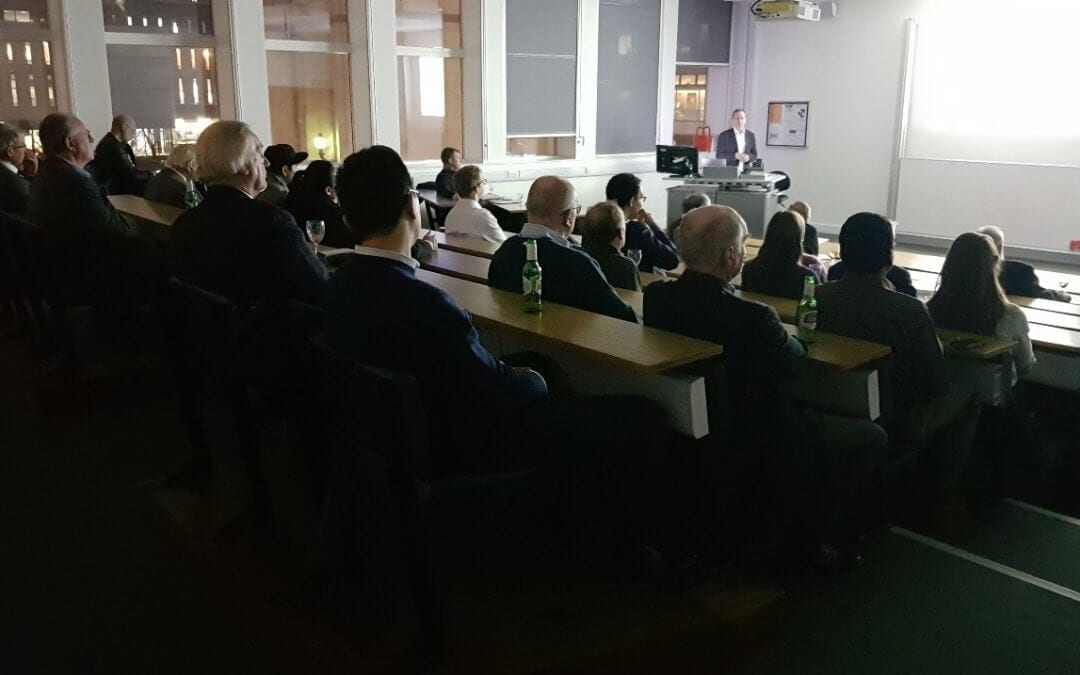
Mark Stone delivered a fascinating presentation on the advancements of Storage Tank Integrity. It’s of particular interest to David Mobbs having been a career objective to establish a mechanism for detecting metal loss on the base plates of tanks without the need to “drop the tank”. The industry is well versed with Non-intrusive inspection of vessels and pipework, but Corrosion Mapping of Storage Tanks has always relied on man entry and physical base plate inspection. The industry does not like working in confined spaces and there are moves towards zero-man entry over the lifetime of storage and process vessels.
Mark Stone explained that Storage Tank inspection plays a major role in effective integrity management of Storage Tanks. Historically, inspection of the floor has relied on emptying the tank and personnel entry for cleaning and inspection and that the common method of using MFL is not necessarily the most effective method of determining metal loss.
Sonomatic have developed a range of methods for inspection of Storage Tanks while in-service. This includes the use of traditional shell wall inspection using crawlers coupled with new technology to determine metal loss in the first meter of the tank using multi skip technology deployed around the outer chime of the tank.
The key element of the program is however the use of a robotic cleaning and inspection of the floor. The tool dropped through the tank fluids to the floor and remotely guided by use of sonar. The first part of the program is to understand the level of sludge which is completed by the sonar that is strategically placed around the base of the tank. The tool is then able to remove the sludge and scan the base plates, results are transmitted to a mobile unit outside where the program is supported by statistical analysis. The presentation included a case study of a field application and the detail can be seen on the LB page of the website
There was a good level of discussion around the floor and it was the view of David Mobbs that this process real value is in an “iterative process” where a tank farm operator would screen all the tanks and identify which was detected as the worst. On opening the tank and carrying out full base plate inspection its possible to check the model to see how accurate it is. By the time the 3rd tank is completed its full inspection the model is going to be pretty accurate. For Copy of the Newsletter please click below;
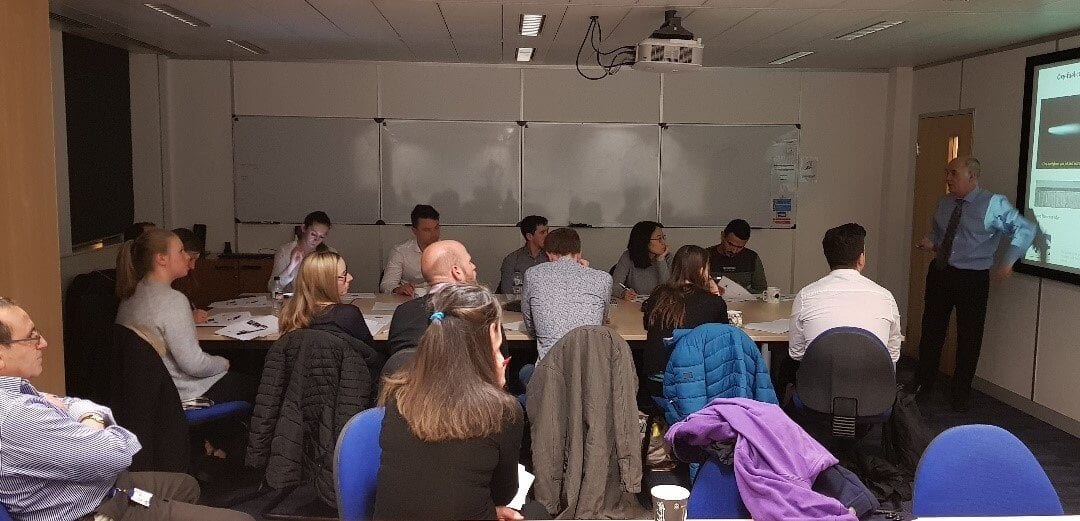
The second presentation of The Young Engineers Program (YEP) also at CB&I in London with an excellent presentation on the complexity of Welding & Cutting followed by Non-Destructive Testing. The program continues through the year with 9 modules including a Case Study which the delegates will complete with the help of mentors.
The discussion was all encompassing but dealt with the basics of;
The basics
The common arc welding processes
o Manual welding with covered electrodes; SMAW (MMA)
o Submerged arc welding; SAW
o Gas shielded welding; GMAW, (MIG / MAG)
o Flux-cord arc welding; FCAW, SS-FCAW
o Gas shielded welding with non-consumed electrode; GTAW (TIG)
Choice of welding processes
Cutting
o Oxy-fuel cutting
o Air-arc gouging
The lecture continued Non-destructive testing where the scope was;
Magnetic Particle Inspection
Liquid Penetrant Inspection
Radiography
Manual Ultrasonic Testing
It did not cover visual inspection which is the most common inspection method
The group enjoyed a networking session after the meeting at a local Lebanese restaurant courtesy of The Institute of Corrosion.
The next YEP meeting will be Materials and Materials Selection to be presented by Sadegh Parvizi on Wednesday 21st March at CB&I in London.
We are extremely grateful to Alan Denney and Sadegh Parvizi at CB&I and all the other members of ICorr that give up their time freely to assist our Young Engineers with their career development
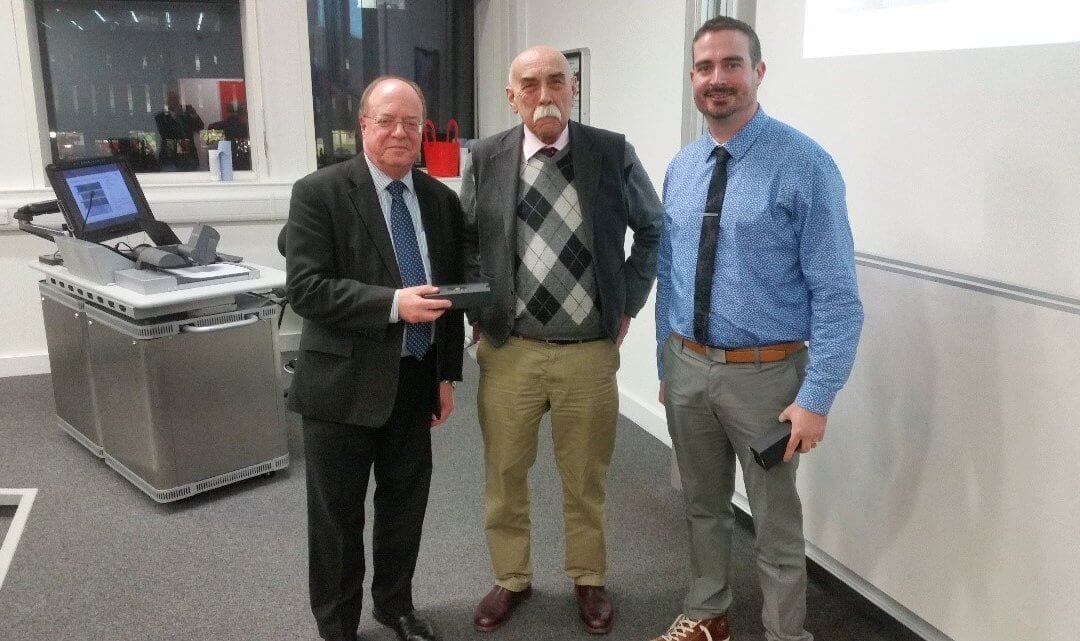
The presentation given by Dustin was excellent, raising a significant discussion amongst those attending. Dustin’s idea was to raise awareness of new predictive modelling techniques for coating life and performance. A new generation of high temperature coatings, such as high glass transition temperature Fusion Bonded Epoxy (with Tg 205°C), are being developed as a lower cost alternative to expensive alloy steels. However, the highly-functional epoxy resin and ingredients in these new coatings can make interpretation of testing results difficult for coating specifiers. Dustin Traylor, MSE and Dr. Stephen Drew of Axalta Coating Systems explore the benefits of using Electrochemical Impedance Spectroscopy (EIS) after atmospheric testing to assess a coating’s life expectancy. This technique has now been adopted by Aramco and Chevron and is gaining credibility as a useful tool in the pipeline market.
The conclusion was that EIS did have a part to play in conjunction with accelerated weathering; Autoclave and Atlas Cell to assist with the determination of expected coating life.
To verify the laboratory work to date, the Axalta team needs field data on aged coatings to establish if this is an appropriate standard for testing of coatings
We use cookies to optimize our website and our service.
Functional
Always active
The technical storage or access is strictly necessary for the legitimate purpose of enabling the use of a specific service explicitly requested by the subscriber or user, or for the sole purpose of carrying out the transmission of a communication over an electronic communications network.
Preferences
The technical storage or access is necessary for the legitimate purpose of storing preferences that are not requested by the subscriber or user.
Statistics
The technical storage or access that is used exclusively for statistical purposes.The technical storage or access that is used exclusively for anonymous statistical purposes. Without a subpoena, voluntary compliance on the part of your Internet Service Provider, or additional records from a third party, information stored or retrieved for this purpose alone cannot usually be used to identify you.
Marketing
The technical storage or access is required to create user profiles to send advertising, or to track the user on a website or across several websites for similar marketing purposes.