Even though the weather seems to want to slow us down in the UK, the Institute continues to move forward at a pace.The last council meeting which was held at the end of February in Northampton, was very lively indeed, and shows the passion that is held by council members for the Institute.Further development plans are in motion and I hope that members are starting to see increased activity.New dates are planned for the “Fundamentals of Corrosion” course in locations around the UK.Branch activity is very encouraging, the informative and dynamic report from Aberdeen was a highlight!
Our search for a new home for the Institute is ongoing, and we are investigating a potential site as I write this.
The route to Chartered Status is moving along and if anyone would like more details on how to get involved with this, as either a mentor or candidate, please contact David Mobbs.The new season of the Young Engineers Programme is in full swing, with our great thanks to CB&I in Paddington for offering a venue for this excellent initiative, and also thanks to the sub-committee of George Winning, Trevor Osborne and David Mobbs, for putting in the effort to run this.
In May, the CEOCOR Congress will be coming to the UK, Brian Wyatt is the current President and together with an ICorr committee headed by Steve Barke, have organised what looks to be a fantastic event, and when I last checked looked like we will be soon reaching capacity.This is an event well worth attending if you are involved in the pipeline protection field.I will have the pleasure of being there and I hope to see ICorr being strongly represented.
As a final reminder to all, if you would like to progress your professional standing with the Institute, then we would welcome any applications, and if you have any questions on this process please contact the Northampton office.
After due consideration of the nominations for the CED 2018 Paul McIntyre award, the selection panel has agreed to give this year’s award to Dr. John Broomfield. He will be attending the next CED working day to receive the award
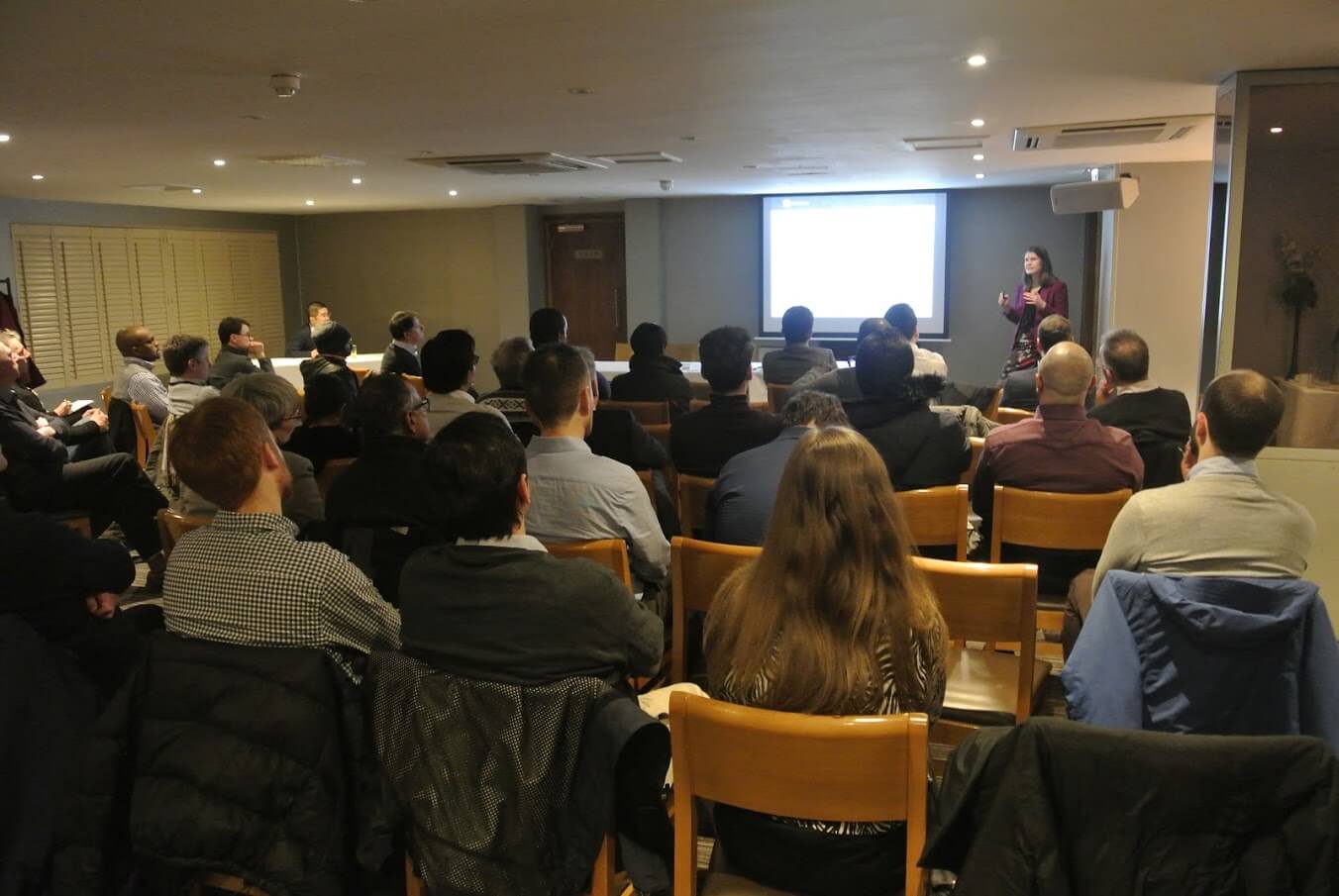
The February event focused on internal corrosion management Issues, particularly corrosion mitigation by chemical control and optimization. A very enjoyable and informative presentation was given by Emma Perfect, CEO of LUX Assure Ltd, who described the development of an onsite technique for measuring dosage of corrosion inhibitors used in the protection of pipelines. This advanced technique was developed as there was a perceived need to identify more quickly, and more accurately, when dosing levels of inhibitor were either below or above the threshold for protection, and hence allow an operator to adjust levels to better protect equipment from corrosion or have options to lower the dosage level to reduce costs of inhibitor supply.
A well supported event at Palm Court Hotel
Development of the LUX Assure Control Concept commenced in 2008 and the company has been supported by key energy industry players including Chevron, ConocoPhillips and Statoil Technology Ventures, along with the Scottish Investment Bank and Archangels / Private Investors. The technique relies on the fact that corrosion inhibitors form micelles in the body of the fluid once all available sites for absorption are occupied. This is essentially a saturation point, and the micelles formed increase in concentration as inhibitor is supplied in excess of optimal levels.
With access provided to suitable trial sites, the development of the technique and a suitable kit for onsite monitoring progressed over a period of 3-4 years until it was fully commercialized in 2013. LUX Assure gathered data to show operators that this technique could be used to test fluids and identify the Critical Micelle Concentration (CMC) of a surfactant above which micelle formation occurs. But the real challenge for LUX Assure was to develop a kit, (now known as CoMic TM) which operators offshore could use to sample and analyse fluids in the field in relatively uncontrolled environments without precise preparation. The specialised kit includes detection reagents and an optical analyser. Final data processing evaluation of the sample is still currently performed back at the offsite laboratory and results and advice swiftly communicated back to the field, but a full onsite service is currently being progressed
The presentation, which was well received, went on to describe case studies and discuss when samples may not be suitable for testing, and also the correct use and interpretation of the data for the test situation. It is hoped that in the near future that all data interpretation can be made by the test operator if a practical and proven site assurance system can be developed.
A helpful starter for anyone in the corrosion industry, Basic Corrosion covers the causes of corrosion as well as how to identify , monitor, and control it. By completing this course, show employers you have a strong understanding of the basics, and take the first step in working towards becoming NACE certified.
For details of the course, please click link below:
We use cookies to optimize our website and our service.
Functional
Always active
The technical storage or access is strictly necessary for the legitimate purpose of enabling the use of a specific service explicitly requested by the subscriber or user, or for the sole purpose of carrying out the transmission of a communication over an electronic communications network.
Preferences
The technical storage or access is necessary for the legitimate purpose of storing preferences that are not requested by the subscriber or user.
Statistics
The technical storage or access that is used exclusively for statistical purposes.The technical storage or access that is used exclusively for anonymous statistical purposes. Without a subpoena, voluntary compliance on the part of your Internet Service Provider, or additional records from a third party, information stored or retrieved for this purpose alone cannot usually be used to identify you.
Marketing
The technical storage or access is required to create user profiles to send advertising, or to track the user on a website or across several websites for similar marketing purposes.