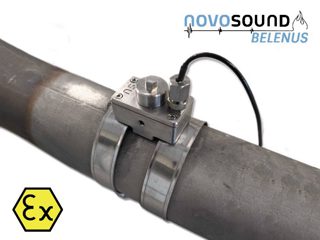
According to the press release, the Novosound Belenus-X corrosion monitoring sensor has been certified for operation in ATEX, IECEx and UKEX Zone 0 locations. Designed and manufactured in line with international intrinsically safe standards, this latest certification extends the potential application of the Novosound Belenus-X to operate in areas where explosive gas atmosphere is present continuously or for long periods.
The Novosound Belenus-X is a permanently installed ultrasonic sensor enabling in-service corrosion monitoring in the most safety-critical and high-risk environments and capable of continuous operation up to 400°C. Combined with its high-resolution imaging capabilities, the Belenus-X provides process engineers with highly accurate wall thickness measurements.
Enabling continuous corrosion monitoring in hazardous areas, the Belenus-X provides plant operators with granular, high-quality and repeatable corrosion data that cannot be achieved with periodic manual inspections.
With the sensitivity to detect small changes in wall thickness, the Belenus-X enables the early and reliable detection of corrosion. This facilitates better maintenance planning and allows operators to carry out timely repairs, mitigating potential, costly damages. By enabling the move away from manual inspections, the safety risk to personnel when operating in hazardous locations is also reduced, concluded the company.
Ceresana has published their latest paints and coatings market survey. Chapter 1 presents and analyses the global market for paints and coatings – including forecasts up to 2030. The development of revenues, demand and production are outlined for each world region, and the market figures on consumption are divided according to applications, product types, and technologies. In addition, the regional markets for paints and coatings are broken downinto, and analysed by, the application, and the demand for each product type is examined separately. In Chapter 2, sixteen countries are analysed in detail according to demand of paints and coatings, export, import, production, and revenues.
The market data on consumption volumes per country are analysed according to the individual paint types, and technologies, e.g.
• Waterborne
• Solvent-borne
• Powder coatings
• Others
Finally, Chapter 3 offers a useful index of 119 major manufacturers of paints and coatings, clearly organised according to contact details, revenues, profits, product range, production sites and a brief company profile.
According to the press release, over the last decade, it has been established that chlorine-induced corrosion is affecting some of the major structures at NSW Ports, including Sydney Harbour and Port Botany, Australia’s largest container port.
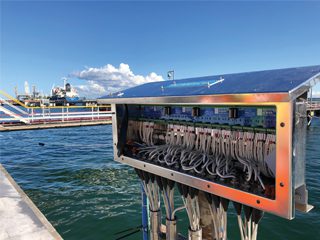
As a result, NSW Ports commissioned Infracorr to design a CP system for use at BLB1, which is located at Port Botany and contains hazardous gas pipelines. The project also included the repair of defective concrete structures which were suffering from the effects of corrosion and concrete spalling in the many pre-stressed beams and headstocks of the various bridges and catwalks at the port.
The CP system needed to be designed to allow for tight control of the currents and voltages used across the site, due to the presence of hazardous materials in the environment on an ongoing basis, meaning that any stray sparks caused by excess voltages and currents could become an ignition source for a major fire or explosion, and that as many of the structures present are constructed using pre-stressed concrete, it was extremely important that all electrical currents applied were carefully controlled to avoid structural damage caused by over protection.
One of the big technical challenges for the project was that there was no off-the-shelf CP system available that had certification for use in zone 1 classified hazardous areas, which meant that a bespoke system had to be designed that met the cathodic protection objectives, including dealing with the challenge of prestressed concrete, and that could be certified to meet the necessary requirements under AS60079 regulations.
The system designed for use at BLB1 by Infracorr, was a hybrid CP system that combined the properties of both passive galvanic and impressed current cathodic protection. It works by inserting specially designed anodes directly into the structure in a matrix. A voltage is then applied to force salt migration from the steel to the anode and passivate the zone, and when the zone is sufficiently charged, the power source is disconnected, and the sacrificial anodes are left to operate galvanically, providing passive protection to the structure.
The system relies on remote monitoring technology to provide asset managers with ongoing reassurance that it is operating as intended, and corrosion levels are under control, and to deliver this, Omniflex were asked to advise on the remote monitoring aspects of the design.
Because this was the first large scale implementation of hybrid CP used in a working hazardous area anywhere in the world, some components needed certification for the design to meet the requirements of AS60079 as an intrinsically safe certified system, which was subsequently obtained.
System performance and corrosion levels are continuously monitored 24/7 using 24 remote monitoring units situated throughout the site, each with the capacity to monitor 16 structures. This should ensure that the integrity of BLB1 is maintained, and the berth remains reliable and available to handle NSW’s growing bulk liquid trade volumes for the next 50 years. For further information, visit www.omniflex.com
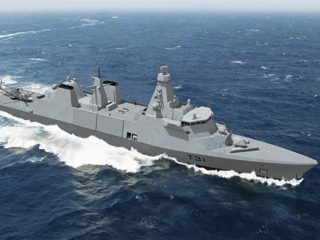
KAEFER UK and Ireland, has announced that it has secured a long-term, £22m contract with Babcock, to provide technical surface protection to the Royal Navy’s newest frigate, the Type 31.
The shipbuilding programme which will continue until 2028, brings continuity of work for KAEFER’s existing industrial services workforce at Babcock’s Rosyth facilities, with new employment opportunities and prosperity for the local economy.
KAEFER will apply over 510,000m2of specialist paint coatings, providing skilled jobs for an additional 70 painters and support staff. With this work forming part of the build programme, KAEFER’s expertise, highest quality standards and long history of delivering ship support services safely, on time and on budget, is vital.
Sean Donaldson, Managing Director, Marine Engineering and Systems, Babcock International Group said: “The contract with KAEFER, to supply the Type 31 programme, builds upon years of collaboration between our organisations. New painting, protection and digitilisation technology will be deployed within a working arrangement, to deliver a successful project for our end customer, the UK Royal Navy.”
Image courtesy of Babcock International Group.
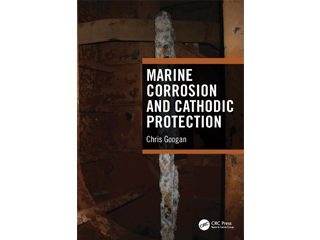
Marine Corrosion and Cathodic
Protection, Ist Edition
By Dr Chris Coogan
Cathodic protection (CP) mitigates the high cost of steel and other alloys corroding in seawater and seabed sediments. Marine Corrosion and Cathodic Protection is a comprehensive guide to corrosion issues and presents methodologies to tackle common offshore code-based CP designs. Advanced theory is developed for non-routine CP applications, with and without subsea coating systems.
The interactions between CP and the fatigue and hydrogen embrittlement characteristics of alloys are explained. Sacrificial (or galvanic) anodes and impressed current systems are examined, followed by descriptions of successful and unsuccessful applications on petroleum installations, harbours, jetties, pipelines, windfarm foundations, ships, and floating production storage and offloading (FPSO) structures. Retrofit CP systems for the life extension of assets, together with methods for applying CP internally in both static and flowing systems are evaluated. A critical review of the role of physical and computational modelling in CP design and evaluation addresses the more geometrically complex applications. Techniques for, and limitation of, CP surveying, inspection and monitoring, are explained in the context of system management.
This book is ideal for engineers, designers, manufacturers, equipment suppliers and operators of offshore CP systems.
The author, Dr Chris Googan, is an AMPP International Accredited Corrosion Specialist. After graduating in chemistry, and spending several years in the steel and
copper industries, and in the protective coatings industry, he became a freelance corrosion engineering consultant. His experience of corrosion, materials, coatings and cathodic protection has been gained in over 40 countries.
Published by CRC Press, ISBN 9781032105819. Price £13
We use cookies to optimize our website and our service.
Functional
Always active
The technical storage or access is strictly necessary for the legitimate purpose of enabling the use of a specific service explicitly requested by the subscriber or user, or for the sole purpose of carrying out the transmission of a communication over an electronic communications network.
Preferences
The technical storage or access is necessary for the legitimate purpose of storing preferences that are not requested by the subscriber or user.
Statistics
The technical storage or access that is used exclusively for statistical purposes.The technical storage or access that is used exclusively for anonymous statistical purposes. Without a subpoena, voluntary compliance on the part of your Internet Service Provider, or additional records from a third party, information stored or retrieved for this purpose alone cannot usually be used to identify you.
Marketing
The technical storage or access is required to create user profiles to send advertising, or to track the user on a website or across several websites for similar marketing purposes.