Ascott have been at the forefront of corrosion and salt spray test cabinets for over 30 years. Their business is totally focused on corrosion test equipment, and today they are one of the leading suppliers of salt spray cabinets and cyclic corrosion cabinets in the world, exporting to over 45 countries.
Everything produced is manufactured in their factory here in the Midlands, with local suppliers very much at the heart of the supply chain. Their latest range embodies customer led innovation, blending performance and technical excellence. The creation and control of corrosive climates has never been more demanding, and the development of new materials and surface coatings, plus increasing user expectations, has given rise to ever more rigorous testing. This is their forte.
Their expertise is the reassurance that a customer needs to ensure their testing is precise, compliant, and repeatable. Their equipment leads the world technically, but they also pride themselves on offering excellent value for money. Investment in an Ascott chamber offers the customer consistency, reliability, and, with their premium level of after sales support as standard, a high degree of confidence.
Many test standards can be complex and difficult to interpret, and the customers rely on their expertise, experience, and knowledge in this field to guide them to the exact product that will meet their needs. Every chamber is built to individual customer specification, even down to incorporating customer branding and corporate colours if required.
They also supply a comprehensive range of laboratory and field test equipment and consumables via an online shop, offering a convenient and trusted one stop solution for all your testing requirements.
The January technical meeting featured a presentation by Joshua Owen (pictured left), Research Fellow in the Institute of Functional Surfaces, School of Mechanical Engineering, University of Leeds, on “Advanced once-through flow cell methodology for validation of a new ‘staged’ inhibition approach for matrix acidising treatments” as part of a collaboration between Schlumberger and Leeds to evaluate staged inhibitor approaches prior to industrial application.
Schlumberger recently introduced and patented a new staged acid corrosion inhibitor (ACI) treatment concept for application in matrix acidising treatments. The staged treatment concept recognises that treatments which employ a fixed dosage of corrosion inhibitor may not be optimal in terms of their efficiency. The concept proposes staged pumping of a first fluid composition designed to establish a persistent inhibitor film (Stage 1) and a second fluid composition to maintain the film and its associated inhibited corrosion rate (Stage 2). The staged ACI concept has the potential to provide enhanced corrosion protection of wellbore casing and coiled tubing (CT) materials, whilst using the same total quantity of inhibitor compared to conventional treatments.
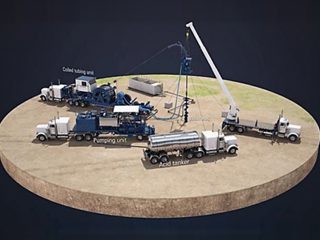
Typical Onshore Well Acidising Treatment.
Typically, the corrosion test methods used to evaluate this approach have involved preparing two equivalent pre-heated and conditioned glass reactors, one of which is used for the first film-forming stage and the other for the second film maintenance stage. This procedure is rather inconvenient and involves a short period of time (~1 min) during which the weight loss coupons or working electrode (a rotating cylinder electrode) are in contact with the atmosphere which could change the corrosion potential and could potentially have an influence on the inhibitor film formed during the first stage. Instead, a bespoke, electrochemical, milli-fluidic once-through flow cell was used for validation of the staged ACI concept by exposing a carbon steel coupon, mounted within the flow cell, to 4 M hydrochloric acid (HCl) flow at a temperature of 80 °C and a flow rate of 5 ml/min. A once-through flow cell enables testing in a continuously flowing environment whilst maintaining a fresh acid solution, a controllable supply of inhibitor, and eliminating any contact of the electrode with the atmosphere.
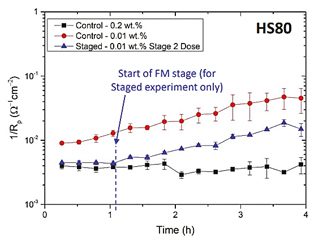
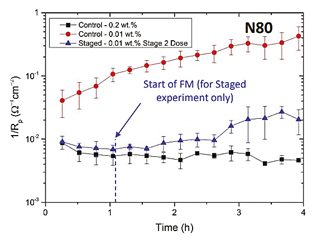
The system was used to quantify changes in corrosion behaviour during continuous flow and during transitions from the first to second stage inhibitor dosages, to find optimal inhibitor concentration for film-forming and film maintenance stages, and to investigate the effect of metal pre-corrosion on inhibitor performance for carbon steel used as wellbore casing and CT materials. In situ linear polarisation resistance measurements confirmed that an acetylenic alcohol-based polymerisable inhibitor, used at a concentration of 0.01 wt.% in Stage 2 after a 0.2 wt.% concentration film forming stage (Stage 1), maintained excellent corrosion protection of N80 (wellbore casing) and HS80 (CT) carbon steel, with corrosion rates of < 5 mm/year measured.
Significant corrosion rate reductions achieved with staged inhibition versus applied controls.
Advantages of the flow cell for application in ACI studies are:
1. Well-defined hydrodynamics: Consistent and predictable flow across metal surface once-through nature:
2. Fresh HCl and ACI are continuously replenished and flow into waste, maintaining consistency in experimental conditions throughout In situ electrochemical measurements:
3. Measurements of corrosion rate in real time seamless condition changes:
4. Composition of fluid can be easily changed prior to inflow during an experiment (no exposure of coupon to air)
For the February presentation, Leo Richards, Principal Engineer and Andrew Duncan, Lead Consultant, both with Intertek Production and Integrity Assurance Group, described the “Implementation of Plan-Do-Check-Act review.
Leo Richards (left) Intertek Principal Engineer Production Chemistry and Andrew Duncan (right) Intertek Lead Consultant, Production and Integrity Assurance.
Corrosion management guidelines were used as the basis for an audit study of a large onshore oil field, the purpose of which was to perform a detailed review of the corrosion monitoring and mitigation systems, and to advise on any required upgrades to ensure world class/excellent asset integrity performance.
The approach taken for the study was to follow the UK Health and Safety Executive’s guidance for ‘Managing Health and Safety’, HSG65 (2013), of PLAN-DO-CHECK-ACT, which considers both Technical and Systems approaches associated with managing assets safely. This is a closed loop planetary model commencing with a high-level corporate policy for health and safety, under which there is a policy and plan for managing corrosion and integrity. The model ends with lessons learned which feed back into the corrosion and integrity policy and plan to ensure risks are managed to ‘As Low as Reasonably Practicable’.
The model ends with lessons learned which feed back into the corrosion and integrity policy and plan to ensure risks are managed to ‘As Low as Reasonably Practicable’.
First, a detailed study was carried out to assess and identify the current corrosion management techniques being used and their effectiveness in the operator’s fields and process plants. The ‘gaps’ were identified within the assets, and corrosion management proposals and solutions were then provided to ensure world class asset integrity performance.
A desktop-based document review was conducted in the UK and also at the client’s offices. This was followed up by site surveys, which included visits to at least one plant of each of these facility types: gas station, degassing station, gas recycle plant, PWI stations, gas distribution stations and stripping plants.
In order to help delegate and spread some of the responsibilities for the study areas within the operator’s corrosion team, Intertek deployed RACI Charts: Responsible – Accountable – Consulted – Informed, which serves to provide structure to the corrosion team as a whole, defining who does which task and allowing the right people to do the right job and move on with it.
The study highlighted a distinct pattern in the working practices of the operator with virtually all sections of the corrosion management system being shown to have some form of PLAN and DO. However, the implementation of the CHECK and ACT stage was missing from almost all aspects.
Some Key Findings
1. Automation and use of a suitable database/Corrosion Management System makes the DO stage easier and quicker.
2. For CHECK and ACT – an automated system requires Specialist assessment, rather than total reliance on the CMS output. Automation may also result in complacency.
3. For CP monitoring, sensors need to be regularly calibrated, and the system checked to ensure full protection.
4. Data requires to be both CHECKED and reviewed.
5. ACT will have double impact – ACT on what the data has shown and ACT on how the data was gathered.
Future Application of P-D-C-A and Corrosion Monitoring
The working world has changed dramatically over the last two years due to Covid and there has been a significant change in Engineers’ working patterns and methods of project study and delivery. This has also combined with a move towards remote and automated inspection and monitoring, however, the speakers were keen to stress that if the PLANNING Stage is not implemented correctly, then wholesale automation of integrity systems is not always helpful, as automated systems will follow ‘Garbage In Garbage Out’ scenarios, Specialist input is always required. (Editor: Readers should note that a longer technical article on this topic appears later in this issue of the magazine).
Both these very engaging presentations generated many questions from the audience that were expertly responded to by the speakers, and all Q&A write-ups may be found on the branch webpage.
Slides of technical papers for branch events, along with their respective Q&A’s can be found at, ICorr Aberdeen Branch (google.com) under Local Technical Programme, Aberdeen Branch – Institute of Corrosion (icorr.org). A library of event recordings may also be found at: ICorr Aberdeen – YouTube.
It is also with our great pleasure to announce that Rysco International Inc. based in Alberta, Canada, has become the latest new sponsor of the branch, as well as becoming a GOLD sustaining member of ICorr. The branch is very grateful to all its sponsors for their continued support.
Finally, the branch is very sad to report the recent passing of Carol Anne Powell BSc., FIMMM, a long-term consultant to both the Nickel Development Institute and the Copper Development Association.
She had written over 40 papers and publications and been a member of our Partner Organisation the Marine Corrosion Forum (MCF), since its inception. During the recent COVID-19 epidemic as we were moving increasingly towards Webinar formats in April 2020, Carol greatly assisted us with an excellent presentation to our ICorr/MCF membership entitled ‘An Overview of the Corrosion of Metals in Seawater. In her memory, we would respectfully direct you to: https://marinecorrosionforum.co.uk/free-webinar-30%2F04%2F2020
The Aberdeen branch would like to invite you (or a colleague) to give a presentation during their 2022/2023 session. The events normally are held at 6 pm on the last Tuesday of the month from September till May 2023, excluding December 2022.
Topics on pressure systems, pipelines, renewables and structural integrity management with regards to the material selection, production chemistry, welding, corrosion/microbiological control and monitoring, inspection techniques and data analytics, are acceptable. Past case studies, project experiences, and emerging technologies have proved popular and interesting to members, and are particularly welcome.
The attendees (members and non-members) include students, technicians, technologists, engineers, scientists, researchers, managers, company directors and other professionals from the oil and gas, power generation, manufacturing and renewables sectors. Subsequently we would publish a report of the presentation in Corrosion Management magazine, and also on the ICorr, and Aberdeen website pages, including the presentation slides and Q&A session write-up. A recording of the event (if conducted online) will be uploaded to our YouTube channel later.
If interested, please supply the following including, speaker’s name, role and company, short biography of the speaker(s) (~ 150 words) and the proposed presentation title and an abstract (400 words), to the ICorr Aberdeen Branch Chair, Hooman Takhtechian, via htakhtechian@oceaneering.com and please also copy in icorrabz@gmail.com in your submission.
All the submitted presentations will be subject to a branch committee review and those successful will be scheduled into the 2022/2023 events programme. Please note that the deadline of the submission is
30th April, and the branch will confirm the successful presenters in May, and announce them in June.
The branch’s February technical meeting was held online, to a large audience including many international attendees, and Mr. Phil Low, presented on “Diversified Approach to Vapor Corrosion Inhibitors (VCIs).”
Philip Low is European/Middle East/GCC Business Development Manager Zerust Oil & Gas. He has 25+ years’ experience in the Global Oil
and Gas industry.
Phil (pictured above) started his presentation by explaining that VCIs are a variety of chemical formulations which prevent corrosion of metals. First patented in 1948 by Shell, VCI’s have evolved into many applications, from powder and liquid forms, to being infused in plastic, oils and greases, and many other delivery methods. He showed a brief animation illustrating how VCIs work and then described the standards and regulations for VCI Use, including:
• NACE TG543: Standard for External Corrosion Control of On Grade Carbon Steel Storage Tank Bottoms
• API 2610 Design, Construction, Operation, Maintenance, and Inspection of Terminal and Tank Facilities, section 12.5 Volatile Corrosion Inhibitors (VCI)
• API 651 Cathodic Protection of Aboveground Petroleum Storage Tanks
• API TR655 Vapor Corrosion Inhibitors for Storage Tanks
Phil then reviewed the many storage tank foundation designs compatible with the use of VCIs for corrosion protection of the tank bottoms, and went into the details of the various methods for validating the effectiveness of VCIs in the field, such as:
• Coupons
• Electrical Resistance Probes
• Ultrasonic Thickness Probes
• Inhibitor Delivery
• Gas Detection
The many VCI application uses in the Oil & Gas industry, were described, including corrosion protection of metals in static, enclosed environments such as:
• Beneath Tank Floors
• ZIF Tape (Impregnated with VCIs) for corrosion under insulation (CUI), scab repairs, and flange protection
• Preservation/Warehousing/Mothballing
• Pipeline Protection and Preservation
• Pipe Casings
• Rust removal/waxes/greases/RP’
Phil concluded that:
• Design and materials help mitigate corrosion
• Cathodic Protection is effective in mitigating corrosion
• Standards and Regulations are looking at new tools to combat corrosion
• Vapor Corrosion Inhibitors are one of those tools
• Field experience indicates that VCIs are effective
There was an extensive question and answer session, and Phil was thanked for his presentation.
The branch AGM was held on 10th March, and the chair, Ben Moorhouse described that the last year had been difficult for everyone, and that the technical presentations had been held virtually, however as the country was getting back to a more normal state, in-person meetings were now being held, of which this will the first. As the virtual meetings had been appreciated by many who could not get to London easily, or were based abroad, technical presentations going forward would be hybrid, in person/virtual events. The branch treasurer, Jim Glynn, then presented the accounts, which highlight that approx £6,500 of our allocation had been returned to head office, as there had been few physical meetings. These were accepted by the floor. The branch committee was then elected with no objection, and Ben then welcomed the new members, Polina Zabelina (who will take over the role of chair), Adam Cliff, Xinming Hu, and Anthony Setiade, and thanked the retiring members, Trevor Osborne and Peter Sinclair, for their contributions to the working of the branch. He also explained he was leaving due to a new work posting.
After the AGM, Ben then gave the usual chair’s presentation, which was on the “Flint Water Crisis – Corrosion, Management and Politics”. The town of Flint in Michigan, suffered one of the worst water crisis in the United States of America in 2014, when the tap water supply began to be poisoned with corrosion products and other toxins. Hundreds of thousands of Flint residents were exposed to dangerous levels of lead and outbreaks of Legionnaires disease that caused deaths and many long-term health problems. This talk focused on the decisions that led to this outcome, the corrosion engineering around ensuring safe water sources, and the importance of ensuring a greater understanding of corrosion issues in relation to environmental issues. Approx. 30 people attended this very interesting talk, including members from S. Africa, Canada, and the Middle East online.
Ben was then presented with a branch pen in thanks for his presentation by the incoming chair, Polina.
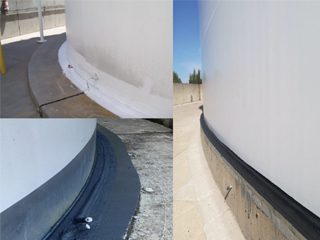
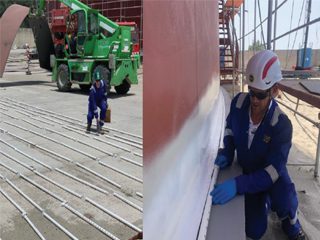
Protection of tank bottoms using Vapor Corrosion Inhibitors (VCIs).
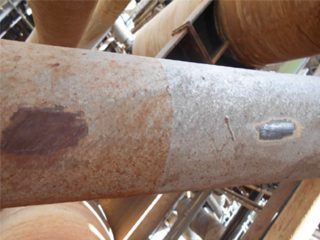
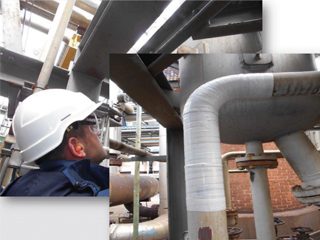
Corrosion Under Insulation (CUI) / scab repair using ZIF tape.
hope you are all looking forward to a ‘normal’ summer, certainly more and more meetings are being held in person, and physical exhibitions have restarted.
This in another bumper issue, with three technical articles, a lot of Institute news, together with the other usual columns The technical articles cover the application of a health and safety management approach to corrosion and degradation in the oil and gas industry, the defects which can occur with PFP systems over time, and a personal view of what to look for when choosing a consultant.
The “Ask the Expert” column as usual contains a coatings related and a CP related questions, and readers are reminded to send in their technical questions to be answered by our panel of experts.
Finally, I welcome comments from readers as to what topics they would like to see in future.
Brian Goldie, Consulting Editor
Email: brianpce@aol.com
This series of articles is intended to highlight industry-wide engineering experiences, practical opinions and guidance, to provide improved awareness for the wider public, and focussed advice for practicing technologists. The series is prepared by ICorr Fellows who have made significant contributions to the field of corrosion management. This month’s articles include, John Boran on measuring hardness in sour service, and Bob Crundwell on sacrificial anodes.
Think about where you measure hardness for sour service applications – weld root hardness.
Great care must be taken in the control of welding processes, as they may introduce significant metallurgical defects and detrimentally alter material performance in the sometimes ‘adverse’ conditions of Oil and Gas operations.
Hydrogen sulphide in oilfield fluids can cause sulphide stress cracking (SSC) in metals and alloys used in oil and gas production for pipelines, piping, pressure vessels, and other items that may come into contact with the sour fluids. SSC occurs if a material is not sour service rated at design, along with other cracking mechanisms, such as hydrogen induced cracking (HIC), step wise cracking (SWC) and stress-oriented hydrogen induced cracking (SOHIC), but this article will concentrate on SSC aspects.
Oilfield fluids are classified partly on the presence of acid gasses in the fluids. Carbon dioxide (CO2), when dominant, results in so-called sweet fluids where it is the major integrity threat in the presence of moisture. Trace amounts of hydrogen sulphide (H2S) are almost always present but when these exceed safe limits, the fluids are termed sour. Acid corrosion of metals and alloys in sour oilfield fluids result in the production of monatomic hydrogen, the hydrogen sulphide present acts as a catalyst to the hydrogen recombination reaction where diffused monatomic hydrogen recombines to form the diatomic hydrogen molecule.
Monatomic hydrogen can diffuse relatively easily into the metal lattice and embrittle the metallic matrix, subsequently causing cracking that can have catastrophic consequences for the integrity of the pressure containment envelope and result in leaks of the well fluids. The hydrogen molecule cannot diffuse into the metallic matrix to embrittle the metal.
The control and assessment of SSC is described in the International Standards Organisation (ISO) and National Association of Corrosion Engineers (NACE) standard ISO 15156 / MR 0175 – Petroleum and Natural Gas Industries – Materials for use in H2S – containing environments in oil and gas production, parts 1 – 3, henceforth referred to as ISO 15156.
One principal method of controlling SSC in low alloy carbon steels is to control the hardness of the base metal, weld, and heat affected zone (HAZ). It has been established over 45 years ago that carbon steels would not suffer SSC if the steel had a hardness less than 250 hardness Vickers (HV) or 22 hardness Rockwell scale C (HRC). Carbon steel can tolerate any partial pressure of H2S if the steel hardness is sufficiently low and the corrosion rate can be tolerated within the corrosion allowance.
The hardness of a metal is measured and controlled during weld procedure qualification and steel plate production to assure the suitability of the parent material and the weld for service in sour conditions, and ISO 15156 specifies how the hardness should be measured as discussed below.
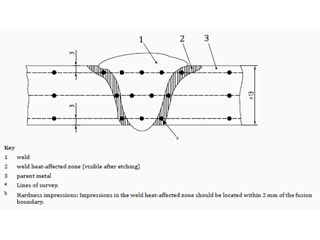
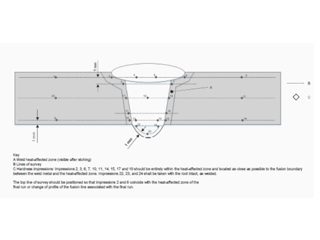
ISO 15156 specifies a number of configurations for the hardness survey, including for butt welds, fillet welds, weld repairs and weld overlay.
The principal ISO 15156 configurations are for a Vickers hardness survey and a Rockwell hardness survey of a butt weld. The Rockwell test is generally easier to perform but the Vickers test has the advantage of an optical system that enables magnification of the material’s target area that allows the tester to pinpoint microelements on the surface for a more accurate and test.
It is important to note that the line of hardness test locations adjacent to the weld root, which is the region of the metal that faces the sour fluid, is 1.5 mm from the inside surface for Vickers hardness surveys and 3 mm for Rockwell hardness surveys. The tip of the root weld will be even further away from the line of the inside surface hardness survey.
It is well known that when welding, the quenching action of the base metal and any root weld backing such as the copper backing shoes or other conductive metallic materials, may result in more rapid weld root cooling rates, resulting in higher hardness’s in the vicinity of the tip of the weld root due to chilling effects.
In a recent sour service pipeline construction that suffered extensive SSC, hardness values of up to 350 HV were recorded at the tip of the weld root, despite passing the ISO 15156 weld procedure test hardness requirements and values of up to 290 HV on the inside surface of the parent pipe which also suffered SSC. It is clear that the hardness traverses specified in ISO 15516, are not adequate to detect all hardened zones in both weld roots and parent plate.
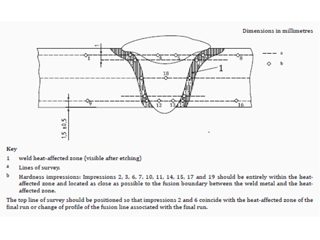
Figure 1: Butt weld survey method for Vickers Hardness measurements. From BS EN ISO 15156.
Figure 2: Butt weld survey method for Rockwell Hardness measurements. From BS EN ISO15156.
Figure 3: Hardness traverse to extreme tip of weld root.
Sacrificial anodes in the future
The largest consumption of sacrificial anodes is in the protection of energy related structures in seawater.
• Anode Alloys
Zinc was the initial choice for marine protection systems and is now mainly related to shipping applications. Zinc alloys do not perform well at elevated temperatures, loss of driving potential and formation of adherent corrosion products, with some reports of high consumption rates, means that they are not considered at temperatures much above ambient. Zinc anode alloys have the advantage that their current capacity is unaffected by operating current density and are therefore well suited to applications where an anticorrosion coating is present.
Aluminium alloys, based on the addition of 5% of zinc and 0.15% tin give a desirable driving potential but only very low efficiency unless solution heat treated after casting, when better capacity is achieved. Aluminium with 5% zinc, 0.02% indium and 0.2% silicon, is the commonest in general use and has found application at higher temperatures, driving potentials hold up but at the cost of a significant proportion of current capacity. Aluminium anode alloys experience a reduction in current capacity at reduced operating current density, this being significant at very low current density such as may be found with well-coated pipelines.
There are unlikely to be any fundamental advances in anode alloys in the foreseeable future. The use of zinc in offshore applications has been limited by opposition from environmental lobbies leading to banning of their use, and the issue of anode performance at elevated temperatures still has to be resolved. Testing has shown that anode performance is significantly reduced at elevated temperatures, but virtually all that testing has been under isothermal conditions, with little testing under heat transfer conditions, which is much more likely to be the actual service situation.
Future offshore developments are venturing into environments more aggressive than plain seawater. The particular issues surrounding Lake Maracaibo are well documented, less well known are those of the Black Sea, where the seabed is at a great depth and covered with centuries of organic matter. The suitability of existing materials and engineering practices will need to be confirmed and if necessary, adapted to such applications. Seawater having limited access to oxygen replenishment is another design challenge.
• Production of anodes
Most anodes are produced by casting the alloy onto an insert (usually a steel pipe or frame which supports the anode material and facilitates its attachment to the structure to be protected) in a permanent mould usually made of steel. Care must be taken in the casting process to take account of expansion of moulds and inserts, and contraction of anodes. Anode alloys are formulated for their electrochemical properties rather than their structural ones and this has led to problems of cracking of the anode material particularly with aluminium anodes. It is unlikely that production techniques will change significantly.
• Application engineering
The shape of an anode will contribute markedly to its performance in a cathodic protection system.
Fixed production platforms have a life expectancy of 30+ years and are usually only provided with coatings in the tidal areas. Anodes for these applications are generally up to 30cm in section and up to 300cm in length with a trapezoidal or circular cross section. Inserts are now invariably a tube with ends bent to facilitate attachment some 30 cm from the surface to be protected. Inserts are made from steels with a composition compatible with welding direct to the structure or via a doubler plate. A typical production platform may stand in 200 metres or more of water and have 1000 tonnes of anodes providing protection for the life of the structure. Care must be taken in the design to allow for current drain to assorted attachments, including but not limited to, production risers, export pipelines and piling. Failure to make due allowance for such current drain may compromise the protection system life, or in extreme cases prevent protection being achieved at all.
Probably the most interesting application engineering challenge is with anodes for submarine pipelines. These traditionally are segmented or semi cylindrical (half shell) bracelets which are a tight fit to the pipe. A taper may be cast into the leading and trailing edges of the anodes for smaller diameter pipelines. Larger diameter pipes often have a reinforced concrete weight coating several centimetres thick over the anticorrosion coating, and in this case the bracelets are made to a corresponding thickness in order to minimise any ‘step’ in the surface profile causing impact as the pipe passes over the stinger or boom on the lay-barge during laying.
Traditional engineering principles for the cathodic protection of pipelines are therefore a compromise between protection requirements and installation requirements. Future developments are likely to focus on the balance of this compromise in favour of the protection requirements ever recognising that the political, environmental and economic results of getting it wrong are usually disastrous.
• Current density for protection
In almost all cases the cathodic current density to initiate polarisation is substantially greater than that required to maintain it, exceptions being where there is a substantial water velocity past the structure or some other depolarising effect such as frequent storms. Protection system specifications are now recognising this and require an initial polarising current density and (much) lower maintenance current density. This will generate considerable rewards and impact substantially on design philosophy in the future. The selective use of coatings on parts of a fixed structure can lead to reduced anode requirements and greatly assist with the initial polarisation current issue. Any reduction in float-out weight can yield significant cost savings and will be relentlessly pursued although the risks make such progress slow.
The design of protection systems for coated structures requires an estimate of the levels of coating break down over the life of the structure to be made. The CP system is then designed to cater for this. In the future this combination of coatings and cathodic protection will merit increased attention, as even a low-grade coating with a relatively short life would address the initial polarisation current.
Offshore pipelines unlike platforms are almost invariably provided with a very heavy-duty anticorrosion coating, and reinforced concrete weight coatings on top are common. Pipeline coating breakdown levels used in CP design are typically 2.5% over the design life of the line or less. The future may well include superior anticorrosion coatings to those used at present. Cathodic protection designs could therefore have fewer unit anode installations, however distribution of protection along the length of the line will be a serious consideration, and anodes may be installed only at the ends of relatively short lines, or even fewer anodes added after the line has been laid in the case of longer lines.
• Quality control and quality assurance
The importance of effective QC & QA cannot be overstressed. Anode producers use instrumented analytical techniques such as infrared spectrophotometry, spark emission spectroscopy, atomic absorption spectroscopy, and plasma emission spectroscopy, to control alloy chemistry. When undertaken by properly trained technicians with access to traceable standards these methods provide rapid and reliable compositional data.
The use of steels with appropriate certification and welding to coded practices can give suitable assurance in respect of inserts.
The use of electrochemical testing as a quality control procedure has become mandatory on alloys, and a whole industry has grown up around such testing both by producing foundries and independent test houses. The testing procedures now used involve small samples of anode alloy often prepared in such a manner as to remove the entire ‘as cast’ surface. Great store is placed on the absolute values of current capacity per unit weight obtained.
In more than 40 years of practice in the use and manufacture of aluminium alloy sacrificial anodes, the author has never heard of a report of the failure of an anode whose chemical composition was within specified tolerance, to operate as expected. Thousands of electrochemical tests have been undertaken at great expense for no benefit whatsoever. It is to be hoped that the future will see realism and this waste of effort and resource consigned to history.
• System design
The calculation of the weight of anode alloy required to protect a structure is given by a simple calculation using area to be protected, current density, required life, and anode capacity. It is a brave designer that claims to know the true surface area of the structure. Dimensional tolerances of rolled sections of the sizes from which offshore structures are made are known quite accurately but it is surprising what bits get left out of the calculation let alone any correction for surface irregularity. Maintenance current density is variously quoted at figures between 0.140 A/m2 and 0.040 A/m2
for the same location, a factor of almost 4 times.
Anode current capacities for Al-Zn-In alloys are variously quoted between 2550 Ahrs/kg and 2750 Ahrs/kg. In general, the lower figure is on the basis of long term field tests, and the higher figure is on the basis of those short term lab tests mentioned previously.
Future design of sacrificial anode systems should focus on true surface areas and the current density required to polarise them, rather than squeezing the last drop of performance out of the anode alloy, and then justifying it with spurious testing.
Dr Bob Crundwell
We use cookies to optimize our website and our service.
Functional
Always active
The technical storage or access is strictly necessary for the legitimate purpose of enabling the use of a specific service explicitly requested by the subscriber or user, or for the sole purpose of carrying out the transmission of a communication over an electronic communications network.
Preferences
The technical storage or access is necessary for the legitimate purpose of storing preferences that are not requested by the subscriber or user.
Statistics
The technical storage or access that is used exclusively for statistical purposes.The technical storage or access that is used exclusively for anonymous statistical purposes. Without a subpoena, voluntary compliance on the part of your Internet Service Provider, or additional records from a third party, information stored or retrieved for this purpose alone cannot usually be used to identify you.
Marketing
The technical storage or access is required to create user profiles to send advertising, or to track the user on a website or across several websites for similar marketing purposes.