The Use of EIS as a Predictive Tool for Coating Lifetime
By
Dustin Traylor – Axalta Global Product Manager
Dr Stephen Drew – Axalta EMEA Coatings Leader
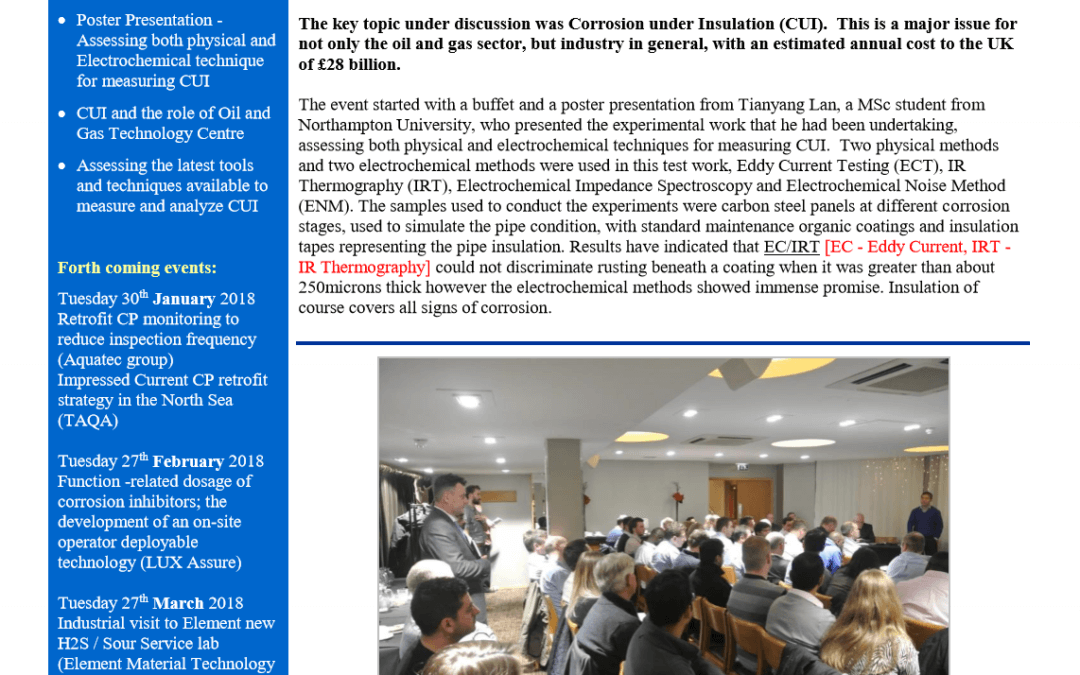
This presentation will evaluate the use of Electro Chemical Impedance Spectroscopy (EIC) to assess the adhesive strength of FBE to the steel of transmission pipe and its use as a predictive tool to determine the lifetime of FBE coating systems
The technique has now been adopted by Aramco and Chevron and gaining credibility as a useful tool in the pipeline market.
Venue: Imperial College, Skempton Building, London SW7 2BB
18.00 Doors Open – Networking
18:30 Presentation
21.00 Close
For further information please contact
icorrlondon@gmail.com or george.winning@clariant.com
The 29th Institute of Corrosion Lunch at The Royal Overseas League, was another huge success with 177 people attending the event in Mayfair London.
Guests started to arrive at 11.30 for a pre-dinner drink and were seated by 12.30 for the first of two acts by The Sirens a singing quartet. It was really well received and set the scene for the afternoon. The meal was excellent and congratulations to the ROSL who never disappoint. After lunch the Chair of London Branch thanked everyone for their continued support of The Institute and in particular London Branch, the organising committee and the Branch Committee who continue to drive the Institute in London forward.
The 2 new initiatives were mentioned; Young Engineer Training Program and Route to Chartered Status which start in January 2018, along with the two new training programs; Fundamentals of Corrosion and the CP Training Program.
The President addressed the guests to a rapturous applause once again thanking everyone for their support and explaining the Institute has exciting plans that will start in Q1 2018.
After the raffle two guests were honoured with a small gift following their highly acclaimed Tallow Chandler award for their work in Materials and Corrosion, a tremendous achievement by Charlotte Vie in 2016 and Simon Bowcock in 2017.
The timing for the event this year was slightly different allowing guests to socialise and network at the ROSL until 7.00pm which appeared to be extremely popular; lots of notes being taken and exchanging of business cards.
Thanks again to all those that assisted in the organisation of the event and we look forward to another exciting event in December 2018
To see the complete newsletter please click link below;
Stable pitting is a precursor to sulphide stress corrosion cracking (SSCC), which is one of the main causes of failure of stainless steel pipelines used in sour Oil and Gas production. Despite this, the underlying mechanism governing the growth of such pits is poorly understood, and hence materials selection for sour service is dependent upon costly and time consuming environmental exposure and SSCC test programmes.
In this study we investigate the role of hydrogen sulphide (H2S) in pit propagation as a first step towards the development of accelerated test methods for SSCC resistance. Novel electrochemical techniques are employed to determine the relationship between bulk solution chemistry and the critical pit chemistry required to induce stable pitting in sour environments.
Electrochemical measurements are correlated with results obtained from standard SSCC tests and are rationalised in terms of the balance between H2S diffusion through the pit mouth, H2S consumption within the pit and the role of the external cathode.
The implications for more informed and cost-effective materials selection are discussed.
This major conference, which this year was combined with the 20th International Corrosion Congress and the Process Safety Congress,was held from 3rd– 7th September 2017 in Prague, Czech Republic. It attracted 1200 participants from 62 countries, with the largest number coming from France, second was China, third was Germany, fourth United Kingdom and fifth the Czech Republic. There was a large exhibition, featuring a total of 49 exhibitors and this was opened on the Monday evening with a reception.In accordance with the traditional format, the conference was divided into parallel sessions, 43 in total, running concurrently. These included sessions organised by the various EFC working parties (details of these are available at http://efcweb.org/wp.html), various Joint Sessions, Technical Forums and Workshops, and six Process Safety sessions. The conference was opened by Tomáš Prošek (Czech Association of Corrosion Engineers and chief organiser) and Damien Féron (President of the European Federation of Corrosion). The European Corrosion Medal was then awarded to Mário G. S. Ferreira (University of Aveiro, Portugal) who gavea talk on ‘Immobilisation of active molecules in nano-structured materials for multifunctional coatings’ in which he argued that although additives can confer important functionalities (corrosion inhibition, anti-fouling, sensing, adhesion), the direct mixing of additives into coating formulations can have serious drawbacks.
The Marcel Pourbaix Award was presented to Christofer Leygraf (KTH Royal Institute of Technology, Sweden), who delivered a plenary talk on ‘Atmospheric corrosion: current challenges in an evolving research field’. The development of simplified but practically relevant model systems, along with international exposure tests and laboratory experiments aided by analytical and technical advancements has greatly increased our understanding of atmospheric corrosion. The speaker sought to highlight present and future challenges.
On the Wednesday morning the EUROCORR Young Scientist Grant award, which provides financial support to young corrosion practitioners to visit and interact with groups working in other countries, was presented to Hongchang Qian, who will work with Dr Yaiza Gonzalez-Garcia (Delft University of Technology, Netherlands); Anissa Célina Bouali, who will work with Dr Alexander Lutz (Vrije Universiteit Brussel, Belgium); and Berk Ozdirik, who will work with Dr Patrik Schmutz (EMPA, Swizerland). Details of this award can be found at http://efcweb.org/EUROCORR+Young+Scientist+Grant.html.
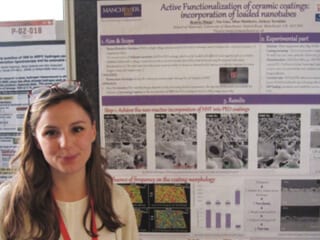
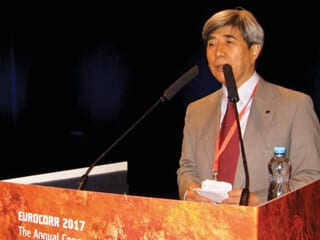
Prizes for the best posters were also presented, with first prize going to Alexander Lutz (Vrije Universiteit Brussel, Belgium) for ‘Local electrochemical study of ternary Zn–Fe–Mo alloy coatings on carbon steel’. The second prize going to Beatriz Mingo (The University of Manchester, U.K.) for ‘Active Functionalisation of ceramic coatings: incorporation of loaded nanotubes’, Theplenary lecture on the Wednesdaywas ‘Continuum and atomic scale simulation of stress corrosion cracking and causality’ by Tetsuo Shoji (Tohoku University, Japan). The speaker described the application of stress and strain analysis by theoretical elastic-plastic stress field analysis and FEM, quasi-continuum (FEM and molecular dynamics) and Quantum Chemical Molecular Dynamics to examine the role of stress and strain in SCC in relation to the chemical and physical properties of materials.
The conference Gala Dinner took place on the Wednesday evening at the riverside Zofin Palace, with an extensive buffet of Czech specialities and drinks, presented in the numerous rooms of this impressive building including an upstairs and gallery. The multiple levels made it possible for a choice of two parallel entertainments, the spacious upstairs ballroom being entertained by the Havelka Sisters and their Orchestra with traditional light jazz and swing music, while the downstairs dance room was rocked by the Beatles Revival (Brouci Band) with their repertoire of Beatles hits.
On Thursday, the plenary lecture was given by John R. Scully (University of Virginia, USA) on ‘Needs, gaps and opportunities for better design of corrosion resistant materials’.The speaker cited a recent National Academy study suggesting that an ideal corrosion-resistant alloy might well be formulated in the future using integrated computational materials design. This presents the challenge of connecting the attribute-defined features of an alloy, with the subsequent properties, by applying relevant scientific principles.Significant scientific needs, gaps and opportunities must be met in order to improve this theory-based design approach
Next year the EUROCORR congress will be held from 9th to 13th September at the ICE Kraków congress centre, Poland.
The above is an edited version of a longer report that will appear in the first issue of 2018 of the journal Corrosion Engineering Science and Technology. Thanks are due to Ruth Bingham for supplying the two photographs.
We use cookies to optimize our website and our service.
Functional
Always active
The technical storage or access is strictly necessary for the legitimate purpose of enabling the use of a specific service explicitly requested by the subscriber or user, or for the sole purpose of carrying out the transmission of a communication over an electronic communications network.
Preferences
The technical storage or access is necessary for the legitimate purpose of storing preferences that are not requested by the subscriber or user.
Statistics
The technical storage or access that is used exclusively for statistical purposes.The technical storage or access that is used exclusively for anonymous statistical purposes. Without a subpoena, voluntary compliance on the part of your Internet Service Provider, or additional records from a third party, information stored or retrieved for this purpose alone cannot usually be used to identify you.
Marketing
The technical storage or access is required to create user profiles to send advertising, or to track the user on a website or across several websites for similar marketing purposes.