WELCOME to our 173 new members and 13 Sustaining Company Members who joined the Institute in 2017.
TOGETHER WITH THE CONGRATULATIONS of the Institute to all the following members who have attained Professional Status in 2017.
Technician
David A Wilson Keith M Wagner James A Ahern Rahul Albert Stephenson Chandresh Ellathuvalappil Nilesh Panchal David Kerr Allen McGee Thomas D Lamb
Professional
Rajasekaran Karthikeyan Alistair Crichton Christian A Lewis Maria Arul Antony R Simeon Nnamdi Okara Ajay Kumar Ricardo Filipe Benjamin J Fellows Neil J Munro Asad Ali Stewart W Gilchrist Steven Brierley Christopher J Everett Amr El-Sayed Saleh Hussein Shan Mohan Castelino Adaikkalam Chidambaram Robert W Burrows Mohammad Hosseini Stephen F Tate Ankit Trivedi Mark A Gough Peter H Smithson Ahmed Asad Naveed Ul-Hassnan Marc Childs William J Smith Mudjat Savran Kamran Anjum Thomas Whittleton Azaz Mohammad Yunus Memon Muhammad Hussain Kausar Fatima Saifee Shady Abdelsalam Abdelhamid Hassan Nikhil Paliwal Anthony Davidson
Fellow
Edward J Boran Lee Wilson Mohsen Mazraeh Amit Kumar Jane P Lomas Zia H Chaudhary Muhammad Arsalan Khan Sherwani Mobeen Hassan Robert W Flannery James A Seton Muhammad Ejaz Graeme Jones Royden de Souza Robert J K Wood William Reid Varghese Chakko Nettikaden
The industry is well versed with Corrosion mapping of vessels and pipework but Corrosion Mapping of Storage Tanks has always relied on “dropping the tank” which has an impact on production and risk. The industry does not like working in confined spaces and there are moves towards zero-man entry over the lifetime of storage and process vessels.
Storage Tanks are susceptible to a range of internal and external corrosion processes. As such inspection plays a major role in effective integrity management of Storage Tanks. Historically, inspection of the floor has relied on emptying the tank and personnel entry for cleaning and inspection. Internal inspection for other mechanisms also takes place at this time. This means tanks can be out of service for significant periods of time.
Sonomatic have developed a range of methods for inspection of Storage Tanks while in-service. A key element is robotic cleaning and inspection of the floor. This forms part of a comprehensive inspection in which the tank shell is also inspected non-intrusively using ultrasonic corrosion mapping supported by statistical analysis. The presentation will give an overview of the technologies involved, how these link into more efficient integrity management of Storage Tanks and will also include a case study of field application.
A fascinating not to be missed presentation
Date: 8th March
Venue: Imperial College, Skempton Building, London SW7 2BB
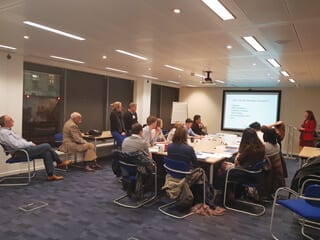
The first presentation of The Young Engineers Program (YEP) also start at CB&I in London with an excellent presentation on the Basics of Corrosion by Jane Lomas. The event was opened by Bill hedges of BP and continues through the year with 9 modules including a Case Study which the delegates will present back at the London Branch meeting in November 2018.
The discussion was all encompassing but dealt with the basics of corrosion from first principals;
Basic Principles
Anodic and Cathodic Areas
What Controls Corrosion rates
Corrosive Environments
Common Types of Corrosion
Pitting
Crevice attack
Galvanic corrosion
Stray current corrosion
Stress corrosion cracking
Microbially induced corrosion
The group enjoyed a networking session after the meeting at a local restaurant courtesy of The Institute of Corrosion.
The next YEP meeting will be Welding and NDT Techniques to be presented by Alan Denney on Wednesday 21st February at CB&I in London.
We are extremely grateful to Jane Lomas and Sadegh Parvizi at CB&I and all the other members of ICorr that give up their time freely to assist our Young Engineers with their career development
For complete article of the newsletter please click link below;
This presentation introduced and explain the benefits of Stress Monitoring in Pipeline Integrity Management. The technique is the only inspection technique that can simultaneously map the lateral position and depth of cover of the pipeline whilst also providing comprehensive defect detection. Moreover, it provides additional deliverables that anticipate the increasing demand of pipeline regulatory authorities such as the location of casings and wrinkle bends.
Hamed talked the audience through the benefits of using this method which is developing to be known as silver bullet of pipeline integrity as it is the only method of measuring stress in pipeline wall. He explained the physical principles of the method that is also capable of measuring the depth of cover, lateral position and detecting welded joints. Specifications of this innovative method was detailed in terms of achieved performance in field trials which took loads of interests among audience. Loads of case studies were explained by the speaker to display the advantages of this the technique over traditional inspection methods in special cases. The technique which also is named Stress Concentration Tomography is able to assess condition of buried pipelines remotely without any dependency to a specific type of defect, manufacturing size, construction configuration or operating condition that will save a considerable amount of time, effort and budget while it will also provide an accurate 3-dimensional mapping of pipe and surrounding objects.”
For full article of the newsletter please click link below;
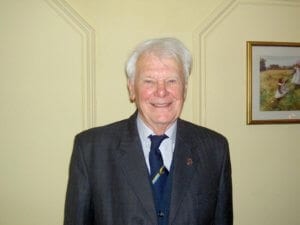
Bill was born on 1st August 1922, to Walter and Georgina Holden. He was an only child. He lived initially on Wigan Road in Westhoughton, then on Manchester Road, before the family moved to St John’s Road in Chew Moor in 1929. Bill went to St Thomas’ School in Lostock, until he took the entrance exams for Bolton School in 1932. He started there in September 1933, aged 11. He left Bolton School in 1940, when he was 18, and went to work at the Chemical Defence Research Establishment in St Helens, synthesising mustard gas and other poisonous gases.
He worked there until 1941, when he decided to volunteer to join the RAF. He was accepted, having astonished the RAF assessor by returning perfect 100% marks in all the entrance exams (The first time that this had ever been achieved), with the remark along the lines of…“Tha’s made of some pretty good stuff, lad !”
Bill went off to train, firstly in London, then Babbacombe, Devon, and then off to Canada and America. He got his ‘wings’ on 16th May 1942. Bill spent most of his time in the RAF in, and around Africa, including Sierra Leone, Cairo and Aden, and then in the Middle East. Later on, Bill was also stationed in Normandy, Ghent in Belgium, and Hamburg.
Bill married Annie on 12th May, 1945. He was demobbed in June 1946, and started as a student at Manchester University in 1946. He studied there until 1949, when he graduated and began his career at W & J Leigh & Co, rising to the position of Chief Chemist – a position that he held with distinction until he took early retirement in 1984 to look after Annie, who was not in the best of health at the time. As with everything, he did a good job – they were married for 67 years by the time she passed in July 2012.
Bill (Often affectionately referred to as ‘BDH’ in general conversation amongst Leigh’s staff, but always a respectful ‘Mr Holden’ in his presence) was renowned for his encyclopaedic knowledge of anything connected with paint technology, and his approachability and willingness to share this knowledge with any of his staff, from laboratory managers right down to the most junior technician.
Bill was an avid reader of all the technical journals and had an incredible photographic retention of the information, right down to the date and issue number of any given paper… Forget Google – Mr Holden was way ahead of the game in terms of a reference source for any information that you needed! He was an active supporter of the Institute of Corrosion and for two years was Chairman of the North-West Branch. In addition, he was a 50-year life-member of the Oil & Colour Chemists Association.
Bill also read and absorbed every single report produced by his R&D team, and would frequently summon a nervous young lab technician into his office to discuss a project, which usually concluded with the dreaded question…”So what do you think we should do next ?”… After listening intently to the junior’s fumbling attempt at an answer for Plan ‘B’, he would typically reply…”Yes, very good, try that; and while you’re at it you might also want to try… “ (Plans ‘C’, ‘D’ and ‘E’). Of course, Bill’s ideas were always the ones which worked best, but he would never discourage his staff from trying anything (within reason!) and to learn from their experimental failures as well as successes.
Outside of work Bill enjoyed many things including gardening, tennis, badminton, painting, photography, yoga, family history, music, dancing, walking and travel. He enjoyed doing many of those things with his family, including his two daughters, son-in-law, three grandchildren and five great grandchildren.
Even in retirement, right up until the last few years – having suffered a stroke in 2013 – Bill would visit the laboratory for a guided tour prior to the annual Christmas party held for retired Leigh’s staff – Joe Nugent, Harold Twyford and Roy Lindley amongst them, who also were staunch ICorr supporters; and he always showed a keen interest and understanding of whatever he was shown, although the news that the lab samples were no longer made by ball mill did not go down at all well.
With typical Bill Holden thoughtfulness and thoroughness, he’d left a recorded message that was played at his funeral, and very typically it was supportive of everyone else rather than concern for his own situation.
Bill Holden will be fondly remembered as a great leader, mentor and most importantly an absolute gentleman.
We use cookies to optimize our website and our service.
Functional
Always active
The technical storage or access is strictly necessary for the legitimate purpose of enabling the use of a specific service explicitly requested by the subscriber or user, or for the sole purpose of carrying out the transmission of a communication over an electronic communications network.
Preferences
The technical storage or access is necessary for the legitimate purpose of storing preferences that are not requested by the subscriber or user.
Statistics
The technical storage or access that is used exclusively for statistical purposes.The technical storage or access that is used exclusively for anonymous statistical purposes. Without a subpoena, voluntary compliance on the part of your Internet Service Provider, or additional records from a third party, information stored or retrieved for this purpose alone cannot usually be used to identify you.
Marketing
The technical storage or access is required to create user profiles to send advertising, or to track the user on a website or across several websites for similar marketing purposes.