




Latest news from Aberdeen Branch

Latest news from Aberdeen Branch

The branch held a joint technical meeting with TWI Scottish Branch on 28th September where the speaker, Matthew Beatty from Sonomatic Ltd. discussed “In-service ultrasonic tank floor inspections”.

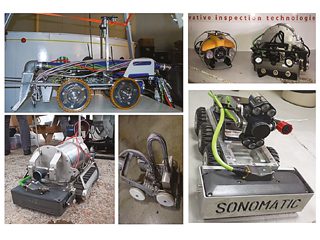
As described below, Sonomatic have developed an advanced system of robotic instrumentation and associated test procedures which can be used to inspect storage tanks while still in service. The instrumentation can easily navigate tank floors and using ultrasonic techniques (UT), measure the remaining through floor plate thickness, detecting both product side and soil side corrosion. From this, the remaining useful life of the tank can be determined by comparing this with the minimum containment thickness criteria for the vessel.

Desludging of tanks is performed during the measurement process as it is essential that the robot has a clean surface to make the measurement, and obtain good and reliable data. This is by done by either pumping sludge away within the tank, or pumping sludge out of tanks into containers for recycling or filtering and return. The inspection process can extend to survey tank shell walls and roof, annular plates and shell to floor welds using ultrasonics techniques.

Two main ultrasonics techniques are commonly used; (1) Short-range ultrasonics (SRUT) for features such as,

• Tank floor annular plate testing

• Testing concrete coated interfaces

• Testing under pipe supports

• Tank dyke piping interfaces

• Under vessel supports

and (2), Multiplexed phased array UT (PAUT) for the shell to annular plate weld inspection, and to  assess the condition of the internal and external weld (for cracking particularly).

Acoustic emission (AE) can be used to scan the floor for active corrosion prior putting the robot into the tank.

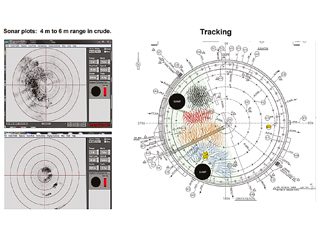
The robots deployed for the inspection are dependent on the tank media content and the accessibility. A hydraulic driven robot is used for heavy to light hydrocarbons and a mini ROV swimmer is used mainly in water tanks. Survey robots are fitted with hydraulic pumps and scrappers to remove sludge and sediment and clean the surface ready for ultrasonic work. All robots have safety systems and monitor critical items such as oxygen and nitrogen pressure through the umbilical and can automatically shut down power at alert safety levels.

For inspections, the robot is lowered through a deployment manway using a tripod and winch system to the tank bottom and connected back to the control room through a tailored sealed temporary manway cover. Finally, the tank is purged and pressurised.

The ultrasonic probes used have a range of diameters from 8mm up to 300mm total coverage and are typically arranged in an array of around 30 probes which speeds up the scanning process and makes data more reliable.

A case study was presented of a detailed in-service inspection of an 80 metre diameter tank with known corrosion. Acoustic emission was used first to check 100% of the tank for ongoing corrosion signs. With the robot deployed the sludge was displaced by suction pump and a rubber scraper to remove surface sludge.This inspection used a total of 521 scans, representing 5% coverage of tank base. The sampling methods and statistical analysis allow for limited coverage inspection so there is no need to inspect 100% of features. With the in-built ultrasonics, in this instance which used 8 transducers with amplitude variation across each transducer, the min thickness found was 4.8mm compared with the nominal thickness of 7mm, which gave an estimated remaining life of 2 years before an out of service inspection was required. After shutdown 3 years later, the floor thickness was confirmed to be 2.20 mm versus a predicted 2.53mm from in-service inspection, a <5% difference between the two methodologies which is considered an accurate and successful prediction compared with manually performed UT readings.

The accuracy of the predictive system using the in-service data illustrated that robotic inspection of the tank floor is a viable alternative to costly shutdown and out-of-service inspection.
The branch October meeting featured an interesting online talk from Professor Y. Frank Cheng. University of Calgary (UoC), entitled “Internal corrosion of pipelines: mechanisms, modelling and management”.

Internal corrosion of pipelines is a complex phenomenon, and the complexity arises from the fact that multiple chemical and electrochemical reactions occur simultaneously with numerous interrelated factors affecting the corrosion processes. A fundamental understanding of the phenomenon is essential to modelling, prediction and management of the corrosion processes, providing recommendations to industry for improved pipeline integrity management.

Currently, pipelines for oil and natural gas are the conduit for around 55% of energy transport and, despite the rise of renewables and net-zero targets, they will still be utilised for a similar amount of energy transportation when H2, CO2 and biogas gain in popularity. For oil and gas transport, the upstream ‘gathering’ pipelines which run from production to the upstream processing plants are the subject of interest here. Of course, the corrosion issues in different sectors of the pipeline system can be very different due to the product being carried and the internal environment. In upstream gathering lines within Alberta in 2019, 46% of the corrosion issues were deemed to be due to internal corrosion alone.

Multiple factors affect the corrosion process, including fluid chemistry, operating conditions and pipe geometry. To deal with the complex issues it is important that computer models take into consideration each of these factors, and study each of the key parameters, reaction chemistry, fluid hydrodynamics and configuration, so as to produce a workable model which will realistically predict the corrosion outcome.

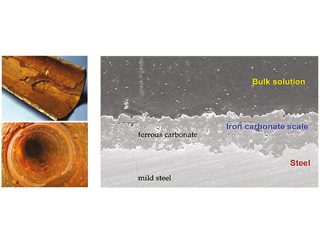
The UoC initially developed a thermodynamic model to determine the electrochemical anodic and cathodic reactions occurring during internal corrosion of pipelines under given conditions, and the chemical reactions (for instance CO2) occurring during electrochemical cathodic (evolution of gas) and anodic reactions (at the steel oxidation). The internal corrosion involves the formation of iron carbonate scale on the surface which changes the corrosion rate. When H2S is also introduced there are competing reactions with CO2, which further complicate the outcome.
For the chemical reactions they derived the reaction equilibrium constants and for the electrochemical reactions calculated the standard electrode potentials by Gibbs free energy and determined partial reaction potentials by the Nernst equation.

Fluid hydrodynamics plays a critical role in influencing corrosion, so studies were conducted by fitting electrodes flush with the inside pipe walls at straight and angled positions to measure corrosion rate with flow and with impingement angle to the pipe wall. Other effects that were incorporated in the flow model were the inhibitive effect of the hydrocarbon oil phase and the erosive effect of inorganic sand and solids.

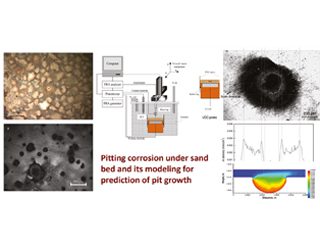
Another consideration for UoC modelling was the organic acid that is always part of the fluid in upstream hydrocarbon pipelines and which will attack the iron carbonate film which readily forms on the inner walls of the pipe. The scale builds faster with higher CO2 and temperature but, when the FeCO3 scale is broken locally at a defect, this leads to pitting corrosion under the scale and can lead to accelerated attack and leaks in pipeline walls. Pitting corrosion also occurs under sand layers which settle on the pipe floor from the high upstream sand concentration in the oil sand.

The final and possibly greatest issue in oil pipeline corrosion was determined as internal microbial corrosion which is believed to be responsible for ~ 40% of all internal corrosion events in pipelines. Microbial Corrosion occurs under any deposit mixture of petroleum sludge, sands, water microorganisms and corrosion. Internal operating environments encourage growth of the microbial population products. However, in the case of gas pipelines a thin layer of water condensate occurs on the chilled wall of the pipe which makes the formation of biofilms difficult and the deposit of corrosion films more favourable, so there is a competition between the two effects.

Several predictive corrosion models have been developed from the experimental studies of parameters and mathematical relationships, and these UoC models can assist in identifying critical corrosion locations, especially pitting and erosive corrosion on a long-distance pipeline, then predict the pitting corrosion rate and pitting growth rate, however corrosion mitigation and control by operators should not rely on inhibitors and biocides as they are not a totally satisfactory solution and periodic pigging is still required as main method of control in removing and reducing deposits and sludge.

This very comprehensive presentation generated much interest from the audience and many questions that were expertly responded to by the author.

Slides of technical papers for Aberdeen branch events, along with their respective Q&A’s can be found at, https://sites.google.com/site/icorrabz/ and also at Aberdeen Branch – Institute of Corrosion (icorr.org) under Local Technical Programme. A library of event recordings may also be found at:

https://www.youtube.com/results?search_query=ICorr+Aberdeen
How Do You Help a Friend with Mental Health Problems?

How Do You Help a Friend with Mental Health Problems?

Spotting the Risks, Seeing the Symptoms, and Offering Support

Talking about your own mental health is often difficult, even today when mental wellbeing is so high on the agenda. How do you approach someone and say, “I’m feeling really low; please help me”?

That’s a tough thing to do, so most people don’t. They put on a brave face, while inside they are all twisted and torn. It’s like being a duck. Cool and calm on the surface, while underneath the waterline their feet are paddling at a hundred miles an hour. Only in the wrong direction.

Yet we know that around one in four people will experience mental health problems every year in the UK, and one in six suffer a common mental health problem in any given week (Mind 2017).

We need to change our way of thinking. If we could only  recognise the signs of mental health issues, that would be a start. Maybe then we could consider how to help someone with their mental wellbeing.

Who is at risk of mental health problems?

When life is ticking along nicely, there is little fear of hitting a wall of depression. It’s when life takes unexpected turns that our minds start to play the cruellest tricks on us. A sudden illness. Loss of a job. The death of a loved one.

Pre-existing psychiatric disorders, like depression, clearly increase the risk of mental health issues. Here are a few other situations you should watch for in others:

·       Illness or health vulnerability

Especially pertinent over the last year and more, vulnerability to ill heath, or ill health itself, is difficult to cope with. Those with pre-existing conditions may feel the pressure more than others. People who have a sudden heart attack, or learn they have a condition that will not improve are also at risk.

·       Changes at work

When changes are made at work, they affect people. Such changes may include a change of boss, change of responsibilities, or change of working environment. It could be that a decades-old process is changed, or that the person is promoted or demoted, or asked to change teams.

At work, you should also pay attention to those who have high workloads and long hours.

·       Loss or impending loss of a loved one

The news of a friend or family member’s terminal illness or death can damage a person’s normal way of thinking. This is especially true if the relationship was close. Difficult emotions can stay with us for years, with remorse triggered by the simplest things – a smell, a song, or even a word or phrase.

·       Life changes

Major life changes can trigger mental health issues. Divorce. The repossession of a home. The loss of a custody battle. The loss of a job. A new baby. A child leaving for university. If you know of a person going through such change, then watch for the signs that it is affecting them adversely.

Recognising that life is taking its toll

Mental health is unlike most physical health conditions. There may be a list of common symptoms, but they are not common to everyone. This can make it difficult to be sure that a friend or colleague has mental health issues, but if he or she is experiencing any of the following you should stay alert to the possibility:

  • Sadness or tearful
  • Pessimistic about the future
  • Detachment from friends or colleagues
  • Loss of interest in hobbies
  • Overly irritable, or acting out of character
  • Less talkative than usual
  • Easily upset
  • Lacking energy
  • Taking unnecessary risks
  • Lacking focus
  • Disinterested in their own appearance and/or personal hygiene
  • Trouble with sleeping
  • Weight gain or loss
  • Forgetfulness
  • Eating more or less than usual
  • Increased consumption of alcohol
  • Talking about feeling of emptiness, worthlessness, death, or suicide

The more of these symptoms you notice, the more likely it is that your friend or colleague is suffering from a mental health issue such as anxiety or depression.

How do you help a friend through their mental health issues?

If your friend is experiencing several of these symptoms, it’s time to talk. But how should you approach them? Here are a few tips.

·       Open a conversation

Show your friend that you’re concerned for them by asking a question that shows you’ve noticed something isn’t quite right. For example:

  • “Hey, you’ve been quiet lately. Is everything okay?”
  • “You seem a little down recently, and you’ve said you’re constantly tired. Is there something on your mind?”

Your friend may find it difficult to talk to you. Don’t force the conversation. Let them know you care, and that you are ready to listen if they need to talk.

·       Listen

When your friend starts talking, don’t interrupt. Show empathy and understanding with your body language and your words. Ask questions to avoid misunderstanding. Make sure they know you care.

·       Avoid giving advice

Ask how you can help, but don’t give advice. You shouldn’t tell your friend to try harder, or pull their socks up, or ‘man up’. Such advice trivialises the condition, and betrays a lack of empathy and understanding.

Don’t seek to justify your friend’s mental health – it’s extremely personal. And don’t try to make your friend feel better by explaining how bad you’ve had it, or what a grim time someone else has had.

Finally, don’t tell your friend that this is something he or she will get over. It’s hard for a person who is suffering mental health issues to see a future when the present is overwhelming, or the past is proving difficult to move on from.

·       Maintain confidentiality

Your friend will be sensitive about their mental health. That’s why he or she hasn’t spoken about it before. Now trust has been placed in you. Don’t destroy that trust. Maintain confidentiality.

·       Help them find the professional support they need

You are there for your friend. Your support is crucial. But to improve mental health, professional counselling is often required. Encourage your friend to seek therapy. Offer to help review therapists and make a first appointment.

·       Continue with your support

Finally, just because your friend is seeing a counsellor does not mean your support is no longer needed. Quite the opposite.

There will be days when he or she crashes. There will be times when he or she wants to give a counselling session a miss. Remind him or her how useful the last session was, and how productive staying the course will prove to be.

It’s time to change our way of thinking

Look around you now. Whether you’re at work, in a café or bar, or on a train. If there are 20 people near you, it’s likely that three of them are suffering inside right now. Five of them will have a prolonged period of mental health issues this year. Yet it’s likely that none of them will seek the help of those closest to them.

So, it’s up to us to make that first move. But we don’t, do we? We’re nervous of getting it wrong, and alienating the person about whom we are concerned. So, we say nothing, and stand by watching while someone sinks into despair, depression, and possibly worse.

It’s time to change our way of thinking. To understand the risk factors associated with mental health, the signs to watch for, and then being brave enough to make the first move. Each one of us could save someone’s life. All we need to do is take that first step, and talk.

Where to get help for mental health problems

Help is available for those with mental health problems from many sources. These include:

Finally, if you know a friend or colleague that had been suffering with their mental health, keep an eye on them. Even if they seem fine, the cracks can still appear. Check in now and again. You may not inhabit the same world as them, but you could be the world of difference.

Coating Surveys online

Coating Surveys online

Course Overview

Are you ready to take your coating expertise to the next level? Enrol on our online course today and become the standout leader in the field.

With this Coating Surveys course, you’ll journey from understanding the essentials such as the European Scale of Rusting and Estimation of Percentages to mastering advanced techniques such as Dry Film Thickness Surveys and Adhesion Testing. Our modules span from Marine Fouling to the nuances of Paint Chemistry.

This globally recognised qualification, endorsed by ICorr and accredited by the Royal Society of Chemistry and Lloyd’s Register, is not just an education but a method for you to pave a successful career path.

Authored by industry experts, the course promises a transformative learning experience for those keen to shine in the world of Coating Surveying.

Course content

  • Coating Surveys
  • Estimation of Percentages
  • European Scale of Degree of Rusting of Anticorrosive Paints
  • Common Defects
  • Marine Fouling
  • Dry Film Thickness Surveys
  • Passive Fire Protection
  • Adhesion Testing
  • Holiday Detection
  • Sampling Techniques
  • Standard Test Methods, Field Tests and Laboratory Analysis
  • Photography, Documentation and Reporting
  • Paint Testing, Paint Constituents and Paint Chemistry

Course fee

£795 + vat
£75.00 – Online exam Fee

Plus 20% VAT if applicable

Course and examination enquiries

For any questions or further enquiries, please visit our training partner’s website at  www.corrodere.com or alternatively you can contact them on:

+44 (0) 1252 732236

info@corrodere.com

Study Time

24 hours of online study over a 12-month period, followed by a 90-minute monitored multiple choice final exam.                                                         

Certificate/Qualification
Certificate of Achievement in Coating Surveys
Accredited by Lloyd’s Register and the Royal Society of Chemistry
Endorsed by ICorr.
Full certification valid for 5 years.                                     

Entry criteria
Candidates must meet ONE of the following criteria;
– Qualified Coatings Inspector (ICorr level 2, NACE level 2, SSPC Level 2, FROSIO level 2)
– ICorr Coatings Inspector Level 1 with at least 5 years coating inspection experience
– Paint Chemist with field experience
– Coating Engineer with field experience
– Coating Surveyors that can demonstrate a minimum of 5 years experience as a Coating Surveyor.