


Aberdeen Branch – November Technical Meeting

Aberdeen Branch – November Technical Meeting

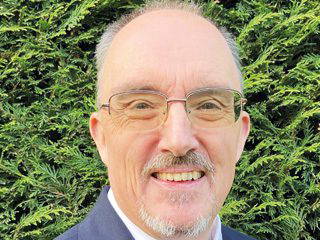
The branch’s November technical meeting was held on 30th, to a large online audience of nearly 60 people including many international attendees.  This was a joint meeting with IOM3 and MIS (Mining Institute of Scotland) with Dr Nigel Owen, Operations Manager of Aberdeen Foundries, presenting “Sacrificial Anodes: Material Specifications, Manufacturing and Anode Design for Effective Cathodic Protection Systems”. 
The opening notes for the IOM3/MIS were given by Babs Oyeneyin of IOM3’s Energy Transition Board and retired Professor of Engineering at RGU who recently participated in COP26, Glasgow.

Aberdeen Foundries are one of the last remaining foundry operations in Scotland for non-ferrous castings and have been involved with the offshore energy and marine services industries for over 40 years, and is the last remaining working foundry in Aberdeen. 

Nigel, who gave a most informative and heart-felt talk, has worked in the aluminium Industry for over 35 years after completing a B.Sc. in Metallurgical Engineering at Salford and subsequently a PhD in Materials at Imperial College before working in a variety of companies, including R&D of cast and rolled Aluminium products in Australia & USA, along with smelter waste recycling in New Zealand. 

At the foundry he is responsible for all manufacturing, testing and technical specifications of marine and subsea sacrificial anode supplies. In addition, Nigel is a long-serving member and officer of the Aberdeen ICorr Committee.

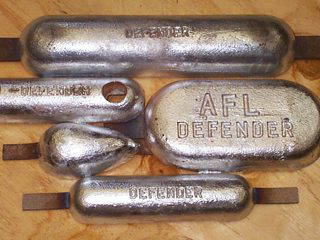
The raw materials used for sacrificial anode manufacture are by necessity, high-purity based metals with very specific alloying requirements and final properties, in order to achieve the desired effective and long-lasting CP system operation. 
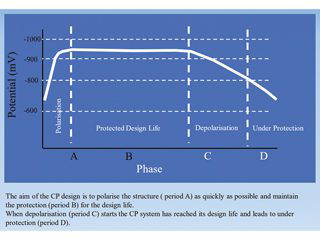
The typical process for manufacturing anodes was presented, from a ‘metallurgical standpoint, the alloying, pouring, testing and finishing processes of various product types were then described in great detail. 

The base materials, properties and costs of modern sacrificial alloys for cathodic protection purposes were detailed along with the conditions and applications for which they are generally used and the complexities of building moulds for casting operations.  Nigel illustrated the importance of the Periodic Table and how alloying from different elements can be used to control/increase electro-negativity, and also the importance of the Galvanic Series showing how CP currents from sacrificial alloys are applied to counter corrosion currents. 

Other key aspects covered included, the role of calcareous deposits and simultaneous reactions occurring at the anode and cathode. The talk also included a very interesting history of anode production and how this has developed into the tightly regulated industry of today, with recent concerns over contaminants like mercury (an effective addition) and also highlighted other bad contaminants like iron and copper that can affect anode performance.

In summary he concluded that:

  • Aluminium alloys (of aluminium/zinc/indium) generally provide low-cost reliable anodes and account for 90% of offshore anode manufacture.
  • Magnesium anodes remain particularly useful for onshore applications and for de-scaling operations.
  • Zinc anodes are still well used for both brackish waters/harbours and offshore (buried applications).

Nigel emphasised the need for good quality control of raw materials sourcing and at all subsequent manufacture stages which can be of very complex geometries and which require very careful planning and preparation. Analysis of cast composition is normally performed together with electrochemical testing and optical emission spectrometry tests, to a combination of client purchase specifications and International Standards.

Good electrical continuity must be ensured between alloy material and surface profiled steel inserts and finally to the structure itself being protected by CP. Some materials like zinc naturally bond to inserts at casting temperatures while other rely on the mechanical key.  Critically, all cathode areas to be protected must be identified at the design stage and then geometry of anode made to suit the area/life/current distribution to achieve Initial polarisation and required final design life. 

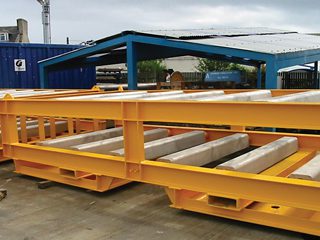
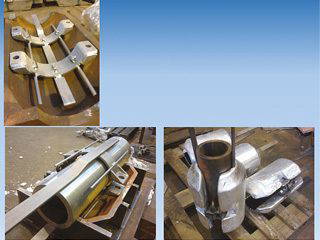
CP system life extensions were also touched upon with illustrations of some recently shipped anode skids.
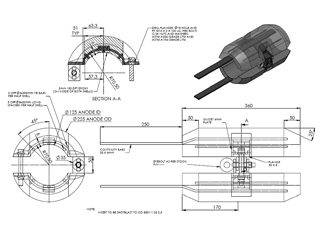
 

The presentation then moved on to discuss the design of Sacrificial Anode Cathodic Protection systems for a Marine Environment including prevailing standards, which involved selection of anode configuration, a detailed calculation process, combined with rules of thumb and practical experience to design an effective working CP system (that is capable of manufacture).
This very engaging presentation generated many questions from the audience that were expertly responded to by the author.  The closing remarks for this well attended event were given by Hooman Takhtechian, the current Chair of Aberdeen Branch, who thanked all participants.

Slides of technical papers for branch events, along with their respective Q&A’s can be found at, ICorr Aberdeen Branch (google.com) under Local Technical Programme Aberdeen Branch – Institute of Corrosion (icorr.org). A library of event recordings may also be found at: ICorr Aberdeen – YouTube.

The branch has a very fully year ahead, running the Young Engineer Programme (YEP) alongside its normal busy technical programme for 2021-2022 Session. With Scottish Govt. guidance still discouraging large public events, initial meetings of 2022 will be held online and recordings published post-event.


Young Engineers Programme (YEP)

Young Engineers Programme (YEP)

Aberdeen branch has now launched the 2022YEP which will run for a full year from January.

The branch received 50 applications for this session, and after a thorough review by branch committee members, 20 applicants were selected for the programme and 3 were selected as reserves. Also 15 applications were found suitable for future YEP programmes and were advised to re-apply for YEP 2024. The first session was held on 27th January by Zoom due to the current uncertainties regarding the COVID restrictions in Scotland. At present the February talk is likely to be similarly organised online, although it is hoped to hold subsequent presentations in-person.

The full 2022 syllabus is given  below.

Session

Date

Speaker

Session 3 – NDT / Corrosion Monitoring

31-Mar-22

Jim McNab (Oceaneering)

Session 4 – Coatings & Linings

26-Apr-22

Michael Young (ROSEN)

Session 5 – Case Studies

31-May-22

Steve Paterson

Session 5.1 – Presentation Skills

31-May-22

Olubayo Latwino

Session 6 – Corrosion Under
Insulation and Fire Protection

28-Jun-22

Clare Watt (KAEFER)

Session 7 – Cathodic Protection

26-Jul-22

ROSEN (speaker to be confirmed)

Extra session – Annual Corrosion Forum (Whole day)

30-Aug-22

Various Speakers

Session 8 – Production Chemistry

27-Sep-22

Ben Smith (BP) (TBC)  Olaf Niemeyer (Shell) (TBC)

Session 9 – Integrity Management / FFS

25-Oct-22

Stephen Tate / Pieter Viever (Oceaneering)


Session 10 – Presentation of Case Studies

29-Nov-22

Panel of Judges

As the 20 participants will be split into 5 groups, the branch has identified 5 mentors to support them during their case study preparations. The following 4 mentors have are already confirmed, and one more needs to be identified. 

Steve Plant, Managing Director, PIM

Bruce McKenzie, Technical Manager, Oceaneering

David Hillis, Material and Corrosion TA, TotalEnergies

Yunnan Gao, SME & Deputy Technical Manager, Stork

For the case study presentations, two judges have been confirmed, Chris Williams from BP and Susan Cushnaghan from Shell, and the branch are in the process of confirming the third judge.  The prize for the best case study presentation has been sponsored by BP, and it is hoped to have a further prize sponsored.

CEOCOR 2022

CEOCOR 2022

International Virtual Congress & Technical Exhibition

17 – 20 May

CEOCOR, founded in 1956, is an international scientific non-profit association dealing with corrosion and protection of pipes and pipeline systems. CEOCOR brings together specialists from universities, research centers, institutes and companies within:

  • Water, gas and oil distribution
  • Waste water collection and treatment
  • Pipe production and manufacture of equipment for cathodic protection systems

The 2022 congress:
The congress consists of high level technical presentations, working group meetings, as well as a technical exhibition.

Program of events

Latest News for Young ICORR

Latest News for Young ICORR

Following on from the popular Young ICorr Festive Quiz of 2020, another online event was held on Thursday 16th December, 2021, preceded by a talk from Bill Hedges, ICorr President (pictured right), on “A career in corrosion and its importance in the future of energy including renewables”. The general energy outlook indicates that there is an increasing global energy demand and that hydrocarbons still contribute to the majority of the global energy mix. However, this talk highlighted new energy sectors and where corrosion will continue to have a negative impact on such sectors.  Bill’s presentation covered three themes including (i) A career in corrosion, (ii) Corrosion and materials challenges facing hydrocarbon production, and finally (iii) How corrosion can impact the future of renewable energies.  Although significant progress and great advancements have been made in the field of corrosion control and management, many challenges remain as we embark on a joint global venture to achieve net-zero; the requirement for future innovation in the energy sectors is more important than ever. On this basis, and from his own experiences as a corrosion engineer. Bill concluded that the future is bright and exciting for anyone pursuing a career in corrosion-related disciplines.

Following the talk by Bill, the quiz winners were revealed as the team ‘Corrosion Forever’. After which there was a networking session to enable young ICorr members to interact with their peers whilst presenting an opportunity to ask the more senior ICorr members questions. 

Further events are planned for 2022 and more information will be uploaded to our website and social media pages. Please, follow Young ICorr on LinkedIn to ensure you do not miss out on future events.

UK Standard of Professional Engineering Competence (UK-SPEC) fourth edition

UK Standard of Professional Engineering Competence (UK-SPEC) fourth edition

For all professional members considering applying for Engineering Council Registration as Chartered engineer, Incorporated Engineer or Engineering Technician (CEng, IEng or EngTech)
the new 4th edition of UK-SPEC has been issued and is now in force from the beginning of 2022

The changes to UK-SPEC aim for greater clarity, making the requirements, i.e. the Standard itself, more obvious, while providing better examples of how applicants might provide evidence of having met the Standard.  The new edition is more informative, particularly with respect to assessment. 

For consistency, a number of terms have been amended: 

  • Applicant – Potential registrants are referred to as “applicant” in place of “candidate” 
  • Recognised Qualifications and Individual Assessment – These terms replace ‘Standard Route’ and ‘Individual Route’. 
  • Licensee – in place of ‘PEI’, ‘Professional Engineering Institution’, ‘licensed PEI’, and ‘Institution’
  • The competences and evidence examples have been revised to clarify the requirements 

ICorr and the Society of Operations Engineers (SOE), have now upgraded their procedures and forms to comply with the 4th Edition, and all new applications must now be on the new forms.  The new forms and associated documents can be downloaded
from www.icorr.org