Under what types of exterior atmospheric exposure (other than marine) is it necessary to test for soluble salts before maintenance painting? PS
Answer:
The effect of soluble salt contamination on protective paint systems is well documented in terms of the acceleration of electrochemical corrosion processes and the propagation of osmotic blistering of paint films that are applied over salt contaminated substrates.
Paint specifications will normally define maximum levels for soluble salt contamination on a substrate. These can sometimes be set by an external specifying body (e.g., owner specifications, NORSOK, Network Rail, Highways England), or by the paint manufacturer.
Whilst the presence of a high level of salt on a surface might be obvious in a marine location due to the high levels of chloride in the atmosphere caused by saltwater spray, it is quite reasonable to expect salt contamination at an inland location. Industrial pollution is much reduced nowadays, due to tightening of air quality regulations, however considerable amounts of nitrates and sulphates are present in road traffic exhaust, and in addition large amounts of road de-icing salt are deposited throughout the winter months on the roads of all countries where winter freezing conditions may be expected. This salt is whipped up into a concentrated salt spray by the action of moving traffic on the wet roads which will deposit a persistent salt contamination that can spread some distance from the road on which it was deposited.
The simple answer to the question would therefore be that it is good painting practice to assess the surface salt level on any substrate that is to be painted, whether it be in a marine or inland location.
If the measured salt levels are low and meet the specification, then the project may proceed with occasional salt testing to ensure that the salt levels are still within specification. If local salt levels are high and exceed the specification, then the substrate will require fresh water washing and re-checking of the salt levels until the specification is achieved. In these contaminated locations then a more rigorous programme of washing down and salt level assessment must be agreed between the asset owner, painting contractor, paint manufacturer and independent inspectors.
Surface cleanliness is defined under the ISO 8502 series of international standards, along with equivalent standards from organisations such as NACE and SSPC.
ISO 8502 consists of the following parts, under the general title:
“Preparation of steel substrates before application of paints and related products — Tests for the assessment of surface cleanliness”.
— Part 2: Laboratory determination of chloride on cleaned surfaces
— Part 3: Assessment of dust on steel surfaces prepared for painting (pressure-sensitive tape method)
— Part 4: Guidance on the estimation of the probability of condensation prior to paint application
— Part 5: Measurement of chloride on steel surfaces prepared for painting (ion detection tubemethod)
— Part 6: Extraction of soluble contaminants for analysis — The Bresle method
— Part 9: Field method for the conductometric determination of water-soluble salts
— Part 11: Field method for the turbidimetric determination of water-soluble sulphate
— Part 12: Field method for the titrimetric determination of water-soluble ferrous ions
In addition, new ISO standards are under development to describe some of the other commonly used methods for determination of soluble salt levels.
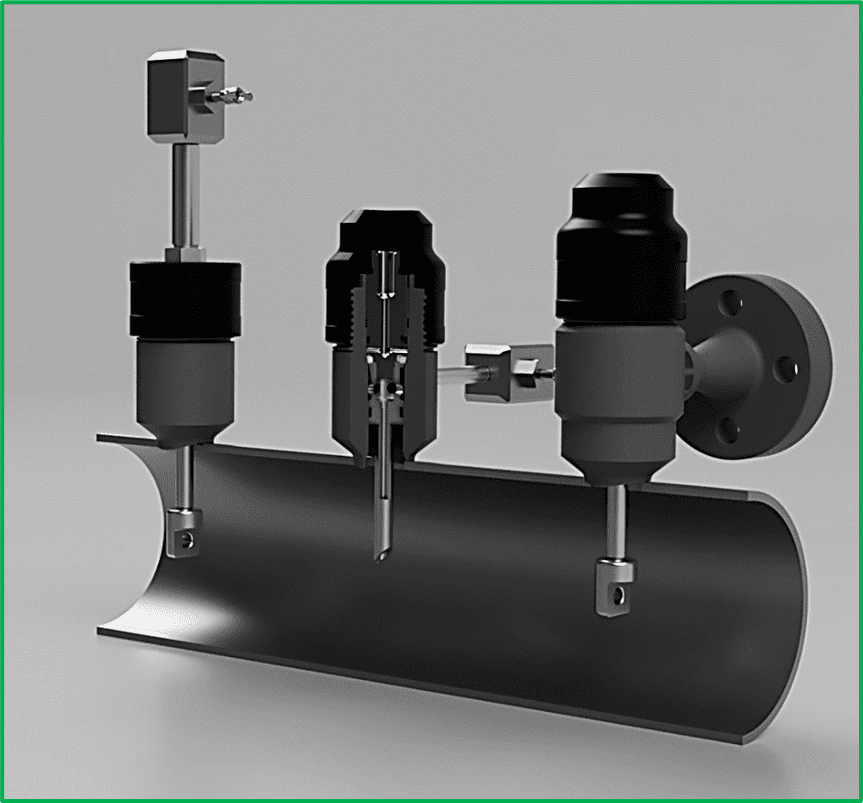
The Institute of Corrosion is very pleased to welcome its latest Gold Sustaining Member and Aberdeen Branch Sponsor – Rysco International, a global provider of Corrosion Management Solutions.
Based in Red Deer, Alberta Canada, Rysco International was formed in 2018 and is a division of the Rysco Group of Companies, responsible for the international distribution of Rysco Corrosion and Rysco Integrity’s equipment and services divisions.
Founded in 2007 by Ryan Finlayson (BSc, MBA), Rysco Corrosion actively promotes teamwork and expertise within its organisation. Rysco’s mission is to provide the best corrosion measurement and monitoring services available to the marketplace, so that clients can make informed decisions related to their infrastructure assets, in the interests of public safety and the environment.
Rysco believes its mission to be an honest commitment to all its stakeholders, delivering on that commitment by adhering to its Core Values, throughout its daily operations, providing quality, consistency, and accuracy in all its business offerings, treating client’s infrastructure monitoring and measurement concerns, as if they were its own.
Rysco’s 5 Core values are:
Service
Integrity
Innovation
Excellence
Knowledge
Rysco seeks to change client’s perceptions of corrosion measurement and monitoring through innovation, knowledge sharing, and providing a superior customer service experience.
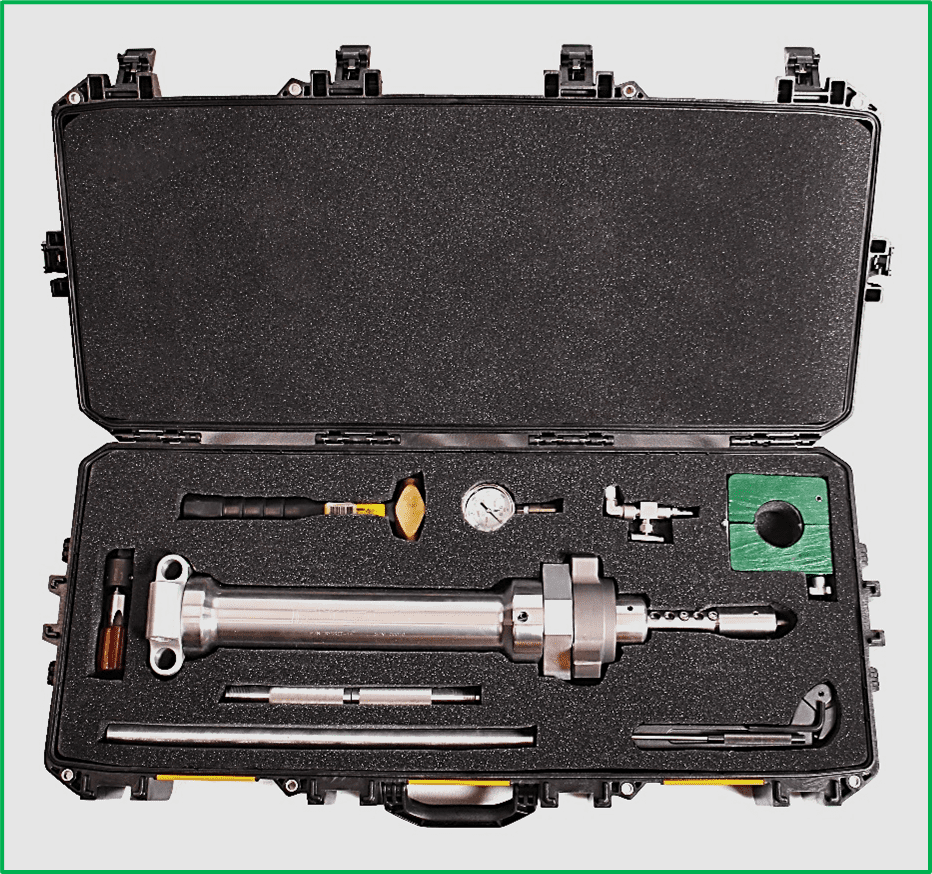
Rysco Corrosions Services and Products include:
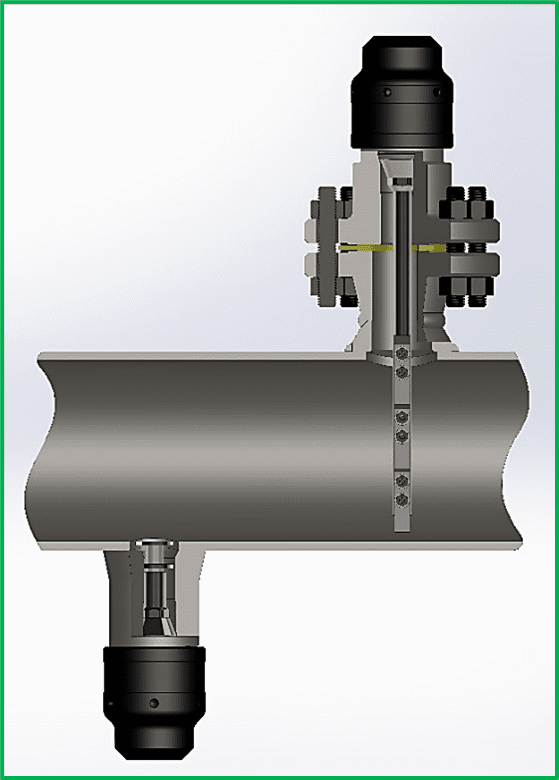
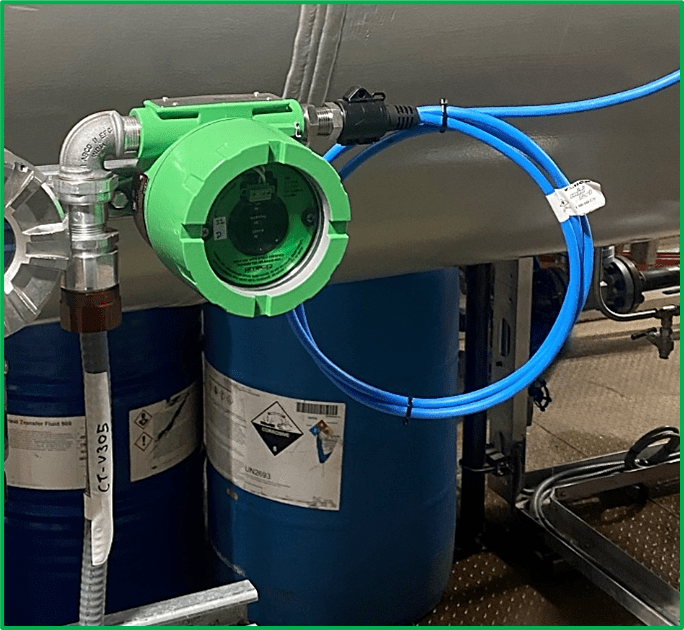
Internal Corrosion Monitoring
External Corrosion Monitoring
Engineering & Design
Pipeline Analysis
Online Reporting
Established in 2018, Rysco Integrity Services was created as a separate business entity from Rysco Corrosion Services Inc. to independently meet the needs of existing clients, with respect to their asset integrity, compliance, chemical management, and assessment concerns.
Rysco Integrity Services utilises the extensive knowledge and experience from within Rysco Corrosion to support a grounded, reasonable, and reliable approach to integrity management.
Rysco Integrity’s Services include:
Pipeline Integrity & Data Management
Management of Change (MOC)
Regulation Compliance & Reporting
Operating & Maintenance Procedures
Facility Inspections
Defect Elimination
Safe Operating Limits
When it comes to competency, all Rysco Group employees either have AMPP certifications or are diligently working towards the necessary achievements to satisfy these certifications. Rysco believe education, along with applicable experience and competency management, to be the cornerstone of its organization.
As part of its “first in class” culture, Rysco maintains certifications ISO 9001, ISO 14001, and ISO 45001 management systems within an IMS that includes Quality Management, Environmental Management, and Occupational Health and Safety Management. In addition, Rysco maintains an active APEGA permit to practice and participates in the Alberta Quality Programme.
The Institute of Corrosion (ICorr) Aberdeen branch would like to invite you (or your colleague) to give a presentation during our next 2022/2023 Session.
The events normally are held at 6 pm on the last Tuesday of the months from September 2022 till May 2023, excluding December 2022.
Topics on Pressure systems, Pipelines, Renewables and Structural integrity management with regards to the Material selection, Production chemistry, Welding, Corrosion/Microbiological control and monitoring, Inspection techniques and Data analytics are acceptable. Past case studies, project experiences and emerging technologies have proved popular and interesting to members. These are particularly welcome.
Our event attendees (members and non-members) include students, technicians, technologists, engineers, scientists, researchers, managers, company directors and other professionals from the oil and gas, power generation, manufacturing and renewables sectors. Subsequently we would publish a report of technical presentations in our Corrosion Management magazine and also on ICorr our Headquarters and ICorr Aberdeen website pages with your presentation slides and Q&A session write-up. A recording of the event (if conducted online) will be uploaded to our YouTube channel later.
If interested, please supply the following including your proposed speaker’s name, role and company, short biography of the speaker(s) and the proposed presentation title and abstract to the ICorr Aberdeen Branch Chair, Hooman Takhtechian, via htakhtechian@oceaneering.com and please also copy in icorrabz@gmail.com in your submission.
Speaker (s) ?
Presentation Title (non-commercial): ?
Abstract (400 Words): ?
Biography (100 Words): ?
Qualifications / Experience (50 Words): ?
All the submitted presentations will be subject to ICorr Aberdeen Committee review and the successful ones will be scheduled into ICorr Aberdeen 2021/2022 Technical Events Programme.
Please note that the deadline of the submission is 30/04/2022.
ICorr Aberdeen committee will approach the successful presenters in May 2022 to work out the event programme and announce it by June 2022. Please be highlighted that early submission of your proposed presentation / abstract is highly preferred and will assist your participation in the programme.
The questions in this issue feature preventing corrosion of rebars in concrete and when to test for salt contamination of a substrate before painting.
Question:
What is the best way to prevent corrosion of reinforcing bars in concrete? CL
Answer:
By far the best way to prevent corrosion of reinforcement is to ensure the design and construction is carried out correctly so as to achieve the required depth and quality of cover. The majority of reinforcement corrosion problems can be traced to poor designor detailing, lack of proper control of the concrete mix, its placement and curing, or mis-location of reinforcement resulting in low and inadequate cover.
Portland cement-based concretes protect reinforcement and other ferrous components by generating a low permeability and highly alkaline environment in which the steel protects itself through the formation of a stable passive oxide film. Provided these conditions are maintained then the steel remains protected. Thecover can be thought of as a thick barrier coating that contains chemical species that actively protects the steel. In the early stages, the concrete cover can even heal itself if there are fine cracks resulting from shrinkage as the concrete completes its curing and reaches its full strength.
Continuing along the protective coating analogy, if the thickness is inadequate or the barrier is impaired in any way, then corrosion of the steel becomes a significant risk.
There are two main initiators of corrosion in reinforcement, chloride ions and carbonation. Above a certain critical level (which can depend on many factors) the reinforcement can suffer from severe pitting corrosion, even in the presence of high levels of alkalinity. Chloride ions can be present due to accidental contamination (for example, using unwashed dune sand), purposeful addition (until relatively recently, calcium chloride was widely used as a set accelerator), and through ingress from external sources such as marine environments and de-icing salts.
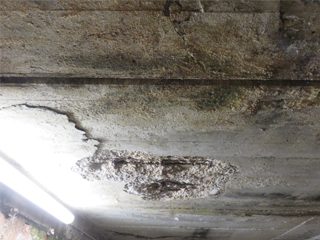
The other important cause of reinforcement corrosion is carbonation. This is where carbon dioxide from the atmosphere is able to enter the concrete cover and dissolve in the moisture present in the concrete to produce carbonic acid which in turn neutralises the alkalinity generated by the cement as it reacts and hardens. For a good quality concrete with adequate cover depth, this effect is slow and means the neutralised zone may not reach the depth of the steel for many tens or even hundreds of years. Where the cover concrete is of poor quality (for example, through the addition of too much water to the mix) or of inadequate thickness, then the time taken for the steel to be in neutralised concrete can be a matter of a very few years. Once no longer protected by the alkalinity, the steel can corrode in the presence of moisture, resulting in the production of expansive corrosion products and the subsequent cracking and spalling of the cover. If maintained in a dry condition (for example, indoor exposure) reinforced concrete can survive carbonation with little or no consequence.
Current standards and codes of practice provide the guidance required to limit the risk of corrosion from either chlorides or carbonation for a range of commonly encountered exposure conditions.
Where the exposure is particularly aggressive, such as offshore applications, additional measures may be required. The same approaches can also be used to reinstate the required durability of existing structures where it has been compromised through historic shortfalls in design, construction practices or maintenance.
The application of coatings to the concrete surface to resist chlorides and carbonation are widely used to extend the service life of existing structures, with periodic recoating further extending the time before further measures are needed. Should corrosion of the reinforcement have occurred then removal of loose and delaminated concrete, cleaning of the steel and reinstatement with fresh concrete (often a modified repair mortar with enhanced properties) can be effective for the treatment of carbonated or mechanically damaged concrete where chloride levels are low but are generally less than satisfactory where chloride induced corrosion has occurred.
Remediation of chloride contaminated concrete requires all residual chloride to be removed or, more practically, dealt with in some other way, such as by the use of corrosion inhibitors or cathodic protection. Corrosion inhibitors can be applied to the surface of the concrete and added to the repair mortar to enhance the ability of the fresh alkaline repair so it can better resist the ongoing influence of the remaining chlorides. Where the residual chloride level is too high for inhibitors to be affective or where a very long additional life is required, then cathodic protection may be the only viable alternative to demolition and reconstruction.
Cathodic protection, dating back to 1824 (coincidentally the same year Portland cement was patented), is widely usedto protect buried or submerged structures such as pipelines, offshore facilities, and shipping but for many decades has also proved invaluable for the corrosion protection of steel reinforcement in concrete. Cathodic protection (CP) requires specialised design and should be carried out by suitably certificated personnel to ISO 15257: 2017 (see ICorr website for more details).
In summary, the best way to prevent corrosion of reinforcing bars in concrete is to keep them within a good covering of alkaline, chloride-free concrete. Where that is not possible, the build-up of chlorides and carbonation can be controlled by surface coatings, and steel that has already suffered corrosion can be rescued by returning it to an alkaline, chloride-free environment. Where that is not possible or practicable then additional measures can be taken to control the corrosion of the steel such as cathodic protection.
A recent report details the results of testing by the Michigan Technological University into the surface chemistry of early-stage rust and the development of a more precise method to observe the formation of iron mineral corrosion with water and oxygen.
The study, “Effect of Cations on the Oxidation and Atmospheric Corrosion of Iron Interfaces to Minerals,” was recently published in The Journal of Physical Chemistry A, and theresearchers hope that a better understanding of this process will aid with carbon dioxide capture, uncover polluted water systems and improve infrastructure like bridges and pipelines.
According to MTU, the main finding is that cations in solution, such as positively charged sodium or calcium ions, influence the type of carbonate films grown when exposed to air. With gradual exposure to oxygen and carbon dioxide, the carbonate films produced are specific to the cation.
The new technique is a three-stage process, assessing changes to the electrolyte composition and using oxygen and carbon dioxide from air as a reactant, to observe real-time formation of the different minerals like rust observed at the air-liquid-solid interface.
We use cookies to optimize our website and our service.
Functional
Always active
The technical storage or access is strictly necessary for the legitimate purpose of enabling the use of a specific service explicitly requested by the subscriber or user, or for the sole purpose of carrying out the transmission of a communication over an electronic communications network.
Preferences
The technical storage or access is necessary for the legitimate purpose of storing preferences that are not requested by the subscriber or user.
Statistics
The technical storage or access that is used exclusively for statistical purposes.The technical storage or access that is used exclusively for anonymous statistical purposes. Without a subpoena, voluntary compliance on the part of your Internet Service Provider, or additional records from a third party, information stored or retrieved for this purpose alone cannot usually be used to identify you.
Marketing
The technical storage or access is required to create user profiles to send advertising, or to track the user on a website or across several websites for similar marketing purposes.