Cortec® has developed VpCI®-337, as an alternative to nitrogen blanketing for easy, effective corrosion protection of void spaces.
Nitrogen purge or nitrogen blanketing is commonly used to protect metal void spaces from corrosion by replacing the oxygen with nitrogen gas. However, nitrogen gas is expensive it requires constant pressure with an airtight seal, and leaks may also pose a safety hazard for personnel. In contrast, according to the company, VpCI®-337 is much safer, cost-effective, and easy to apply and maintain option. It is a waterborne vapour phase corrosion inhibitor that can be applied by fogging into metal void spaces. The fogging fluid diffuses throughout the void and is attracted to metal surfaces where the VCI “condenses” and form a protective molecular layer. This layer inhibits the corrosion reaction on the metal surfaces even in the presence of oxygen and residual moisture. The space must be completely closed for the corrosion inhibitors to be effective, but an air-tight seal is not required as for nitrogen purge, continued the company.
Westlake Chemical Corporation has entered into a definitive agreement with Hexion to acquire their global epoxy business for approximately EUR 1.0 billion.
Based in Rotterdam, The Netherlands, Hexion’s epoxy business is an industry leader in the manufacture and development of specialty resins, coatings and composites for a variety of applications, including wind turbine blades and light-weight automotive structural components. In the twelve months ended September 30, 2021, Hexion’s epoxy business had net sales of approximately EUR 1.3 billion.
The transaction is anticipated to be completed in the first half of 2022 and following customary closing conditions, Westlake intends to significantly expand its integrated business by adding a downstream portfolio of coatings and composite products to its businesses.
Professor Sir Peter Gregson has been appointed Chair of the Henry Royce Institute, the UK’s national institute for advanced materials research and innovation.
A Materials’ Scientist by background and recipient of the Rosenhain Medal and Prize of the Institute of Materials in 1996, Sir Peter Gregson has served as Vice-Chancellor of Queen’s University Belfast (2004-13) and Cranfield University (2013-21).He has been Non-Executive Director of Rolls-Royce Group plc and served on the Councils of the Royal Academy of Engineering and the Council for the Central Laboratory of the Research Councils. He is currently Trustee of the Royal Anniversary Trust and of Lloyds Register Foundation.
Speaking about his appointment, Sir Peter said: “The Henry Royce Institute is a national asset for Advanced Materials Research and Innovation for a Sustainable Society.I pay tribute to the exceptional work of Baroness Brown of Cambridge, CEO Professor David Knowles and Chief Scientist Professor Philip Withers and all the Partners in establishing this outstanding academic partnership. In looking forward, Royce will need to work ever more closely with business to accelerate the research, development and commercial exploitation of advanced materials for the benefit of society, and I look forward to working with the Governing Board, the leadership team and partners in Government and industry to realise this ambition.”
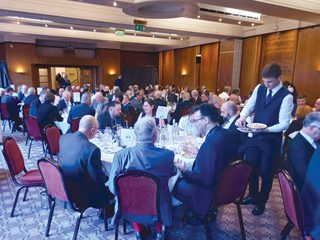
The branch Christmas lunch returned to the Royal Overseas League in Mayfair on 2nd December 2021 after the enforced absence of 2020. The number attending was restricted compared to previous years but over 120 guests attended the event which again started with a drinks reception followed by a four-course meal in the Hall of India and Pakistan.
After the meal, branch chair Ben Moorhouse introduced the guest speaker Bob ‘the Cat’ Bevan who entertained the guests with old style jokes and comedy. Most of the guests stayed on for a while to socialise and network and many then transferred to a local public house to continue chatting. The event made a small surplus and thanks must go to the organising committee, Jimmy Glynn for organising the raffle as he has for many years, plus Correx, CTS and Telpro for providing sponsorship. The 2022 lunch is already booked at the ROSL for 1st December this year and we look forward to another successful event.
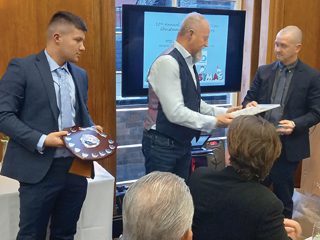
There was a presentation after the meal to the best apprentice of 2021, Kian Power, who received his certificate and shield from Kevin Harold, MD of Correx.
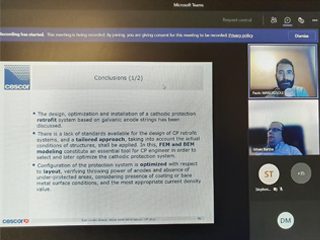
The January technical meeting, chaired on this occasion by David Mobbs, featured an online presentation on “Life extension of offshore platforms, through retrofit CP design assisted by modelling” given by Dr Paolo Marcassoli, Cathodic Protection and Inspections Manager at Cescor Srl, Italy, and Istvan Bartha, Independent Subsea Consultant.
Paolo Marcassoli has fifteen years’ experience in materials and corrosion engineering and cathodic protection engineering gained in an academic environment and in the onshore and offshore oil & gas industry, offshore wind, and in infrastructures. He primarily carries out activities in the fields of CP design and FEM modelling, monitoring and CP inspections, and corrosion control.
Istvan Bartha is an experienced integrity engineer with over 20 years’ experience in fields of subsea, pipelines, structures and bridge engineering, who has participated in major oil and gas projects ranging from concept and design stages through to fabrication, installation and operation of new and ageing assets. Istvan has a detailed knowledge of key design and operational principles of onshore, subsea and topside production, and control systems, requiring detailed analyses of technical data such as RBI, FMECA, RCA or CP, and collaboration with other engineering disciplines and close interface with the client.
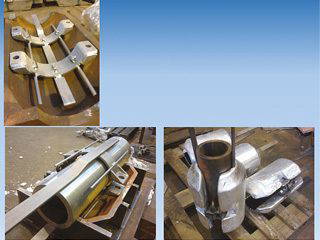
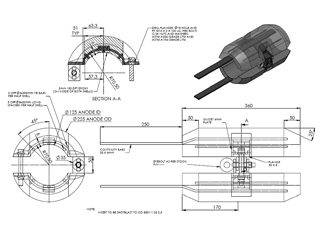
Paolo explained that a significant number of permanent offshore structures for oil and gas production in the world, including steel jacket platforms, are reaching or have exceeded their original design life. They require extension of life or requalification programmes to prolong their operating life. Cathodic protection (CP) is one of the issues to be carefully managed as part of this process. In case the original CP system cannot guarantee the planned residual life, a retrofit intervention needs to be designed and executed.The design of CP retrofit systems, although technically adhering to the stipulations of the applicable codes, does not necessarily follow the criteria and approaches adopted for new facilities, as the intervention is required to be executed with the structure in-place, including significant marine growth and calcareous deposits, aspects which could affect CP repolarisation and maintenance rates as well as potential obstructions from installation perspective. All the above, have a strong impact on installation requirements and costs. Accordingly, dedicated CP expertise has been developed for retrofit applications, aimed at selecting the most convenient system. A tailored approach is followed, by considering the most appropriate design parameters, affected by the present polarisation conditions, presence of marine growth and calcareous deposits, on the structure. Paolo described the retrofit process though a real case where Cescor designed, supplied and commissioned the system. The pros and cons of impressed current vs galvanic anodes were highlighted and in this case the options verified through Boundary Element Method (BEM) modelling.A galvanic anode string as opposed to an anode pod was selected due to installation constraints, the detailed design developed and the materials supplied.
Istvan then described the installation phase in detail, which had its own challenges due to the Covid pandemic affecting the workforce, personnel limitations on the platform due to simultaneous operations. A high level insight was provided regarding the engineering studies completed to support the installation phase, such as Finite Element Analysis of the above water clamps, fatigue checks, lateral displacement and tensioning requirement of the strings as well as developing the subsea anchoring. Furthermore, a short presentation of the offshore installation phases and activities was provided.
Finally, Paolo described the preliminary CP survey about six months after installation, which confirmed the corrosion protection target had been restored.
David Mobbs thanked the speakers for a very interesting talk which had been attended to by 40 engineers including several from Europe, Canada, USA, S. Africa and the UAE.The online event was organised by Agnieszka Knyter of London branch, who also very efficiently managed the Q&A session with the speakers. A video of the presentation can be found on the Institute website at www.icorr.org/london-branch-online-meeting-13-january-2022/
The branch’s November technical meeting was held on 30th, to a large online audience of nearly 60 people including many international attendees.This was a joint meeting with IOM3 and MIS (Mining Institute of Scotland) with Dr Nigel Owen, Operations Manager of Aberdeen Foundries, presenting “Sacrificial Anodes: Material Specifications, Manufacturing and Anode Design for Effective Cathodic Protection Systems”.
The opening notes for the IOM3/MIS were given by Babs Oyeneyin of IOM3’s Energy Transition Board and retired Professor of Engineering at RGU who recently participated in COP26, Glasgow.
Aberdeen Foundries are one of the last remaining foundry operations in Scotland for non-ferrous castings and have been involved with the offshore energy and marine services industries for over 40 years, and is the last remaining working foundry in Aberdeen.
Nigel, who gave a most informative and heart-felt talk, has worked in the aluminium Industry for over 35 years after completing a B.Sc. in Metallurgical Engineering at Salford and subsequently a PhD in Materials at Imperial College before working in a variety of companies, including R&D of cast and rolled Aluminium products in Australia & USA, along with smelter waste recycling in New Zealand.
At the foundry he is responsible for all manufacturing, testing and technical specifications of marine and subsea sacrificial anode supplies. In addition, Nigel is a long-serving member and officer of the Aberdeen ICorr Committee.
The raw materials used for sacrificial anode manufacture are by necessity, high-purity based metals with very specific alloying requirements and final properties, in order to achieve the desired effective and long-lasting CP system operation.
The typical process for manufacturing anodes was presented, from a ‘metallurgical standpoint, the alloying, pouring, testing and finishing processes of various product types were then described in great detail.
The base materials, properties and costs of modern sacrificial alloys for cathodic protection purposes were detailed along with the conditions and applications for which they are generally used and the complexities of building moulds for casting operations.Nigel illustrated the importance of the Periodic Table and how alloying from different elements can be used to control/increase electro-negativity, and also the importance of the Galvanic Series showing how CP currents from sacrificial alloys are applied to counter corrosion currents.
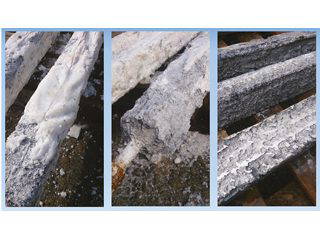
Other key aspects covered included, the role of calcareous deposits and simultaneous reactions occurring at the anode and cathode. The talk also included a very interesting history of anode production and how this has developed into the tightly regulated industry of today, with recent concerns over contaminants like mercury (an effective addition) and also highlighted other bad contaminants like iron and copper that can affect anode performance.
In summary he concluded that:
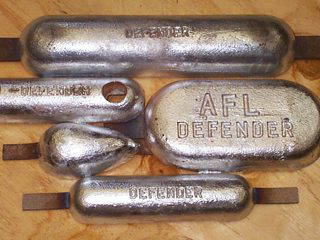
Aluminium alloys (of aluminium/zinc/indium) generally provide low-cost reliable anodes and account for 90% of offshore anode manufacture.
Magnesium anodes remain particularly useful for onshore applications and for de-scaling operations.
Zinc anodes are still well used for both brackish waters/harbours and offshore (buried applications).
Nigel emphasised the need for good quality control of raw materials sourcing and at all subsequent manufacture stages which can be of very complex geometries and which require very careful planning and preparation. Analysis of cast composition is normally performed together with electrochemical testing and optical emission spectrometry tests, to a combination of client purchase specifications and International Standards.
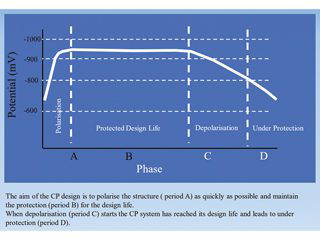
Good electrical continuity must be ensured between alloy material and surface profiled steel inserts and finally to the structure itself being protected by CP. Some materials like zinc naturally bond to inserts at casting temperatures while other rely on the mechanical key.Critically, all cathode areas to be protected must be identified at the design stage and then geometry of anode made to suit the area/life/current distribution to achieve Initial polarisation and required final design life.
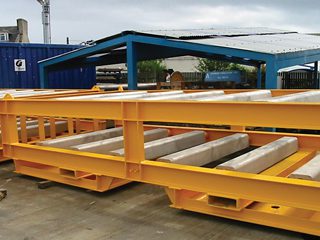
CP system life extensions were also touched upon with illustrations of some recently shipped anode skids.
The presentation then moved on to discuss the design of Sacrificial Anode Cathodic Protection systems for a Marine Environment including prevailing standards, which involved selection of anode configuration, a detailed calculation process, combined with rules of thumb and practical experience to design an effective working CP system (that is capable of manufacture).
This very engaging presentation generated many questions from the audience that were expertly responded to by the author.The closing remarks for this well attended event were given by Hooman Takhtechian, the current Chair of Aberdeen Branch, who thanked all participants.
Slides of technical papers for branch events, along with their respective Q&A’s can be found at, ICorr Aberdeen Branch (google.com) under Local Technical Programme Aberdeen Branch – Institute of Corrosion (icorr.org). A library of event recordings may also be found at: ICorr Aberdeen – YouTube.
The branch has a very fully year ahead, running the Young Engineer Programme (YEP) alongside its normal busy technical programme for 2021-2022 Session. With Scottish Govt. guidance still discouraging large public events, initial meetings of 2022 will be held online and recordings published post-event.
We use cookies to optimize our website and our service.
Functional
Always active
The technical storage or access is strictly necessary for the legitimate purpose of enabling the use of a specific service explicitly requested by the subscriber or user, or for the sole purpose of carrying out the transmission of a communication over an electronic communications network.
Preferences
The technical storage or access is necessary for the legitimate purpose of storing preferences that are not requested by the subscriber or user.
Statistics
The technical storage or access that is used exclusively for statistical purposes.The technical storage or access that is used exclusively for anonymous statistical purposes. Without a subpoena, voluntary compliance on the part of your Internet Service Provider, or additional records from a third party, information stored or retrieved for this purpose alone cannot usually be used to identify you.
Marketing
The technical storage or access is required to create user profiles to send advertising, or to track the user on a website or across several websites for similar marketing purposes.