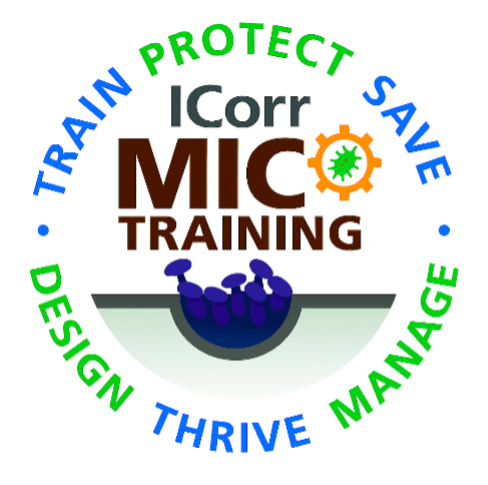
ICorr MIC Training Course 12th–16th October 2026
Advance your organisation’s capability in microbial corrosion management with this high impact, ICorr training programme. Designed for professionals in operations, integrity, inspection, management, design, R&D, consultancy, and utilities. The course equips participants to:
• Identify MIC drivers across a wide range of systems
• Implement targeted monitoring, mitigation, and control strategies • Lead investigations supported by robust, defensible evidence
• Influence organisational policies and strengthen MIC governance • Align internal practices with global standards and
best-in-class methodologies
Delivered by a leading subject matter expert and aligned with ICorr recognised competency framework, this course blends technical depth with practical application—empowering participants to protect assets, enhance performance, and drive meaningful organisational improvement. It contributes to Continuing Professional Development (CPD)
Certification Opportunity
Participants who successfully pass the final examination will earn the ICorr Certified MIC Technologist credential—a globally recognised mark of excellence in microbial corrosion management and a valuable step toward professional chartership.
Venue: ICorr HQ, Northampton, United Kingdom
For further information: Dr Tony Rizk – ETGBchair@icorr.org • Registration: admin@icorr.org
ICorr FOCE (MICorr) Training Course 14th–18th September 2026
Advance your ICorr Professional Membership
This industry leading course provides direct access to professional membership of ICorr, for those with relevant experience. Corrosion management, failures and remediation commonly occur throughout all branches of engineering where metals are part of the structure or process. FOCE is a corrosion course that covers the basic principles of corrosion that are needed by engineers to understand why and how failures occur, actions that can be taken to manage the ongoing corrosion and/or remediate the structure, and options to prevent further corrosion, where possible. The course is presented as a series of modules, starting with essential background information about the corrosion process and then applying the basic principles to common engineering metals, including stainless steel, aluminium, and copper alloys. Both the general and the different types of localised corrosion such as crevices, pitting, bi-metallic corrosion, etc., is considered. Common atmospheric and immersed conditions, re-bar in concrete, high-temperature atmospheres, water treatment, buried pipes, etc are considered to understand corrosion.
Corrosion management strategies, including material selection, cathodic protection, surface preparation, coatings, chemical treatments, inhibitors, etc., are included in the course. The role of the corrosion engineer is described and includes investigation of failed components, inspection, and testing of samples, with practical examples and case histories included in the course notes.
As a classroom-based course, FOCE is provided in English by
an experienced, practicing corrosion consultant. A copy of the training material is provided to each attendee. Questions and active participation are encouraged throughout the course, as many participants enjoy learning about the additional real-life examples that are provided by fellow attendees. Fun quizzes are held each morning so both the candidates and the tutor can assess their progress during the week on an ongoing basis. One-on-one sessions can be arranged where a student has a specific module requirement.
The learning modules are given over four intensive days, and candidates for the examination on the final day are encouraged to revise the material each evening to ensure that they understand the course content. At the end of the course, all attendees are given a Certificate of Attendance, which shows that they have been present for all the modules. After passing the examination, participants receive a Certificate of Achievement, which demonstrates that they have received sufficient corrosion training to apply directly. Previous attendees of the course have ranged from complete beginners in corrosion (zero previous knowledge) to practicing Corrosion Consultants.
Certification Opportunity
Participants who successfully pass the final examination will receive certification towards MICorr Professional Membership and contributes to Continuing Professional Development (CPD).
Venue: ICorr HQ, Northampton, United Kingdom
For further information: Dr Jane Lomas – ETGBchair@icorr.org • Registration: admin@icorr.org