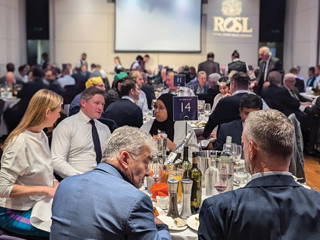
On Wednesday, 13th November 2024, the North-East (NE) Branch of the Institute of Corrosion hosted the Institute of Corrosion 2024 AGM at Neville Hall in Newcastle upon Tyne.
The day commenced with a technical offshore wind programme, followed by the AGM and concluding with an evening dinner. Almost 70 people from all over the UK attended the Technical Program, and 60 attended the evening dinner. Attendees included the ICorr Council, Sustaining Members, Professional Members, General Members and potential future members. The day was a great success, with the variety of engaging content keeping the attendees entertained for almost 9 hours from start to finish.
ICorr NE Branch, Christmas Dinner
After a busy year, the Branch committee got together, (minus a couple of late withdrawals due to heavy snow), to enjoy a well-earned Christmas Dinner and had time to discuss the success of 2024, in particular the ICorr AGM and Technical Wind Day.
Photo: AGM Delegates Gathered in the Neville Hall on 13th November 2024.
On December 15th, 2024, we hosted a webinar with experts Rene Goderie (Dow Chemicals) and Phil Yule (AMPP). It attracted 200+ registrants, 85 attendees globally, with strong engagement from ICorr members and industry professionals.
Formation of Volunteer Committee A volunteer committee is being formed, with 12+ members expressing interest. The first meeting is scheduled for February 20th, 2025.
Upcoming Events and Initiatives
Midlands Corrosion Forum (MCF) Joint Event A joint event with MCF is planned for April 2025, focusing on innovations in corrosion monitoring.
Seeking Experts for Future Webinars on:
Corrosion and use of advanced analytics including AI
Industrial IOT and remote monitoring, digital twin
Applied practices in corrosion and cathodic protection
Regional Engagement We are strengthening relationships with Cranfield University, Cambridge University, and other institutions to involve students in ICorr activities through technical talks and industry collaborations.
Prafull Sharma – Interim Chair, Midlands Branch, Institute of Corrosion
Before sitting down for the meal there were pre-lunch refreshments, and time for the guests to meet each other.
After the lunch, the guests were entertained by Gary Richardson. Garry presented the Sunday morning sports programme, Sportsweek on BBC Radio 5 Live until 2019, although he remained a sports presenter on the weekday morning Today show on BBC Radio 4 until September 2024. He gave a very interesting insight into his interviewing of sports stars over the years, after which the President, Yunnan Gao, gave a brief update on the Institute, before a raffle and time for networking. The branch would also like to thank the sponsors, Akzo Nobel, Carboline, Concrete Repairs Ltd, Corrodere, Corrpro Europe, Owens Corning, and Winn and Coales (Denso) Ltd., for supporting this event.
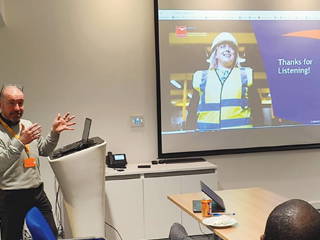
The first technical meeting of 2025 was held on 9th January, when Esteban Amirante of Beasy Ltd. presented “Implementation of a Digital Twin for an Offshore Structure.” Esteban has a degree in mechanical engineering and a master’s in business administration and is the International Business Development Manager at CM BEASY Ltd.
Esteban started by describing the concept of a “Digital Twin” and moved on to how this could be implemented for an offshore structure to revolutionise asset management far beyond simple 3D digitalisation. This innovation promises to transform how assets are managed and decisions are made. The “Digital Twin” provides a digital replica of an offshore asset, enhancing clarity and efficiency in managing corrosion control systems.
He explained that the current corrosion data management is plagued by fragmented data and time-consuming processes, but the “Digital Twin” concept can address these issues by offering a comprehensive, colour-coded visual representation of the asset, where green indicates expected conditions and red signals the need for attention. This tool goes beyond visualisation; it can integrate survey data and predict future performance, ensuring timely intervention and maintenance.
Key features include monitoring sacrificial anode depletion, remaining life, and mass. The “Digital Twin” can plan anode replacements, and predict protection potentials across the entire structure, moving beyond limited survey locations. It aligns with the asset’s lifespan, requiring minimal updates and providing systematic monitoring.
Additionally, the “Digital Twin” serves as an early warning system, predicting anomalies before they occur. It can simulate and explore various scenarios, empowering departments to make informed decisions based on predicted outcomes. This not only streamlines workflows but also unleashes significant cost savings and time efficiency.
In essence, the “Digital Twin” can be an innovative partner, enhancing decision-making and mitigating risks. Esteban concluded by stressing that the concept is not just a tool; it’s way to the future, where decisions are bold, operations are optimised, and risks are identified early.
After a very interesting Q&A session, the Chair thanked Esteban for his presentation, and presented him with an ICorr pen, in appreciation of his talk.
The branch AGM will be held on 13th March, at the slightly earlier time of 6.15 pm and will be followed by a presentation from the Chair, Paul Brooks.
Paul would be pleased to answer any queries on the Branch activities: Please contact him at Londonchair@icorr.org
Photo: Guests Enjoying Christmas Themed Meal.
Photo: Gary Richardson Sharing Insights into His Interviewing of Sports Stars Over the Years.
Photo: Esteban Amirante Delivering His Presentation.
Photo: Paul Brooks Presenting ICorr Pen to Esteban.
Following its launch earlier in 2024, the new Central Scotland Branch had an eventful and productive 2024, marked by significant growth in membership and excellent technical meetings. The number of companies and academic institutions represented in our meetings continues to grow. Sponsorship engagement sponsors has been remarkable—3 new companies have indicated interest in becoming branch sponsors, in addition to our two existing sponsors. The Chair, Dr. Philip Enegela, welcomes all enquiries on this matter.
On 27th November 2024, Graham Murray (Head of Metallurgy, Manufacturing Test and Equipment Qualification at Altrad Babcock) provided a seminal presentation on “Refurbishment and Improvement of Operating Assets” to close out the branch’s 2024 activities. It was a very stimulating talk that elucidated challenging modifications and repairs on long-lead, high-criticality fixed equipment that are safety critical in industrial assets. Case studies were presented covering intricate valves in power plants and pressure equipment in petrochemical facilities. Graham demonstrated how innovative thinking
and novel solutions are being used to help enhance asset longevity. Flyers and registration links will be issued in due course to members.
Interested presenters can contact cschair@icorr.org to supply abstracts for consideration for the 2025-2026 technical programme.
The Central Scotland Branch remains committed to collaborating with other Institutes of repute. Discussions are underway with the Institution of Engineers in Scotland (IES) for a joint meeting in 2025.
The Branch has a full and very varied programme up to Summer 2025. Presentation topics include:
Topic
Month
Presenter / Company
Deep optimisation for cathodic protection: advanced technology for transformer rectifiers output current optimisation.
January
Nicolas Rossi, Automa srl
Cost-effective corrosion protection using two-pack epoxy coatings in an aerosol and protecting nozzles and flange faces, using alternatives to hand coating.
February
Graham Greenwood-Sole, Corrocoat
Linings and PFP (Cementitious or Epoxy).
March
Robert Allan, Carboline
Selection of internal coatings for pressure vessels.
April
Simon Daly, Safinah Energy & Infrastructure
Enhancing spot-welding efficiency: assessing the precision of response surface methodology in predicting optimal parameters.
May
Ahmed Elgahani, Brega Petroleum Marketing Co.
Catching the IR-free potential: an overview of the remaining IR components in off measurements and the importance of the design for PRE with integrated coupon.
June
Ivano Magnifico, Automa srl
Composite repairs for pipework—standard and advanced.
July
Stuart McKay
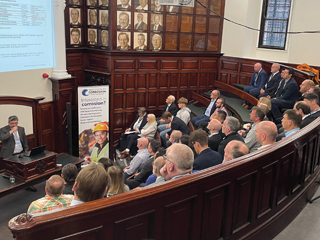
Photo: Graham Murray (Head of Metallurgy, Manufacturing Test & Equipment Qualification at Altrad Babcock), November 2024 Presentation.
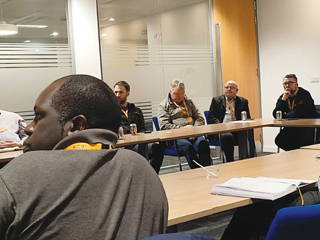
Photo: Delegates for the November 2024 Presentation.
In early November 2024, ICorr Aberdeen was pleased to announce the very first Joint Webinar Week between ICorr and CSCP (Chinese Society for Corrosion and Protection) which consisted of five lunchtime presentations held over an eight-day period.
No
Date
Speaker Name
Job Title
Organisation
Presentation Title
1
Monday 11th November 2024
Dr Anqing Fu
Director of corrosion research team
CNPC Tubular Goods Research Institute
Corrosion research progress in oil and gas and new energy industry.
2
Tuesday 12th November 2024
Professor Yong Xiang
Professor and doctoral supervisor
China University of Petroleum, Beijing
Spontaneous inhibition phenomena of corrosion in CCUS system and their mechanisms.
3
Thursday 21st November 2024
Dr Di Wang
Associate professor of material science and engineering
Northeastern University, Shenyang
The mechanism and protection of microbial corrosion in oil and gas field.
4
Friday 22nd November 2024
Dr Mindong Chen
Associate Research Fellow
SINOPEC Research Institute of Safety Engineering, Qingdao
Optimising corrosion resistance of low-alloy steel for the refining industry by corrosion big data methods.
5
Monday 25th November 2024
Dr Xinpeng Lu
CEO
Corrosion X Technology Co., Ltd.
Progress in the application of generative artificial intelligence in the cathodic protection industry.
Summaries of the webinars are shown in the table below, which included five individual presentations from members of CSCP. The CSCP/ICorr Webinar series was arranged by ICorr President-elect Dr Yunnan Gao and President Stephen Tate, after the signing of a Memorandum of Understanding (MoU) at the 22nd International Corrosion Congress held in Xi’an, China.
The five sets slides have all now been uploaded to ICorr website with the link as https://www.icorr.org/aberdeen/ Refer to local technical programme.
Meeting Recordings: All the five meeting recordings have also been uploaded to ICorr YouTube channel at ICorr YouTube Channel.
Summary Post on LinkedIn: The summary of this event has been posted on linkedIn. The link to the post is LinkedIn Post for ICorr-CSCP Webinar Week.
Presentation 1 – Corrosion Research Progress in Oil & Gas and New Energy Industry by Dr Anqing Fu
Dr Anqing (Andy) Fu is the Director of Corrosion and Protection Research Center of CNPC TGRI (Tubular Goods Research Institute of China National Petroleum Corporation). Dr. Fu graduated from University of Calgary in 2010 and obtained PhD degree in energy and environment. Andy has more than 14 years of working experience in corrosion and protection of the oil & gas industry, and he specialises in electrochemical corrosion, stress corrosion cracking, corrosion failure analysis of OCTG, anti-corrosion techniques (inhibitor, organic/metallic coating, and clad pipe) R&D, and pipeline and wellbore integrity management.
Abstract: Corrosion is a great threat in the oil and gas industry, including upstream oil and gas fields, middle-stream transmission pipelines, and downstream refineries. Much more attention needs to be paid to corrosion not merely due to the economic issue in terms of oil and gas loss but also to safety and environmental considerations. Firstly, several typical case studies of downhole tubing and gathering pipeline corrosion collected from the field were analysed. Secondly, microbiologically influenced corrosion (MIC) in the shale gas production system was investigated. MIC is prevalent in the shale gas production system due to the bacteria generation in recycled fracture fluid. Thirdly, Carbon Capture, Utilisation, and Storage (CCUS) is a substantial measure to realise carbon neutrality, while CO2-induced corrosion is nonnegligible. Typical failures in terms of supercritical CO2 corrosion, sour impurity gas-induced stress corrosion cracking, and packer rubber sealing failure were analysed in CCUS-CO2 injection and production wells. Fourthly, hydrogen is regarded as the ultimate clean energy; pipelines are regarded as the most economical and effective means for transporting H2 in a gaseous state. The difference between gaseous hydrogen and ionic (cathodic) hydrogen-induced damage to pipelines was compared, and three typical facilities for gaseous hydrogen-mechanical interaction, gaseous hydrogen permeation, and content tests by TDS were introduced. Finally, corrosion protection technologies developed by CNPC TGRI, including inhibitors, organic coatings, and metallurgically clad pipes, were introduced; moreover, several challenges for corrosion and protection research in the oil and gas and new energy industries were summarised.
Presentation 2 – Spontaneous Inhibition Phenomena of Corrosion in CCUS System and Their Mechanisms by Professor Yong Xiang
Yong Xiang serves as a professor and doctoral supervisor at the College of Mechanical and Transportation Engineering, China University of Petroleum, Beijing. He is the director of the Laboratory for Low Carbon Energy Equipment and Materials Protection and the deputy dean of the Ocean Engineering Institute. He received both his bachelor’s and doctoral degrees from Tsinghua University, and he was also the post-doctoral researcher of Ohio University. Yong Xiang is an active member of several committees under the China Society for Corrosion and Protection, including the Corrosion Inhibitors and Water Treatment, Oil and Gas Field and Pipeline Corrosion and Safety, and Non-metallic Corrosion-Resistant Materials committees.
Abstract: Carbon capture, utilisation, and storage (CCUS) technology has been considered for reducing CO2 emissions and improving energy efficiency. However, during the capture process, impurities such as O2, SO2, and NO2 are present, which accelerate corrosion of transportation pipelines and wells. Nevertheless, research also found several interesting corrosion inhibition phenomena in the system. This study summarised the spontaneous corrosion inhibition phenomena during the capture and transportation process and outlined the corresponding inhibition mechanisms. These included the corrosion inhibition mechanisms of the degradation products of organic amines and the inhibition behaviour of SO2 on CO2 corrosion processes. Additionally, this study also proposed several corrosion inhibition methods in CCUS system. Understanding these corrosion inhibition mechanisms is considered crucial for corrosion control of CCUS facilities.
Presentation 3 – The Mechanism and Protection of Microbial Corrosion in Oil and Gas Field by Dr Di Wang.
Di Wang is an associate professor of material science and engineering at Northeastern University in Shenyang, China. He focuses on the mechanism and mitigation research of microbiologically influenced corrosion in the oil and gas industry. His research activities are aimed at deciphering the electron transfer mechanism of classic corrosive microbes of sulphate-reducing bacteria, investigating eco-friendly natural D-amino acids as green biocide enhancers combined with commercial biocides to kill the bacteria, and modifying the microbial sample methods in the oil and gas field.
Di Wang obtained his doctorate degree at Ohio University in Athens, United States, in 2022. From June 2022, he continued his research of MIC in the oil and gas industry at Northeastern University. He has published 27 peer-reviewed research papers, including 16 first-author papers. He also joined the working group—AMPP Standard 21495 of Laboratory Evaluation of the Effect of Biocides on Biofilms.
Abstract: Microbial corrosion of metal materials in the oil and gas field industry causes serious economic losses and threatens energy security. For the mechanism research of microbial corrosion, deciphering the electron transfer mechanism of microbes in a complicated oil and gas environment is a critical point to having a better understanding of microbial corrosion. Electron mediators like riboflavin and magnetite nanoparticles promote the indirect electron transfer and distinguish electron transfer microbial corrosion from other corrosion. Both could be useful tools in a microbial corrosion sensor to distinguish the corrosion mechanism. The indirect electron transfer mediated by hydrogenase genes plays a role in promoting sulphate-reducing bacteria corrosion, but it was not found to be a dominant role in the corrosion process, which denied the previous classical theory of Cathodic Depolarisation Theory coming out in 1934. For the protection research of microbial corrosion, physical methods like pigging and chemical treatments such as biocide dosing are used to mitigate microbial corrosion in the oil and gas industry, but they lead to problems like environmental concerns, high operational costs, and low efficacy in the same system after prolonged applications. Alternatively, eco-friendly natural D-amino acids as green biocide enhancers combined with commercial biocides to kill the bacteria can be used to block the electron transfer between bacteria and metal surfaces and disperse the sessile cells from the metal surfaces.
Presentation 4 – Optimising Corrosion Resistance of Low-Alloy Steel for the Refining Industry by Corrosion ‘Big Data’ Methods by Dr Mindong Chen
Dr Mindong Chen is an associate research fellow at the Department of Equipment Safety at the SINOPEC Research Institute of Safety Engineering, Qingdao, China. Mindong undertakes technical R&D in the field of equipment safety at the SINOPEC Research Institute of Safety Engineering and the National Institute of Hazardous Chemicals Safety (Qingdao). His primary research areas include material corrosion and protection, equipment condition monitoring, and equipmentintegrity management. He has published over twenty SCI papers, including two ESI Hot Papers, and holds more than thirty patents. Chen serves as a reviewer for multiple international journals and has led projects funded by the National Key R&D Program of China, SINOPEC Corporation, and the National Natural Science Foundation of China. His achievements include a First Prize in Science and Technology Progress from the Chinese Society for Corrosion and Protection, a Second Prize in Management and Technological Innovation from the China Association of Plant Engineering, a Third Prize in Technological Invention from SINOPEC Corporation, and a Second Prize in Management Innovation from the SINOPEC Corporation.
Abstract: The refining and chemical industry plays a crucial role in national economic development and is integral to national industry. Among materials used in this industry, steel is predominant, facing complex corrosive media and environmental loads. Mindong Chen has focused on the corrosion mechanisms within typical environments, aiming to improve the corrosion resistance of metal materials by leveraging corrosion big data and addressing the material requirements for crude oil refining equipment. Key areas of focus have included: Interface-diffusion behaviour in corrosion of low-alloy steel: Chen’s research has investigated the electrochemical corrosion behaviours of low-alloy steel under the kinetic and diffusion-controlled phases. Mechanisms and correlation rules of alloy elements in inhibiting corrosion diffusion: For long-term service materials, specific corrosion resistance indicators, such as corrosion product film thickness and FeO OH content, have been analysed. Chen has correlated these indicators with alloy composition using methods like Spearman and Pearson correlations, as well as non-linear mutual information, achieving high consistency with traditional theories. The optimisation theory of corrosion resistance for low-alloy steel in corrosive environments has been utilised: In complex, multi-factor environments, a complex relationship exists between alloy components and corrosion resistance. By applying neural networks, Chen has established quantitative relationships between environmental factors, alloy elements, and corrosion resistance indicators. Through high-throughput time-scale correlation, this work has provided an optimised alloy composition formula tailored for multi-factor coupled corrosion environments, based on microalloying strategies. His report presented in detail Chen’s work in advancing the theoretical and practical understanding of corrosion resistance in steel alloys within the refining and chemical industry.
Presentation 5 – Progress in the Application of Generative Artificial Intelligence in the Cathodic Protection Industry by Dr Xinpeng Lu.
Dr Xinpeng Lu is CEO of Corrosion X Technology Co., Ltd., based in Shenzhen, China. Dr. Lu has 18 years of experience in the field of corrosion and protection of oil and gas facilities, integrity management, and artificial intelligence. Dr. Lu is a Director of the Chinese Society of Corrosion and Protection (CSCP), a member of the specialised Society on Cathodic Protection Technology, and a member of the specialised Committee on Intelligent Diagnosis of Facility Health. Additionally: • A member of International Gas Union (IGU) Transmission and Distribution Committee. • An AMPP Cathodic Protection specialist (CP4), Integrity Management Technologist (PCIM). • A Manager-level member of British Gas Association (IGEM). • A Member of Standardisation Committee of China City Gas Association. Dr Lu has directed and implemented the cathodic protection gas and storage support project, which won the highest award for civil engineering in China, the Tien-yow Jeme Civil Engineering Prize, twice, in 2021 and 2022.
Abstract: This paper reviewed the application status and development trend of generative artificial intelligence technology in the cathodic protection industry. As an important technical means for metal corrosion protection, cathodic protection has particular problems such as complex data analysis and high experience dependence in its design, monitoring, and maintenance. With the rapid development of generative AI technologies such as large language models (LLM) and diffusion models, new ideas have been provided to solve these industry problems. This paper introduced the application of generative AI in cathodic protection design optimisation, including parameter configuration optimisation and protection potential distribution prediction; secondly, it analysed the application cases in cathodic protection system operation monitoring, such as anomaly detection and life prediction; and discussed the practice in the field of maintenance decision support, including fault diagnosis and maintenance suggestion generation. Studies have shown that generative AI technology can effectively improve the design efficiency and operational reliability of cathodic protection systems and has broad application prospects. However, in practical applications, it still faces challenges such as model accuracy, generalisation ability, and knowledge updating. In the future, it is considered necessary to further strengthen algorithm innovation, data accumulation, and industrial practice to promote the in-depth application of generative AI technology in the field of cathodic protection.
The Aberdeen branch was very proud to be asked to host these prestigious presentations for which there were extensive question and answer sessions, documented in the five meeting recordings uploaded to the ICorr YouTube Channel at ICorr YouTube Channel Feedback to date has been extremely favourable, and a further series of ICorr-CSCP joint webinars will take place later in 2025. Please contact the Aberdeen Branch Chair meiling.cheah@gmail.com if you wish to present, or for any further information on upcoming events and check www.icorr.org/events/
Photo: Dr Anqing Fu.
Figure 1: Dr Anging Fu. in the Opening Presentation at the CSCP/ICorr Webinar Series.
We use cookies to optimize our website and our service.
Functional
Always active
The technical storage or access is strictly necessary for the legitimate purpose of enabling the use of a specific service explicitly requested by the subscriber or user, or for the sole purpose of carrying out the transmission of a communication over an electronic communications network.
Preferences
The technical storage or access is necessary for the legitimate purpose of storing preferences that are not requested by the subscriber or user.
Statistics
The technical storage or access that is used exclusively for statistical purposes.The technical storage or access that is used exclusively for anonymous statistical purposes. Without a subpoena, voluntary compliance on the part of your Internet Service Provider, or additional records from a third party, information stored or retrieved for this purpose alone cannot usually be used to identify you.
Marketing
The technical storage or access is required to create user profiles to send advertising, or to track the user on a website or across several websites for similar marketing purposes.