
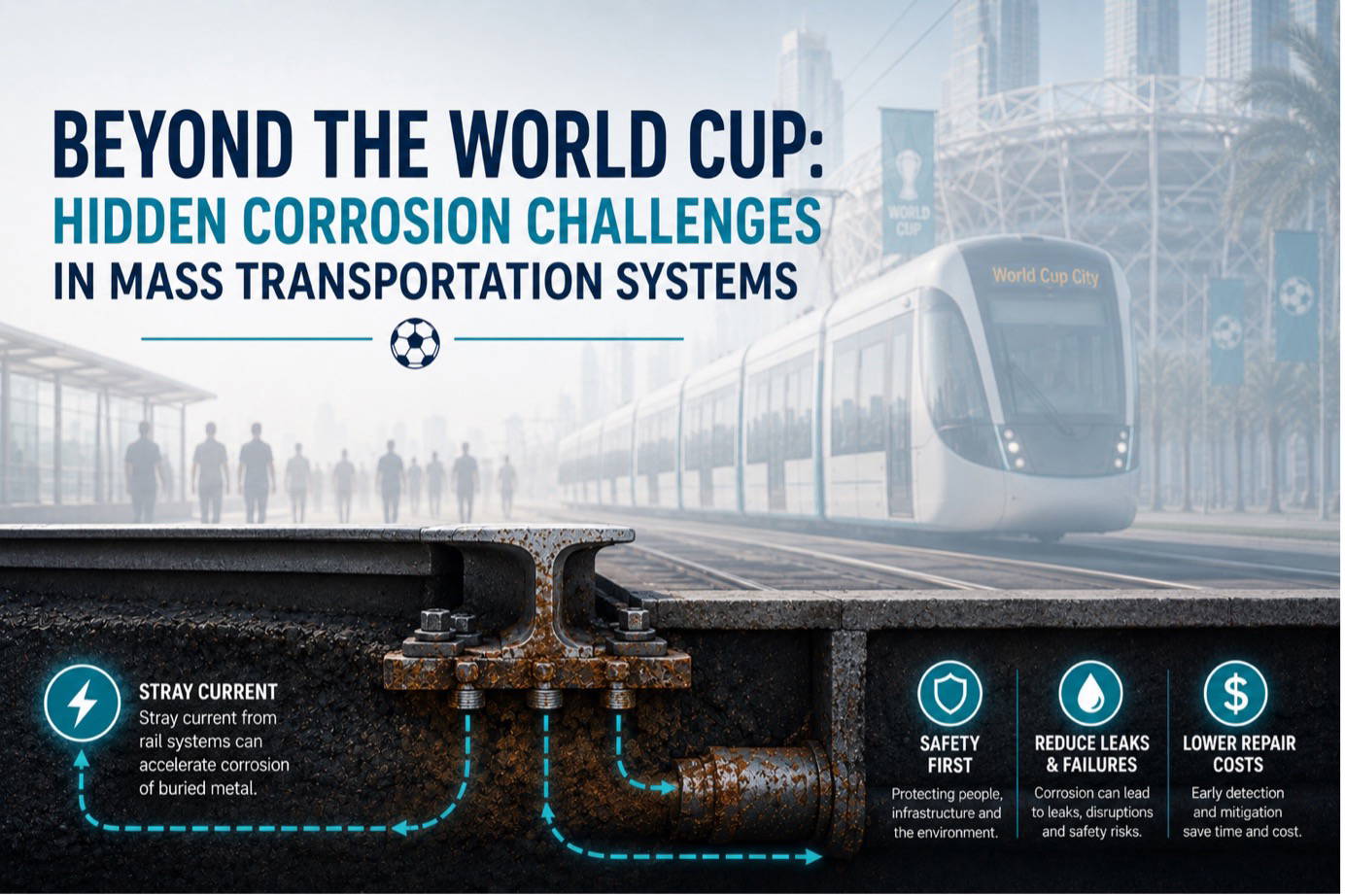
Big sporting events mean big crowds and the need for mass transportation systems. In many cities this need has recently been met by retrospectively fitting light rail and tram systems into existing and older city infrastructure. As you travel on these electric rail systems you may wonder what safety challenges they face and how they are managed. This is actually an important stray current corrosion concern because it is inevitable that operation of these direct current (DC) light rail and metro systems will generate some stray or leakage current. In most systems, the electric current required to run the vehicles returns to the power source via the running rails. It is not possible to fully insulate the rails from the ground, which meant some current will leak or stray into the ground.
In urban areas, where these transit systems typically operate, there are buried metallic infrastructure such as gas pipelines and power cables sheaths and the stray current from the rails may interact with these utility services. Stray current can accelerate the corrosion rate of unprotected metal surfaces and lead to early failure, increasing repair costs, increased leakage rates and possible safety and environmental risks.
There is also the possibility of corrosion of the transit system rails, buried trackside equipment and structures such as bridges or tunnels.
It should be noted that only metal surfaces are affected and plastic pipes or cables with plastic outer sheaths are immune – a positive for many modern digital cabling services and newer water systems.
Getting stray current wrong costs time and money, devalues assets and can become safety-critical
However, if good practice is followed, interference and accelerated corrosion can be avoided. Transit system operators can effectively manage stray current by controlling stray current at source. This may be achieved by maintaining track bonding to provide a low resistance path for the return current – this encourages more current to remain in the rails by providing an attractive return route for the current. In addition, maintaining effective rail insulation helps to minimise losses by acting as a barrier. However, in wet conditions, the rail insulation tends to be less effective and stray current typically increases. It is therefore important to ensure drainage is effective, to avoid pooling of water and allow rainfall to run away efficiently.
Stray current is always an on-going issue and levels may increase over the years due to degrading rail insulation or other system faults. Because of this risk, regular monitoring is carried out to check the level of interference and the impact of any stray current. Criteria given in standards allow interference levels to be assessed and actions prioritised.
Monitoring typically includes the routine collection of stray current performance data from monitoring locations on the transit system and on a mix of water, gas and power utility assets. Evaluations are also carried out as part of repair work operations to ensure changes do not inadvertently introduce a bigger risk.
On most systems, to ensure that stray current is managed successfully and any issues are satisfactorily resolved, technical groups are arranged including the transit owner and operator and affected third parties, such as utility companies.
Travelling to the big match conveniently on mass transport can be done knowing stray current risks are being managed as part of the wider system safety.
We would like to extend sincere thanks to Dr. David Buxton, MICorr of Intertek CAPCIS for his valuable contribution to this article.
If you’d like to know more, please visit our Training page whereby we run our Fundamentals of Corrosion and Cathodic Protection Certification Scheme.