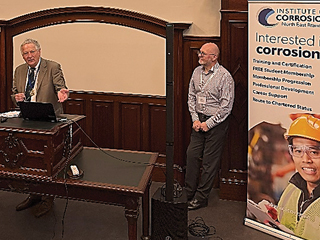
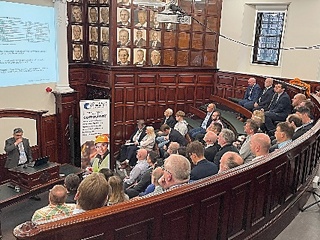
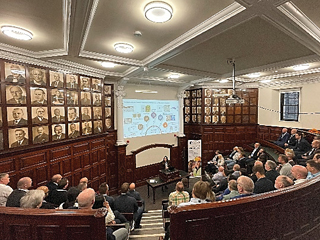
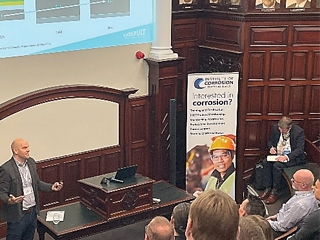
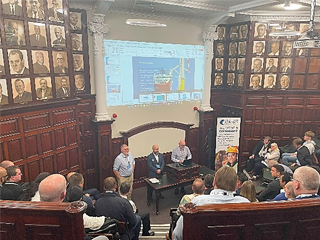
On 10th October 2024 the branch held a joint meeting with the London Materials Society (LMS), when Ali Morshed presented, “Why Effective MIC Control is Still a Major Challenge in the Industry.”
Ali has a PhD in corrosion engineering from University College London and is the author of five corrosion management books, and one book on MIC, with NACE/AMPP. He is a corrosion engineer with more than 21 years of experience, starting his career in the Oil and Gas industry in 2002, and gradually expanded his work to many other industries.
Microbiologically influenced corrosion (MIC) remains as a major integrity threat and cause of failure for many upstream, mid-stream, and downstream, oil and gas assets, despite the continuous technological advances in the areas of oilfield microbiology, metallurgy, and chemicals.
MIC can be defined as corrosion influenced by the presence, or activity, of microorganisms. Such microorganisms can cause corrosion problems for various oil and gas assets either directly or indirectly. The corrosion damage inflicted by them is considered direct when they create, or further increase, the environment’s corrosivity (e.g., by acid production through their metabolism). The damage is considered indirect when they attack, deteriorate, or weaken, a corrosion control measure already in place, thus further promoting corrosion. Such affected corrosion control measures include surface coatings and some corrosion control chemicals such as certain types of oxygen scavengers.
Ali explained that the locations or systems most susceptible to bacterial contamination and MIC include, but are not limited to, sea water injection, fire water, cooling water, sand-wash water (where treated sea water is used to wash the sand accumulated in various pressure vessels), water displacement systems (where treated sea water is used to empty a product storage tank), and wet product transfer pipelines and product storage tanks.
He highlighted an important caveat regarding MIC – prevention is always better than cure, because microbial control once lost, may take years to restore, if at all! Extensive field experience from both the UK’s North Sea sector and the Persian Gulf r egion indicated that the main root cause of the encountered MIC leaks, failures, and issues, has been either the total lack, of or inadequate, knowledge and expertise in relation to bacterial and MIC basics and fundamentals, among the relevant personnel.
More precisely, MIC incompetency has been the main culprit behind the failures. In general, the observed MIC incompetency can be divided into the following subject areas:
Bacterial nourishment and growth conditions
Bacterial and MIC monitoring
Bacterial and MIC assessment and control
The last two items, when combined comprise the overall bacterial and MIC mitigation process, as was mentioned earlier.Simultaneously, it has also been observed that Oil and Gas assets which successfully managed and controlled the MIC integrity threat were those where the relevant personnel possessed adequate MIC competency, mainly due to the MIC training they had received.
Ali finished by saying that while MIC incompetency remains the main root cause of bacterial and MIC problems, timely, practical, and adequate MIC training is regarded as the main solution, and way forward for tackling the existing MIC issues for the Oil and Gas assets concerned.
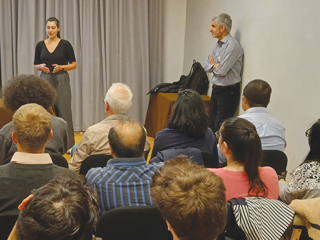
Photo. The chair for the Evening Introducing the Speaker and the LMS Vice Chair, Melissa Tiskaya.
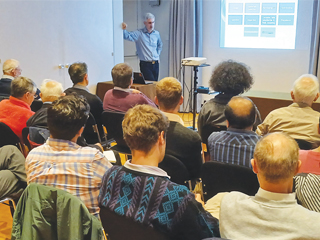
Photo. Ali Morshed Presenting on MIC.
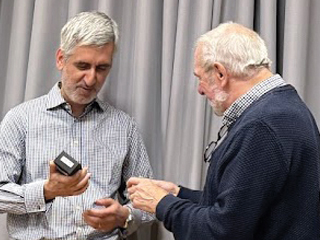
Photo (Right): After an Interesting Q&A Session, Ali was Presented with an ICorr Pen in Appreciation of His Talk, by the Chair for the Evening, ICorr Committee Member, Brian Goldie.
The London Branch also kindly hosted the 2024 Young Engineers (Case Study) Programme reported separately above on page 10.
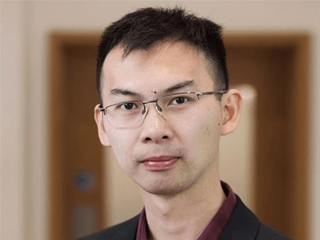
On Thursday 7th November 2024 the Aberdeen Branch in a joint meeting with TWI welcomed Dr. Cheng Huan Zhong of Inductosense Limited, with a talk entitled ‘A Pathway to Thickness Measurement Locations (TMLs) Digitalisation.’
Complimentary to the recent presentation to South-West Branch by Erik Fabre this event focussed specifically on Case Studies of Inductosense Applications globally.
Cheng Huan received a B.Eng. degree in mechanical engineering and a PhD. degree from University of Bristol, England, in 2015. From 2015 to 2016, he was a Research Associate in the non-destructive testing research group at the University of Bristol. Both his PhD and Research Associate work was focused on the development of passive wireless transducers for structural health monitoring. He is a co-founder of Inductosense Ltd, an industrial spin-off from Bristol University in 2015 and the Chief Technology Officer. He has managed multiple product development projects such as sensors, handheld data collector and remote data collector.
A Pathway to Thickness Measurement Locations (TMLs) Digitalisation
Synopsis: Permanently installed sensors provide more accurate results compared to conventional inspection due to their consistent positioning and coupling. However, due to their cost, they are normally used for monitoring critical areas for corrosion rate estimation. There are hundreds of thousands of thickness measurement locations (TMLs) on a process site for piping and vessels, making it challenging to monitor all of them. Inductosense has proposed an alternative approach that combines passive sensors and a different data collection method to enable a cost-effective, consistent, and deployable solution with wide sensor coverage possible at low cost.
Dr. Zhong presented their handheld data collector, robotics, and online solutions and demonstrated how they work together to address different applications with accessibility and inspection frequency. The presentation concluded with a large number of case studies aiming to demonstrate the benefits of this approach.
Amongst applications included were:
Buried Pipeline Monitoring
Drones
Erosion Monitoring
Integrated Corrosion Management
Manual Wands
Overhead Pipework Monitoring
Production Optimisation
Remote Data Collectors
Riser and Flowline Monitoring
Robots and Crawlers
Ship Tank Usage
Specialised Vessel Monitoring
Subsea ROV Data Collectors
The Event provided interesting opportunities for questions.
Please contact the Aberdeen Chair for details of future ICorr Aberdeen Events.
ICorr Aberdeen Joint Online Meeting with TWI
On Tuesday 24th September 2024 the Aberdeen Branch held a joint online meeting with TWI and welcomed Neil Gallon, Principal Engineer of Rosen, with a talk on Welding and Metallurgy Requirements for Hydrogen Service.
Having previously worked for various consulting and manufacturing companies, including British Steel Tata Steel and GE Wellstream. Neil’s, current work with ROSEN UK concentrates on understanding the effects of gaseous hydrogen on steel properties.
Neil outlined the requirements for material selection, welding, and metallurgy of carbon steels for gaseous hydrogen service. He also described the mechanisms and effects of gaseous hydrogen embrittlement, presented current code requirements in terms of material properties (including welding), and gave an overview of recent research and code developments.
Key Points
Hydrogen embrittlement is the detrimental effect of hydrogen on the mechanical properties of metals and alloys.
The fundamental feature that drives much of the integrity concerns and challenges in gaseous hydrogen pipelines is the absorption of atomic hydrogen within the steel microstructure. The interactions of hydrogen can lead to major degradation of mechanical properties such as strength, durability, fracture toughness, and fatigue crack growth rate. These have been studied by various researchers of material types used in repurposed pipelines, such as API Series 5L X42, X52, X65, X80 and X100.
The data available to date, is not comprehensive but all show that all performing properties are reduced by increasing levels of Hydrogen.
While hydrogen pipelines could be purpose-built, it is very likely that a major proportion of the future transmission network will revolve around the integration of existing natural gas or other hydrocarbon infrastructure. Hydrogen pipeline design codes tend to be more constraining or restrictive than that for hydrocarbons. For example, typical hydrogen standards will limit the use of steels up to API 5L X52 (L360) to tackle hydrogen embrittlement issues, while over 45% of the European NG system is designed with higher steel grades.
The Code for Hydrogen pipeline integrity ASME B31.12 lists pipeline materials suitable for hydrogen transportation. Material compositions and properties are more restrictive than “standard” API 5L requirements on items such as the Charpy shear area requirement, the Maximum YS and UTS (including AWT) and a more restrictive chemical composition. The implications are that additional manufacturing and purchasing restrictions will be necessary and existing natural gas pipelines for repurposing may not meet material requirements. From a design perspective and materials performance factor, hydrogen pipelines will operate at lower pressure than that of natural gas unless specific hydrogen test data (KIH) is available.
A Material Hardness maximum of 248HV is required for production testing, which is even more severe than sour service requirements.
The magnitude of the interaction of hydrogen and steel is determined by the specific nature of the steel microstructures and chemistries, not just the grade. This important facet puts a great emphasis on the understanding of materials ‘DNA’ and on testing. Microstructure performs an important role in achieving higher fracture toughness in the presence of gaseous hydrogen up to 20.7 M Pa and alloy processing design influences final steel microstructure formation.
Mechanism of Hydrogen Embrittlement in Steels
Hydrogen embrittlement is basically the loss of ductility of a metal resulting from the adsorption of Hydrogen.
Adsorption of H2to the steel surface.
Dissociation of H2molecule.
Absorption of H atoms into metal matrix.
Diffusion to thermodynamically favoured sites e.g. crack tips, dislocation cores, grain boundaries.
Actual embrittlement takes place (mechanism unknown).
Hydrogen pipeline integrity depends on material susceptibility, stress, and environment. The possibility of cracking is largely dependent on the environment, and susceptibility to HE is dependent on the amount of hydrogen available. The equilibrium concentration of hydrogen in the metal depends on the partial pressure of hydrogen (Sieverts’ law) and its diffusivity (Fick’s law). At room temperature, H concentration from gaseous hydrogen is very low.
Neil outlined the effect that hydrogen has on pipeline integrity in terms of the principal properties of strength, durability, fracture toughness, and fatigue crack growth rate.
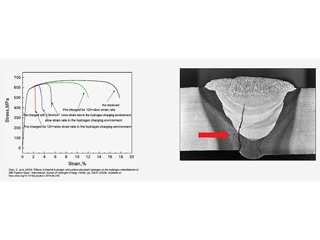
Hydrogen has a relatively small effect on strength at transmission pipeline pressures, while its effect on ductility is more dramatic; this has implications for fracture toughness. Laboratory studies of the effects of internal hydrogen and surface absorbed hydrogen on tensile strength and ductility demonstrate this slight fall in UTS in charged environments, but dramatic loss of ductility from 18 down to ~3% strain levels.
It is also clear that hydrogen reduces toughness from lab studies, but there is large variability in results, possibly due to microstructural differences in pipe grades.
Testing Approaches
There are two main approaches for testing H effects on fracture toughness:
Rising load fracture toughness as recommended by ISO 11114-4. This produces a measurable toughness value J, K, CTOD; however, the fracture toughness depends on H kinetics, and the results depend on loading rate.
Threshold stress intensity factor KIH – recommended by ASME B31.12 and ISO 11114-4. The results do not depend on H kinetics. However, on the downside, this is a pass-fail outcome, has long testing time with several tests required, and the result is not quantitative.
Studies have also been made of fatigue crack growth rates in hydrogen environments:
As yet, there are currently no agreed standard test protocols, but full-scale tests are currently ongoing, and there is currently a lot of research activity in this area.
Crack growth da/dt is realised in the laboratory conditions, although there is no evidence that it has happened in pipelines in service, so the implications for pipelines are unknown.
Crack propagation does not happen all the time; it appears to be due to the pre-conditioning and stress state around the crack tip, with unpublished evidence that sometimes cracks arrest.
In summary, the requirements for material selection, welding, and metallurgy of carbon steels for gaseous hydrogen service are developed, but there remain areas for further study and development:
Codes are not mature enough to follow prescriptively.
No clear relationship between in-air and in-hydrogen material properties.
Likely that extensive programmes of material qualification in gaseous hydrogen will be required.
Significant amounts of current code developments and research are necessary.
An extensive Q&A followed this well-attended online event, and the Aberdeen ICorr committee offered its thanks to Neil on following his most informative presentation.
The Aberdeen Branch provides a very full technical programme of both in-person and online events. Abstracts of potential papers for the Aberdeen Technical Programme are always welcome for consideration, and anyone wishing to present should correspond soonest with the 2024/2025 Chair and Technical Programme Co-ordinator: meilingcheah@gmail.com
Further information about the Aberdeen Branch and past presentations may be found on their website page: Aberdeen Branch – Institute of Corrosion. https://www.icorr.org/aberdeen/ under Local Technical Programme and to join the Aberdeen Branch mailing list, please contact: icorrabz@gmail.com
Presenter: Dr. Cheng Huan Zhong.
Neil Gallon, Principal Engineer of Rosen.
Photo: Explanation of Hydrogen Embrittlement Process.
Figure 1: Effects of Internal Hydrogen and Surface-Absorbed Hydrogen on Hydrogen Embrittlement.
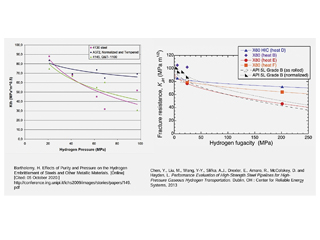
Figure 2: Effects of Purity and Pressure on Hydrogen Embrittlement.
All of ICorr’s 2023 courses were fully booked, and to “clear the waiting list,” we have already launched all 2024 CP training dates on the below website.
Candidates can now purchase their space on future courses directly. So far, the new Dante online booking system has been a great success, and we are filling 2024 dates nicely and steadily.
Also, we have started using a secondary training site since September – Argyll Ruane in Sheffield—to manage the increased demand particularly for buried courses, and this has worked very well so far. A further centre for CP Marine courses is also being explored.
On Wednesday, 13th November 2024, the North-East Branch of the Institute of Corrosion hosted the Institute of Corrosion 2024 AGM at Neville Hall in Newcastle upon Tyne.
The day commenced with a Technical Offshore Wind Programme, followed by the AGM and concluding with an evening dinner. Almost 70 people from all over the UK attended the Technical Programme and 60 attended the evening dinner, attendees included the ICorr Council, Sustaining Members, Professional members, general members and potential future members. The day was a great success with the variety of engaging content keeping the attendees entertained for almost 9 hours from start to finish.
Matt Fletcher, Chair of the North-East Branch of ICorr, opened proceedings, which was followed by the formal opening of the Technical Program by the Lord Mayor of Newcastle, who welcomed everyone to Newcastle and described how offshore wind and the project to re-paint the Tyne Bridge brought valuable jobs to the region. Lord Mayor also explained that as he did not have his “driver” available, he was unable to wear his full collection of Mayoral Medals as they were too valuable to be worn in public without the extra security of his “driver!”.
The Offshore Wind Technical Programme then opened, consisting of 4 presentations:
Environmental Considerations for Offshore Wind Foundations Corrosion Protection
Dr. Anthony Setiadi Chief Consultant / Associate Director Wood Thilsted
Anthony described how offshore wind industry growth is accelerating as the world is pushing towards renewable energy sources. These wind turbines need to be installed on foundations located in aggressive environments and are prone to corrosion if not protected and/or designed with corrosion in mind. There are various offshore wind foundation types, such as monopiles, jacket tetrabases, gravity bases, and floating structures. The presentation discussed what level of protection is required, what the options are, and how all of this would impact the structural integrity throughout the design life, as well as how fabrication, transport, and installation limitations would affect the corrosion protection design.
Anthony explained how equally important the environmental considerations need to be taken into account with respect to carbon equivalents in producing and protecting these foundations, as well as the potential byproducts expected. In discussing the creation of habitats for nature, Anthony made an interesting point: if habitats are created on the foundations, what happens to these environments when the foundation is decommissioned in the future?
Assessment of Thermal Spray Aluminium Coating in Synthetic Seawater by Using Complementary Techniques
Dr. (candidate) Adriana Castro Vargas Research Associated – Materials Innovation Centre University of Leicester and NSIRC
Adriana presented the results of her PhD that used complementary techniques, such as in-situ imaging and an analytical rotator, to understand the performance of thermally sprayed aluminium (TSA) coating in simulated marine immersion service. The experimental work involved evaluating TSA in quiescent and flowing synthetic seawater at room temperature. The coating (300 µm thick) was obtained by twin-wire arc spraying of 1050 aluminium alloy on an S355 carbon steel substrate. In quiescent condition, TSA-coated steel samples were evaluated by the optical analysis of sequential images captured in situ: (i) with defects machined before immersion (5% of exposed steel surface); and (ii) with a defect machined after 35 days of immersion (10% of exposed steel surface).
When the defect is machined before the immersion, initial dissolution of iron occurs until the air-formed oxide layer degrades, the electrolyte penetrates the coating, and the aluminium surface is activated. Conversely, when the defect is created after immersion, the aluminium activates rapidly, and the system reaches the range of protective potentials (according to DNV-P-B401), providing immediate protection to the exposed steel. In flowing synthetic seawater, cylindrical coupons were tested in an analytical rotator at 50 rpm and 600 rpm for 10 days. Open Circuit Potential (OCP) and Linear Polarisation Resistance (LPR) measurements were carried out to assess the flow velocity effect and calculate the corrosion rate.
An Introduction to the Offshore Renewable Energy (ORE) Catapult and Its Key Role in Advancing and Derisking Technology in Offshore Wind.
Mr. Tom Chaplin Marketing Manager Offshore Renewable Energy Catapult
Tom Chaplin provided an introduction to the Offshore Renewable Energy Catapult and described the key role it plays in advancing and derisking technology in offshore wind. ORE Catapult is one of the world’s leading offshore renewables technology centres, with an unrivalled set of test assets that aim to accelerate the creation and growth of UK companies in the offshore renewable energy sector. Established in 2013, ORE exists to accelerate the development of offshore wind, wave and tidal energy technologies in the UK. Through its world-class testing and research programmes and its unique centres of excellence, ORE works with industry, academia and government to improve technology reliability and enhance knowledge, directly impacting the cost of offshore renewable energy. ORE delivers products and services in four main areas: research, engineering, testing and validation, and supply chain growth.
Tom showed the scale of the ORE Catapult testing facilities, showing a video of testing a 107 m blade (which needed to be cut down to 100 m to fit in the test facility) and the 14 GW powertrain, which, as a result of the testing, had its capacity increased. Tom also revealed plans to increase the capacity at ORE Catapult to be able to handle wind turbines well into the future with capability to test blades up to 150 m long (and expansion potential to 180 m) and a significant increase in drive train capacity to 23 MW (with potential expansion to 28 MW).
After the presentation Tom was asked about catastrophic failure during testing; although unable to share images, Tom said it had happened and was quite dramatic. All was not lost, as the fractured blade provided insightful data on blade failure to the owners.
Development of ISO 25249 – Corrosion Protection of Offshore Wind Structures
Mr. Simon Daly Consultant – Energy and Infrastructure Safinah Limited
Simon described how a series of parts of a new international standard, ISO 25249, are currently being worked upon. The standard will address the issues of developing a corrosion protection approach for the protection of offshore wind farms. With the growth in offshore wind will come the need for large-scale construction of assets, which will be placed in a corrosive offshore environment.
While the corrosion of steel structures offshore is well documented through experiences in the oil and gas industry, offshore wind energy has encountered its own challenges when it comes to providing corrosion protection. The ISO 25249 standard will address key issues and develop a framework for a more standardised approach to the selection, execution, and operation of a variety of different corrosion protection methods.
Simon presented on behalf of the program managers for the first 5 parts of this new standard, the development of which will shortly commence within the International Standards Organisation (ISO) framework. During the questions after the presentation, the sharing of experiences gained in the oil and gas industry was discussed. It was generally agreed that to prevent mistakes from 30 years ago being repeated, experiences should be reviewed and shared. It was hoped that with more of the traditional oil and gas companies entering the offshore wind market, this would be more likely to take place.
Following the Technical Program the ICorr AGM took place, details of the AGM can be found in the AGM minutes. At the AGM Stephen Tate passed on the Presidency of ICorr to Yunnan Gao and Yunnan passed on the Vice-Presidency to Anthony Setiadi.
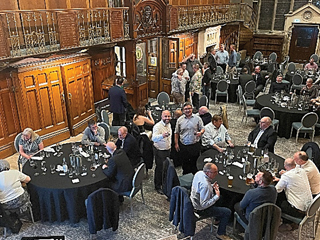
The evening saw a three-course dinner, enjoyed in the library at Neville Hall. As can be seen in the photographs, the library is a beautiful wooden clad room, with many original features, such as elevated bookshelves, bookshelves hidden behind wooden doors, and stained-glass windows. A jazz band played throughout the evening, and the dinner was opened by the new president of ICorr – Dr Yunnan Gao.
Feedback following the event was overwhelmingly positive:
“NE Hospitality is famous and you certainly lived up to that.” – Stephen Tate: outgoing ICorr President.
“Please accept my thanks for the superb organisation and excellent day yesterday.” – Brian Wyatt of CPGB and Council.
The Chair of the NE Branch of ICorr is grateful to the NE Branch Committee for all their hard work in creating a most successful day; all are volunteers and worked tirelessly to make the event a success. Simon Daly, Patrick Johnson, David Mobbs, Bruno Ravel, Barry Turner, and Josie Watson.
Future Meetings
Due to a date clash with London Branch Dinner, NE Branch will now hold its Xmas (Branch) event at the end of January 2025.
There will be a tour of the Newcastle Castle Keep, the cost of which will be £20 a head.
Please contact nechair@icorr.org for further details.
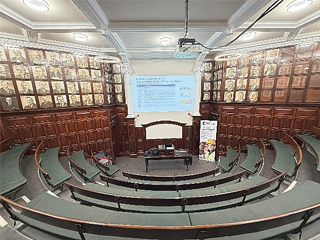
The Historic Lecture Theatre at Neville Hall.
Photo: The Lord Mayor of Newcastle Upon Tyne Opening the Technical Programme.
Photo: Dr Anthony Setiadi of Wood Thilsted Presenting.
Photo. Dr Adriana Vargas of the Materials Innovation Centre University of Leicester Presenting.
Photo. Dr Adriana Vargas of the Materials Innovation Centre University of Leicester Presenting.
Photo. Tom Chaplin of ORE Catapult Presenting.
Photo: New Vice President – Dr Anthony Setiadi, New President – Dr Yunnan Gao, Past President – Stephen Tate.
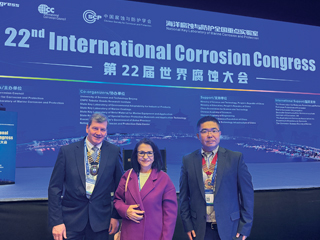
The 22nd International Corrosion Congress, is a prestigious global event dedicated to advancements in corrosion science and engineering and was held on 22nd to 26th October 2024 in Xi’an, China.
Organised by the International Corrosion Council (ICC) and supported by the Chinese Society for Corrosion Protection (CSCP), the congress brought together corrosion experts, scientists, engineers, and industry leaders from around the world. The event aimed to share the latest research, technological innovations, and sustainable practices in corrosion management across many different industries.
The Institute of Corrosion (ICorr), represented by President Stephen Tate and Vice President Dr. Yunnan Gao, attended the congress upon the invitation from the CSCP and the congress organisers, as providing international support to this congress and following ongoing ICorr/CSCP discussions during the previous 12months. The congress featured a diverse program of keynote presentations, technical sessions, workshops, and networking opportunities. Topics ranged from enhancing corrosion controls and corrosion management procedures to new digital tools and artificial intelligence for corrosion monitoring and mitigation. Xi’an, known for its rich history and role as a cultural hub, served as an inspiring venue for this landmark event and attracted a large audience.
During the Congress, ICorr Presidents actively engaged in discussions with the leadership team of the International Corrosion Council (ICC), including ICC past president Prof. Dr. Günter SCHMITT President (2018-2021) from Germany, ICC President (2021-2024) Prof. Emma ANGELINI from Italy, ICC President Newly Elected President in Xi’an (2024-2027) Prof. Vngaranahalli Srinivasan RAJA from India and ICC President Elect (2027-2030), Prof. Dr. Zehbour PANOSSIAN from Brazil.
The ICC Congress provided an excellent platform for ICorr to showcase its initiatives and contributions to corrosion science. ICorr leaders shared insights on professional development programs, such as training and certifications, and emphasised the organisation’s dedication to advancing corrosion engineering standards globally.
ICorr’s participation at this congress greatly enhanced its mission to contribute to global advancements in corrosion control and its aspiration to promote knowledge exchange and innovation within the international community. The interaction between with the ICC leadership emphasised ICorr’s growing influence outside of the UK and reinforced its commitment to strengthening ties with international counterparts.
The ICorr presidents’ successful joint participation in the Xi’an conference highlighted the growing interconnectivity and shared purpose of the global corrosion community. It also set the stage for a future defined by mutual support between CSCP/ICC/ICorr and welcome advancement in knowledge sharing.
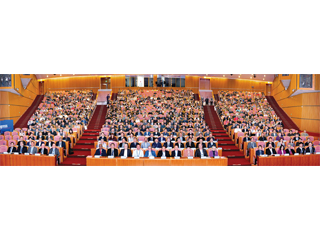
Photo: All Attendees of the Opening Ceremony of the 22nd ICC Corrosion Congress in Xi’an. ICorr Presidents: Right 3 and Right 5, 2nd Row, Central Block.
Photo: ICorr Past and Future Presidents and ICC President Elect (2027-2030), Prof. Dr. Zehbour PANOSSIAN from Brazil, during the Congress.
Photo: ICorr Past and Future Presidents and ICC Presidents and Congress VIPs at the Congress Dinner.
Each year the Institute of Corrosion bestows a range of internationally renowned awards in recognition of excellence in corrosion science and engineering and to reward outstanding service to the Institute and the wider corrosion community. Many of these awards are open to nomination by both members and non-members of the Institute. Below is a brief description of each award, together with details of how to nominate potential candidates.
U.R. Evans Award
The U.R. Evans Award is the premier scientific award of the Institute of Corrosion and is presented annually for outstanding international achievements in pure or applied corrosion science. The recipient is selected by a Corrosion Science Division panel and presented with an engraved sword at the annual Corrosion Science Symposium (CSS). The symposium is one which seeks to encourage the participation of the junior members of the corrosion community who would appreciate the visit of, and address by, a corrosion scientist of international repute. The form of the award symbolizes the fight in which we are all engaged. The recipient is also granted Honorary Life Fellowship of the Institute. Nominations may be submitted at any time via email to the CSD Chair, Julian Wharton (j.a.wharton@soton.ac.uk).
Prof David Shoesmith (University of Western Ontario, Canada) was presented with the U.R. Evans Award 2024 by Stephen Tate (ICorr President) at the 65th Corrosion Science Symposium, which this year joined Electrochem2024 at Manchester Metropolitan University, held between 11th and 13th September. In his plenary talk entitled ‘Corrosion of the Spent Fuel Waste-form and Engineered Barriers in a High-Level Nuclear Waste Repository’, David addressed how various intricate electrochemical investigations into the possible long-term corrosion processes within Canadian/Swedish/Finnish deep geological repositories. This was a very fitting commemoration for the centenary of the first publication of Corrosion of Metals by Ulick Richardson Evans in 1924.
Paul McIntyre Award
The Paul McIntyre Award recognises a distinguished senior corrosion engineer who has demonstrated excellence not only as a leading practitioner in the field but also in fostering European collaboration and advancing international standards. This prestigious award includes an engraved trophy, presented at the annual CED Working Day meeting. The recipient will be invited to deliver a short presentation of their professional contributions and is encouraged to submit an article for publication in Corrosion Management. We’re also excited to announce that the 2024 award winner will be revealed at the upcoming CED Working Day on Corrosion Awareness Day on 24th April 2025. Nominations for the 2025 award are now open and should be submitted to the CED Chair, Danny Burkle, at Danny.Burkle@lbbcbaskerville.co.uk by the end of July 2025.
T.P. Hoar Award
The T.P. Hoar Award is presented to the authors of the best paper published in the scientific journal Corrosion Science during the previous calendar year. The winning paper is selected by a sub-committee of the Corrosion Science Division and the authors receive a certificate and a cash sum of £400.
Galloway Award
The Galloway Award is presented to a student author for the best publication describing original research in corrosion science and engineering as judged by a sub-committee of the Corrosion Science Division. The student should be the primary author of the work and preferably first author. A summary of the winning paper is published in Corrosion Management and the prize consists of a certificate and a cash sum of £300. The Institute does not retain copyright of the material, so this does not prevent separate publication of the work in a scientific journal. Submissions (in the form of a paper published within the past 12 months or a draft publication) may be sent via email at any time to the CSD Chair, Julian Wharton (j.a.wharton@soton.ac.uk). Supervisors may nominate students.
Lionel Shreir Award
The Lionel Shreir Award is given to the best student presenter at the annual Corrosion Science Symposium. Selection of the recipient is carried out by a sub-committee of the Corrosion Science Division. The award consists of a certificate and a cash prize of £125.
The Shreir award in 2024 was presented to Amber Sykes (University of Leeds). Amber gave an excellent presentation linked to her PhD research into the evolution of porous FeCO3 layers, and their influence on the CO2 corrosion rate of carbon steel.
For further details on the Institute awards, including lists of past recipients, please visit https://www.icorr.org/icorr-awards/
We use cookies to optimize our website and our service.
Functional
Always active
The technical storage or access is strictly necessary for the legitimate purpose of enabling the use of a specific service explicitly requested by the subscriber or user, or for the sole purpose of carrying out the transmission of a communication over an electronic communications network.
Preferences
The technical storage or access is necessary for the legitimate purpose of storing preferences that are not requested by the subscriber or user.
Statistics
The technical storage or access that is used exclusively for statistical purposes.The technical storage or access that is used exclusively for anonymous statistical purposes. Without a subpoena, voluntary compliance on the part of your Internet Service Provider, or additional records from a third party, information stored or retrieved for this purpose alone cannot usually be used to identify you.
Marketing
The technical storage or access is required to create user profiles to send advertising, or to track the user on a website or across several websites for similar marketing purposes.