Following on from the success of the 2012-13 and 2014-15 young engineers program the Institute of Corrosion will be starting the next event in this series in January 2018.
There will be lectures on the subjects related to Corrosion in Oil and Gas as shown below. [1][2]
Basic corrosion
Welding
Materials
Coatings
Painting, fire protection and linings
Cathodic protection
Chemical treatments
Presentation skills
As before the lecture series will be followed by case studies with a presentation given at an event around the London area.
We are currently looking for pre enrolment for these events and we are looking for around 20 participants early in their career in the corrosion industry and who are looking for extra experience to set them up for their future.
The event will be sponsored by BP and held at the CB&I offices in Paddington, London. There is no cost for this course for the delegates and we would like to thank the sponsor and host to allow this.
[1] Subject may change due to availability of personnel
[2] Subjects will be focused on the oil and gas industry
[3] This program is open to non members as well as member of ICorr. Those taking part will receive a year’s membership of the Institute as Indiviual members
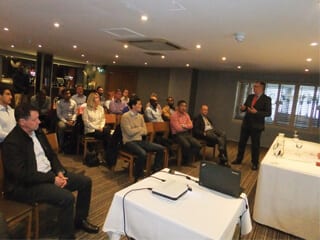
The final evening event of 2017 was held on Tuesday the 30th May, with 50 attendees representing a wide range of sponsors and also many visiting guests. The Branch was once again honoured to have the presence of ICorr President Sarah Vasey, who provided a welcome update on HQ Plans and thanked the Branch Committee for all its efforts over a very successful 2016-2017 Session.
A technical paper entitled “A Review of State of the Art in Corrosion under Insulation Testing (CUI)” was presented by Simon Daly, Group Oil & Gas Segment Manager of Hempel A/S, who explained the company’s long involvement with CUI R&D, via its association with the Danish Technical University in Copenhagen.
Billions of dollars are spent worldwide due to CUI issues, and as there are many operating variables, failure risks and repair costs associated with undetected CUI, any attempt to lessons these can only be to the Industry’s advantage.
Frequently the weak areas are field joints with field repairs of piping and coating systems difficult to equal in quality to the factory coating systems that are applied under controlled conditions. Similarly external cladding may not be of consistent quality in terms of weather proofing and sealing abilities.
It is not often realized that coatings hidden under insulation must have multiple and simultaneous performance properties and must be resistant in service to, immersion conditions (saturated insulation), thermal cycling (equipment in intermittent use) and varying levels of surface preparation.
Commonly used test methods were reviewed by Simon, along with the benefits and drawbacks of each system. In addition, suggestions were offered for a pre-qualification system which not only takes into account the CUI test itself but also test methods to qualify some of the considerations shown above, as well as likely inclusions in the new ISO standard 19277 ‘Petroleum, petrochemical and natural gas industries – Qualification testing and acceptance criteria for protective coating systems under insulation’, currently under development for CUI protection.
There were many questions from the very attentive audience on a wide range of topics, including future ISO tests on coatings for CRA’s, blasting methods, maintenance painting, life cycle / life extension considerations and use of TSA coatings.
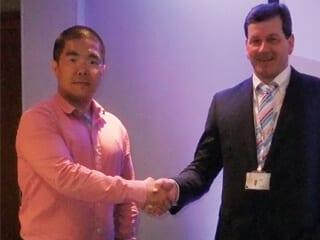
The well supported evening closed with a handover of the Chair to Dr. Yunnan Gao, this year’s Events Co-ordinator, by the current Chair Stephen Tate.
The Branch has one more event before the new session starts, the Annual Corrosion Awareness Day on 29 August at the usual venue, the Palm Court Hotel, which this year is kindly sponsored by Sherwin-Williams.
This course is aimed at graduate engineers, non-corrosion engineers and others working closely with corrosion, (e.g. integrity engineers, inspection engineers, etc.). The full-day course, will comprise a number of lectures covering different aspects of corrosion, providing basic information on corrosion principles and mechanisms of corrosion control, including,
Introduction to Corrosion and it’s costs, plus corrosion mechanisms and everyday examples, Professor Paul Lambert (Mott MacDonald)
Mitigation by coatings and materials selection, and corrosion mitigation by chemicals, Malcolm Morris (Sherwin Williams)
Corrosion mitigation by cathodic protection (sacrificial and impressed current), Nigel Owen (Aberdeen Foundries)
Corrosion monitoring and microbiology – analysis and data trending, Dr Carol Devine, North East Corrosion Engineers Ltd
Corrosion management overview and risk based inspection, Hooman Takhtechian (Oceaneering)
Corrosion rate modelling, Dr Muhammad Ejaz, Plant Integrity Management Ltd.
The objective of this course is to improve understanding of corrosion processes and to raise awareness of corrosion management. The course is hosted by ICorr Aberdeen through kind assistance of its local / national sponsors. As spaces are strictly limited, they will be allocated on a first-come first-served basis. For registration or further information please contact admin@icorr.org
For information about all forthcoming Aberdeen branch activities, please contact the new session chair, Dr Yunnan Gao, ICorrABZ@gmail.com. A calendar of local events of interest to corrosion professionals in the Aberdeen area, and the opportunity to sign up to the branch mailing list, is available at https://sites.google.com/site/icorrabz/home
Aberdeen Branch have also established a new Media Centre, which can be found at ICorrABZ@gmail.com
I had the pleasure of attending the North East Branch summer event in Durham recently, it was well attended by members old and new. We had a tour of the Castle followed by an excellent presentation from Professor Jon Gluyas entitled “Energy past, present and future”. It was a thoroughly interesting evening enjoyed by all.
This month has been a busy one, I was invited to join the BCF meeting on behalf of ICORR, where it was great to see so many ICORR members round the table.
We have also launched the re-vamped website this month, which has been a great effort by many behind the scenes, and I do hope that you will see the benefit.One of the big changes is that new members are able to sign up directly on the website, and moving on, this reminds me that you should have all received your renewal letter and I hope you have found time to renew your subscriptions, which from next year is also something that will be available to members, who would prefer to do this online.
As some of you will recall we have now organised two programmes of educational training courses aimed at Young Engineers, which involve a series of lectures and a group case study, the conclusions of which are then presented to an audience of their peers and judged by a panel of industry experts.The winners from the last programme won the prize of attending the NACE conference in Vancouver.We are planning to run this event again, so if you are interested in being a candidate, or would like to nominate a candidate, please let me know.
I would finally like to highlight an upcoming event being held by the Aberdeen Branch, the ICorr Corrosion Awareness Training Day on the 29th August.This is an annual event and always well worth attending.
After a year’s hiatus the North West Branch held a lively Golf Day followed by the AGM. The meeting was well attended and the incoming Chairman is Andy Bradley of Omniflex, a manufacturer of specialist monitoring and control systems including cathodic protection power supplies for reinforced concrete.
At the meeting several options for the forthcoming year were discussed, including the Christmas meal, golf day and AGM, together with an initial couple of technical events. On the 4th of September, Chris Atkins will be outlining the new international standard on cathodic protection training and certification at an evening meeting. This is an important document that extends the remit of the current BS EN 15257 to draw in NACE influenced areas. There are a number of changes that need to be highlighted, along with the Institute of Corrosion’s programme for rolling the new scheme out.
On 4 October the Branch will be supporting Salford University in the one day ‘hackathon’ on Lean Construction. Lean is all about removing waste, be it physical waste, or wasted time, energy and effort in processes (see technical article later in this issue). Salford hope to bring together key people who represent the processes involved in corrosion protection of structures with Highways England. The outcome of the day is aimed at producing a research package, or series of packages, that they can obtain funding for and develop something that is not only academically interesting, but of practical added value to the industry.
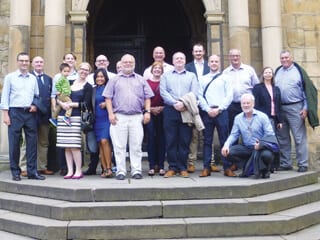
The Branch had their summer event at Hatfield College Durham on 6 July, including a very interesting tour of Durham Castle with a wee bit of a history lesson!
Durham castle is the ancient palace of the Prince Bishops of Durham. It was built on the order of William the Conqueror on his return from Scotland in 1072 as a projection of the Norman kings power in the North of England. Strangely enough he thought we were a bit ‘wild’, no change there then! The tour took us around the two chapels, the Norman chapel built in 1078 & Tunstall’s chapel built in 1540 exclusively for the Prince Bishop. The last wish of the Prince Bishop in 1837 was to leave the castle and all surrounding land to form the University, which at the time was heavily challenged by London and the government, but they thankfully lost. To this date it it is still owned as used by Durham University and quite frankly is impressive. It is a fully functional home to students who use the grand ballroom for breakfast and dinner, and the upper floors are now student accommodation for the lucky ones.
The second part of the evening was taken up by a very informative and interesting look at “UK Energy Past, Present and Future” presented by Prof Jon Gluyas, who is currently Dean of Knowledge Exchange and Director of Energy Institute Durham University. The presentation covered the issues of the ENERGY TRILEMA which within the UK is seen as relating to Equity/Sustainability/Security. The origins of the petroleum age were described with three important landmark discoveries, Bibi – Aybat Caspian 1846, Spindletop – Texas 1901, and Masjed e Suleyman – Iran 1908. The use of Mineral Oil really took off in the 1860’s and led to reduction in use of Whale Oil therefore resulting in the reduction of whale Hunting! One of the most frightening statistics was that there have been no large Oil discoveries for over 50 years which has resulted in a decline in global reserves. The audience was taken through the issues of declining oil and gas prices and the resultant increase in consumption which again is putting major stresses on reserves. The increase in USA on Shale Gas is having little effect on the reserves which were steady from the 80’s but the gap is narrowing.
The presentation then turned to the situation in the UK showing the trend in energy production and consumption and again a widening energy gap was described through which we as a nation need to address from within the UK. Recent headlines show what is happening to our energy base, the last three deep coal mines are to close resulting in increased imports of coal for the remaining coal fired power stations, Ferrybridge power station to close, and oil & gas platform decommissioning accelerating in some cases 10 years early.
In the 1980’s the UK was self-sufficient in coal/gas/oil, but today is increasing our import of these. Most of our gas consumption is imported from Norway and Qatar, which is a real issue at the moment and we are talking about increasing imports. Most of Europe’s gas in controlled by Russia! Currently UK has 14 days of gas reserves whereas France & Germany have 100 days.
Finally the UK is cancelling many green energy policies making renewables more expensive as currently gas and oil are low in price. UK is considering following US lead and drawing upon fracking as an energy source as well as increasing reliance on nuclear. In summary these are interesting times in the energy industry and the UK needs to find ways of improving its self-sufficiency. One potential source is Geothermal which is estimated to be around 100 years worth of low carbon heating here in the UK, with potential centres in Cheshire, East Yorkshire and Wessex, to name a few. Utilisation of this technology could cut UK emissions by up to 38%.
We use cookies to optimize our website and our service.
Functional
Always active
The technical storage or access is strictly necessary for the legitimate purpose of enabling the use of a specific service explicitly requested by the subscriber or user, or for the sole purpose of carrying out the transmission of a communication over an electronic communications network.
Preferences
The technical storage or access is necessary for the legitimate purpose of storing preferences that are not requested by the subscriber or user.
Statistics
The technical storage or access that is used exclusively for statistical purposes.The technical storage or access that is used exclusively for anonymous statistical purposes. Without a subpoena, voluntary compliance on the part of your Internet Service Provider, or additional records from a third party, information stored or retrieved for this purpose alone cannot usually be used to identify you.
Marketing
The technical storage or access is required to create user profiles to send advertising, or to track the user on a website or across several websites for similar marketing purposes.