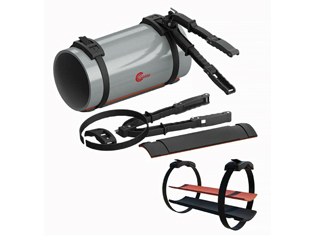
The RedLineIPS SmartPad System, from Cogbill Construction of Texas U.S.A., is a patent-pending Fiber-Reinforced Plastic (FRP) solution specifically engineered to address Corrosion Under Pipe Supports (CUPS) at coastal and offshore facilities in the petrochemical and gas sectors. Designed for above-ground piping systems, the SmartPad System offers a revolutionary approach to external corrosion protection at pipe support points. The system combines tried-and-true materials and components, a saddle-shaped design, and an innovative watertight sealing mechanism to provide durable, efficient, and cost-effective protection for industrial pipes.
Unlike traditional solutions, the RedLineIPS SmartPad System eliminates the need for fixing methods such as epoxy or welding, allowing installation, removal, and reinstallation in minutes. This capability facilitates rapid visual corrosion inspections, reducing reliance on expensive methods such as radiography and ultrasound, and thus reducing the overall cost of ownership.
The SmartPad System: An Alternative Solution to CUPS
The RedLineIPS SmartPad System is a potential breakthrough in external corrosion protection, offering the following key benefits:
Cost-Effective Maintenance: SmartPads allow rapid visual inspections, reducing reliance on expensive and time-consuming methods like ultrasound or X-ray.
Moisture Barrier: The integrated closed-cell Hydroseal gasket creates a NEMA-4-rated watertight seal when installed, preventing moisture accumulation.
Non-Metallic Construction: The FRP material eliminates metal-to-metal contact, preventing galvanic corrosion.
Quick Installation: The system can be installed, removed, and reinstalled in seconds without welding, epoxy, or line shutdowns.
Saddle-Shaped Design: This innovative shape evenly distributes stress, prevents point loading, and protects the pipe’s coating.
Reusable components promote sustainability and green initiatives.
Suitable for extreme temperatures (-60°F to 400°F). convert to Centigrade.
Applications and Industry Adoption
The SmartPad System is suitable across industries, including:
Oil & Gas: Offshore platforms, pipelines, and refineries.
Petrochemicals: Chemical processing plants.
Power Generation: High-pressure, high-temperature piping systems.
Water Treatment: Corrosion protection for water and wastewater facilities.
Early adopters include major industry players such as Chevron, Formosa Plastics, and Nutrien – all at coastal facilities and offshore platforms at the Gulf of Mexico. They have successfully implemented the SmartPad System in challenging environments, achieving significant reductions in maintenance costs and improved pipeline longevity.
A new set of best practices created specifically for the Oil, Gas and Petrochemical industries has been released on 18th December 2024, giving guidance on the deployment, usage, inspection strategies and maintenance of Corrosion Under Insulation (CUI) monitoring systems.
The Recommended Practice document, which is referred to as CUI RP 101 Issue 1 and includes contributions from experienced users throughout the industry, including Aramco, Dow, INEOS and Chevron, contains best practices from asset selection to the use of maintenance management systems, inspection strategies and economic justification principles. It has been developed to enable Asset Owners to optimise inspection and repair strategies and enhance CUI management processes with continuous monitoring systems in the arsenal.
CUI costs the industry billions of dollars every year to mitigate the risk and repair the damage it causes to assets. Unmanaged CUI can result in leaks, leading to process safety incidents, severe harm to the environment, high unexpected repair costs and operational downtime.
Continuous monitoring systems for CUI offer remote detection of localised corrosion and moisture on an asset, while also providing corrosion rates. This empowers Asset Owners to make informed decisions on where and when to conduct repairs, leading to significant cost savings, reduced safety hazards, and minimised environmental risks across the industry.
The key principles outlined in the guidance include:
Asset selection criterion.
Organisational recommendations.
The process to be used for technical justification, validation and qualification.
The technology behind a CUI monitoring system.
Use of remote monitoring in different inspection strategies.
For further information, visit www.corrosionradar.com or email info@corrosionradar.com
London − Equinor UK Ltd and Shell U.K. Limited are to combine their UK offshore oil and gas assets and expertise to form a new company which will be the UK North Sea’s biggest independent producer. The incorporated joint venture (IJV) will be set up to sustain domestic oil and gas production and security of energy supply in the UK.
On deal completion, the new independent producer will be jointly owned by Equinor (50%) and Shell (50%), two leading global energy companies with decades of experience operating in the UK North Sea. With the once prolific basin now maturing and production naturally declining, the combination of portfolios and expertise will allow continued economic recovery of this vital UK resource. The new company will be more agile, focused, cost-competitive, and strategically well positioned to maximise the value of its combined portfolios on the UK Continental Shelf.
On 17th January 2025, following a successful handover meeting led by Dr Danny Burkle and Izabela Gajewska, we are thrilled to introduce Kathy as the new Young ICorr Chair.
Both Danny and Izabela have dedicated significant effort to advancing Young ICorr initiatives, and while they now step back from the leadership role, they will remain supportive members of the new committee. This collaborative approach promises a seamless transition and continued progress for the group. Kathy brings an impressive background and lots of enthusiasm to this role. Here’s a bit about her in her own words:
“Hi, I’m Kathy, and I’ve been in the corrosion field for several years now. After completing a Master’s in Chemistry at the University of Hull, I worked as a Technical Service Manager at Teal and Mackrill, a specialist coatings manufacturer, while also working as an ICorr-qualified Coating Inspector. After several years in this role, I pursued a PhD in Corrosion at The University of Manchester, where I became more involved in ICorr activities, joining the Northwest Committee and initiating a student lecture series. I now work at the University of Leeds as a research fellow in Corrosion. I’m excited and looking forward to developing more opportunities and activities for the Young Members of ICorr, and I’m incredibly grateful for this opportunity.”
Kathy’s vision for Young ICorr focuses on fostering engagement and creating opportunities that empower young professionals in the field of corrosion. Her leadership is guided by enthusiasm, collaboration, and a strong commitment to developing initiatives that support career development.
The Young ICorr Committee is actively seeking further proactive and enthusiastic individuals to join and contribute to the future of ICorr’s young members. If you’re looking for an opportunity to make a difference, now is the perfect time to get involved!
Let’s all join in welcoming Kathy to her new role and look forward to the exciting journey ahead for Young ICorr!
Please contact Kathy on youngicorrchair@icorr.org to register your interest in joining the Young ICorr committee.
Kathy brings a wealth of experience and enthusiasm to the role. Her background includes:
A MSc in Chemistry, from the University of Hull.
Industry experience as a Technical Service Manager at Teal & Mackrill, specialising in protective coatings.
Becoming an ICorr qualified Coating Inspector.
Completing a PhD in Corrosion at The University of Manchester, where she initiated a student lecture series.
Currently working as a Research Fellow in Corrosion at the University of Leeds.
Aramco, one of the world’s leading integrated energy and chemicals companies, has signed a shareholders’ agreement with Linde and SLB, paving the way for development of a Carbon Capture and Storage (CCS) hub that is expected to become one of the largest globally. Under the terms of the shareholders’ agreement Aramco will take a 60% equity interest in the CCS hub, with Linde and SLB each owning a 20% stake. The project will support the company’s ambition to achieve net-zero Scope 1 and Scope 2 greenhouse gas emissions across its wholly-owned operated assets by 2050.
It represents a significant milestone for the project and is a key component in Aramco’s emission mitigation strategy. With the support of the Ministry of Energy, phase one of the new CCS hub in Jubail, in the Kingdom of Saudi Arabia’s Eastern Province, is expected to capture and store up to nine million metric tons of CO2 annually, and construction is expected to be completed by the end of 2027. Later phases are expected to further expand its capacity.
For more information contact media.inquiries@aramco.com
We use cookies to optimize our website and our service.
Functional
Always active
The technical storage or access is strictly necessary for the legitimate purpose of enabling the use of a specific service explicitly requested by the subscriber or user, or for the sole purpose of carrying out the transmission of a communication over an electronic communications network.
Preferences
The technical storage or access is necessary for the legitimate purpose of storing preferences that are not requested by the subscriber or user.
Statistics
The technical storage or access that is used exclusively for statistical purposes.The technical storage or access that is used exclusively for anonymous statistical purposes. Without a subpoena, voluntary compliance on the part of your Internet Service Provider, or additional records from a third party, information stored or retrieved for this purpose alone cannot usually be used to identify you.
Marketing
The technical storage or access is required to create user profiles to send advertising, or to track the user on a website or across several websites for similar marketing purposes.