





Meet the Corrosion Specialist – This Month, David Horrocks (FICorr)

Meet the Corrosion Specialist – This Month, David Horrocks (FICorr)

11 Questions in 11 Minutes

It’s that time again when we get to ‘Meet the Corrosion Specialist’. This month we spoke with David Horrocks, Materials Engineer at BAM Nuttall Ltd., Chairman at the Institute of Corrosion, and Chairman of the training committee at NHSS19a Highways England. David is also a Fellow of ICorr.

As ever, we posed 11 questions for David to answer, encouraging him to invite us into his professional and private life. Here’s what he had to say.

1.     What did you aspire to be when you were younger?

A painter and decorator. My father said I needed to ‘get a trade’ when I left school. Things sort of went to plan as Dad wanted, but I left comprehensive school early and failed my mock exams! Luckily a local painting and decorating company, T. Taziker & Sons, was advertising for apprentices in Farnworth, Bolton. I was taken on, and attended Bolton College on Manchester Road one day each week. After four years, I had become a fully-fledged painter and decorator through the prestigious City & Guilds training scheme.

2.     So how did you end up as a corrosion specialist?

The painter and decorator life was superb. Hotel decoration, hospitals, wallpaper hanging, specialist spraying techniques, and high-end finishing… but the company wanted to utilise my skills not only to broaden my field of work but give me more managerial roles such as ‘foreman’, or ‘supervisor’.

As a young kid this was somewhat daunting, but I grabbed each opportunity with both hands. This led to new ventures in the industrial painting world. Blast cleaning and painting old steel structures –  including the Anderton Boat Lift in Cheshire and Tees Newport Bridge Middlesbrough – were milestones in a working career that was starting to showcase my passion for corrosion protection.

Inspection and management of projects really did take my career to another level, and gave me the platform to push for quality excellence in corrosion protection of steel structures.

3.     What was your first job like?

My first job was nothing to do with corrosion, painting, inspection, or management. I was a paperboy. Then I worked on the old electric milk float delivering milk!

In terms of my first job in corrosion mitigation, I suppose I realised that blasting old paint and rust off a very old bridge and spraying a new paint system on it that would protect it for a number of years to come was pretty cool.

4.     You decided to stick with blasting and painting, management and supervision. Why? Did you think this career was going somewhere?

My career progressed from blaster/sprayer to supervisor, manager, and inspector. I trained through ICorr and BGAS CSWIP and eventually gained ICorr Level 3.

Following a successful career in contracting from 1981-2006, I joined BAM Nuttall Ltd. as a Rail Managing Agent managing rail and highways infrastructure works. 2006-2020 has been spent helping industry in terms of corrosion control and how we manage this.

5.     What have yoICAA - industrial coatings apprenticeshipsu enjoyed most about your career in corrosion?

I suppose my biggest and most passionate enjoyment was the role I played in steering a new trailblazer industrial coating applicator apprenticeship scheme. This was a labour-intensive, three-year process, but every minute spent on this was worth the present-day fact that new apprentices are emerging!

(You can read about David’s part in the ICAA (Industrial Coatings Applicator Apprenticeship) programme here.)

6.     What career advice would you give to a young corrosion specialist?

That’s a difficult question. Every young person looking for a career will have a percentage of their thoughts as ideal job prospects, but for those candidates unsure on this industry and are wondering what the future holds, I would say don’t be afraid to approach us – but also bear in mind that a ‘corrosion specialist’ in the true form is not necessarily a specialist! He or she may have multiple skills and one of those may just be the ticket to a long and successful career.

7.     What is in store for corrosion professionals?

A life of change! Travel? Well maybe not so much now, but if you decide to be a corrosion specialist or just be involved in a corrosion-related career, you are certainly not going to be bored! ‘Corrosion’ – look it up!

8.     What have you gained from your membership of ICorr?

When I first gained my ICorr Level 1 Inspector certification, I was so pleased and personally proud to be part of an organisation that had peers such as David Deacon. Could I go higher?

The Institute offers routes to not only progress levels of professionalism such as ICorr Levels 2 & 3, but also offers professional status such as Technician (TICorr), Member, (MICorr), and the prestigious accolade of Fellow (FICorr). In addition to this, the Institute is recognised through other professional bodies such as NACE.

Let’s get personal

9.     What’s your favourite food?

Indian. Mind you, I’m a sucker for tapas.

10. What do you like doing most outside of your professional life?

Photography. I’m a keen photographer and love to capture wildlife. My other passion is cycling in Spain.

11. Tell us a secret about yourself, something that might surprise fellow members (and something we can print!)

I left school at 16, no qualifications, but knuckled down in life and did ‘OK’. But, I was a doorman bouncer in the late 80s – not really my thing.

But my biggest secret is that I have photographed numerous stars as a gig photographer.

(You can see a few on Instagram and on Facebook. We also persuaded David to ‘lend’ us a few of his photos of the Moon to accompany our article ‘The Moon is rusting’.)

What do you want to ask a corrosion specialist?

Wow! Where do we start? Our questions unveiled a lot about David! Who knew how far he’s come since leaving school at 16, working as a paperboy, and even as a doorman before his professional career in corrosion progressed so far?

Thank you, David, for a very interesting and inspiring interview for many budding corrosion professionals out there.

Right then, readers! What would you like us to ask the next ICorr member in our next ‘Meet the Corrosion Specialist’ interview? If you have a question for them, send us an email and we’ll try to get it answered.

ISO 12944-5:2018 – Protective Paint Systems

ISO 12944-5:2018 – Protective Paint Systems

Setting Coating Specifications for Environment and Durability

Before undertaking surface preparation, it is critical that you consider the protective paint system to be used to protect the steel structure from corrosion. In this article, we continue our review of ISO 12944 with an overview of protective paint systems – Part 5 of the standard.

What is a protective paint system?

A protective paint system is a corrosion protection layer designed to protect the steel from the corrosivity of its surrounding environment (ISO 12944-2).

A paint system may include the following coats of paint:

  • Priming coat – the first coat of a coating system
  • Intermediate coat – any coat between the priming coat and the top coat
  • Tie coat – any coat which is used to improve the adhesion between coats or to eliminate void defects during paint application
  • Stripe coat – a further coat to increase thickness in vulnerable areas such as edges, welds, and threaded items such as bolted connections
  • Top coat – the last coat in the coating system

How do you select the appropriate protective paint system?

When considering which protective paint system, and, indeed, which type of paint should be used, you should consider the corrosivity of the environment, the structure itself, and durability requirements.

ISO 12944-2 details five environmental categories for onshore assets, from low corrosivity (C1) to very highly corrosive environments (C5). There is also a CX category that has been introduced to cover offshore environments, and which is described in a new section of the standard (part 9).

CX was introduced into the 2018 revision of the standard. In the previous version of ISO 12944, the C5 (severe) category of corrosion was split into two sub-sections: C5(I) for industrial environments and C5(M) for marine environments.

The C5(M) category clashed with another standard, ISO 20340, concerning the protection of offshore structures, which had a much more onerous test requirement. There was an anomaly with the relatively benign test regime for C5(M) which allowed the use of these systems in extremely severe corrosive environments such as offshore structures, leading to coating failures.

The 2018 revision of ISO 12944 has abolished C5(M) and now there is just C5 to represent a very severe onshore environment. ISO 20340 has been absorbed into ISO 12944 as a new section (Part 9), and the new corrosivity category of CX (extreme offshore) introduced for any structure that will be situated in an offshore marine environment with the more onerous test qualification regime; thereby closing the C5(M) loophole.

In addition, there are four categories for water and soil, as follows:

  • IM1 River installations and hydro plants (fresh water)
  • IM2 Immersed structures without cathodic protection (sea or brackish water)
  • IM3 Buried structures (soil)
  • IM4 Immersed structures with cathodic protection (sea or brackish water with cathodic protection)

The paint system used will also depend upon the structure and type of steel. For example, new structures are low-alloy steel as well as galvanised and metallized steel. The type of steel will be a determinant of the surface preparation undertaken as well as the appropriate paint system to employ to protect the structure from corrosion.

Where a steel structure is to be installed in a C1 environment, there should (at least in principle) be no need for a protective paint system. However, the structure may be susceptible to corrosion before it is installed, during transportation from the fabrication facility and the construction phases of the structure, and so may require temporary protection.

There may also be a decorative requirement for the steel structure that requires a paint system to be applied even though C1 poses little or no corrosion risk. Usually a C2 system will be specified in this case.

Durability definitions are provided in the first part of the standard, and depend upon several factors, including:

  • The structure’s design
  • The conditions during application
  • The environmental exposure after application
  • The surface preparation grade and work carried out
  • The condition of joints, edges, and welds prior to surface preparation

The paint system used should be appropriate for the period until the first major maintenance is due – its durability. Durability is expressed in terms of four ranges:

  • Low (L): up to 7 years
  • Medium (M): 7 years to 15 years
  • High (H): 15 years to 25 years
  • Very High (VH): more than 25 years

The durability range is not a ‘guarantee time’. Durability is a technical consideration/planning parameter that can help the owner set up a maintenance programme. A guarantee time is a consideration that is the legal subject of clauses in the administrative part of the contract. The guarantee time is usually shorter than the durability range. There are no rules that link the two periods of time.

Protective paint systems will be subject to many external influences such as weathering, mechanical damage, erosion etc. during their service life, and as such they should be regularly inspected and, if necessary, minor maintenance should be performed in order for the overall system to achieve its life to first major maintenance.

Types of Paint

The list of generic coating types in ISO 12944-5 5 is not intended to be exclusive or exhaustive. Other coating technologies not mentioned in the standard, including older traditional coatings or new innovative coatings may be classed as ISO 12944 conforming, provided that they have passed the qualification laboratory tests in Part 6, or have demonstrated a real-time track record in the given environment.

Coatings may be reversible or irreversible:

  • Reversible coatings dry by solvent evaporation, and the process can be reversed by re-dissolving in the original solvent.
  • Irreversible coatings dry by solvent evaporation (if a solvent is present) followed by a chemical reaction or coalescence. The coating cannot be dissolved in the original solvent or a solvent that would usually reverse the process.

Paints may be air-drying; waterborne; chemically curing; or moisture curing.

Dry film thickness

One of the key changes between the 2012/13 iteration and the 2017/18 iteration of the standard is the way that dry film thickness (DFT) is now treated by the standard. Previously the specified DFTs were provided as guidance. They are now mandatory normative minimum thicknesses.

Manufacturers had pushed DFTs for their products lower, to remain cost competitive. It was felt that this was creating a ‘race to the bottom’ and risking premature failure of protective paint systems. Therefore, the standard has been changed to require mandatory minimum DFTs.

ISO 12944-5 sets out recommended generic paint specification film thicknesses, which global experience has shown can give acceptable standards of corrosion protection for any given combination of durability period (L to VH) over the full range of corrosivity categories from C2 to C5 (CX is covered separately in Part 9).

The suggested paint systems are set out in a tabular fashion to indicate suggested product types and the minimum values for nominal DFT and the minimum number of coats required for the specification.

The systems in ISO12944-5 are not intended to guarantee proof of performance but have been arrived at by the considered judgement and experience of the international panel of industry and academic experts who worked on the ISO standard development.

Any proprietary paint specifications based on the model specifications that are laid out in ISO12944-5 MUST be verified by either laboratory pre-qualification testing as outlined in ISO12944-6; or have a proven track record of performance in the appropriate environment before they can be specified as being in accordance with the standard.

Should you apply protective paints systems on-site or in shop?

Finally, the standard also recommends that the complete protective paint system should, whenever possible, be applied in shop rather than on-site.

This approach enables greater control over the application in a controlled environment in which temperature and humidity are more stable, with better waste control and ease of repairing damage as well as easier access for the paint applicators to reach all areas of the components and for inspectors to reach and assess all areas of paintwork. Of course, this approach cannot be applied to aged structures that are being refurbished on-site.

To ensure your painters and inspectors are fully up to date with ISO 12944 and all of its parts and are working to the latest industry standards and best practices, the Institute of Corrosion offers Coating and Inspection Training Courses presented by Argyll Ruane and Corrodere. For more information, contact us today.

Meet the Corrosion Specialist – This Month, Kevin Harold

Meet the Corrosion Specialist – This Month, Kevin Harold

11 Questions in 11 minutes

It’s that time again when we get to ‘Meet the Corrosion Specialist’, and this month we invited Kevin Harold, who is the Director of Paintel Ltd.

Here’s 11 answers from Kevin as he takes the hot seat of our infamous 11 Questions in 11 Minutes.

1.     What did you aspire to be when you were younger?

I went to school in Tottenham. When I was at school we were being prepared for factories and menial work. No one went to college or university. Therefore, my expectations were not much.

At that time, I was being looked after by my mum and the social services. Tottenham Borough Council came up with a nine-month training scheme – for young men in particular – to learn a trade. I was invited to a couple of meetings with my mum where I was presented with a list of trades. I chose painting and decorating. A couple of weeks later, 6th September 1976, I went to my first day of work.

I spent the next nine months learning about painting and decorating. This proved highly successful and I really enjoyed it, too. Three years later I had earned my City & Guilds in painting and decorating.

2.     So how did you end up as a corrosion specialist?

I had no qualifications from school as I didn’t go much, but decided some years later to go to night school and try and get some.

This I did, and part of the journey was studying chemistry as one of the subjects. That got me thinking about things differently – that and maths. I became extremely interested in chemical bonding, fusion of substances, and the creation of new ones. This led me to enquire as to how paint was working and what was happening at a molecular level. This stoked my ambition to become a painting inspector – which I did.

3.     What was your first job like?

My first job as a Painting Inspector was at Barking Power Station in London, in 1992. There were 50 blasters/painters on site at any one time. I had a lot of respect from the lads, because I was from the tools and had extensive knowledge of paints and coatings by this time.

4.     You decided to stick with paint inspection. How did your career progress?

I’ve worked mostly with structures. I worked with British Gas on gas holder projects for some time, and was heavily involved as an advisor and inspector during the redevelopment of docklands in London. Plus, I’ve worked on new prisons, on MOD contracts, with local authorities, Cardiff Bay Developments, and so on.

5.     What have you enjoyed most about your career in corrosion?

I have been able to work in most parts of the UK, choosing not to work overseas, and that has been excellent. I have found myself on wonderful structures, using amazing equipment, and enjoying that journey.

Most recently, August this year, I was one of the ‘End Point Assessors’ for the first ever Industrial Coating Applicators apprentices in the UK. I also wrote the technical information on which the apprentices were being assessed.

I spent a week assessing seven students, and it has become a treasured memory. It was an honour to be part of what was a big process with many ICorr people involved. All the apprentices received distinction.

6.     What career advice would you give to a young corrosion specialist?

For me, the biggest and most important aspect of what I do is understanding your subject matter. Learn your stuff. I memorised charts and standards. Then it would appear that I could tell people that black was white, and people would believe me.

7.     What is in store for corrosion professionals?

This business is most interesting. Corrosion is indeed fascinating, and not understood by most – even engineers. Learn your stuff and enjoy visiting different locations, even around the globe should you choose to. Of course, you will also enjoy a good salary and look after your loved ones.

8.     What have you gained from your membership of ICorr?

Meeting like-minded professionals at the top of their game. Being part of the ICorr team is wonderful, even by association. To be involved with a learned society is a great honour for me.

Let’s get personal!

9.     What’s your favourite food?

My favourite food is steak and chips with pepper sauce. I remember clearly my mum getting me steak the first time I was able to contribute to housekeeping when I was 16.

10. What do you like doing most outside of your professional life?

I love spending time with my family and friends, and my grandchildren, very much.

I also love running. I race in the UK and Europe.

11. Tell us a secret about yourself, something that might surprise fellow members (and something we can print!)

I have a brown belt in Karate and went on to train in multiple martial arts and fight on a weekly basis against other mixed martial artists before MMA existed. That will certainly surprise everyone!

What do you want to ask a corrosion specialist?

So, there you have it! Kevin has gone from strength to strength throughout his career, yet has always remained grounded, loves a steak, and will fight you for it with his martial arts skills.

Thank you, Kevin, for your involvement in ICorr and your contribution as a corrosion specialist.

Right then, readers! What would you like us to ask the next ICorr member in our next ‘Meet the Corrosion Specialist’ interview? If you have a question for them, send us an email and we’ll try to get it answered.

ICAA – The New Acronym Exciting the Industrial Coatings Industry

ICAA – The New Acronym Exciting the Industrial Coatings Industry

100% Apprentice Success Delivered by Jack Tighe Ltd.

In August 2020, seven apprentices at Jack Tighe Ltd. became the first to complete the new ICAA – Industrial Coatings Applicator Apprenticeship.

Running an apprenticeship scheme is a sizeable commitment. It must be done for the right reasons, and provide the potential to deliver your goals. It’s an even bigger undertaking when the apprenticeship scheme you are considering has not been tested elsewhere.

In this article, you’ll learn why Jack Tighe decided to take the apprenticeship route with the ICAA.

An apprenticeship that delivers to the needs of the employer

The industry is experiencing an increasing average age of coatings applicators, and Jack Tighe mirrors this. Concerned about the possible effects of a workforce getting nearer to retirement, the company undertook an analysis of its workforce to assess the scale of the issue.

What it found was disturbing. Almost a third of its workforce are aged between 55 and 65. With no new applicators coming through the company, and the whole industry experiencing the same issue, Jack Tighe’s forward-thinking management team could see big problems on the horizon.

Without new employees, natural employee attrition would soon leave a hole in their workforce.

We looked at how we could fill this void for the future,” says Martin Hillyard, Chairman of the Jack Tighe Group. “We realised, though, that if we were to hire experienced employees, our new recruits would be likely to fall into the same age bracket as our existing employees,” Martin says. That wouldn’t solve the looming staffing issues.

They also determined that, without an apprenticeship programme in place, there was only one option available and that was to train new recruits through the Industrial Coating Applicator Training Scheme (ICATS).

The advantages of delivering apprenticeships

There are many benefits for employers who take on apprentices. These include:

  • Potential government incentives. Employers will receive £1,000 for each apprentice between 16 and 18 years of age. In certain circumstances, financial incentives are also available when an employer hires an apprentice aged up to 24 years old.
  • Another financial benefit is that the employer does not pay class 1 National Insurance contributions if the apprentice is under 25 years of age and earns below £827 per week.
  • Companies that pay into the Apprenticeship Levy have a fund to develop apprentices through a training course. Those who don’t pay into the Levy only need pay 5% of the course cost, with the remainder subsidised by the government.

For the apprentice, the experience and learning they receive provides a valuable and nationally recognised qualification. While learning, they are also earning.

The real benefit of employing apprentices

While all the above advantages clearly incentivise both employers to take on apprentices and employees to seek apprenticeships, for Jack Tighe there were two much bigger benefits.

An apprenticeship programme will be a more long-term solution than hiring already qualified coatings applicators,” says Martin Hillyard. “But there’s also an additional benefit. We work with a blank canvas.

Hiring and training apprentices meets Jack Tighe’s strategic goals of:

  • Upskilling its workforce
  • Shifting its workforce age demographic down
  • Growing and developing a workforce aligned to its company culture

Tailoring the training of apprentice industrial coatings applicators

Working with ICATS, Jack Tighe was also able to tailor its apprenticeship delivery to suit its unique needs.

We could have an input into the type and standard of training to be delivered – which is tailored to our industry,” says Martin Hillyard.

The 18-month apprenticeship scheme started in 2018. Now completed, Martin reviews the apprenticeship with great satisfaction.

We’re so very proud of the first ever industrial coatings apprentices in this country,” he said. “They all passed their End Point Assessment (EPA) with distinction.” That’s some achievement.

Of course, the proof of how worthwhile the experience has been is if the provider would repeat it. In this, Martin Hillyard has no hesitation.

Considering the success of the first and second cohorts in the Industrial Coatings Applicator Apprenticeship, we have had no hesitation in deciding to recruit another 10 apprentices to commence in October 2020.

In addition, we’re more than happy to include any other company’s apprentices on this course.

We’re sure that making the decision to run the first ever apprenticeship scheme for industrial coatings applicators, with the 18-month course provided in association with DN colleges and the Institute of Corrosion, was a tougher decision to make than Martin Hillyard admits.

However, this first for the industry has proved to be a runaway success. To learn more about the ICAA, send an email to the admin team at the Institute of Corrosion. In the final part of this series detailing the design, delivery, and success of the ICAA, we examine how the apprenticeship was delivered at Jack Tighe.

The Birth of Apprenticeships for Industrial Coating Applicators

The Birth of Apprenticeships for Industrial Coating Applicators

Introducing the First Ever Industrial Coatings Applicator Apprenticeship

With a high demand for skilled industrial coatings applicators in the UK and globally, it is surprising that it took so long for an entry-level apprenticeship to become available. Until recently, industrial coatings applicators were drawn from within the industry.

The first Industrial Coatings Applicator Apprenticeship (ICAA) has now been completed, and all apprentices who took part in the programme passed with distinction. The Institute of Corrosion spoke to the driving forces behind the ICAA programme, and asked how they not only developed the training programme, but also managed to get this much needed apprenticeship programme into the marketplace.

Why are apprenticeships for industrial coatings applicators needed?

The country’s infrastructure is under constant attack from the environment. Such infrastructure includes structures such as bridges, sports stadia, buildings, hospitals, lighting columns, and wind turbines.

Industrial coatings applicators prepare steel surfaces and apply protective coatings to protect them against corrosion. They may work closely with coating inspectors, for whom separate and specialised coating inspection training is available.

However, despite the critical nature of the work of industrial coatings applicators, employers in the sector are facing a serious problem. The average age of applicators has been rising for years. There is a danger that in a few years there will be very few qualified and experienced industrial coatings applicators remaining. In a nutshell, the industry needs new, younger employees.

What difference will ICAA make to industry?

The whole of the industry is trained and regulated, except for applicators. This apprenticeship, when coupled with the Institute of Corrosion’s applicator training scheme (ICATS), is the first time that this gap has been rectified.

David Mobbs had responsibilities for the End-Point Assessment on behalf of ICorr, and he recalls how one of Jack Tighe’s existing applicators, who was applying epoxy PFP in the factory told him, “There wasn’t anything like this when I joined. I just got given a paint brush.

An industrial coatings applicator is a highly-skilled role, and key to the integrity of the national infrastructure. Poor workmanship can have dire consequences, including increased risk of fatalities. Competent industrial coatings applicators are able to work autonomously, to the highest standards.

Industrial Coatings Applicator Apprenticeships – an idea is conceived

Stephen Hankinson, Chairman of Hankinson Whittle Group, explains how the concept of apprenticeships for industrial coatings applicators came from an idea to reality.

The journey really started at a meeting of the Advisory Committee for National Highways Sector Scheme 19A back in October 2015. 

An employers group was established from 19A accredited companies. We also established a sub-committee training group, chaired by David Horrocks from BAM Nuttall Ltd. David was ideally placed with a vast knowledge and experience in the coatings industry spanning some 38 years. The group also included other members from the Advisory Committee – Jeff Bowden and Lance Williams from Highways England, and also Pete Walker from the British Constructional Steel Workers Association (BCSA). All on the sub-committee were a great help in getting the standard developed.

19A specifically deals with corrosion protection and therefore has always had an interest in raising quality standards within this sector. As a committee, we recognised for a number of years that there was a shortfall of new young entrants coming into the sector.

(Watch the video on YouTube: ‘How the first Ever Industrial Coating Applicator Apprenticeship Was Created’.)

The passion behind the mission

David Horrocks, Materials Engineer at BAM Nuttall Ltd., Fellow of the Institute, is passionate about the apprenticeship programme and says, “I was delighted to be a part of this apprenticeship development and to chair the committee was a real pleasure.

As a committee in Highways England, we were and still are very passionate about making sure that the UK’s infrastructure is protected for many years to come,” David says. “I think that one of the key things that was highlighted within that committee was that the government had started to demand that more apprentices were trained in various sectors.

The industrial coatings applicator sector didn’t have that in place, so there was a gap in the market that needed filling. We were clearly keen to see this come to fruition.

Peter Walker from the BCSA had described to the committee the new apprenticeships being developed for roles such as steel erector and steel fabricator. Thus, the committee was able to tap into the format of applying for a new apprenticeship and how the standard should be presented to the Institute for Apprenticeships.

The training committee took on responsibility for creating the standard, with a view to providing a pathway for training providers to deliver this much needed apprenticeship programme for industrial coatings applicators.

Apprenticeships are real opportunities

There was a period when apprenticeships were scoffed at. Certainly, the Young Trainee Scheme (YTS) of the 1980s seemed to morph apprenticeships into cheap labour programmes. Thankfully, today’s modern apprenticeships provide real opportunities for youngsters to gain skills, qualifications, and a pathway into rewarding careers.

The apprenticeship standard in terms of the committee developing it, was something of a passion of mine to get over the line,” David Horrocks says. “Leaving school and getting an apprenticeship or ‘trade’ is the best way to start a career in this industry and certainly the first step towards further opportunities in this exciting industry.

It took a lot of hard work and dedication to get the ICAA standard developed, written, created, accredited, and available for employers to take on. But it has proved to be worth every ounce of effort.

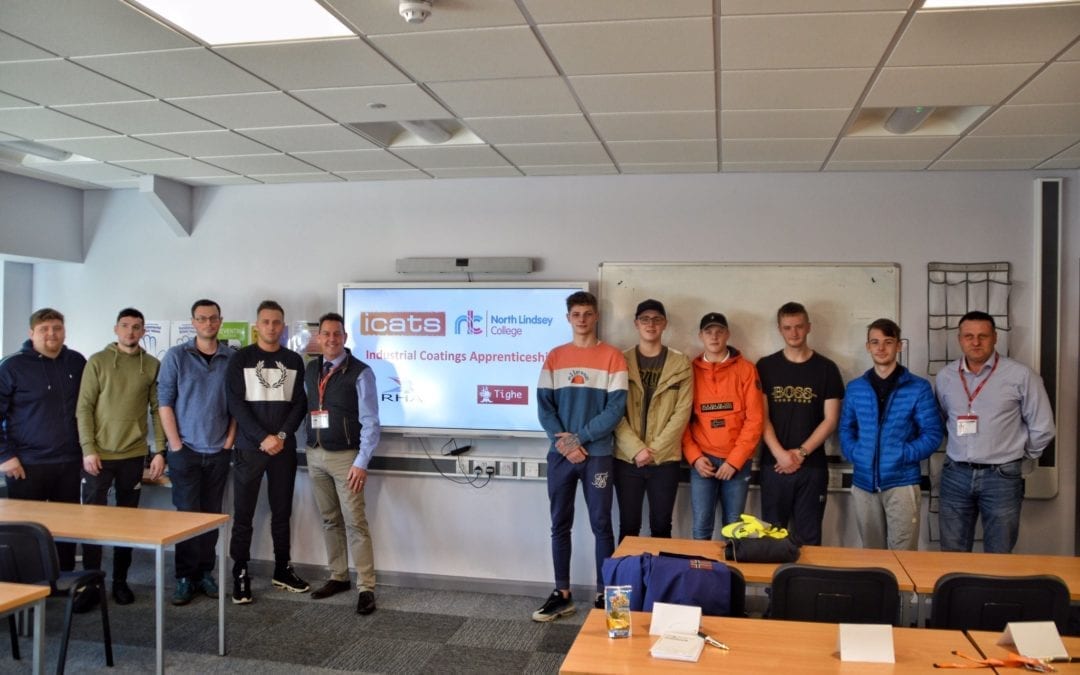
In late 2018 the ICAA apprenticeship standard was accepted by the Institute For Apprenticeships, which was shortly followed by classroom candidates taking their seats in early 2019 at North Lindsey College in collaboration with Jack Tighe Ltd.

I met the apprentices at North Lindsey College during their initial introduction to the apprenticeship programme. This was an absolute privilege for me,” David Horrocks says. “I presented to the class in terms of how they could progress from being an industrial painter, into paint inspection, and even management.

Stephen himself is no stranger to the power of apprenticeships to change lives. Hankinson Whittle runs its own apprenticeship schemes, and has witnessed apprentices make similar career progression to that experienced by David Horrocks. “There’s something about seeing your hard work in developing others bear real fruit,” he says.

David Horrocks agrees. “It is this pinnacle of seeing this developed that gives me the passion to make sure this continues for many years to come.

In our next article, we meet John Whittaker, Training Manager, and Sam Panter, who is Health & Safety Director of Jack Tighe Ltd., the first employer to run the ICAA scheme in the United Kingdom. They tell us about their journey in taking the apprenticeship standard and developing a new apprenticeship programme for Industrial Coating Applicators.

In the meantime, whether you are an employer considering your workforce and business strategy, or a youngster considering your career options, to learn more about the ICAA, email the admin team at the Institute of Corrosion.

A Passive Fire Protection Course is Critical: The Experts’ View

A Passive Fire Protection Course is Critical: The Experts’ View

We Asked the Questions You Want Answered

A passive fire protection (PFP) course is critical for asset integrity and health and safety of employees. Poorly applied PFP systems put at risk both, as well as adding huge costs to the industry when rectification must be executed.

The Institute of Corrosion has been working with PFPNet to address these issues. The outcome is the Fire Protection Coatings Inspector Training Programme, led by the evolution of needs within the oil and gas industry.

Together with PFPNet, we’ve spoken to many industry experts, including:

  • Shivas Lindsay, Fixed Gas Platforms Process Safety Lead & Technical Authority, Woodside Energy
  • Bill Hedges, Chief Engineer, Materials & Integrity Management, BP
  • Sebastien Viale, Paint and Insulation Group Leader at Technip Energies
  • David Stowers, Associate Consultant at PFP Specialists
  • Gautam Arya, Managing Director at Muehlhan Middle East Holding Limited
  • Sarah Vasey, Global Project Director at Sherwin-Williams
  • David Mobbs, Business Development Manager at Corrosion Integrity Management Ltd
  • Gareth Hinds, President of the Institute of Corrosion
  • Simone Thurlbeck, Visiting Professor, University of Manchester and Director at PFPNet
  • John Dunk, Director of PFPNet and Passive Fire Protection Specialists

Why do we need this PFP course?

The PFP market over the past 10 years has become much more competitive,” says Bill Hedges. Though he says that more suppliers entering the market is a good thing, he adds, “This also means that they’re not able to provide the inspectors we need at our facilities when the PFP has been applied.

It’s become evident that the quality standards associated with PFP installation have become quite poor over the recent years,” says John Dunk. “Therefore, having a qualified inspector to inspect the installation becomes very much more important.

What are the consequences of poorly applied PFP?

Poor installation of PFP systems can have extreme consequences. The financial cost of poorly applied PFP can be colossal, and PFP is critical for health and safety and asset integrity.

If passive fire protection has been badly applied, it means that we don’t know how it would act in a fire. Therefore, the safety of personnel and facilities could be undermined,” says Shivas Lindsay.

It could also lead to corrosion under the passive fire protection, which is a problem,” says Bill. “If we need to repair it, it’s very expensive. We estimate it can cost anywhere between 10 to 100 times the original cost if we have to go back and repair.

Why are current inspection regimes missing PFP installation defects?

The need for an upgrade in PFP inspection competency across the entire industry is highlighted by many of the experts we have spoken to.

The main reason we miss defects is because we don’t have enough experienced inspectors to find them,” continues Bill. “We find this to be especially true in more remote parts of the world, where we’re constructing many of our facilities these days.

Simon Thurlbeck remarks, “In my experience of inspecting lots of PFP systems over the last 20 or 30 years, I’ve found many errors and mistakes in the way things have been done.

Some people have the misconception that passive fire protection is just like regular paint – even the paint you might apply in your own house,” says Bill. “That’s far from the truth.

Improving PFP inspector competence

There’s a clear gap in the market in passive fire protection. We’re looking to raise the bar and support industry to set higher standards for people who are qualified to inspect work on passive fire protection systems and sign off work on passive fire protection systems,” says Gareth Hinds.

Introducing the Fire Protection Coatings Inspector Training Programme

The comments from these experts give a flavour of the desire within the industry for a huge upgrade in the training and competency of PFP inspection. Which is why the Institute of Corrosion (ICorr) and PFPNet have developed a market-leading Fire Protection Coatings Inspector Training Programme specifically aimed at the training of inspectors who inspect installation of hydrocarbon passive fire protection coating materials.

We’ve really tried to write the course in a way that people are going to absorb it and enjoy it,” says Sarah Vasey.

The main purpose of this course is to properly qualify inspectors of hydrocarbon passive fire protection coatings used to resist hydrocarbon fires,” says David Stowers. “It’s not a fire engineering course, but we do start with an overview of the effects of fires on plants and structures – and, hence, the need for PFP.

The course isn’t a PFP application course, either, but it does look in detail at the application and quality control requirements of the most widely used hydrocarbon PFP materials. The course also covers installation issues that influence how well PFP will withstand operational and environmental demands.

At the end of the course,” says Simon, “there’s quite a detailed examination that covers all the course materials that participants have heard over the previous few days.

Then there is a peer review,” says Sarah, who is excited by the panel of people who will be conducting it. “People in the industry who we look up to,” she says.

Sebastien sums up the real-world benefits of this training when he says, “It’s great to have people like PFPNet putting together a course that will improve the knowledge of inspectors. For me, this is improving safety.

Who should attend the course?

The people who will benefit from this course in the first instance are those inspectors who are currently practising PFP inspection on major projects,” says David Mobbs.

We’re looking for those who have a minimum Level 1 Paint Inspector course. We would like to have seen them work in the PFP industry for a minimum of three years,” confirms Sarah.

In addition to these early-stage course participants, John Dunk says, “the course could also be of interest to engineers or other parties who just want to understand passive fire protection and its installation.

Those who will benefit from this course include:

  • Owner-operators who will need to build the course into specification, to ensure that PFP is fully considered and that the design and application of PFP meets improving standards and industry best practice;
  • Fabricators and applicators who will need to have their inspectors competently trained, demonstrating that they are committed to maintaining improved standards of application and inspection; and
  • Inspection houses who will need to have trained inspectors ready to meet the market requirement.

In summary

Developed by highly experienced industry experts – people who really understand the needs of the industry – this course will raise the competence of persons responsible for inspecting and signing off on the quality of installation of such systems, covering epoxy intumescent and cementitious PFP systems in the hydrocarbon industries.

With the need for improved PFP inspection, there is a career path for people in this discipline. This comprehensive Fire Protection Coatings Inspector Training Programme will be the springboard for all those who want to develop their career in this area.

We cover the course content in more detail in our article ‘PFP Course for Inspectors – Finally, Training That Meets Industry Needs’.

For more information, contact either John Dunk at PFPNet or David Mobbs at ICorr.