






Revolutionary Coating Inspection Technology

Revolutionary Coating Inspection Technology

Real-time data to boost your effectiveness and efficiency

In the constant battle against the potentially catastrophic effects of corrosion, coating inspection is a critical strategy. However, for many coating inspectors, recording site data is a laborious task and one that suffers from the potential for costly errors.

Thankfully, the latest coating inspection technology offers a faster and more effective alternative to outdated paper-based inspection methods.

Paper: an outdated technology for coating inspection

We may not view paper as high-tech, but it was certainly so when it was first invented. The ability to record information on something that could be placed in a pocket and transported easily, in a format that was easy to share would have been the height of technology many years ago.

Paper allowed the world to record the results of experiments, gather and distribute news, and create books and maps. In its day, paper was the world’s Google, Kindle, and GPS.

Paper took such a hold on society that it became part of human DNA. We write lists, record memories, read news, and use paper to gain entry to events. Our money is paper.

However, the addiction we have with paper is shifting. All technologies have their day, and in recent years society has been learning to live without paper. Sat Navs have replaced maps. You can carry a whole library of eBooks wherever you go. Recipes are watched on various devices instead of reading from cookbooks.

We are choosing technology to replace paper in many aspects of our lives – including at work. And the corrosion industry is no exception. For example, paint and equipment manufacturers have automated processes. Testing equipment has gone digital and is connected by Bluetooth technology. However, site data hasn’t kept pace with technology – until now.

How are you collecting your site data?

During and after a painting project, there is a lot of data that must be collected and collated daily. This includes:

  • Labour and shift details
  • Ambient conditions
  • Surface preparation
  • Application sessions
  • Test data
  • Plant and equipment and photos

The use of paper is engrained in the DNA of the protective coatings industry. Traditionally, site data is recorded on A4 worksheets to be stored in lever arch files. These files contain daily reports, time sheets, data sheets, and a whole ream of other information. They are stored on shelves and boxes for years.

So why does the industry continue to work this way? If it isn’t broken, don’t fix it, right?

The problem with paper

Setting aside the environmental negatives from our reliance on paper, there are several downsides of continuing to rely on paper as your way of recording and communicating site data.

·         Storage space

Those boxes of lever arch files that must be stored take up an incredible amount of space. Shelves and shelves of space, which develop into rooms. Often in basements, and often rarely visited. That unused space costs money.

·         Inefficiency and error

Recording information on paper leaves a lot of room for potential errors or misinterpretation of handwritten information.

On top of the inefficiency of space, compiling reports from paper records is inefficient, too – and with more potential for errors to be transferred or multiplied.

·         Poor use of time

When using paper systems, the time it takes to compile data, store it, use it and transfer it (often by manipulation, scanning, photocopying, attaching to emails, etc.) is all at a cost. Data held on paper is also of no use until it is stored electronically – how often have you needed information that is unavailable because it remains in a coating inspector’s vehicle because he’s in the field for a few days?

In today’s technological age, the paper system is broken. It’s inefficient, reduces your effectiveness, and it’s costly and environmentally unfriendly.

Elcometer and IRIS – revolutionary painting and corrosion inspection technology

Mobile technology has revolutionised the way we live and work. Given that it is essential that coating inspection tasks are correctly logged and that records are maintained so that they are readily available for review and auditing, digital record keeping in the industry is long overdue. There are two notable systems that offer this functionality – one in the United States and one in the UK. Of course, it should be noted that other commercial systems are available.

ElcoMaster (UK)

ElcoMaster from Elcometer is a software package that allows you to transfer data via Bluetooth and Cloud applications. You can scan handwritten notes and convert to PDF to store in project files. Data can be imported and combined from Elcometer gauges. With this system you can:

  • Store data in file trees, by project and inspection type
  • Conduct on-screen analysis
  • Generate reports instantly using standard or pre-designed templates
  • Produce bespoke reports

IRIS (UK)

Developed by a team which includes Institute of Corrosion and NACE inspectors, and one of the UK’s leading paint consultants, IRIS (Intelligent Reporting Inspection Software) allows painting contractors and inspectors to record and upload data from their mobile device. The system enables:

  • Recording of all essential information, including ambient conditions, surface preparation, coating applications and inspections
  • Data entry to be made online and offline (if no internet connection is available)
  • Sending of reports (such as daily journals, non-conformance, and corrective actions) to multiple recipients
  • Compliance with all relevant international standards
  • Easy file retrieval at the click of a button
  • Reduction of your carbon footprint by going paperless

The system is compatible with both IOS and Android devices, and allows information and data to be shared in real time.

Managed from a desktop dashboard, remote employees and contractors have access to the system and can create different reports as needed for clients before loading back to the desktop. This is an excellent way to keep track of daily inspections in real time, and enables the recipients to be kept up to speed with quality and whether any Non-Conformance Reports, Compliance Assessment Reports or technical queries are raised.

Summing up

Systems like IRIS and ElcoMaster are changing the way in which painting contractors and inspectors work. Your mobile phone or tablet is now an essential work tool, helping you to work more accurately and more efficiently.

Data collection and distribution that used to take half your day now takes just a couple of minutes. You can get more done in less time, and take your professionalism to the next level in an industry that is becoming more highly regulated, with increasing numbers of companies and regulatory bodies insisting that applicators and inspectors are fully trained to the highest standards.

For more information about Coating and Inspection training, check out our dedicated training course pages.

Coating Inspector Training at ICorr is Recognised by Petrobras

Coating Inspector Training at ICorr is Recognised by Petrobras

Examining the New N-2941 Standard

The critical nature of coating inspector training has been highlighted by the new standard published by Brazil’s Petrobras, one of the giants in the global oil, natural gas, and energy industry.

We’re delighted to announce that Petrobras has recognised the high standards of the training courses offered by the Institute of Corrosion through its training partners. Inspection of coatings is a key practice in management of corrosion.

Now, Petrobras has confirmed that ICorr’s Level 2 Coating Inspector and Level 3 Coating Inspector courses will give you the certification to inspect corrosion management coatings when working for Petrobras or any of its units or subsidiaries.

N-2941: Petrobras going over and above national standards

Petrobras has published its standard N-2941 (Personal Competence for Inspection Activities) to establish what certification professionals must hold to carry out a range of corrosion management tasks and responsibilities. Inspection activities applicable under this standard include those aimed at:

  • Improving reliability of coatings
  • Reduce the need for rework
  • Increase the security of installations
  • Improve operational continuity

The rigorous nature of certification required by Petrobras ensures that the standard of those inspecting its corrosion protective paint systems meet at least the minimum requirements of national and international standards.

Indeed, N-2941 cites many of these standards to make it clear that these standards (in part or their entirety) constitute requirements for N-2941. These standards include:

  • ABNT NBR 15218 – Criteria for Qualification and Certification of Painting Inspectors Industrial
  • ABNT NBR 16049 – Onshore pipelines – Qualification and certification of People – Inspectors

ICorr Coating Inspector Training is Accredited by Petrobras

Under the standard, issuance of personal competence certificates may only be made by:

  • Certification bodies that have been accredited for their training and certification processes and competence in providing training
  • Those bodies that are accredited by N-2941 to provide personal certification of competency

The Institute of Corrosion is now one of only five bodies that have been recognised by Petrobras to provide training that meets the requirements of ABNT NBR-15218, with both our Level 2 and Level 3 training now recognised under the standard.

The Benefits of ICorr Coating Inspector Training

Our Level 2 and Level 3 Coating Inspector courses are comprehensive and aligned to international standards as well as the current best working practices.

The Level 2 Course is designed to prepare ICorr Level 1 Painting Inspectors for the Level 2 exam. The course goes into greater depth of the syllabus in Level 1, and includes the practical use of equipment needed for an inspector to carry out his or her duties.

The Level 3 Course is designed for Level 2 Inspectors wit more than 3 years of coating inspection experience. With this qualification, you will be able to:

 Direct any inspection or test operation for which they are certified

  • Assume full responsibility for an inspection or test facility and staff
  • Establish and/or validate work instructions or procedures
  • Interpret normative documents
  • Designate the extent of inspection and the test methods and procedures to be used

It has been agreed that an experience assessment will be added to all ICorr certifications for those engaged in painting and coating inspection.

ICorr – supporting corrosion professionals around the world

When rebranding the Institute of Corrosion earlier this year, we set out our mission to support corrosion professionals around the world. Our focus is on the people who make the corrosion industry vibrant and innovative, and our purpose is to ensure that we hep to advance science, technology and ideas; influence policy and decision-making; and ensure a healthier and safer environment.

Our digital communication strategy is now starting to pay dividends (for example, with the Institute of Corrosion booming on social media), but it is behind the scenes that much of the work is done by so many people.

One of these is Lucia Fullalove FICorr MSc BSc, and Director at Fullalove & Associates Corrosion Consultancy Ltd. With her help and expertise, ICorr has been working closely with the Brazilian Association of Corrosion (ABRACO) on Paint Inspector and Paint Applicator’s courses.

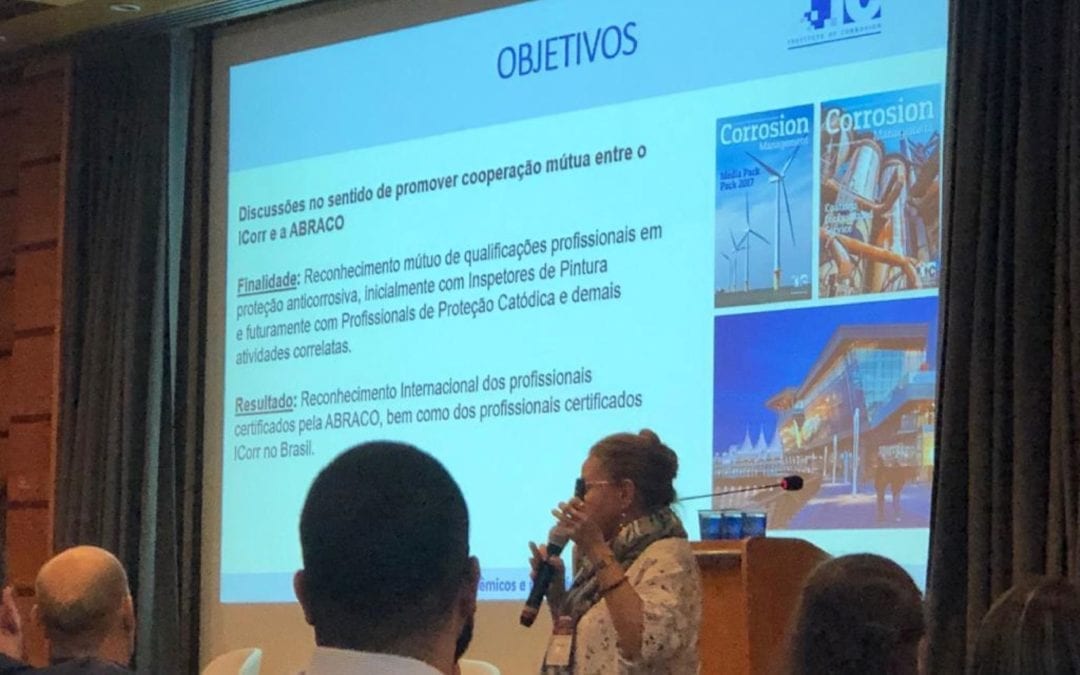
The Institute was further introduced to the Brazilian market on 3rd December at the VI SBPA – the Brazilian Seminar of Paint Application. At that event, Lucia delivered a well-received presentation to the ABRACO-organised Brazilian Coatings Seminar discussing greater collaboration and cooperation between ABRACO and ICorr.

Speaking of these latest exciting developments, ICorr President Gareth Hinds says:

‘I’m delighted that ICorr certification of Level 2 and Level 3 Coating Inspectors has been formally recognised in the new Petrobras standard. This reflects our status as a leading global provider of training in this area and the excellent relationship with our sister society in Brazil, ABRACO.

“I’m pleased to announce that we have recently signed a Memorandum of Understanding with ABRACO to develop further training activities together and I look forward to strengthening this relationship further in the years to come.’

With the dedication and expertise of Fellows and Members of ICorr, we continue to spread our membership’s knowledge, experience, and expertise to an increasingly global audience.

If you would like to learn more about our Coatings Inspector Training, or to enquire about membership options available to you, please email the Institute of Corrosion at admin@icorr.org.

The Critical Nature of Coating Inspection in Corrosion Management

The Critical Nature of Coating Inspection in Corrosion Management

The Essential Role of the Coating Inspector

Effective corrosion management relies on coating inspection, carried out by a certified coating inspector. In this article, you’ll learn why coating inspection is critical, and the responsibilities of contractors and asset owners.

Quality of protective coating is not just desirable – it’s critical

As consumers, we are used to goods and services that we buy meeting a certain standard. In fact, quality is something we expect. After all, if the produce we buy from a supermarket isn’t up to scratch, we won’t shop there again. We expect a restaurant that comes recommended to produce the finest cuisine with exceptional service. If we’re disappointed, we make a complaint and refuse to pay the service charge.

However, in some situations we cannot afford to take a chance on quality. In industries such as oil and gas, rail, highways, and infrastructure, poorly executed work can be disastrous – not only financially but also with potential loss of life.

When a coating is applied to an asset, its primary purpose is to protect it against corrosion and give longevity of life to the asset; this process needs managing. The coatings need to be applied correctly by trained and certificated applicators, and certificated inspectors play a vital role in ensuring the process is delivered correctly.

A coating inspector’s work is to confirm that coatings have been applied correctly, to prevent corrosion that can have disastrous consequences.

Why can’t we just trust coating applicators?

In the UK, coating applicators are trained and qualified under the Industrial Coating Applicator Training Scheme (ICATS). Such training should ensure that applicators carry out their work in a professional manner and deliver a high quality of work. But it’s not quite that simple, and the risks associated with errors are too large to leave work unchecked.

People make mistakes, and a quality check makes sure that mistakes are corrected before they become expensive errors. A specification could be misread, or a detail missed.

In short, the coating inspector is a safety net, to help avoid dire consequences of human error.

Who is responsible for coating inspection?

The responsibility for coating inspection falls on both the contractor and the asset owner.

Contractors should have their own coating inspectors to check the work of their applicators. This is a mandatory requirement in industries such as rail and highways. It’s good business practice, and helps to foster good client relationships by ensuring quality of work is maintained.

However, the asset owner should never rely on the contractor to confirm the quality of their own work. That’s one huge conflict of interest to be avoided. So, good asset owners will employ their own coating inspectors, or hire a third-party coating inspector to check the protective coating application a second time. Using this strategy, asset owners should avoid the disasters that could be caused by contractors who may be tempted to cut corners.

In summary

Protective coating systems are complex. As we have been highlighting in our series outlining ISO 12944, coating is impacted by a range of factors that include:

Such factors make application complicated. It is therefore preferable for highly trained and suitably qualified professionals to collaborate. This should ensure that:

  • Specifications are met
  • Standards are maintained
  • Quality is assured

While the contractor will wish to ensure their work is of the highest quality, the ultimate responsibility rests on the asset owner. After all, it is in their best interests to make certain that disastrous failures of coating systems are avoided – a valuable by-product of which is that properly applied protective coatings will protect assets more effectively and reduce the costs of ongoing maintenance.

For more information about our Coatings Inspector Training, please email the Institute of Corrosion at admin@icorr.org.

ISO 12944-4: Surface Preparation Standards

ISO 12944-4: Surface Preparation Standards

Preparing Steel Surfaces for Corrosion Protection Coating

In our previous article in this series discussing ISO 12944, the standard providing guidance for the corrosion protection of steel structures by protective paint systems, we looked at what the standard says about steel structure design and corrosion. In this article, we examine the main points of Part 4 of ISO 12944 which lays out instructions covering surface preparation for different types of surface.

What Is Surface Preparation?

Surface preparation is the first-stage treatment of a steel substrate which must be undertaken before applying a protective coating. Correct surface preparation is essential to the success of the corrosion protection coating being applied.

The objectives of surface preparation are to:

  • Remove deleterious matter
  • Produce a surface that enables paint to adhere to the steel
  • Minimise the contaminants that initiate corrosion

Mill scale must be removed from new hot rolled steel (in accordance with ISO 8501-1) in order to produce a surface profile that is appropriate for the coating system to be applied (which will be defined in the painting specification).

When surface preparation is carried out, health and safety regulations must be observed, and the surfaces that are to be prepared must be accessible and adequately illuminated. Burrs, sharp edges, and weld spatter should normally be removed around weld details and steel edges; this is generally carried out during the fabrication stage of new steel structures. More details on preparation grades can be found in ISO 8501-3, which define acceptance criteria based on a given specification requirement.

Factors that affect surface preparation

There are many factors that affect the surface preparation strategy and method chosen. These include:

  • Whether it is an existing or new structure (and age)
  • The structure’s location
  • The quality of the previous surface prior to preparation
  • The performance of the coating system
  • The type of corrosive environment
  • The coating system that is likely to be used

The preparation grade necessary to provide the required surface cleanliness and the surface profile (roughness) should also be considered.

Types of surfaces covered by ISO 12944-4

The standard covers surfaces of steel structures consisting of carbon or low-alloy steel of the following types:

  • Uncoated surfaces, consisting of bare steel (which are assessed in accordance with ISO 8501-1)
  • Metal coated surfaces, which include hot-dip-galvanised surfaces, zinc electroplated surfaces, sherardized surfaces, and thermally sprayed surfaces
  • Surfaces painted with prefabrication primer (in accordance with EN 10238)

The standard is mainly concerned with the protection of carbon steel new-build structures or extensive maintenance projects to be cleaned back to bare metal.

Surface preparation methods

The method used to prepare the surface for its corrosion protection coating should remove as much oil, grease, dirt, salts, and other contaminants as possible before further surface preparation is performed. Once known contaminants have been removed, testing may be required to detect less visible contaminants such as soluble salts (as per ISO 8502-6).

Any corroded material that exists should be removed by manual or mechanical techniques, though no sound metal should be removed unnecessarily. When preparing surfaces, the two types of surface preparation are:

  • Primary – which takes the whole surface to bare steel
  • Secondary – which leaves the sound parts of any coatings as they are

Methods that might be used to prepare surfaces for their protective coating include (but are not limited to):

·         Water, solvent, and chemical cleaning

A water jet may be used if the contaminants to be removed include water soluble materials and loose rust or paint coatings.

If detergents are used in the cleaning process, then the surface should be rinsed with clean, fresh water after cleaning.

·         Steam cleaning

Steam cleaning removes oil and grease, though again the surface should then be rinsed with clean, fresh water if detergent is added to the steam. Further testing may be carried out to determine the presence of oil and grease in accordance with ISO 8502-7.

Other methods to remove oil and grease include emulsion cleaning, alkaline cleaning, and organic solvent cleaning.

·         Chemical conversion cleaning

For hot-dip-galvanized surfaces, electroplated-zinc coatings, and sherardized surfaces, cleaning may be carried out by chemical conversion. Such treatments can only be used if the manufacturer of the paint system to be applied approves this type of cleaning.

·         Stripping

Solvent-borne pastes or alkaline pastes may be used to strip paint coatings, though this is usually used only on small areas and then followed by other appropriate cleaning.

·         Mechanical cleaning

Mechanical cleaning methods include cleaning with power tools, blast cleaning (of various types), and flame cleaning. Blast cleaning may be used to remove contaminants, to smooth or roughen the surface metallic coatings, or to remove a surface layer. ISO 8503-3 details these methods.

What if the surface preparation doesn’t achieve its aim?

The requirements of surface preparation are based on a range of preparation grades that are laid out in ISO 12944-4. If the required preparation grade is not achieved – or if the surface condition has changed before the coating system is applied – then further surface preparation must be carried out.

Who can carry out surface preparation work?

The standard is specific in describing who can carry out surface preparation work, saying that:

‘Personnel carrying out surface preparation work shall have suitable equipment and sufficient technical knowledge of the processes involved to enable them to carry out the work in accordance with the required specification.’

After the surface has been prepared, it must be assessed as fit for the coating system to be used. There are separate standards that regulate testing and how testing must be carried out – ISO 8501 and ISO 8502.

The Institute of Corrosion Coating and Inspection Training Courses – presented by Argyll Ruane and Corrodere – will help ensure your painters and inspectors work to the latest industry standards and benefit from new technology and innovative approaches. For more information, contact us today.

In our next ISO 12944 article, we look at laboratory performance test methods and the changes that were made to these in the latest revision of the standard.

In the meantime, if you have any questions, please feel free to get in touch with ICorr or download our guide ‘Surface Preparation Methods’.

Passive Fire Protection – The Financial Cost of Getting It Wrong

Passive Fire Protection – The Financial Cost of Getting It Wrong

There is change afoot in the world of passive fire protection (PFP), especially in the protection of structures in high-risk industries such as oil and gas. Unlike in many other sectors, it is the industry itself that is leading the way in more stringent competencies in application and inspection of PFP to ensure quality installations.

What are the forces that are driving this change? In this article, the first in a six-part series we’ll be publishing over the coming weeks, we look at the financial cost of getting passive fire protection application wrong.

What is passive fire protection?

PFP systems reduce the rate at which temperature rises on the protected structure. They do this primarily through heat absorption, reflection and insulation. They are passive because they don’t require external activation to work, such as water deluge, which is why they are considered more reliable, provided they are installed correctly.

In high-risk facilities such as offshore oil and gas installations, the most common form of PFP is epoxy intumescent coatings. These protect structural steel from extreme heat and provide full corrosion protection. They work by swelling and producing a carbonaceous char when heated, which insulates the steel substrate.

How are PFP coatings applied?

Epoxy intumescent coatings are usually applied by spray application using dedicated spray pumps. They must be applied onto properly prepared surfaces, and surface preparation and priming are critical to their adhesion and, in consequence, longevity. Epoxy PFP systems are frequently reinforced with a fibre mesh system, the primary purpose of which is to reinforce the char formed in a fire situation. On occasion they might be reinforced with a wire mesh, but in some systems there is no reinforcement. Typically, the thickness of an epoxy intumescent coating is between 3mm and 20mm.

The significant advantage of epoxy PFP coatings is their toughness and durability, meaning that they can be applied to steel before it is erected. In modular construction they have the ability to withstand the steel deformation when modules are loaded for transportation to their installation site and during the offloading and installation process.

PFP is failing – but why?

The international standards for PFP have been improved tremendously over the last few decades, especially in response to headline disasters like Piper Alpha and more recent incidents. However, in recent years the industry has witnessed a marked increase in the failure of PFP before the plant is commissioned. The reason for this appears to be changing market dynamics. Let us explain.

There used to be only very few manufacturers that produced epoxy PFP intumescent coatings. It was a highly specialised field, and consequently the margins were high. These manufacturers would provide free-of-charge on-site technical service personnel to help ensure correct application of PFP.

Over the years an increasing number of manufacturers have entered the epoxy intumescent market, chasing the same market opportunity. Consequently, margins have been reduced and a level of commoditisation has taken place. Additionally, the drive in the oil and gas industry to reduce project costs has exerted considerable pressure in all areas of construction and supply. The result has been an inability for manufacturers to offer the same level of on-site technical services that was previously provided free of charge, and instead fabricators and contractors are charged for these services. There is no doubt that this has resulted in a reduction in available competency to ensure quality installations.

A further factor is the tendency to treat epoxy intumescent coatings like paint and even to call them ‘paint’. Whilst they are similar, especially the epoxy types, there are significant differences requiring specific skills and understanding for quality PFP installations.

Shortage of early-stage technical competency is a false economy

PFP is an expensive necessity, and from a financial point of view keeping a lid on those costs is important. However, the cost of correcting poorly applied PFP is colossal. When a PFP system is incorrectly installed or fails, the impact can include:

  • Risk to the project schedule and potential delay of production due to lack of authority to operate whilst corrective action is taken
  • The high cost of access, including scaffolding, to carry out remedial work, particularly in the offshore environment
  • Impact on other trades whilst areas are ‘quarantined’ for corrective PFP work to be carried out
  • The sheer difficulty of removing and reinstating in an on-site environment

Experience from a leading coatings manufacturer shows that:

Offshore maintenance is 15 to 20 times more expensive than performing work at a yard, and corrosion accounts for 60% of offshore maintenance costs. Further, 85% of coating failures appear within 1 to 3 years, with 95% of failures occurring because of:

  • Incorrect specification choice
  • Poor surface preparation
  • Poor application
  • Climatic conditions

To put this into perspective, PFP that is commissioned at an implementation cost of, say, $10 million for a facility in an isolated area of the world (the best fields are usually isolated, right?) and is poorly implemented could cost $150 million to $200 million in rectification costs.

From a purely financial viewpoint, it’s clear that if you spend money upfront you save hugely on project overrun costs, let alone the project complexity of re-work.

How the industry is evolving

The industry is calling for improved competency in the application and inspection of PFP. It simply cannot continue to burn cash on rectification requirements that could and should be avoided. Whilst development, testing and certification for use of PFP materials is regulated, the application and inspection of PFP is not regulated in the same way.

Currently, owner operators specify that inspectors should be paint level 2 qualified as a minimum. What this means is that someone who has good knowledge of paint, but no knowledge or experience of PFP, can go onto a site and inspect PFP. As manufacturers continue to bring new and improved products to the market, with additional features and benefits, this issue is magnified.

In response to this and other issues, PFPNet was established around four years ago to tackle what was becoming a significant loss of skill in the industry across a broad range of PFP topics. With an objective to improve knowledge and understanding, and increase competency across the hydrocarbon passive fire protection industry, PFPNet – whose membership comprises owners, engineers, contractors, manufacturers, and others – has tapped into the skills of its members to tackle key subjects including improving quality of installation.

As PFPNet has evolved and grown with a broad range of membership of companies and individuals who truly understand the business, it has become clear that there is a real desire to develop best practice, navigate regulations, and remove confusion and conflicts.

The result is the evolution of a new PFPNet Competency Framework, which will lay out the knowledge and competency levels expected across all disciplines in the fireproofing of industrial facilities. It is expected that this framework will be mandated by owners and other stakeholders as a requirement for projects and operations.

To stay in the know and be part of the PFP conversation, contact either John Dunk at PFPNet or David Mobbs at ICorr.

Meet the Corrosion Specialist – This Month, Bill Hedges

Meet the Corrosion Specialist – This Month, Bill Hedges

11 Questions in 11 Minutes

Each month, we plan to introduce you to a corrosion specialist from the membership of the Institute of Corrosion. This month we spoke to Bill Hedges, Chief Engineer, Materials & Integrity Management, BP. Bill is the current Vice President of the Corrosion Institute, and in November 2020 will become President for a two-year term.  Bill has been married to Joanna for 32 years and has two daughters.

We asked him about his professional life, career advice he would give to a younger corrosion specialist, and took a peep into his private life.

Here’s the 11 questions we posed in the 11 minutes we took of Bill’s valuable time.

1.      What did you aspire to be when you were younger?

As a child in the 1960s and 70s, the world was dominated by the Space Race. Like many boys of that era, my ambition was to become an astronaut and travel to different galaxies.

2.      So, how did you end up as a corrosion specialist?

When dressed in my astronaut suit (seriously, most boys my age had one), I developed an interest in science, and particularly chemistry. I had a chemistry set and was constantly experimenting – leaving scorch marks on the coffee table from an early magnesium burning adventure.

My love for chemistry was cultivated further by wonderful teachers at school. That passion led me to Southampton University, where I discovered electrochemistry. Encouraged by the exceptional Professor Derek Pletcher (who remains a good friend), I studied rechargeable lithium batteries for my PhD. I was fascinated, and realised that a battery is simply a controlled corrosion reaction. I suppose I ought to apologise to battery chemists at this point!

After a year at Oxford as a post-doctoral student, I started my first job at a company called Metal Box as a Corrosion Scientist. Perhaps not one giant leap from astronaut to corrosion science, but certainly many small steps.

3.      What was that first job like?

It was tremendous fun. My job was to study the effects of a range of substances on tin and aluminium cans. I would experiment with beer, wine, household cleaners, food products, and many more. It was almost like being back at home on that coffee table!

I learned a huge amount about corrosion testing methods at Metal Box, and that is really where my lifelong passion in corrosion really embedded itself.

I then moved to Exxon Chemical (later known as Nalco Exxon, and now as Nalco) as a corrosion scientist in their oilfield chemistry group. This was where my career started to blur between corrosion science and corrosion engineering.

4.      You decided to stick with oil and gas. How did your career progress?

Eventually, I joined BP as a corrosion engineer in 1997. The team I joined was led by Don Harrop (who was President of the Institute of Corrosion from 1994 to 1996). He became my mentor and a good friend.

I started at BP running the corrosion laboratory, where we worked to gain a greater understanding of the role of acetate ions on CO2 corrosion rates. We also developed a CO2 corrosion rate prediction model known as Cassandra, which we provided to the industry.

Around three years into my career with BP, I moved to Trinidad and Tobago as a corrosion engineer and was promoted to Integrity Manager. After five years in the tropics, I was offered the opportunity to relocate to Alaska. It was here that I directly experienced the effects of a devastating corrosion leak. Living and working through this incident and its impact, whilst dealing with lawyers, consultants, politicians, regulators and the media was life changing and, in the end, very rewarding.

I returned to the UK in 2012 to become the Corrosion Authority for BP’s upstream business. Then, in 2018, I was promoted to Chief Engineer for the Materials & Integrity Group – comprising of Corrosion, Materials, Welding, Inspection, Production Chemistry, Pipelines, Risers, and Subsea teams.

5.      What have you enjoyed most about your career in corrosion?

Now this is a hard question. There is so much for which I’m grateful, including, of course, all the wonderful people I have met and had the pleasure to work with and learn from.

However, I think that I would have to say the amount of travel I have been able to do, and the different places and cultures I have been able to experience. It may not be journey to the moon, but from the heat of the tropics to the icy tundra of Alaska is quite something, nevertheless. I’m not sure there is another career (unless you happen to be Sir David Attenborough) that could provide such diversity.

The other passion that I have been able to fulfil is working with and developing people. That’s a role that I have been able to fill since first becoming a Team Leader – and it’s a role I will never grow tired of doing.

6.      What career advice would you give to a young corrosion specialist?

First, if someone ever offers to pay you to work as a corrosion specialist on a Caribbean island, don’t hesitate to take the opportunity!

Second, I’ve been lucky in my career, but that luck took a lot of hard work. I was rejected for numerous roles, and the frustration is real. Don’t let rejection get you down. If you are passionate about what you do but cannot seem to find the right career path, stick at it. Work hard, persevere, and look for alternative pathways. In my experience, opportunities usually appear – although not always at the most convenient time!

Third, never stop learning. You’ll have fun in a rewarding career in which you are responsible for keeping people and the environment safe. Corrosion isn’t simple – it’s a complicated, multi-disciplinary subject where it’s rare for one person to have all the answers, which means teamwork is essential.

7.      What is in store for corrosion professionals?

Well, I don’t have a crystal ball, but I do think the future will be exciting. We’re going to see more automation in the industry, and this should help to reduce risk to people.

There will be more openings for data analytics and artificial intelligence within the field of corrosion, and those who are prepared to continue to learn and adapt will be rewarded with long and exciting careers.

Finally, we’ll continue to develop materials, striving to produce non-corrosive, lightweight materials that can be used wherever appropriate.

8.      What have you gained from your membership of ICorr?

Clearly training and the ability to demonstrate my professionalism through obtaining my Fellowship and Chartership have been great. But I would say the most important benefit has been the networking. Membership improved my ability to have a range of professional colleagues that I can talk to about technical issues and the best ways to tackle them. I’ve been fortunate to be able to attend many of the London branch monthly meetings to hear some excellent talks and discussions and meet some great people.

Bill Hedges This Month's Corrosion SpecialistLet’s get personal with the corrosion professional!

We know that corrosion scientists aren’t all work and no play, so we asked Bill three final questions to learn a little more about him personally.

9.      What’s your favourite food?

Eating is one of my favourite things. I like all food – except melted cheddar! I particularly love spicy food of all types but would have to say my favourite single thing is Joanna’s Tiramisu – closely followed by her Hazelnut Pavlova.

10. What do you like doing most outside of your professional life?

Family and church are very important to me. Joanna and I love walking and visiting new places. For personal relaxation I listen to a lot of music – mostly guitar-oriented rock and I’m still learning to play guitar.

11. Tell us a secret about yourself, something that might surprise fellow members (and something we can print!)

I was born in Glasgow, Scotland – but I only lived there for three months before moving to Sidcup in Kent/South East London where I grew up. I’ve always loved visiting Scotland.

What do you want to ask a corrosion specialist?

Who would have thought it? Guitar-playing Bill loves spicy food, but is most in love with Joanna’s homemade Tiramisu and Hazelnut Pavlova.

He has certainly had an interesting and varied career, and has plenty to offer to the Institute of Corrosion when he takes up the mantle of presidency.

Now, over to you. Let us know what you’d like us to ask the next ICorr member we put in the hotseat for 11 questions in 11 minutes. Send us an email, and we’ll try to include your question.