The Institute of Corrosion is very sad to announce the passing of Dr Michael John Graham FICorr, on August 2nd 2022, at the age of 82.
Over Michael’s long research career, he published more than 250 papers on his work in corrosion science and engineering, including thin oxide film formation on metals and semiconductors, surface passivation, high temperature oxidation, and the application of surface analytical techniques to degradation of materials. The outstanding nature of his work was recognised by the Institute through the receipt of both the U. R. Evans Award (1994) and the T. P. Hoar Award (1983). He was made a Fellow of the Institute in 1984.
Michael had a distinguished 36 year career at the National Research Council of Canada, starting as a Post-Doctoral Fellow and retiring in 2005 as a Researcher Emeritus. In addition to his ICorr awards, he received the W. R. Whitney Award (2003) and the H. H. Uhlig Award (1997) from NACE, and was Chair of the International Corrosion Council (1996), Chair of the Gordon Research Conference on Corrosion (1985), Co-chair of the 9th International Congress on Metallic Corrosion (1984), and Fellow of NACE (1994).
His leadership responsibilities at the National Research Council of Canada included, Head of Metallic Corrosion and Oxidation, Head of Chemical Characterisation, Head of Surfaces and Interfaces, and Chemistry Division representative to NRC-wide planning and management committees.
He will be particularly remembered for his love of the Gordon Research Conferences on corrosion where he was an active participant in the science and recreational aspects of all but one conference over 47 years. He will be remembered for his sharp mind, determination, fairmindedness, soft-spoken nature, and genuine kindness.
In addition to his love for research in surface science, he was an avid golfer, captained his cricket club in Ottawa,
and played bridge nearly weekly with close friends for over 40 years. Michael was educated at the Creighton School, Carlisle, and the University of Liverpool (B.Sc. with Distinction, 1961; Honours Chemistry, 1962, Ph.D., Surface Chemistry, 1965). In 1998, he was awarded the Honorary Degree of D.Sc. for his contributions to science. He was also a proud recipient of the Queen Elizabeth Diamond Jubilee Medal (2002).
Michael is survived by his wife and best friend of many years, Lynda Pilkington, his daughter, Karen Lavallee, his sons, John and Andrew, and the mother of his children, Marion Payne.
Adapted from: The Electrochemical Society Interface
31 45 – Winter 2022, www.electrochem.org
A joint evening event was held by the branch and the Institute of Mining (NEIMME) in Newcastle on December 18th at the NEIMME, where, Britt Gevaert presented “Humidur Char: Facing Fire in One Coat.”
This was the first event of the reformed Northeast Branch and Lee Wilson’s (previous Chair) contribution to restarting the branch was acknowledged, with his widow also present in the audience. There were nearly 40 attendees in the room and another 30 on-line attendees for the presentation, that had a high level of expectation due to the ground-breaking properties of the product being discussed.
Britt presented Humidur® Char, the one coat Passive Fire Protection (PFP) system. This PFP coating is unique because it has been independently approved and certified for application on minimal prepared steel (St 2), and does not require a primer, nor a reinforcing mesh, even in the most severe fire scenarios. This product has been extensively tested to (High Heat Flux) Jet Fires, Pool Fires and Gas Explosion Resistance, and received Type Approval by the class society DNV. It is currently being utilized by Woodside on both onshore and offshore assets and has been specified for future global projects for various other clients.
At the end of this very informative presentation questions were raised by the audience including local industry experts, and answered by Britt. Following the presentation drinks and snacks were enjoyed by the attendees whilst networking and further discussing the evening’s presentation.
A recording of the presentation can be watched at, https://www.youtube.com/watch?v=P_srzMOfdN0&feature=youtu.be
Future branch events include a presentation and demonstration from PlasmaBlast covering plasma surface cleaning, in March. This will be followed on 22 and 23rd June 2023 by the “Integrity Engineering for a Sustainable Future” conference. This 2-day event will feature a series of technical presentations from leading figures and companies in the renewables sector, followed on the second day by tours of Ore Catapult (offshore renewable energy test and research centre) and Bates Colliery (a Coal Board managed ex-coalmine with 5MW geothermal energy potential). Both events will be held in Newcastle upon Tyne.
After the restricted event in 2021, the 33rd annual branch Christmas Lunch was held on 1st December 2022. Numbers were back to a pre-covid level, as 170 guests attended at the Royal Overseas Club in central London. A drinks reception in the Hall of India was followed by a four course meal served in the Princess Alexandra Hall. In a break with tradition, instead of a speaker the entertainment was a corrosion themed quiz, which was won by the table from CTS Europe. As usual the popular raffle was organised by Jimmy Glynn.
As in previous years, most of the guests stayed on for a while to network before many then transferred to a local public house to continue socialising. Thanks must go to the organising committee, plus sponsors Carboline, Corrodere Academy, PPG Protective and Marine Coatings, Protective Polymers Ltd and Winn & Coales (Denso) Ltd.
The first presentation of the year was a hybrid event, at which Kenneth Wunch, discussed “Microbially Influenced Corrosion in Oil & Gas Systems.”
Kenneth holds the position of Energy Technology Fellow at Lanxess in Houston responsible for business development, technology transfer, and shaping the innovation pipeline and strategy for global oil and gas applications. He has 15 years in the industry including positions at Baker Hughes, BP and Dow, and extensive experience in development and field application of biocides, corrosion inhibitors & sulfide scavengers, and is the global Subject Matter Expert in oilfield microbiology, bioinformatics, reservoir souring, microbially influenced corrosion (MIC) and biofouling.
In his presentation, Ken gave an overview Microbially Influenced Corrosion (MIC) in oil & gas systems focusing on:
• Operations that introduce the threat of MIC
• Consequences of MIC including a case study
• MIC assessment and monitoring
Risk management for MIC relies on the application of robust preventive barriers that typically involve the physical scraping of pipelines via oilfield “pigs”, and the chemical application of biocides and corrosion inhibitors.
These preventive barriers are analogous to the control of dental caries which uses scraping via a toothbrush along with a chemical application of toothpaste to limit the microbial growth. However, the surface active and reactive biocides that are applied in oil and systems are designed to prevent or remediate corrosion in much harsher environments.
Routine monitoring for microbial growth and general corrosion is imperative for MIC risk management. However, when preventive barriers fail, Reactive Root Cause Assessments (RCA) utilise various microbial analytical techniques (ATP, qPCR, metagenomics) to identify the underlying cause, and provide corrective actions. Often, these investigations produce unexpected results. For example, a RCA performed for corrosion issues that were suspected to be MIC-related, were actually caused by oxygen intrusion into the system, with identification of oxygen-tolerant bacteria being the key piece
of evidence.
Kenneth finished his presentation by discussing key performance indicators (KPIs) and MIC management strategies, after which he answered questions from the audience.
The branch chair, Polina, thanked Ken for this very interesting and informative presentation.
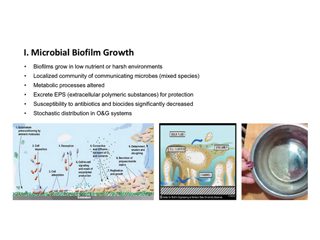
Hydrotesting, drilling and completion operations in oil and gas systems introduce microbial contaminants into the topside equipment and reservoirs via numerous pathways. For example, offshore platforms can inject 10 quadrillion (1016) cells into the reservoir each day with a proportion of these able to thrive in the harsh conditions of the reservoir and production equipment.
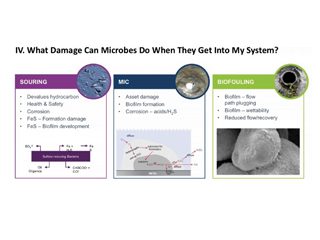
These introduced microbes will become established and form recalcitrant biofilms that can lead to corrosion, souring (H2S production), plugging and separation issues.
Microbially influenced corrosion (MIC) is the localised interaction between microbes and metals where microbial metabolisms accelerate corrosion processes. These metabolisms influence the corrosion process and change the environment via:
• Uptake and excretion of substances that affect the solid material (chemical change)
• Creation of microenvironments (causing physical/chemical boundaries) influencing the local environment
• Deposition of scale and organic material
• Uptake and change of functional chemical addition (parasitic absorption)
It has been estimated that approximately 13% of oilfield pipeline corrosion failures can be attributed to MIC, costing the industry billions of dollars annually. For example, a 2006 pipeline failure on the North Slope of Alaska was diagnosed as due to MIC and ended up costing the operator close to $2B in fines, lost production, and equipment replacement.Furthermore, market economics of having the operations shut down increased the price of oil in the United Sates by $2 a barrel.
The branch committee are pleased to announce the following upcoming events for which registration details will be sent to all members:
• Tuesday – 28/02/2022 Hybrid, Raza Amin, Ankaa Consulting, will talk on, “The Enterprise Holistic Digital Solution for Asset Integrity Management.”
• Tuesday – 28/03/2023 Hybrid, Kevin McDonald, Sonomatic, will talk on, “Effective Pipework analysis and inspection planning using Digital Twins.”
The branch is also very pleased to announce that ICR Aberdeen are to host the annual ABZ ICorr Industrial visit, planned for the 25th of April 2023. This innovative company offer specialist repair, inspection, and integrity solutions to a diverse range of industries. Places are limited for this event.
Further Information about the Aberdeen Branch, and past presentations, may be found on their website page: Aberdeen Branch – Institute of Corrosion (icorr.org), and to join the Aberdeen branch mailing list, please contact: icorrabz@gmail.com
Abstracts of potential papers for the branch technical programme are always welcome, and anyone wishing to join committee should correspond with the Aberdeen Chair, Dr Muhammad Ejaz,
itsejaz@yahoo.com
The Corrosion Engineering Division invites you to join our annual working day and symposium on Thursday 27th April, 2023. The theme of this year’s symposium is, “Corrosion Prevention in the 21st Century: Learning from the past to protect the future.”
This one-day meeting will be the latest in a series of recent working days of the Institute of Corrosion’s Corrosion Engineering Division. The meeting will be held in person at the National Physical Laboratory (NPL), Teddington. This year’s meeting is wide ranging and covers ‘Corrosion Prevention in the 21st Century: Learning from the past to protect the future.’
After the technical talks and tour of the facilities and laboratories on site at NPL, the meeting will break up into the individual CED working groups. Where possible, agendas for the working group meetings will be published separately in advance on the CED website
(http://www.icorr.org/about_icorr/technical_divisions.phtml).
In addition to the technical talks and a tour of NPL, the 2023 Paul McIntyre Award will be presented.
The working day is a fantastic opportunity to network with other corrosion professionals from a range of different industry sectors; and, to learn about how corrosion prevention techniques can help preserve equipment and infrastructure occurs within their organisations.
Meeting Schedule:
09:00 – Registration & Welcome drinks
09:30 – Welcome & Introduction
09:45 – Industry Talks (x2)
10:45 – Refreshments & Exhibition
11:15 – Industry Talks (x2)
12:15 – Paul McIntyre Award Presentation
12:45 – Lunch & Networking
13:30 – Industry Talks (x2)
14:30 – Facility/Lab Tour
15:00 – CED Working Group Meetings
16:00 – Closing Discussions
16:15 – Finish
We use cookies to optimize our website and our service.
Functional
Always active
The technical storage or access is strictly necessary for the legitimate purpose of enabling the use of a specific service explicitly requested by the subscriber or user, or for the sole purpose of carrying out the transmission of a communication over an electronic communications network.
Preferences
The technical storage or access is necessary for the legitimate purpose of storing preferences that are not requested by the subscriber or user.
Statistics
The technical storage or access that is used exclusively for statistical purposes.The technical storage or access that is used exclusively for anonymous statistical purposes. Without a subpoena, voluntary compliance on the part of your Internet Service Provider, or additional records from a third party, information stored or retrieved for this purpose alone cannot usually be used to identify you.
Marketing
The technical storage or access is required to create user profiles to send advertising, or to track the user on a website or across several websites for similar marketing purposes.