
George Sergi, FICorr, Technical Director at Vector Corrosion Technologies Ltd
Meet The Author
George Sergi is the technical director at Vector Corrosion Technologies Ltd. He has long been involved in research and development for concrete durability consulting and problem-solving in the construction and concrete repair industry and is skilled in materials science, highways, bridge inspection, and steel-reinforced concrete repair and protection. George holds a PhD from Aston University for his work on the corrosion of steel in concrete. He was previously the head of corrosion at the Building Research Establishment (BRE), technical manager at FOSROC Constructive Solutions and lead bridge consultant for Birmingham City Laboratories.
The following summary is intended to provide specific clarification on the use of the Exponential Ageing Model for CP in Concrete, as referred to by C M Stone and G K Glass in their article “A critical assessment of the half-life Ageing term and failure to predict future galvanic anode behaviour”, Corrosion Management, Issue 187 [1].
Regarding long-term monitoring data from a hybrid anode installation at Whiteadder Bridge [1] they argued that:
- The observed current decay did not follow an exponential relationship over the full-service life.
- A constant residual current dominated long-term
- Early high current output was governed by curing or resistivity changes in the activator rather than anode ageing.
- Changes in steel passivity, rather than anode condition, governed long-term current trends [3].
These interpretations are examined below in the context of electrochemical fundamentals, field data from multiple installations, and laboratory evidence.
An Explanation of the Pre-Passivation Regime Within the Ageing Factor (AF) Model
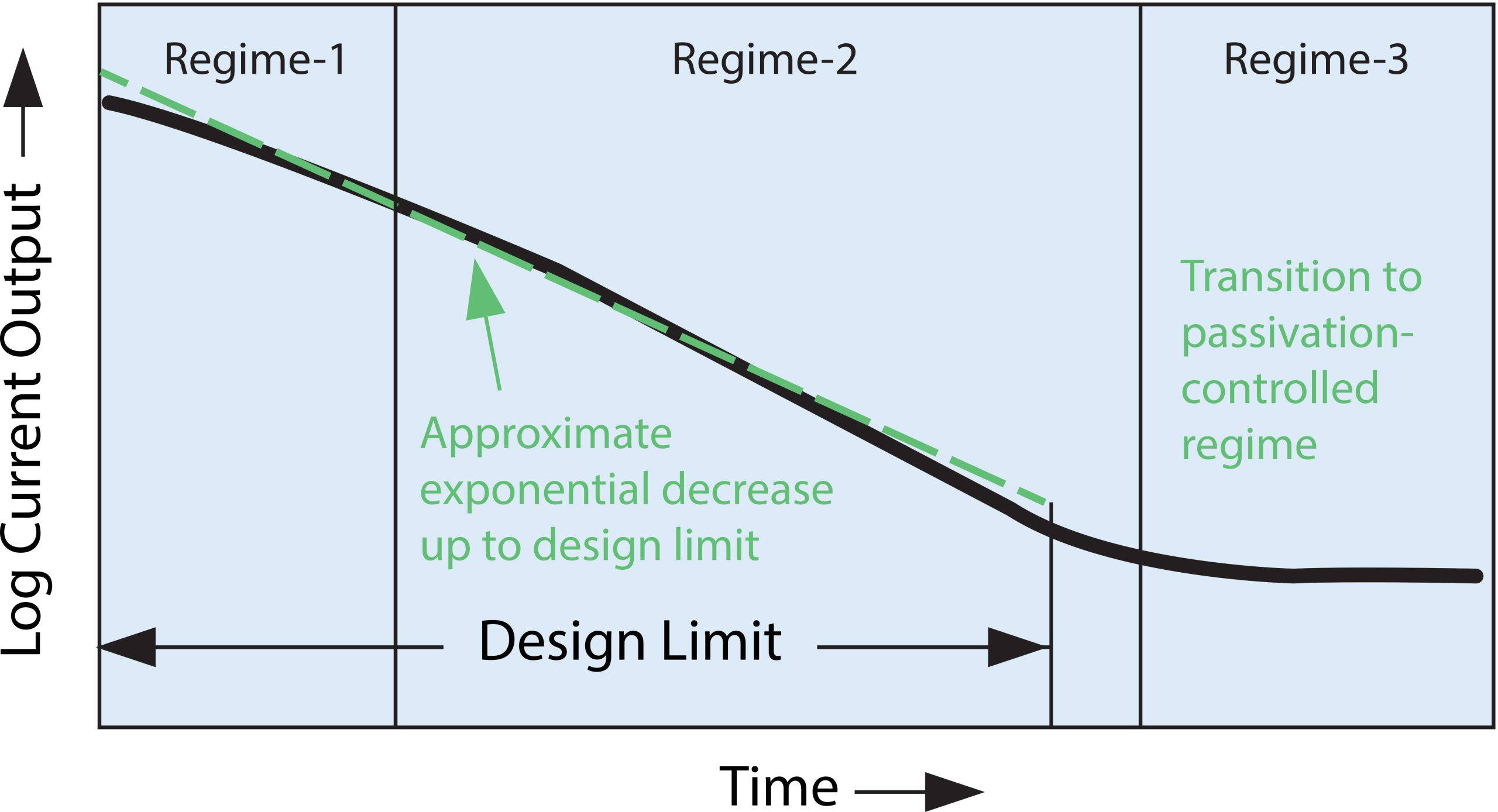
The (AF) model does not assume indefinite exponential decay. It describes the pre-passivation regime, during which:
- Corrosion products are at least partially transported away from the zinc/activator
- The anode remains electrochemically
- The zinc surface area decreases progressively due to
- Both geometric modelling and long-term field data consistently show that, during this regime, current output halves at approximately constant time intervals. This behaviour has been observed across multiple installations and for:
- Different anode geometries
- Varying exposure conditions
For the Whiteadder Bridge data [1], the first 8–9 years of operation exhibited a clear exponential decline, yielding an AF of approximately 3 years, which confirms the existence of an exponential ageing regime.
Transition to Passivation Stage
The deviation from exponential decay at later ages, resulting in an asymptotic or quasi-constant current, is not evidence against the AF concept and instead reflects a transition to a passivation-controlled regime, in which:
- A continuous corrosion product layer forms at the zinc/activator
- The zinc surface becomes effectively
- Current output is limited to a low level governed by oxide
This behaviour is well known in electrochemistry and is analogous to passive steel behaviour. The same transition has been observed in:
- Laboratory depolarisation and potential-shift studies [4]
- Non-alkali-activated anodes
- Overdriven alkali-activated anodes
Steel Passivation – Effect on Anode Current
It has been proposed [3] that decreasing current is driven by increasing steel passivity. This interpretation is electrochemically inconsistent. As steel becomes more passive, its potential shifts in the positive direction. For a galvanic system, this increases the driving voltage between zinc and steel, which would, all else being equal, tend to increase rather than decrease anode current.
Observed reductions in current therefore, cannot be attributed to steel passivation alone and must originate primarily from changes at the anode interface.
Post Passivation Behaviour
Once passivation occurs, current output becomes largely independent of remaining zinc mass or theoretical surface area, and exponential modelling is no longer applicable. The AF model is therefore not intended to describe post-passivation behaviour, a limitation that is now explicitly recognised.
Activator Resistivity Changes
It has been suggested that early current decay resulted from curing or resistivity changes in the activator putty. For this mechanism to account for the observed reduction, the resistivity of the activator would need to increase by several orders of magnitude over a relatively short period.
Such behaviour is inconsistent with:
- Known curing behaviour of cementitious or polymeric activators
- Independent laboratory measurements of activator resistivity
- Observations from alkali-activated systems where similar activators exhibit stable resistivity but very different ageing behaviour
By contrast, the formation of zinc oxide/hydroxide corrosion layers several millimetres thick provides a physically plausible, experimentally supported explanation for the observed current limitation.
Zinc Potential Evolution
Potentiodynamic scans and long-term exposure tests demonstrate that:
- Aged anodes show substantially less negative potentials (≈ −750 mV).
- New alkali-activated zinc anodes exhibit corrosion potentials <−1100 mV vs Ag/AgCl.
- Non-alkali-activated anodes can shift to even more positive values within a short period.
This progressive ennoblement of the zinc potential directly reduces the galvanic driving force and is consistent with corrosion-product-induced passivation and anode-controlled ageing. Some independent studies by BAM/ibac [4] corroborate this behaviour.
Implications for Future CP Design and Interpretation
The apparent contradiction between exponential decay and long-term constant current disappears once ageing is recognised as a multi-regime process:
- Geometry-controlled exponential decay (AF regime)
- Resistance-influenced decay due to gradual pore blocking
- Passivation-controlled residual current
Well-designed alkali-activated anodes delay the onset of Regime 3 above beyond the design life, allowing the AF model to be used
reliably for long-term prediction. Note. Systems that enter Regime 3 early must instead be designed based on the residual current.
Galvanic Anode Monitoring – Design Considerations
An explanation of the Exponential Ageing Model
Discussion
- Exponential decay of galvanic anode current has been experimentally observed and theoretically justified.
- Any deviation from exponential behaviour typically results from passivation and should not be interpreted as failure of the ageing model.
- Differences between systems arise from activator chemistry, anode geometry, and degree of over-driving.
- The AF remains a valid and necessary design parameter within its defined
Galvanic Anode Monitoring – Lessons Learnt
- Current Density halves at regular time intervals found to be 3-15 years, depending on anode activator and type and degree of anode overdriving, a term described as “Ageing Factor”.
- Exponential decline of current density up to the Design Limit is consistent with “Half-Life” principle.
- Humidity and particularly temperature, modify current output
Conclusions and General Guidance
The normal service life of installed galvanic anodes is expected to be at least 15 years and possibly 20-30 years.
- Current output of galvanic anodes is sustained for many years with a gradual exponential drop at a measured rate (Ageing Factor – AF).
- The Ageing Factor can be built into the design of the anode system to predict minimum service life.
- Enough knowledge has now been gained about anode behaviour over time to allow design to any required level of steel
References
- M. Stone & G.K. Glass “A critical assessment of the half-life Ageing term and failure to predict future galvanic anode behaviour” Corrosion Management, Issue 187, pp. 35-39, September/October 2025.
- Stone, W Carr & A Roberts “Analysis of the half-life “ageing-constant” theory for galvanic anodes: Analysing the model’s predictive power for CPT anodes” MATEC Web of Conferences 409, 02001 (2025) https://doi.org/10.1051/matecconf/202540902001.
- Dodds, C. Christodoulou, C.I. Goodier, Hybrid anode concrete corrosion protection – independent study, Proceedings of the Institution of Civil Engineers: Construction Materials, Vol. 171, 4, pp. 149-160, Aug. 1918.
- Federal Institute for Materials Research and Testing (BAM) and ibac – Institute for Building Materials Research at RWTH Aachen University “Performance of galvanic and hybrid anode systems for reinforced concrete structures” Final Report on Industrielle Gemeinschaftsforschung (IGF) Project no. 20408 N, 30/11/2022
- https://www.icorr.org/wp-content/uploads/2021/06/2021-03-30-ICorr-Aberdeen-Event-ICorr-Aberdeen-Presentation-30-03-21-Dr-George-Sergi-Vector-Corrosion.pdf