


Latest News – London Branch

Latest News – London Branch

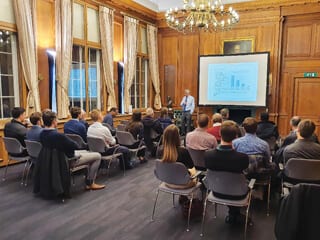
A joint meeting with the Society of Chemical Industry (SCI) was held at their newly refurbished auditorium in their Belgravia HQ, on 26 September. The audience of over 70, included Professor Ken Grattan, OBE, FREng, who is the Dean of the graduate school at City University, London, and who agreed to give the vote of thanks.

The evening Chairman, John T O’Shea, introduced Dr Fred Parrett, Hon Treasurer of the SCI London Group, who gave the first presentation on the laying of the first Transatlantic Telegraph Cables.

The electric telegraph was first developed by Samuel F. B. Morse in 1832 who also developed Morse Code. Land based cables to use the telegraph soon followed, and within a decade, more than 20,000 miles of telegraph cable criss-crossed the USA, the UK and Europe. Trials of underwater cable were undertaken by Samuel Morse across New York Harbour in 1842 and Charles Wheatstone across Swansea Bay in 1844. In 1851 a cable crossed the English Channel.

The problems of laying a cable across the Atlantic were a greater challenge, not just the technical and logistical problems, but financing such a great undertaking. The first attempt in 1857 failed when the cable broke, and could not be recovered. New finance was arranged and in August 1858 they succeeded, when the first transatlantic telegraph message was transmitted. Unfortunately the cable failed after only three weeks, which was thought  to be due to breakdown of the cable insulation when voltages of a few thousand volts were used to try and speed up transmission speed.  It took another 7 years before new finance was arranged and improved cable designs were developed for the next attempt. For this Brunel’s ship the Great Eastern was acquired, the largest ship in the world at that time. In 1865 it almost succeeded, starting in Valentia Bay, Ireland it reached 600 miles from Newfoundland when the cable again broke. The final success came one year later in August 1866 when the cable finally crossed the Atlantic and permanent telegraph communication established. The 1866 transatlantic cable could transfer 8 words a minute, and initially it cost $100 to send 10 words, which translates to about $1,340 today, and was mainly used by the British and American governments and large corporations.

The second presentation was given by Trevor Osborne, a Past President of ICorr and a Past Chairman of London Branch, on 50 Years of Oil and Gas Offshore Corrosion Control Experience and Transfer of Technology to Offshore Renewables.

Development of offshore structure corrosion control methodology in the North Sea, and all around the world, has been on-going for decades, in fact close to 50 years and possibly longer in some parts. Given this long experience, corrosion engineers rightly considered that all aspects of barrier coatings and cathodic protection were honed to a fine art and as a result one system followed another with great success, in fact Trevor had been involved in many offshore structure designs with responsibility for painting, coating, CP, biocides, inhibitors and other aspects of corrosion control. However the fabrication and installation of new offshore structures for the oil and gas market has declined greatly and that work load has in part been replaced by the upsurge in renewable energy requirements. Specifically offshore wind generation in the form of monopiles, transition pieces and substation fixed jackets. All exposed parts of each structure need to be addressed from a corrosion perspective if the asset is to be protected and the lifetime met.

The presentation walked the audience through the period of time from early offshore structure design and construction for the oil and gas markets, to the painful transition to wind energy, including the attendant problems that have occurred along the way and what should have been an easy transformation but often times was not.

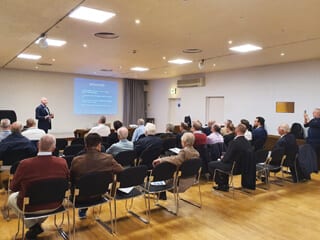
The first meeting at the branch’s new venue, the Lancaster Hall hotel in Bayswater, was held on 10 October.  Kevin Harold of Paintel Ltd gave a fascinating insight into the world of an Industrial Coating Applicator, taking a look at past, present and future practices in the industry. Kevin explained how the Industrial Coating Applicator Scheme (ICATS) has changed the view of Health and Safety and the concept of “slap it on and get out of here”, to ensure the work is compliant to the specification. He began his presentation by describing his journey as a painter from the era when PPE was non-existent, how he moved into industrial painting, became a painting inspector, and after joined the Tamar Bridge strengthening and widening project, found the painters could not apply coatings properly, so he began teaching them.

Even as late as the early 21st Century clients were not getting what they wanted in terms of standards or quality, and in 2006 after becoming aware of ICATS, registered his company, got his workforce trained and subsequently became a trainer himself. 

Kevin could see the enormous benefits of ICATS, notably the evidence that the training results in major savings from less repeat work and the advantages gained by the asset owners and operators, so he became an ICATS senior specialist trainer, and the current ICATS course material, launched in 2018, was written by him and his wife Jo.  He has also written the ICATS Supervisor course and the new Managers Coating Awareness course which provides an insight into coatings for specifiers and engineers.

Kevin finished his presentation by saying that a lot of asset owner operators are happier with the final product they get from ICATS accredited applications, and ICATS is now mandated by many companies.  The enormous impact of ICATS on the whole industry has yet to be completely realised and it’s now going global.

The January meeting will be held on Wednesday 8th at the Lancaster Hall hotel (note change from usual second Thursday for this month), when there will be a panel discussion on “Linings for Extreme Duty” with Dr N Miskin, DuraPol, and Michael Harrison, Sherwin Williams.
Latest News – Midland Branch

Latest News – Midland Branch

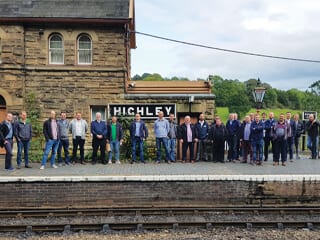
The branch held a half-day networking event for sustaining members at the Severn Valley preserved steam railway on 26 September.

It was a well-attended event by members from all ICorr disciplines, with all members expressing thanks to ICorr for sponsoring the event in return for being a sustaining member. All members thought the day severed them well in terms of networking with other corrosion professionals. Following a 30min train ride on a steam train, lunch was severed within the Severn Valley museum, ICorr members then enjoyed the offerings at the museum followed by a train ride back to Kidderminster. 

The feeling of the day was that ICorr should be organising more events like this up and down the UK as it is a real member benefit.

New Sustaining Member – Paintel Ltd

New Sustaining Member – Paintel Ltd

Paintel Ltd has been specialising in industrial painting and maintenance of structures since 1999.   They are privileged to have partnered with clients, and cared for some of the most iconic bridges and structures in the South West UK.

Paintel applicators are fully ICATS trained, including Specialist and Supervisor modules. Their team have numerous years of experience between them and hold a raft of industry qualifications including; Rope Access (IRATA), MEWP (IPAF), Towers (PASMA) & Confined Spaces.

The trainers, both ICA & specialist, operate from the Paintel office & ICATS Approved Training Centre in Lee Mill, Devon.

They are proud to support Correx and be part of the ICorr/ICATS development team for creating courses.  Kevin Harold is the lead ICATS trainer, delivering the ICATS Company Trainer, Supervisor and Technical Manger courses. Kevin is also involved with writing courses for ICorr, ICATS, and the ICATS Apprenticeship scheme.

There is an experienced team of ICorr Painting Inspectors covering all three levels. Paint investigation work is carried out for various clients, including Highways, where the investigation is used to determine the existing paint system(s) and how best to prepare and re-paint with a new system.

Paintel are accredited to ISO 9000 and NHSS 19A, ISO 14001 and ISO 45001, which demonstrates to customers that they are willing and able to take the extra steps to prove that they will be held accountable for what advice they give and work
they do.

Young ICorr joint meeting with Young Members

Young ICorr joint meeting with Young Members

Young ICorr held a joint meeting with the Greater London region Young members network on the 21st of November. The talk was held in the Council room of the argyll Ruane on Birdcage walk followed by networking in a nearby hostelry. The evening brought together young engineers, professionals and students from across the country who are interested in corrosion, materials, metallurgy and welding. It was a great opportunity to meet like-minded peers from other industries and also provided many of the attendees enrolled on the 2020 Young Engineering Programme (YEP) to meet prior to the programme starting in January.

Guest speaker Roger Francis (RF Materials) gave a fascinating talk on “Corrosion Engineers (& Metallurgists) can save you money”. This covered a whirlwind tour of case studies from fertiliser production to deep sea diving, highlighting poor materials selection and the importance of working together to understand the operating environment for the mechanical equipment. Often mistakes are repeated without learning, emphasising the need to engage a corrosion engineer. Roger’s extensive knowledge on duplex and superduplex stainless steels, in conjunction with correct heat treatments, demonstrated how the corrosion problems could be solved, often with cost savings. He then emphasised the importance of corrosion engineers’ involvements in QA/QC activities to ensure the correct testing and support regimes were put in place at the procurement stage. The talk was very well received and definatly got people thinking about the importance of materials selection.

Sponsorship was kindly provided by the Institute of Corrosion. To stay informed about future Young ICorr events please join the LinkedIn group by searching for ‘Young ICorr’ or alternatively email Caroline.Allanach@gmail.com

Institute Awards – call for nominations

Each year the Institute of Corrosion bestows a range of internationally-renowned awards in recognition of excellence in corrosion science and engineering and to reward outstanding service to the Institute and the wider corrosion community. Many of these awards are open to nomination by members of the Institute. Below is a brief description of each award together with details of how to nominate potential candidates.

U.R. Evans Award

The U.R. Evans Award is the premier scientific award of the Institute of Corrosion and is presented annually for outstanding international achievements in pure or applied corrosion science. The recipient is selected by a Corrosion Science Division panel and presented with a sword at the annual Corrosion Science Symposium. The symposium is one which seeks to encourage the participation of the junior members of the corrosion community who would appreciate the visit of, and address by, a corrosion scientist of international repute. The form of the award symbolizes the fight in which we are all engaged. The recipient is also granted Honorary Life Fellowship of the Institute. Nominations may be submitted at any time via email to the CSD Chair, Julian Wharton (J.A.Wharton@soton.ac.uk).

Paul McIntyre Award

The Paul McIntyre Award is presented to a senior corrosion engineer, who, as well as being a leading practitioner in his field, has advanced European collaboration and international standards development. The award consists of an engraved trophy, which is presented at the annual CED Working Day meeting. The recipient is requested to present a brief overview of their activities and encouraged to prepare an article for publication in Corrosion Management. Nominations should be submitted to the CED Chair, Nick Smart (nick.smart@woodplc.com), by
28 February 2020.

H.G. Cole Award

The H.G. Cole award is in the form of a poignard and is made in recognition of exceptional services to the development of the Institute. It is only awarded on an occasional basis, typically every 5 to 10 years, reflecting the highest possible level of commitment of the recipient to the activities of the Institute. Nomination and selection for this award is administered by the ICorr Awards Committee. Nominations may be made at any time to the Awards Committee Chair, Gareth Hinds (gareth.hinds@npl.co.uk).

Honorary Fellowship

Honorary Fellowship is awarded in recognition of outstanding service to the Institute over many years. The recipient is bestowed the suffix FICorr (Hon) and all future membership fees are waived. Nominations for Honorary Fellowship must be submitted via Council.

T.P. Hoar Award

The T.P. Hoar Award is presented to the authors of the best paper published in the scientific journal Corrosion Science during the previous calendar year. The winning paper is selected by a sub-committee of the Corrosion Science Division and the authors receive a certificate and a cash sum of £400.  The recipient of the award in 2019 will be announced by the end of the year.

Galloway Award

The Galloway Award is presented to a student author for the best publication describing original research in corrosion science and engineering as judged by a sub-committee of the Corrosion Science Division. A summary of the winning paper is published in Corrosion Management and the prize consists of a certificate and a cash sum of £300. The Institute does not retain copyright of the material, so this does not prevent separate publication of the work in a scientific journal. Submissions (in the form of papers published within the past 12 months or draft publications) may be sent via email at any time to the CSD Chair, Julian Wharton (J.A.Wharton@soton.ac.uk).  The decision on this year’s award will be made shortly.

Lionel Shreir Award

The Lionel Shreir Award is made to the best student presenter at the annual Corrosion Science Symposium. Selection of the recipient is carried out by a sub-committee of the Corrosion Science Division. The award consists of a certificate and a cash prize of £125.

For further details on the Institute awards, including lists of past recipients, please visit https://www.icorr.org/icorr-awards/