
Reducing Detection Time for Sulphate- Reducing Bacteria in Industrial Water Systems
Les Merrill, CEO, Retego Labs
Bacterial contamination does not always lead to material degradation, however, microbiologically influenced corrosion (MIC) continues to present a significant operational and economic challenge across a wide range of industrial sectors, including oil and gas systems, water treatment, and process industries.
A substantial proportion of corrosion-related failures are associated with MIC [1], a complex process in which microbial activity alters localised chemical conditions at metal surfaces, accelerating degradation.
Among the microbial groups implicated in MIC, sulphate-reducing bacteria (SRB) are widely regarded as one of the most significant contributors [2]. These anaerobic microorganisms reduce sulphate to hydrogen sulphide (H2S), a corrosive species that can promote pitting, contribute to sulphide stress cracking, and interfere with corrosion inhibition strategies. The presence of SRB is also associated with oilfield reservoir souring and operational inefficiencies in industrial systems. Despite the well-established role of SRB in corrosion processes, effective monitoring of these organisms remains challenging. Traditional detection methods often involve extended incubation periods or sophisticated laboratory-based analysis, limiting the ability of operators to respond rapidly to changing microbial conditions. As industrial systems increasingly move toward predictive and proactive maintenance strategies, there is a growing need for faster, field-applicable methods of detecting microbial activity.
Limitations of Conventional Detection Techniques
Table 1. Comparison of Conventional and Rapid SRB Detection Methods.
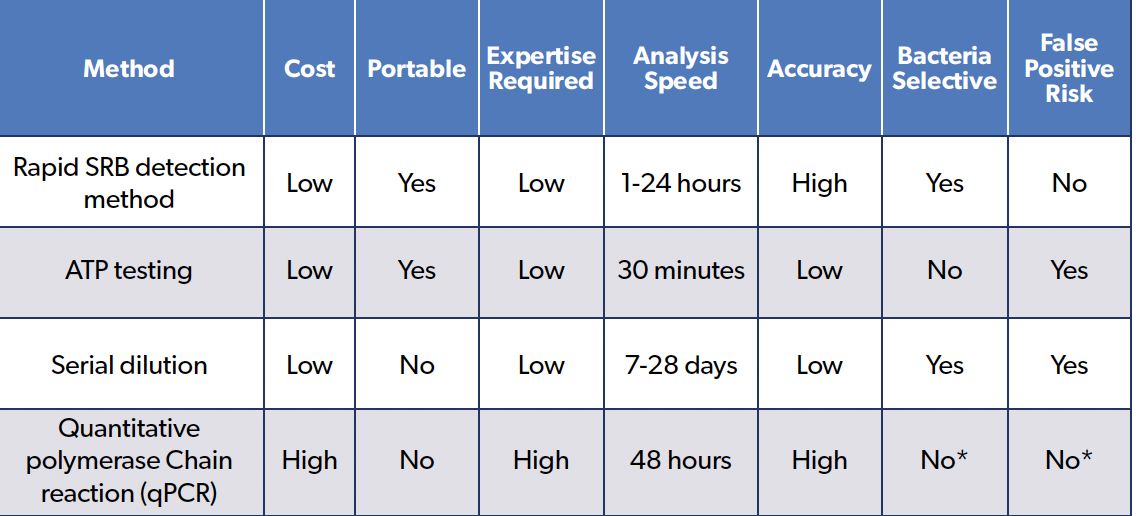
*Note: qPCR selectivity depends on the DNA target primers; however, it cannot distinguish between viable and non-viable microorganisms without propidium monoazide (PMA) sample optimization.
A range of analytical methods has been developed to detect and quantify sulphate-reducing bacteria in industrial water systems. These include culture-based techniques, serial dilution methods, and molecular approaches such as qPCR.
Another commonly used approach utilises adenosine triphosphate (ATP) testing, which measures total microbial activity by quantifying cellular energy present in a sample. While ATP testing provides rapid results and is useful for assessing overall biological activity, it does not distinguish between specific microbial groups such as SRB, limiting its ability to directly assess SRB-related corrosion risk. ATP testing is additionally susceptible to false positives, as it can have difficulty distinguishing between viable and non-viable bacteria [4].
Culture-Based and Serial Dilution Methods
Culture-based methods, including the serial dilution most probable number (MPN) technique, remain widely used due to their relative simplicity, ease of on-site use and historical acceptance [3]. These approaches rely on the growth of microorganisms under controlled conditions to estimate bacterial populations.
However, a key limitation of these methods is the time required to obtain results. Incubation periods may extend up to 28 days before observable changes occur, particularly in samples with low bacterial concentrations. During this time, environmental changes such as oxygen exposure, temperature variation
and sample handling can influence microbial activity and affect accuracy.
In addition, culture-based methods may underestimate microbial populations due to the inability to cultivate all organisms present in a sample, leading to incomplete assessment of microbial activity.
Molecular Techniques
Molecular approaches, including qPCR, offer faster detection compared to culture-based methods and can provide highly sensitive identification of microbial DNA, often within hours to days depending on sample logistics.
Despite these advantages, molecular methods require specialised laboratory infrastructure and trained personnel. Additionally, DNA-based detection does not necessarily indicate active metabolism, as genetic material from non-viable organisms may still be present [5], unless both propidium monoazide (PMA) and photoactivation protocols are optimized for each sample. This limitation can complicate interpretation when assessing current corrosion risk through overestimation of bacterial content.
Operational Implications
The extended timelines and logistical requirements associated with traditional detection methods can delay decision-making in corrosion management. In dynamic industrial environments, a delay of several weeks between sampling and results may result in missed opportunities for early intervention.
Emerging Approaches to Rapid Detection
Alternatives to traditional microbiological detection protocols have led to the development of methods that focus on measuring microbial activity rather than microbial growth. These approaches aim to provide faster and more relevant insights into the presence of metabolically active organisms.
A new method uses two key indicators of SRB activity:
• Enzymatic activity associated with microbial metabolism
• Production of hydrogen sulfide (H2S)
By targeting these indicators, it is possible to detect active SRB populations without prolonged incubation.
Case Example: Rapid Detection of SRB Activity
A field-deployable detection approach has been recently developed and evaluated that combines biological and chemical indicators to assess the presence of sulphate-reducing bacteria in water samples. The method employs two complementary detection pathways:
• Biological detection: Enzymatic activity from SRB produces a fluorescent signal through reaction with a substrate.
• Chemical detection: Hydrogen sulfide (H2S) from the sample reacts with a reagent to generate a visible color change.
These combined mechanisms allow for detection of active SRB without requiring propagation of the organism.
Rapid SRB Detection Workflow
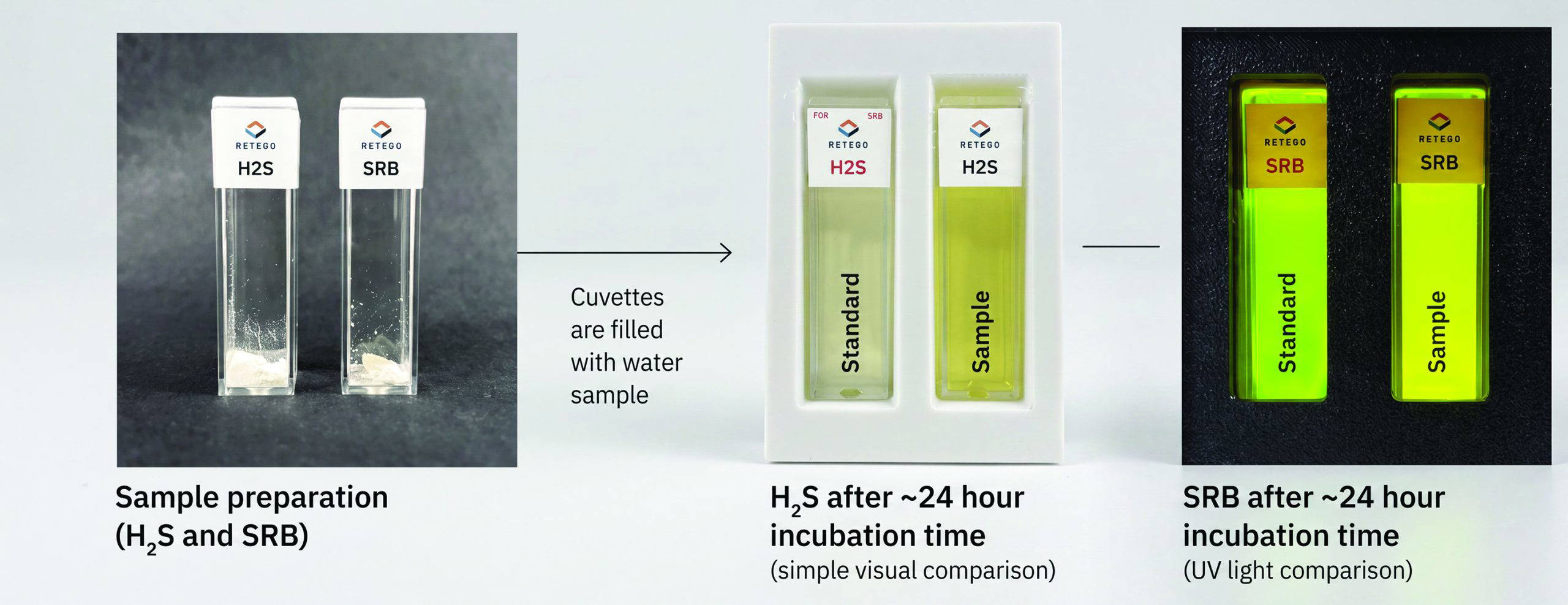
Figure 1. Workflow for rapid detection of sulphate-reducing bacteria (SRB) and associated hydrogen sulfide (H2S) in water samples. Following sample preparation, results are obtained between 1 and 24 hours, with visual indicators distinguishing microbial activity through colorimetric and fluorescent responses. This workflow illustrates how rapid detection enables earlier identification of microbial activity compared to traditional incubation-based methods.
Detection Time and Sensitivity
Field evaluations have demonstrated that this method can produce detectable results within approximately 1 to 24 hours, depending on bacterial concentration. Detection sensitivity has been observed at levels as low as 1,000 colony-forming units per milliliter of water (CFU/mL).
Field Application
The new method can be applied directly in the field and is effective across a wide range of water conditions, including variations in salinity and pH. Field-based testing reduces the need for sample transport and minimizes environmental impact on microbial activity prior to analysi
Validation and Comparative Performance
The new rapid SRB detection methods have been evaluated against established techniques, such as serial dilution and ATP-based testing across diverse environments, including Arctic, desert and tropical conditions. These evaluations demonstrate that rapid detection methods can provide results consistent with traditional techniques while significantly reducing time to result [6]. Faster turnaround enables more frequent monitoring and improved responsiveness.
Performance Characteristics
Key performance characteristics include:
• Detection sensitivity down to 1,000 CFU/mL
• Effective across a wide range of salinity and pH conditions
• Reduced likelihood of false-positive results
• Suitable for field-based application without
laboratory infrastructure
• Time to result typically between 1 and 24 hours
Limitations and Considerations
While the new rapid detection method provides significant advantages, several limitations should be considered. The method is specific to sulphate-reducing bacteria and does not detect other microbial groups, such as acid-producing bacteria. Additional testing may be required for comprehensive microbial analysis. Sample conditions are also critical. Fresh samples provide the most reliable results, while aged or oxygen-exposed samples may exhibit slower reaction times due to reduced microbial activity. Rapid detection methods should be used as part of a broader corrosion monitoring strategy that includes chemical analysis and system inspection.
Implications for Corrosion Management
The ability to detect SRB activity within hours rather than weeks has important implications for corrosion management. Operators can use rapid results to:
• Adjust treatment strategies, including biocide dosing
• Assess corrosion risk more quickly
• Identify microbial activity earlier
• Monitor effectiveness of bacteria mitigation programs • Provide early indication of reservoir souring
This supports a shift from reactive maintenance toward more proactive corrosion management.
Conclusion
Sulphate-reducing bacteria play a critical role in microbiologically influenced corrosion, yet traditional detection methods often fail to provide timely insight into their activity. Rapid detection approaches that target metabolic indicators offer a significant advancement in corrosion diagnostics. By reducing detection timelines from weeks to hours, these methods enable faster, more informed decision-making. As these technologies continue to evolve, they are likely to become an increasingly important component of modern corrosion management strategies and associated treatments. Regardless of the technique used, regular microbial monitoring is essential to evaluate whether preventative treatments are effective over time, as trend analysis provides the clearest insight into system conditions .
References
1. H Byars, Corrosion Control in Petroleum Production, 2nd ed. NACE International, Houston, TX, 1999, pp. 32–33.
2. D Enning and J Garrelfs, “Corrosion of iron by sulfate-reducing bacteria: New views of an old problem,”
Applied and Environmental Microbiology, 2014, 80(4). https://doi.org/10.1128/AEM.02848-13.
3. NACE TM0194-2014, Field Monitoring of Bacterial Growth in Oil and Gas Systems. NACE International, Houston, TX, 2014.
4. S A Hernandez et al., “ATP bioluminescence assay for onsite microbial assessment in drilling rig operations,” in Proceedings of the SPE/IADC Middle East Drilling Technology Conference, Abu Dhabi, UAE, 2018.
5. H S Khanfar et al., “Molecular approach for identifying and quantifying viable microorganisms using PMA-qPCR,” in Proceedings of the Middle East Corrosion Conference (MECC), 2025.
6. A Confer, J Fajt, K McLeroy and K P Ramirez, “Use of novel, rapid enzyme based assays to detect the presence of sulfate-reducing bacteria in oil and gas produced water,” Paper No. C2026-00198, in Proceedings of the AMPP Annual Conference and Expo 2026, AMPP, Houston, TX, 2026.