ICorr Microbiologically Influenced Corrosion remains a Global issue.
Join our MIC Training Courses, running from 11 to 15 May 2026. Secure your spot today and gain expert insights into the industry most misdiagnosed threat.
Microbiologically Influenced Corrosion (MIC) is a complex phenomenon that silently undermines industrial and infrastructure assets across the globe. Despite its widespread impact, MIC remains one of the least understood and most frequently misdiagnosed form of corrosion.
In 2023, a relatively minor leak at the Wytch Farm oil field, United Kingdom, triggered the temporary closure of Poole Harbour, Europe’s largest natural harbour and a designated Site of Special Scientific Interest. This incident served as a stark reminder of MIC potential to cause significant environmental and economic disruption, and the urgent need for more robust understanding and control strategies.
The Institute of Corrosion (ICorr) proudly offers the only MIC training course of its kind delivered by a major professional body. This comprehensive programme is designed to meet industry demand, equip professionals with cutting-edge knowledge, and empower them to protect assets and advance their careers.
Industry-Relevant Scope
While MIC is most extensively studied in the oil and gas sector, this course also addresses its impact across:
Water treatment and filtration systems
Nuclear energy facilities
Marine structures and vessels (ships, yachts, narrowboats)
Paper and pulp industries
Infrastructure, including Accelerated Low Water Corrosion (ALWC)
Traditional and advanced monitoring and mitigation technologies
Molecular microbiology for precise microbial characterisation
Future trends in MIC modelling and predictive analytics
Expert-Led Instruction
Based on over 35 years of research and field experience
Delivered by leading experts in industrial and oilfield microbiology
Enriched with global case studies and best practices
Practical Meets Theoretical
In-depth exploration of microbial colonisation in water-prone systems
Covers both metallic and non-metallic degradation mechanisms
Actionable strategies for detection, control, and prevention
Flexible Learning Formats for Every Level
Certified MIC Technologist
A five-day intensive course focuses on developing and managing MIC control programmes, monitoring strategies, data interpretation, and risk identification. Includes a half-day certification exam. ICorr Certified MIC Technologist certificate awarded upon passing the exam.
MIC Technologist
A four-day version of the above course, without the certification exam. Certificate of attendance provided.
Awareness Level
A one-day overview designed for managers and stakeholders. Focuses on understanding MIC risks and mechanisms to support informed decision-making and cost avoidance. Certificate of attendance provided.
Who Should Attend?
This course is of significant benefits for:
Managers, consultants, and project leaders
Industrial biologists and corrosion technologists
Engineers, scientists, and students
Contractors, field management, and technical staff.
Course Fees
Course Format
Fee (excl. VAT)
One-Day Awareness Course
£800 + VAT
Four-Day MIC Technologist
£1,950 + VAT
Certification Exam (Optional)
£500 + VAT
Note: VAT is reclaimable by VAT-registered companies. Fees apply to UK-based courses.
Delivery Options
Courses are currently delivered in a classroom format and can be hosted:
At ICorr Headquarters at Northampton in the UK, or
On-site at your organisation, anywhere in the world.
Delivered by a Global Expert
The course is led by Dr. Tony Rizk, a world-renowned authority in MIC with decades of hands-on experience in industrial microbiology and corrosion control.
How do we Detect and Mitigate AC Interference in Pipelines Using Software Modelling? J N Agrawal, B Tech, MBA, ICorr CP4, FICorr, CEO of Corrsol Tech, India
Meet the Author
Jaiprakash Narain Agrawal is an expert in corrosion management and cathodic protection. He has a wide experience in pipeline integrity management and cathodic protection for 40 years. Jaiprakash has worked in projects, construction, operation and maintenance of oil and gas pipelines. Jaiprakash has presented papers in corrosion related subjects at AMPP and ASME conferences in India. He has also authored books on cathodic protection and pipeline integrity management. Jaiprakash also initiated a process for corrosion audits for gas pipelines. He has contributed to the preparation and implementation of procedures for various CP monitoring techniques. Jaiprakash received the AMPP India corrosion awareness award in 2023 for his contribution in corrosion science and technology in industry.
For the last 7 years he has been a certified ICorr Level 4 CP specialist. He is an independent consultant and CEO of Corrsol Tech and engaged in providing solutions in corrosion control, pipeline integrity management and cathodic protection. Jaiprakash has carried out pipeline integrity assessments including fitness for purpose (FFP) and remaining life assessment (RLA) of onshore and offshore pipelines. He has also been involved in conducting training and coaching in pipeline integrity management (PIM) and cathodic protection (CP).
He has published more than 30 technical papers in peer-reviewed events and journals and has provided industry training on integrity management and CO2 and H2.
Background
Electrical interference by alternating currents (AC) is a major consideration for oil and gas pipelines. Computer modelling can be used to assist with its mitigation. AC interference corrosion in pipelines typically occurs when alternating current (AC) from nearby power lines induces a voltage on the pipeline, leading to corrosion, especially at small coating defects. This phenomenon is a serious concern due to the potential for rapid and localised damage, even in pipelines with cathodic protection.
What is Software Modeling?
Computer modelling is based on the simulation of all field data and the assessment of AC interference based on computer modelling with the following outcomes:
• The results are usually more accurate than field surveys alone, as data simulation is assisted by computer modelling.
• Various mitigation strategies can be implemented based on computer modelling outcomes for the most effective and cost-‘optimised’ manner.
• The most important features required for effective mitigation are:
Configuration of grounding Location of grounding Selection of materials of grounding
Effectiveness can be checked after implementation of mitigation measures.
Background
Electrical interference by alternating currents (AC) is a major consideration for oil and gas pipelines. Computer modelling can be used to assist with its mitigation. AC interference corrosion in pipelines typically occurs when alternating current (AC) from nearby power lines induces a voltage on the pipeline, leading to corrosion, especially at small coating defects. This phenomenon is a serious concern due to the potential for rapid and localised damage, even in pipelines with cathodic protection.
What is Software Modeling?
Computer modelling is based on the simulation of all field data and the assessment of AC interference based on computer modelling with the following outcomes:
The results are usually more accurate than field surveys alone, as data simulation is assisted by computer modelling.
Various mitigation strategies can be implemented based on computer modelling outcomes for the most effective and cost-‘optimised’ manner.
The most important features required for effective mitigation are: Configuration of grounding Location of grounding Selection of materials of grounding
Effectiveness can be checked after implementation of mitigation measures.
Impact of Contradiction Between Field Survey and Simulation Result
•Designed mitigation measures may be ‘more or less’ compared to actual or required.In case of more than required, cost will be more.
• In case of less than actual required, effectiveness will be less.
•Pipeline will be affected in case of ineffective mitigation measures. however, simulation results can be verified by the field survey results.
•Even then, errors may happen in case of inaccurate data or interpretation of the simulation results.
Possible Reasons for Contradiction in Software Simulation Results and Field Data
• Global earthing systems.
• Local earthing systems.
•Parallel underground pipelines in the vicinity of the powerline or electric traction.
• Inadequate pipeline coating parameters.
• Influence of soil resistivity in the field and simulation software.
• Actual or real-time load current instead of maximum load current of powerline.
Computation of Induced AC Potential and AC Current Density Based on Real Time Load Current or Peak Load:
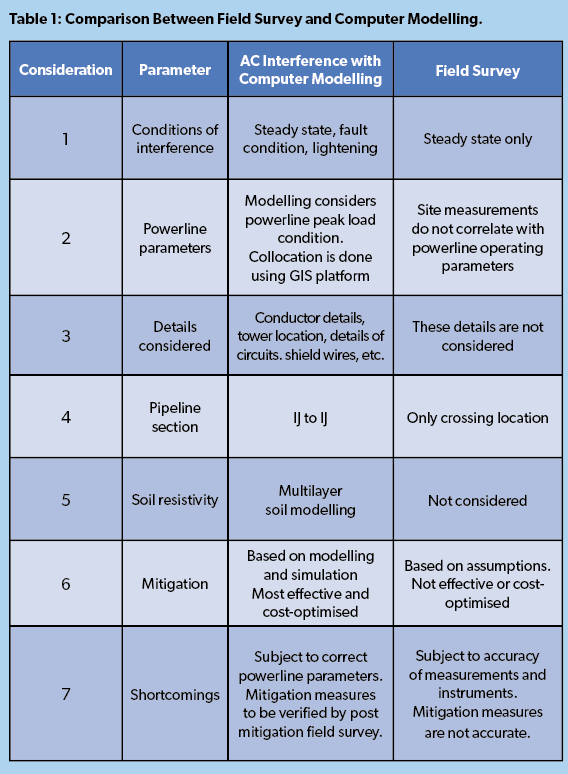
• Field survey is performed for AC induced voltage and AC current density based on real time load current while simulation is done based on peak load current.
• Hence, AC induced voltage and AC current density will vary. Simulation results are on the higher side than field surveys.
• The mitigation measures based on simulation results consider optimum conditions.
• Powerlines generally run on load, which is less than the peak load but may reach peak’ load at peak hours.
• Powerlines are designed to withstand higher load capacity.
• Actual load current data consideration will give almost similar results as simulation software provides.
Possible Solutions to Achieve More Accurate Results
• Accurate multi-layer soil resistivity data is required for software simulation.
• Reliable and accurate software with high calculation accuracy is preferred.
• Software should allow multiple input parameters and provide precise simulation results.
• The accurate and calibrated instruments should be used with recommended technique by a certified and experienced CP technician.
• Real time load data should be used instead of peak load.
•n Simulations must consider other factors such as global earthing system (GES), local earthing system (LES), pipeline coating characteristics and parallel pipelines.
• Simulation results should invariably match with field survey.
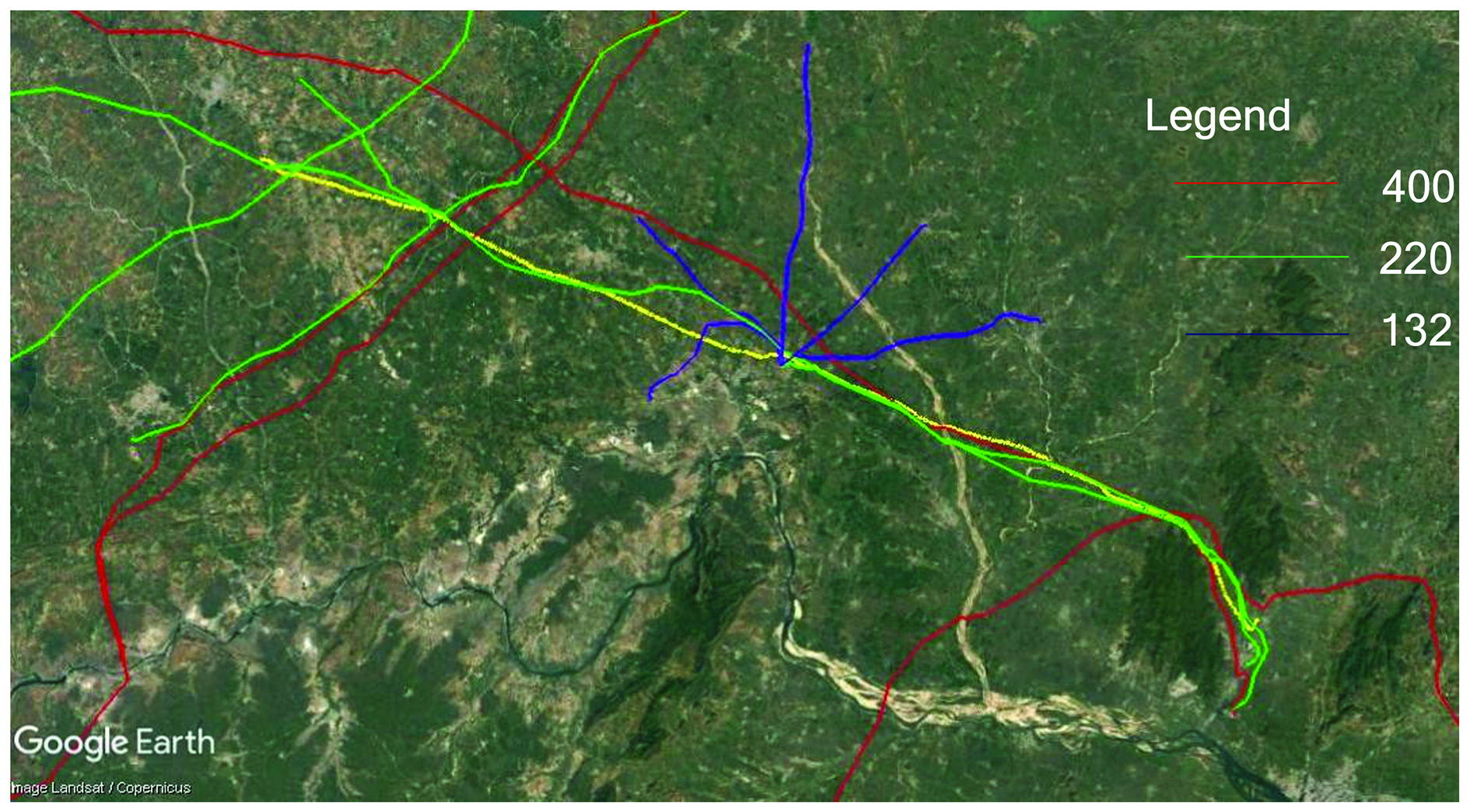
Case Study of AC Interference and Mitigation with Computer Modelling Using the Following Input Considerations
• Grounding material: Copper conductor/Zn anodes 10 Kg
• Number of transmission lines running parallel/crossing pipelines: 14
• KV rating of transmission lines: 132, 220, 400
• Normal load/peak load in A: 15 to 260/25 to 589
• Simulation done from peak load.
Figure 1: Interpolation of Transmission Line and Pipeline.
Interpretation of Results with Existing Pipeline Ground Points
Key Observations
•Induced AC voltage in the pipeline is proportional to the load current in the transmission line as load current varies at different lines.
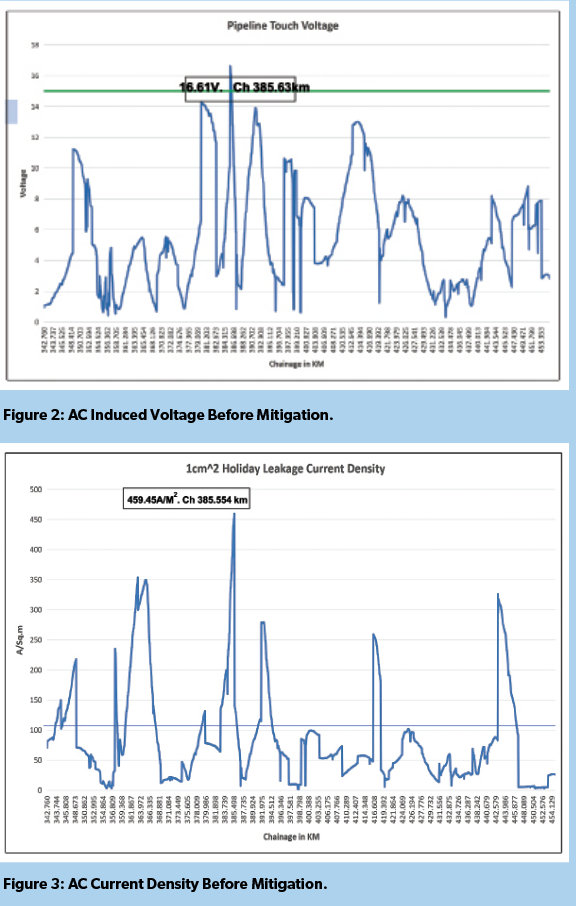
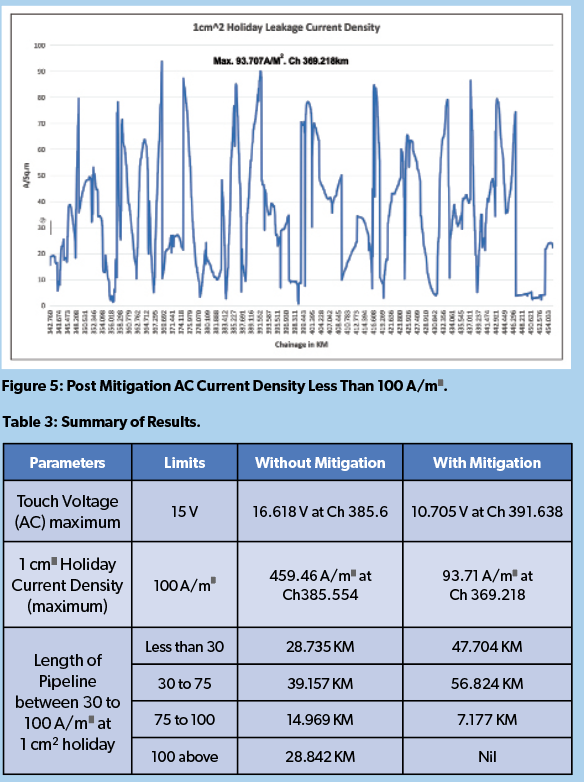
•The touch voltage on pipeline exceeds the prescribed safe limit of 15V with a maximum of 16.618 V at chainage 385.63 KM.
•High values of current density between Chainage 382.8 and 386.43 km where induced AC voltages are higher and soil resistivity is low.
•The current density exceeds the prescribed value of 100 A/m2 for about 28.84 KM as shown in the figure.
•Induced AC voltage and AC current density can be interpolated to draw the conclusion that wherever AC current density is higher, AC induced voltage is also higher but higher induced AC potential may not cause higher AC current density if soil resistivity is higher.
•An interpolated graph of pipeline route with chainages and transmission line along with a graph showing chainages, soil resistivity, induced AC voltage and AC current density will establish relationship with multiple parameters.
Material Specification for Grounding Depending Upon AC Current Density and Length of Parallelism
A copper conductor wire of following specifications is required
• AWG No 6.
• Overall Diameter: 38 mm.
• Length: 25.4 m, 76.2 m and 152.4 m in horizontal configuration.
•To be placed at 1m from pipeline wall and at the same depth as of pipeline.
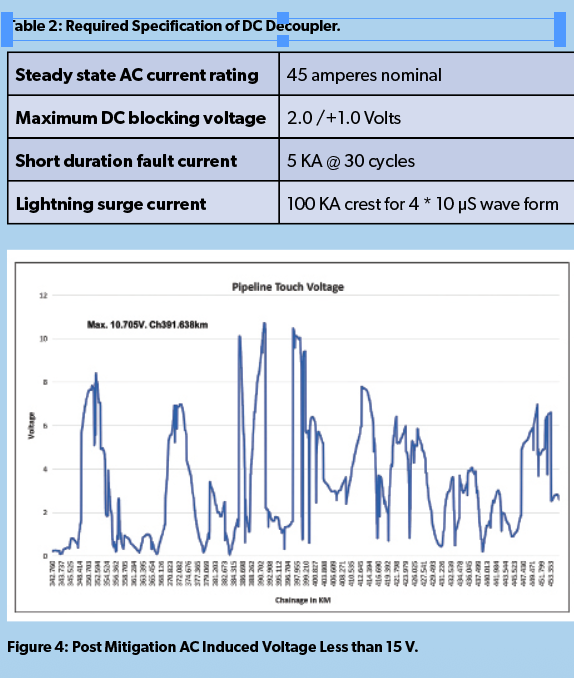
•Copper conductor shall be connected to pipeline through DC Decoupler.
Case Study Conclusion
The major observation is this case study was that existing grounding/earthing arrangements were not adequate to ground induced AC potential and limit AC current density because of wrong location or wrong grounding material. Further work would be required for this and other similar situations.
References
1.NACE SP 0177–2014: Mitigation of Alternating Current and Lightning Effects on Metallic Structures and Corrosion Control Systems.
2.NACE SP 21424:2018: Alternating Current Corrosion on Cathodically Protected Pipelines: Risk Assessment, Mitigation, and Monitoring.
3.EN 50443:2012 Effects of Electromagnetic Interference on Pipelines Caused by High Voltage.
4.BS EN 15280 – 2013 – Evaluation of AC. corrosion likelihood of buried pipelines applicable to cathodically protected pipelines.
5.Criteria for Pipelines Co-Existing with Electric Power Lines, prepared for The INGAA Foundation by DNV GL.
6.CEPA – A/C Interference Guideline Final Report – June 2014 and INGAA or CEPA for mitigation measures.
7.ISO 15589 Part I – Cathodic protection of pipeline/structure transportation systems – Part I-On land pipeline/structure, issued by the International Organisation for Standardization (ISO).
The Institute of Corrosion welcomes applications from ICorr members, for this important arising vacancy due to retirement of Jane Lomas, FICorr the existing post holder.
Job Title: Training Scheme Manager (Surface Treatments and Passive Fire Protection)
Location: Remote Working with occasional Northampton ICorr HQ Visits
Company Name: Institute of Corrosion
Job Type: Part-Time Consultancy (2 Days a week – part remunerated/part voluntary).
Remuneration:15K/Annum (Reviewed Annually)
Applications: Initially via email to admin@icorr.org attaching CV and Training Experience Record
Closing Date: 31st October 2025
Commencement Date: 1st January 2026 (with prior Handover)
Job Description:
General
To act on behalf of the Institute of Corrosion (ICorr) in all matters relating to Surface Treatment Training and Competence Assessment (the Surface Treatment Scheme).
To report to President and take instructions from the Surface Treatment Governing Board (STGB) in all activities.
To keep the President and chair of STGB advised of all significant activities and to extend this advice to the President of ICorr in respect of any issues that may have significant strategic importance or expose ICorr to risk.
To issue monthly STSM reports with dashboards to President
To liaise with the Professional Assessment Committee (PAC) in respect of Certification of personnel (Certification being the ultimate responsibility of PAC) and in respect of any complaints received.
To liaise with course providers in respect of their marketing, booking and organising of all Surface Treatment (ST) and Passive Fire Protection (PFP) courses, in accordance with the Qualification Procedure Document (QPD), using approved ICorr Tutors and ICorr Course Packages, monitoring updates where required.
To actively help promote ST and PFP courses and maintain ICorr Website information.
To attend monthly STGB meetings and contribute to STGB updates of the QPD.
To work towards progression of Iso Certification for ST courses.
To recruit, train and mentor a deputy in all aspects of the role, with a view to succession planning.
Key Requirements
Ability to manage time effectively and prioritise tasks.
Experience at senior level in the surface treatment industry
Hold membership of ICorr, preferably FICorr.
Knowledge of Institute of Corrosion training activities (or other established Corrosion Training provider)
Level 3 certification
Significant experience in training and certification management
Strong relationships with key industry stakeholders
ARL have a very long association with ICorr as a Training Partner
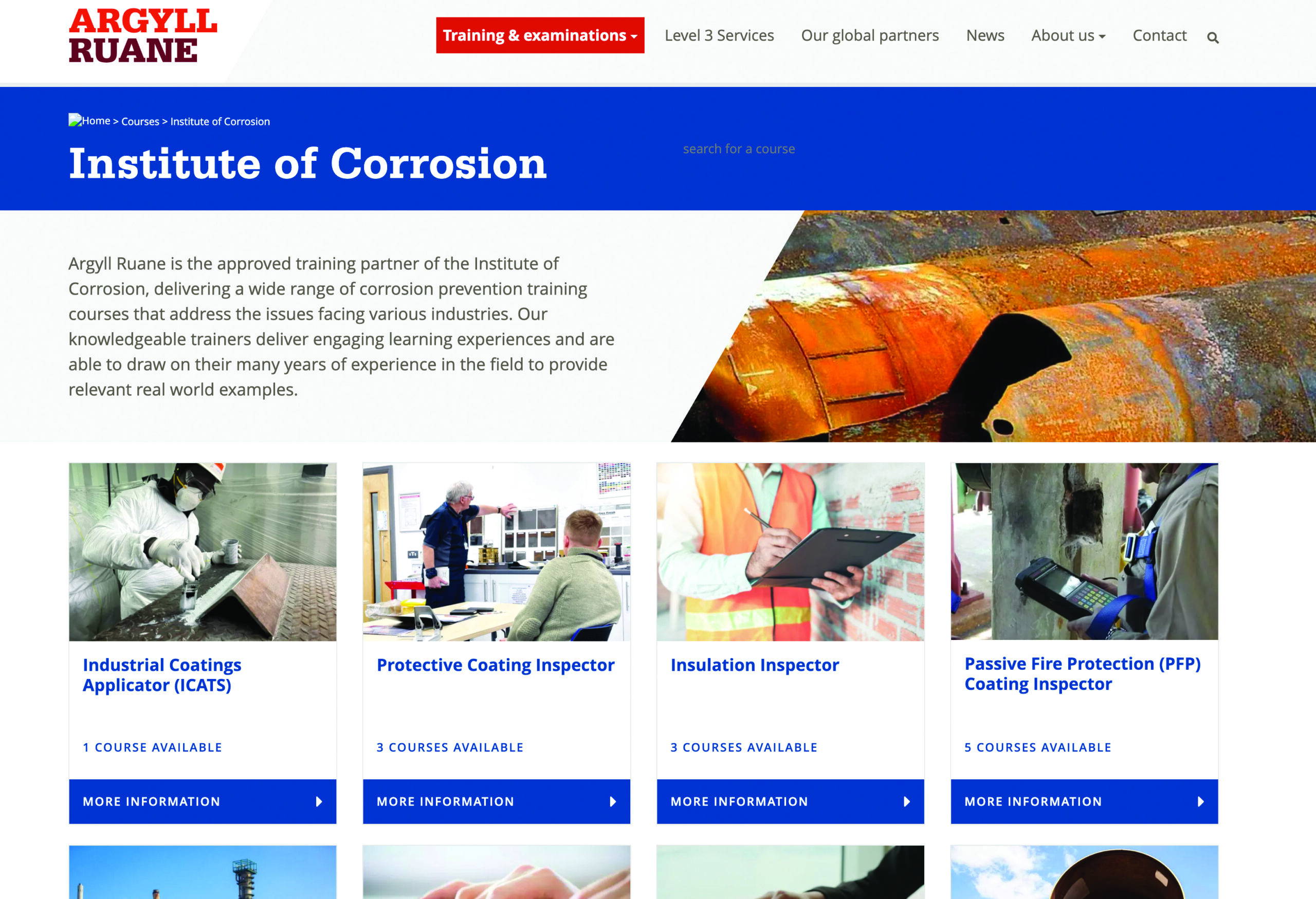
With over 25 years of experience, ARL are a world-leading provider of coatings training and examinations in all major methods. Accredited by the Institute of Corrosion (ICorr), our courses range from Level 1 to Level 3.
Training Courses
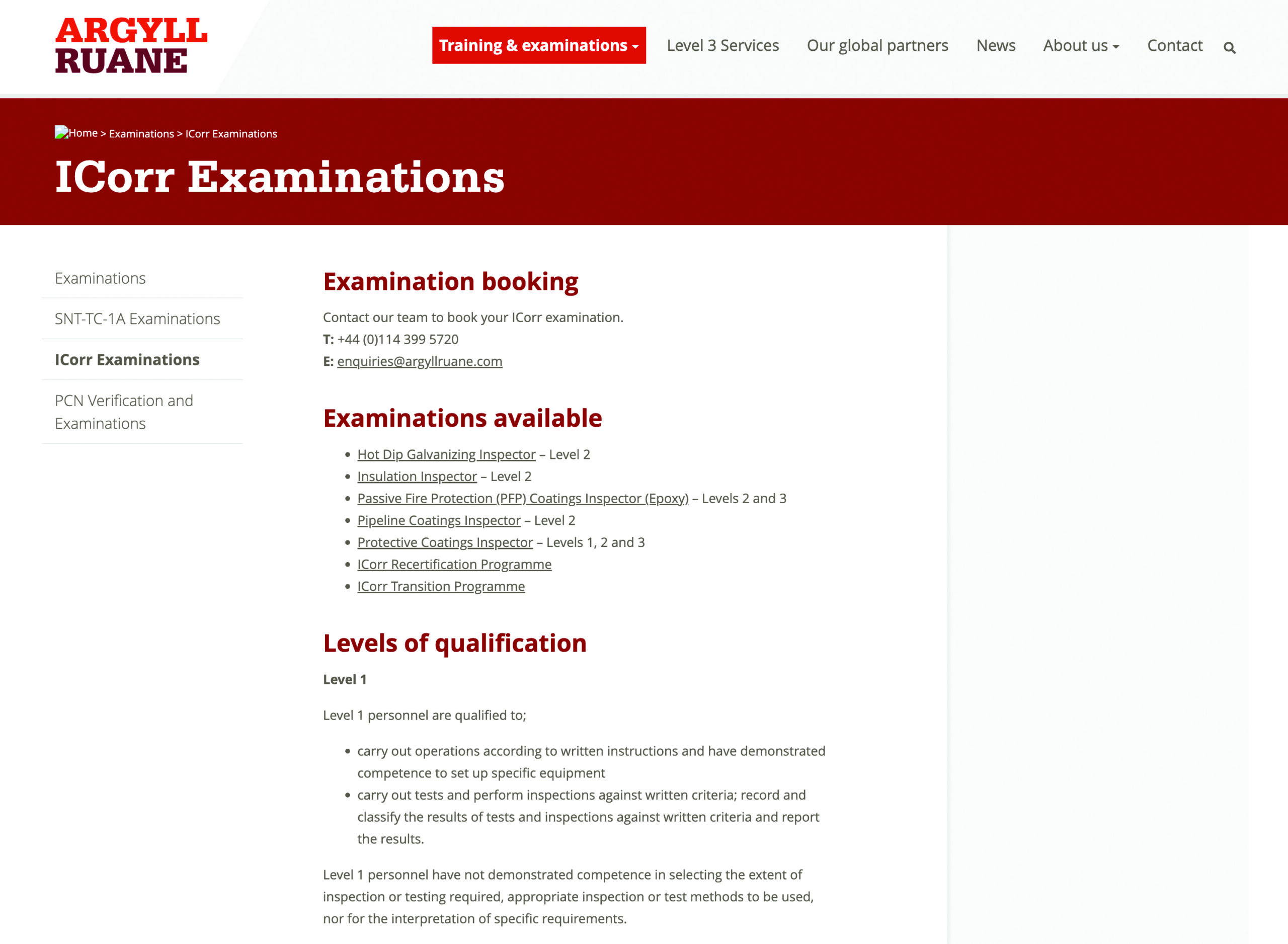
Examinations
Recertifications
ARL also support our CORREX training operations
Screenshot
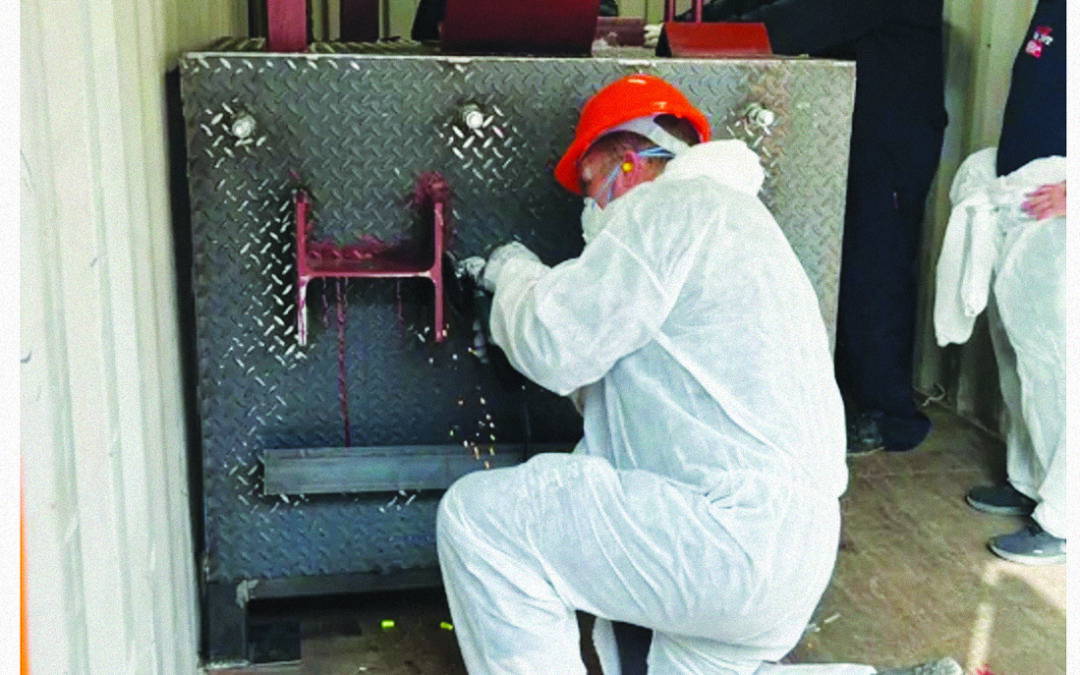
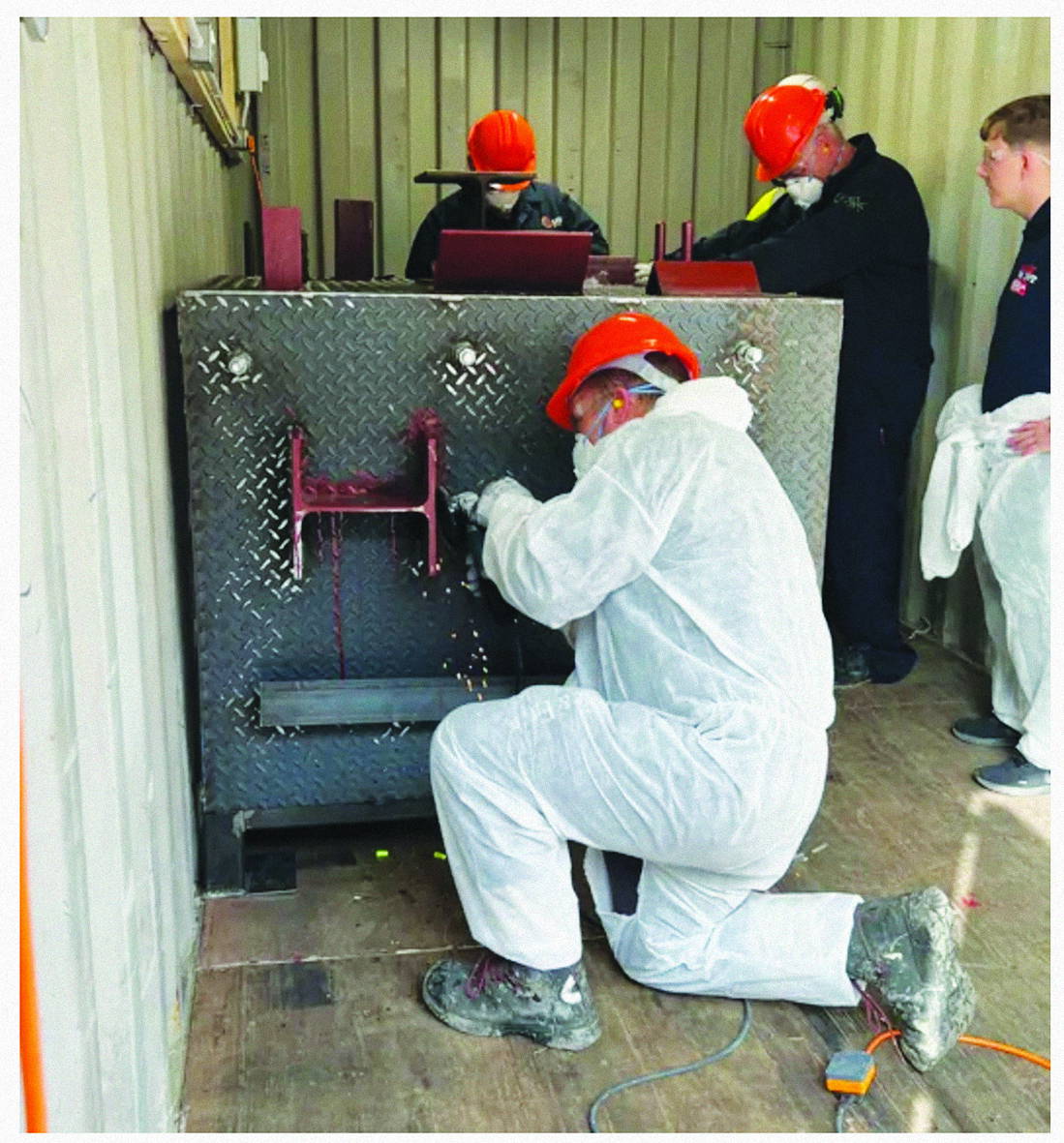
ICATS course, accredited by the Institute of Corrosion, caters to organisations seeking to enhance the skills of their workforce by training them as competent industrial coatings applicators under an accredited scheme. Additionally, individuals looking to forge a career as a certified Industrial Coatings Applicator can greatly benefit from this programme.
The course curriculum is divided into theory and practical elements, providing a comprehensive educational experience. Ongoing assessments are conducted to gauge the candidates’ knowledge and understanding of the course material. The content is segmented into 12 chapters, covering a range of vital topics including:
• Health and safety in painting
• Corrosion protection
• Adhesion and paint service
• Paint application by brush
• Tools and equipment maintenance
• Environmental and inspection aspects of painting
If you’re interested in becoming a certified Industrial Coatings Applicator or wish to enhance the skills of your workforce, join us for our next ICATS course in Sheffield.
Contact
For more information on all its activities, please visit the ARL website pages: Global Leaders in NDT, Corrosion and Coatings Training or reach out to the team at Coating application & inspection | Argyll Ruane.
Welcome to the new UAE branch, in a very exciting period in the history of ICorr. We hope that our expanding corrosion community in the UK (and internationally) are all keeping well.
I am most happy to report that the ICorr UAE Branch officially launched on 6th May 2025 with an inaugural general meeting, which was followed up with an excellent technical presentation (online event).
During the AGM, an introduction to the ICorr and its vision for the future was presented.
The ICorr president inaugurated the branch with kind wishes and then set out his expectation for the branch to share knowledge and advance science and engineering in the prevention of corrosion for the public benefit in the Middle East. The ICorr President Dr Yunnan Gao proposed Dr Muhammad Ejaz as the first chairman for the UAE branch and Hooman Takhtechian as its first vice chair. Past ICorr President Stephen Tate seconded the proposal.
A large number of candidates have come forward in response to a branch survey, and a full UAE branch committee will be formed over the coming months, and additional online events are being planned for later in 2025. Due to current requirements for non-profit institute registration with the chambers of commerce in the UAE, the team is planning to run only online events initially, to confirm the level of interest. The UAE Team will also incorporate expertise from Oman – Emmanuel Marcus, who will be Vice Chair for that section.
We also take this opportunity to welcome Amir Attarchi (above) as our Events Coordinator who previously provided excellent support to the ICorr Aberdeen Branch.
Technical Presentation
The technical presentation by Sarah Bagnall, Director of R-TECH Materials, showcased studies on failure analysis, highlighting an insight into forensic investigation explaining failure mechanisms and prevention. Sarah Bagnall has been involved with over 700 failure investigations and has broad experience with a wide range of engineering components, metallic and non-metallic materials, and industries and has extensive expertise in corrosion of a wide range of materials, particularly for the chemical processing and petrochemical industries.
Photo: UAE Branch Chair – Dr. Muhammad Ejaz, PhD, CEng FIMMM, FICorr.
Over the last 10 years, Sarah has developed specialist expertise in the corrosion and thermal degradation of austenitic stainless steels and is the ICorr presenter for the BSSA stainless steels course; refer to Corrosion Mechanisms in Stainless Steels – Institute of Corrosion. She is also the Chair of the Wales & South-West England branch for the ICorr that launched successfully in 2024.
Sarah strongly emphasised that determining the root cause of plant failures presents an opportunity to learn from the experience and that adopting such a philosophy is critical to the continual improvement of plant safety, performance, availability, and reliability whilst reducing maintenance costs. She added that conducting an effective Root Cause Analysis (RCA) investigation provides an avenue to understand and critically analyse all of the factors that have contributed towards a plant failure and failure mode. Sarah outlined the necessary steps for conducting a successful materials failure analysis with examples and discussed failure mechanisms which were encountered within the oil and gas industry. Several case studies relevant to the energy sector were also presented and discussed.
We do, of course, wish to acknowledge the support provided by ICorr HQ and our President and Past President for the successful start-up of the UAE branch following extensive research and planning. This report and where we are today represent the continuing commitment of the ICorr UAE Team, who bring their wide range of experience and contacts to the table at every meeting.
We use cookies to optimize our website and our service.
Functional
Always active
The technical storage or access is strictly necessary for the legitimate purpose of enabling the use of a specific service explicitly requested by the subscriber or user, or for the sole purpose of carrying out the transmission of a communication over an electronic communications network.
Preferences
The technical storage or access is necessary for the legitimate purpose of storing preferences that are not requested by the subscriber or user.
Statistics
The technical storage or access that is used exclusively for statistical purposes.The technical storage or access that is used exclusively for anonymous statistical purposes. Without a subpoena, voluntary compliance on the part of your Internet Service Provider, or additional records from a third party, information stored or retrieved for this purpose alone cannot usually be used to identify you.
Marketing
The technical storage or access is required to create user profiles to send advertising, or to track the user on a website or across several websites for similar marketing purposes.