

ICorr Wales and South-West Branch Marks One-Year Anniversary with Joint Event in Cardiff with IOM3  Newport and Cardiff Materials Society

ICorr Wales and South-West Branch Marks One-Year Anniversary with Joint Event in Cardiff with IOM3 Newport and Cardiff Materials Society

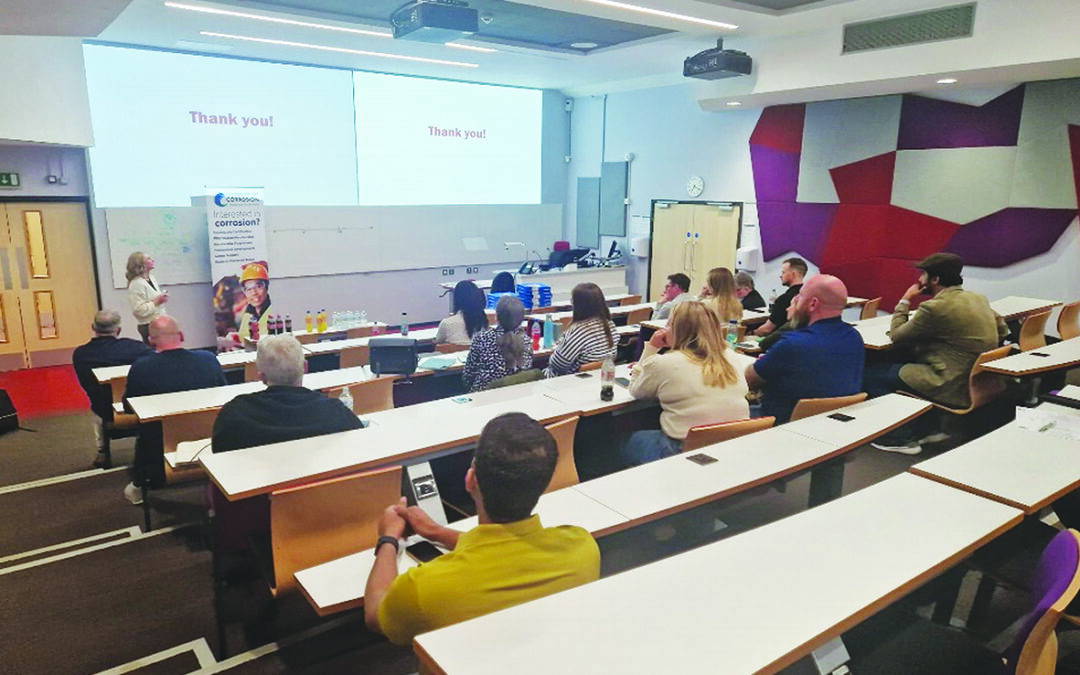
The Wales and South-West Regional Branch of the Institute of Corrosion marked its one-year anniversary with a collaborative event in Cardiff, held in partnership with the IOM3 Newport and Cardiff Materials Society. The event brought together professionals, students, and experts from across the fields of corrosion and materials science for an evening of knowledge sharing, networking, and cross-disciplinary engagement.

Hosted at Cardiff University, the event featured two technical presentations, the first being delivered by Simon Daly, who is a Senior Consultant at Safinah Group. The presentation focused on the growing complexity and importance of passive fire protection (PFP) and protective coatings in large-scale infrastructure projects such as high-rise buildings, stadiums, and data centres. It highlighted the challenges posed by evolving fire scenarios, new materials, and compressed project timelines, emphasising that quality outcomes depend on thorough planning, early-stage specification, and effective coordination across all project phases. Drawing on extensive industry experience, the presentation explored how risks increase and opportunities for value diminish as projects progress, underscoring the need for a proactive, design-first approach and illustrating key lessons through real-world examples of project handoffs and failures.

The second presentation was given by Dr Nicola Emmerson, a practical conservator and lecturer with a focus on the preservation of metallic heritage. The presentation covered the challenges faced by conservators in preserving metal heritage, from historic structures like iron bridges and ships to archaeological artefacts. It discussed how corrosion science is applied to heritage conservation, balancing preservation of original materials with maintaining the object’s intangible historical value. Through research examples conducted at Cardiff University in partnership with heritage organisations, the presentation emphasised the importance of collaboration between corrosion scientists and conservators to develop effective corrosion prevention strategies within ethical and professional guidelines.

Since its launch in 2024, the ICorr Wales and South-West Branch has rapidly grown in momentum, hosting a series of successful technical events and building a strong network of industry professionals, academics, and early-career engineers. The anniversary event not only celebrated this progress but also reinforced the importance of regional collaboration and community in addressing the evolving challenges in corrosion and materials performance. The ICorr Wales and South-West Branch also held its Annual General Meeting (AGM), which provided an important platform to acknowledge the ongoing contributions of the committee members. All members, apart from Ben Capewell, who has resigned from the committee, will continue their roles in driving the organisation’s initiatives forward. The AGM also introduced Syed Umair Niaz Bukhari, who joined the committee as a new member, bringing fresh perspectives and energy to the group.

For more information about the branch and upcoming events, contact: swchair@icorr.org

You can also keep up to date on events by visiting our LinkedIn page; https://www.linkedin.com/groups/12992293/

ICorr North-West Branch Hosts Joint Event with the Institute of Asset Management (IOM)

ICorr North-West Branch Hosts Joint Event with the Institute of Asset Management (IOM)

ICorr NW Branch held a joint meeting with the Institute of Asset Management at the University of Manchester on 1st April 2025. The event explored the theme of infrastructure asset failures, with speakers presenting various case studies—particularly highlighting the impact of corrosion to infrastructure.

Dave Champness  (Post-Graduate Researcher and Previous Water Industry Engineer) opened the session with a personal story related to asset management and aspects of corrosion in his talk “Concepts of Asset Management and How Corrosion Features”.  Paul Russell, Product Manager Concrete Repair and Composites at Mapei (UK) Ltd then spoke on product environmental sustainability, sharing case studies on extending the lifespan of structures in his presentation “Re-Lifing Structures to Extend Service”. Paul covered the carbon reduction gained in the products Mapei employs and also how they’ve sympathetically restored heritage buildings. Darren Henson (Workshop Manager at United Utilities) spoke about how corrosion can affect key assets such as pumps and the challenges of maintenance and prevention of shutdowns. Carlos Sanchez Senior Materials Scientist at The Health and Safety Executive (HSE) also contributed, using case studies to illustrate his presentation, “How Corrosion can Result in Catastrophic Asset Failure”.

This was a very well attended event that attracted many questions from the Audience.

Presentations

All presentations will be uploaded soon to: https://www.icorr.org/northwest/ under Local Technical Programme.

Forthcoming Events

UK-China Corrosion Summit – 3rd-4th September 2025

Institute of Corrosion National AGM – November 19th.

Planning continues for these exciting events. Further details will be released to the NW Branch website, mailing list and ICorr members in due course.

Future NW Branch Committee meetings are planned for:

• 12th August 2025

• 14th October 2025

If you would like to know more about our activities or become involved with the NW Branch, please contact: nwchair@Icorr.org

ICorr North-East Updates

ICorr North-East Updates

The NE Branch Programme for 2025 has also been agreed with 3 technical evenings planned and 2 social events. Presenters will be announced once confirmed.

Late July/early August – Summer Social.

11th September – Technical Evening with AGM

13th November – Technical Evening

11th December – Christmas Social

Due to the increasing costs of using Neville Hall, the Committee has been investigating other venues. Afterresearch by the committee members, the next door Lit and Phil (https://www.litandphil.org.uk/) was visited at the start of May. The Lit and Phil is a 200-year-old society housed in another historic venue (Grade II listed building), which provides plenty of character and is also relevant to ICorr, as the Lit and Phil Society was founded to discuss and develop scientific as well as artistic topics. The Committee has agreed that the Lit and Phil would be a suitable venue for future NE Branch events.

All event slide packs are available in the North-East Branch web page at: www.icorr.org/northeast/ under Local Technical Programme.

For all other inquiries and membership / sponsorship opportunities, please contact the Branch Chair Matt
Fletcher at:
nechair@icorr.org

ICorr Midlands Update

ICorr Midlands Update

Annual General Meeting, DNV Facility Visit and AI Webinar on Corrosion Inspection.

The UK Midlands branch officially commenced its 2025 activities with the Annual General Meeting (AGM) held on 28th April, attended by ICorr President Dr. Yunnan Gao.

Annual General Meeting

The ICorr Midlands Chair, Dr. Prafull Sharma, introduced the new committee volunteers, who were formally approved to commence their roles. Strategic priorities for the year were set. A key focus is expanding engagement with academia to promote student membership. The committee chair also emphasised collaboration with other professional societies, aligning with ICorr’s broader strategy for mutual growth and knowledge exchange. As part of the new strategy, the branch will also host subject-specific webinars, such as the timely topic of AI application in corrosion and inspection management on 16th April.

Uzma Anjum (DNV) will oversee the branch’s online events
and webinars.

Other committee roles include:

• Ali Oskuie (Worley): Committee Secretary

•Louis Ramdall (Premtech): Coordinator for in-person events

•Ben Knight (Premtech): Social media and digital communications

The committee will also benefit from the continued support of Bill Whittaker, former Midlands Chair, whose experience will help guide strategic decisions.

DNV Facility Visit

Screenshot

Coinciding with the 2025 AGM, the committee and guests participated in a technical visit to DNV’s Loughborough facility. Attendees from both academia and industry took part in the event, gaining valuable insights into DNV’s operations in the field of failure and root cause analysis. The Midlands branch extends its appreciation to DNV for hosting both the visit and the AGM.

Attendees participated in a guided tour of the facility, where they observed firsthand the sophisticated techniques and methodologies used in root cause and failure investigations.
The lab showcased a variety of real-world case studies, including failures in gas pipelines and components from the energy sector. These samples illustrated the complexity of determining failure causes, which often involve a blend of technical, managerial, and communication-related factors.

The visit also included a series of technical presentations, highlighting DNV’s multidisciplinary approach to integrity management across the renewable, hydrocarbon, and electricity sectors. The sessions offered deeper insights into how engineering expertise, forensic analysis, and risk assessment converge to support industry resilience and safety.

The ICorr Midlands committee extends its sincere appreciation to DNV, especially Uzma Anjum and Kathryn Thomas, for their generous hospitality and for making the event a rich learning experience for all. Events like this reinforce the importance of cross-sector collaboration and knowledge sharing in the evolving field of corrosion and asset integrity.

Webinar on AI Application in Corrosion Management

The branch hosted a well-attended webinar titled “AI-Powered Digital Corrosion Inspection and Coating Survey”, presented by Kashif Salim (Abyss Solutions). This session explored Abyss Solutions’ advanced system, which integrates high-precision data collection tools—such as 3D scanning—with AI algorithms to assess and prioritise corrosion risks, particularly in offshore piping systems. The topic resonated with online attendees, generating many audience questions and highlighting the growing importance of digital tools in asset integrity management.

This was the second webinar on the application of the AI in corrosion management. The Midlands branch plans to continue offering webinars on high-interest topics and will soon release its annual webinar calendar.

Further Contacts

www.linkedin.com/posts/icorr-midlands_corrosion-materialsscience-engineering-activity-7312949751820267520-FSzp/ and see the ICorr Events Calendar at: www.icorr.org/events/

Interested members can also subscribe to the branch’s YouTube channel to access recordings of past webinars at:
www.youtube.com/@ICORRMidlands

All event slide packs are available in the Midlands Branch web page at: Midlands Branch – Institute of Corrosion under Local Technical Programme.

For all other inquiries and membership / sponsorship opportunities, please contact the Branch Chair
Dr. Prafull Sharma at: midlandschair@icorr.org

London Updates

London Updates

The branch held a technical meeting together with TWI on 10th April, when Mr John Thomson, Director – SeaShield, Winn & Coales (Denso) Ltd., presented “An innovative approach to offshore, subsea pipeline field joint protection.”

John has worked for Winn & Coales for nearly 15 years. A mechanical engineer, he has been involved in both commercial and technical operations with the company. He oversees the technical and commercial aspects of the systems the company supplies for marine and major pipeline projects.

The presentation described the protection of the field joints for two subsea sour-rated carbon steel pipelines, an 18 km run of 254 mm (10”) diameter pipe and a 22 km run of 304.8 mm (12”) diameter, both designed to operate at a temperature of 109° C, and covered the testing and approval of the system and the application of the system during production.

John began by explaining which system is typically used, Heat Shrink Sleeves (HSS), due to their good mechanical properties (bond strength, resistance to damage  and high operating temperature) and equivalence to 3LPE and 3LPP main pipe systems, plus good installation time and a well understood system.  However, he then explained the downside of such a system, hot working needed, strict temperature and surface preparation requirements, and the time taken to repair any damage. He then described the application of FJCs offshore, and noted that the typical critical path on the lay barge is usually welding the joints, however the FJC can also be a critical path due to the need for surface preparation, heating and cooling, and repair, hence the need for an innovative system to reduce the time taken to coat a joint.

This is where viscoelastic coatings (as per ISO 21809-3, Type 13) come to the fore. These can be applied as a roll or sheet, with mechanical protection provided by a polymer mesh or similar material.

The actual system applied on this project was: one viscoelastic layer (1.8 mm), two layers of polyethylene compression wrap (0.38 mm), glass reinforced resin (0.28 mm per layer), finally, one layer of polymer mesh (6 mm).

John then showed details of application, and the results of pre-qualification tests, and described the benefits of this type
of system:

• Safety – no blasting, no hot work

• Cost effectiveness – no blasting, no heating

• Efficiency – multiple steps concurrently, no PU infill

•FJC off critical path – fast pipelay rate, low repair rate (number of repairs and time of repair

Finally, John summerised the key performance highlights from the use of the novel offshore field joint coating system on this project, including:

•Achieving a record 1,766 hours free of Lost Time Injury (LTI) during the FJC operation.

•Averaging 200 to 290 Field Joint Coating (FJC) joints per day for the 304.8mm and the 254 mm diameter pipelines respectively, with a peak of 305 joints per day.

• Production application time of less than 5 minutes per joint.

•One of the lowest industry repair rates of 0.28% and 0.07% for the 304.8 mm and 254 mm diameter pipelines respectively. Averaging 0.19% for the entire project versus the KPI of 5%.

•Realising further cost savings by eliminating the need for PU infill foam on concrete weight joints.

After an interesting Q and A, the chair, Paul Books, presented John with an ICorr pen, as thanks for his presentation.

The branch held two social events for members and their partners on 8th May, the final event of the
24/25 season.

First was a guided walk through Highgate Cemetery, London, where many well-known people are buried, including Michael Faraday, who discovered the principles behind the electric motor and the link between light and magnetism – well known to people in our industry, Karl Marx, the German political philosopher and revolutionary socialist, and the singer George Michael and his family.  The guide explained the history  of the cemetery, before the small group of members were taken on a tour, and the significance of the different grave stones were explained, and also the resting places of other notable people, eg the Mears family, who owned the Whitechapel Bell foundry which produced the “Big Ben” bell and the first Liberty Bell.  The group were also shown round the Terrace Catacombs, before visiting the resting places of Faraday and Marx.

The second event was a Blue Badge guided walk around Paddington basin, now known as Paddington Central.

Our guide, Ingrid, who we have used over many years for these walks, described the new neighbourhood, centred around the restored canal, once a major hub as the result of the industrial revolution. Now gleaming office blocks and new (expensive) apartments overlook the old quayside, with landscaped public spaces, artworks, and social venues.

The Brunel building , a 17-storey office complex, was constructed with sustainability in mind, resulting in a lowering of its carbon footprint. It has a BREEAM “Excellent” and LEED “Gold” ratings.

The area is also connected with several groundbreaking people, e.g., Alexander Fleming, the discoverer of penicillin, and Roger Bannister, who was the first to break the 4-minute mile barrier; both worked at St Mary’s Hospital, which overlooks the area. There are also links to “The Paddington Bear” character author, Michael Bond, and Alan Turing, the ‘father’ of modern computer science, who cracked the Enigma code during WW2.

Finally, the walk ended at a pub in Bayswater for much needed refreshments and a meal.

ICorr London offers an extensive range of activities.

Abstracts are welcome now for consideration for the 2025-2026 Technical Programme. Interested presenters and those wishing to be added to the mailing list can contact: londonchair@icorr.org