




The cart is empty!
Corrosion Engineering Division (CED)
CED Day: The annual CED Working Day and Symposium, this year entitled ‘Corrosion Prevention in the 21st Century’, was held on Thursday, April 27, 2023, at the National Physical Laboratory (NPL), Teddington.
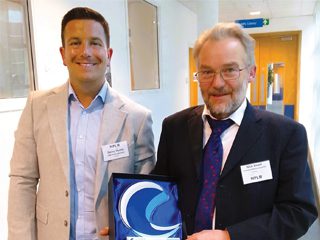
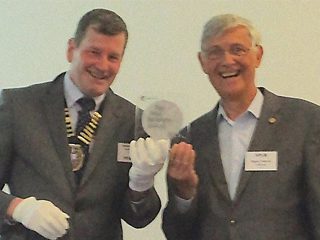
The day highlighted the need to share and transfer knowledge across all industries facing similar corrosion challenges. There were seven main talks and three working groups, led by Douglas Mills (coatings), Nick Smart (nuclear), and Steve Paterson (All Energy Group). This one-day meeting was the latest in a series of working days for the Institute of Corrosion’s Corrosion Engineering Division. Dr. Danny Burkle (Corrosion Testing Specialist – LBBC, Baskerville), Chair of CED, welcomed delegates to the meeting and introduced the speakers. He emphasised that the financial loss due to corrosion in the UK is 3.4% of GDP, or £77.5 M (comparable with defence at 2% or education at 4%). Danny thanked Nick Smart, the previous chair of CED, for his invaluable services over the past 15 years, and he presented him with a special award. Their shared vision is to bridge the gap between the CED and CSD divisions in future, to the benefit of both.
There then followed, ‘An introduction to NPL and NPL Activities’ by Gareth Hinds (Fellow and Science Area Leader, Electrochemistry Group at NPL), a past President of ICorr (2018–2020), the current President of the World Corrosion Organization (WCO), and Vice-President of the European Federation of Corrosion (EFC). Gareth outlined the history of NPL, founded in 1900, and active in corrosion research since 1924 (Guy Bengough (FRS) was an early scientist working there). Subsequently, Alan Turnbull, FRS, FREng, OBE, with 50 years of service at NPL, was introduced and applauded. The focus of government funded research at NPL is: net zero, offshore wind, nuclear waste disposal, and materials selection for these areas. Knowledge transfer includes: NPL corrosion guides, international standards, and industrial guidelines. NPL though continues to do a large amount of corrosion testing on behalf of oil and gas operators (separately, on a commercial basis).
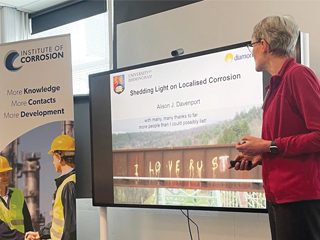
Professor Alison Davenport (University of Birmingham) addressed the subject of “understanding localised corrosion’ and how this can improve corrosion prevention methods. The corrosion of metals in natural environments is a non-uniform process. Using synchrotron X-rays, water and metals are both penetrated, thus permitting mechanisms of formation and breakdown of passive films to be elucidated. A video study providing 3-D tomograms was shown. Rotating disc electrodes enable the growth of passive films to be followed via current transients over millisecond periods. These studies were necessary to assess the risk of fatigue failure in ageing aircraft, e.g., by atmospheric corrosion studies of NaCl deposits on Al-Cu-Mg alloys (AA2024). Similar methods were used to study the corrosion of stainless-steel containers used to store intermediate-level waste. The role of salt films in growing pits was described, along with their relationship to Pourbaix diagrams. At each point in a growing pit, it can be shown that the corrosion current is a function of metal ion concentration and the electric field through the droplet.
Dr. James Hesketh, (Principal Corrosion Science Consultant at Jacobs) spoke on ‘The corrosion of canisters during interim and deep geological disposal of radioactive waste’. There are three levels of radioactive waste: high, intermediate, and low (HLW, ILW, and LLW). Containers for LLW and ILW include unshielded, thin-walled stainless steel, concrete fabrications, and robust cast iron canisters, which have greater impact and fire-damage resistance. Intermediate storage items have been subjected to atmospheric corrosion over several decades. Key environmental parameters are % RH, surface chloride concentration, and time of wetness. Future deep geological disposal will provide permanent, safe disposal. One specification is KBS-3. However, a Swiss concept enabled progress to a more advanced stage. All present designs make use of a multi-barrier approach, comprising copper/carbon steel, with predicted lifetimes >10,000 yr. Despite the complexity and time-variation of corrosive environments, two distinct phases may be identified – early, ‘oxidic’ and long-term, ‘anoxic’. In-situ experiments involving boreholes were then outlined.
Alyshia Keogh (University of Manchester – PhD student) discussed her current research, on the ‘Effect of microstructure on localised corrosion and atmospheric stress corrosion cracking of 15-5PH stainless steel’. The type of microstructure influenced the susceptibility and was very dependent on the ageing temperature, 450 °C, 540 °C or 650 °C. Microstructural characterisation was carried out by STEM/EDX, and differences in pitting behaviour were assessed using double loop electrochemical potentiokinetic reactivation (DL-EPR), which found a linear trend in degree of sensitisation with ageing temperature, and which correlated with the increase in the presence of Cr carbides. Electrochemical noise measured by galvanically coupling dissimilar microstructures suggested that the higher temperature ageing treatment produced the most metastable pitting events. This may have a higher probability of transitioning to stable pitting. Four-point bend specimens with Cl- salt deposits exposed to controlled temperature and humidity revealed that higher ageing temperatures were more resistant to cracking. The mode of cracking changed from intergranular at 450 °C to mixed-intergranular and transgranular, at 540 °C, whereas no cracks occurred in samples aged at 650 °C.
After an excellent lunch there followed several further talks, including one by Roger Francis himself, together with a presentation of the Paul McIntyre Award to him, a very worthy winner. This award is among ICorr’s premier awards, and is presented to a senior corrosion engineer, who, as well as being a leading practitioner in their field, has advanced European collaboration and international standards development.
Roger has been a corrosion engineer for over 45 years, working in the fields of marine corrosion, desalination, sour oil and gas corrosion, mineral processing, and the chemical and process industries. He has published over 100 technical papers in all these areas, written six books on various aspects of corrosion, and jointly edited three others.
Dr. Steve Paterson, (Materials and Corrosion Adviser, Arbeadie Consultants Ltd.) then presented on ‘Applying materials experience from oil and gas production to carbon capture and storage’. Carbon Capture and Storage (CCS) processes prove challenging in so far as the CO2 source may contain impurities, and processing is determined by the level and type of these. Problems encountered in transporting the fluid include liquid dropout, corrosion, and running ductile fracture. Joule-Thomson cooling causes low temperatures with an attendant lack of toughness, the preferred option is to avoid drop-out. Essentially, it is important to consider transients/unstable conditions when assessing processes and defining CO2 specification limits. Also discussed were low temperature brittle fracture and hydrogen-related cracking mechanisms, Stress Corrosion Cracking (SCC), the use of corrosion-resistant alloys, the application of downhole barrier valves, and non-metallic materials.
Dr. Jonathan Mann (Nuclear structural integrity engineer, Jacobs) gave an entertaining but most important talk entitled ‘How to make trends and influence people’ which focused on how fatigue damage is increased by corrosive environments, and is a key consideration in numerous industries, including nuclear. Fatigue crack growth (FCG) studies had been initiated by Rolls-Royce and supported by Jacobs. Current predictive methods are fairly simple, providing over-conservative results. An improvement was to move to a better model, that reflected real behaviour. The ASME Environmental Fatigue document provides fatigue and FCG data for austenitic stainless steels in PWR water (low dissolved oxygen), and an equation relating fatigue life to temperature, strain rate, and oxygen concentration was given. Other factors affecting fatigue life include, varying amplitude, load, multi-axial loading, surface finish, material variability, non-isothermal loading, and thermal gradients. Consequently, rigs have been designed to investigate any type of waveform over a wide-range of temperatures.
Dr. Roger Francis, (Director at RF Materials) gave a resume of ‘The limits of copper alloy and stainless-steel heat-exchanger tubes’. Common alloys used for heat exchangers are, copper alloys (w/o), Al-brass, 90Cu/10Ni, 70Cu/30Ni, and 66/30/2/2 Cu-Ni-Fe-Mn, plus stainless steels, 304L, 316L, 20Cr/18Ni/6Mo; 2304 and 2205 duplex plates, Z100 and 2507 super-duplex. Erosion-corrosion and pitting/crevice corrosion are encountered.
With Al-brass erosion ’horse-shoe going upstream’ defects occur at velocities of 1.5 – 2.0 ms-1. Where seawater contains chlorine to prevent fouling, minimal concentrations should be used. If silt is present, corrosion rates rise rapidly with silt content. However, titanium shows no erosion-corrosion over the entire range of silt levels. For copper alloys, crevice corrosion is not a significant problem, and pitting corrosion is not problematic in fresh water. Sulphide ions at 0.1 mg/l cause pitting corrosion but may be mitigated by acid-cleaning. Super-duplex steels have demonstrated excellent corrosion-resistance since the early 1990s.
Dr. Anthony Setiadi (Chief Consultant / Associate Director – Wood Thilsted) presented finally on the ‘Benefits of using corrosion protection for offshore wind’. Monopiles (MPs) widely used in the supply of renewable energy presently range from 8–10 m diameter and 90 m high. However, for future MP’s, 15 m diameter and 120 m high are envisaged. MPs operate in 15 – 60 m water depth, deeper waters require jackets or floating foundations. In any case, increasingly large surface areas are involved. Corrosion protection via materials selection, corrosion allowances, coatings, and CP for sea-water immersed areas, were discussed. Coatings and cathodic protection support a large decrease in the tonnage of steel required for these structures. Percentage steel tonnages were compared to a ‘base cost’ and tables were presented for 25, 30 and 35-year timescales for C1, C2, C3, and C4 environments.
Typical losses (kg y-1 m-2) ranged from 1.56 in C5 to 0.624 in C4 environments. It should be noted that the coating type can impact corrosion protection very significantly as does control of application at build. Finally, the need to consider the different climates encountered was discussed: tropical, sub-tropical, temperate and arctic.
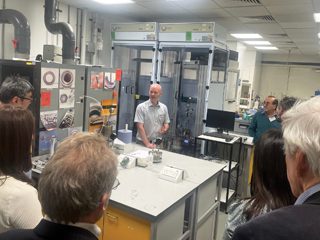
It was possible later in the day for participants to visit the extensive corrosion laboratories of NPL.
All CED presentations will be uploaded to the ICorr website for members to view and download. The three working groups will continue to advance their activities and will announce dates for further meetings in due course. To find out about next year’s CED event, or if you are interested in attending, speaking, or exhibiting, contact Dr. Danny Burkle, at danny.burkle@lbbcbaskerville.co.uk The CED is actively recruiting for a vice chair to assist Danny with growing the division. If this is of interest to you or a colleague, please contact Danny and let him know. Corrosion Management is most grateful to Dr David Nuttall, FICorr and Dr Douglas Mills, FICorr, for providing this event write-up.
Presentation to retiring CED Chair Nick Smart, By Dr Danny Burkle, New CED Chair.
Professor Alison Davenport (University of Birmingham) addressed the subject of ‘understanding localised corrosion’.
Presentation of the Paul McIntyre Award to Dr Roger Francis by Stephen Tate, ICorr President.
Dr Gareth Hinds – Fellow and Science Area Leader, Electrochemistry Group conducts a tour of NPL facilities with ICorr guests.