The 62nd Corrosion Science Symposium (CSS) hosted by the University of Manchester between 6th and 9th September and held jointly with the “Advances in Corrosion Protection by Organic Coatings” meeting, was a hybrid meeting with delegates attending in person and online. The CSS has been held annually since its launch in 1960 by Prof. L.L. Shreir. The symposium is an ideal opportunity for students and junior researchers in corrosion science from across Europe to congregate, discuss their work, and share ideas in a stimulating/friendly environment. This year there were 15 talks and the UR Evans award plenary talk given by Prof Mary Ryan (Imperial College London). Prof Ryan eloquently discussed why fundamentally it is vital to understand materials at the nanoscale, and specifically the nanoscale interfaces in, and between, materials and their environments, in her talk entitled, ‘Corrosion at the nanoscale’.
She reviewed her interest in the development of operando approaches, as well as her pioneering nanoscale corrosion studies using synchrotron methods.
Symposium highlights included presentation by, Yashwantraj Seechurn (University of Mauritius) who gave an interesting overview
of his work studying the atmospheric corrosion of S235 carbon
steel when exposed to the tropical/marine aerosol pollutants of
Port-Louis, Mauritius. Port-louis is situated on the northwest coast
and has a distinct microclimate which leads to major atmospheric corrosion concerns. Yashwantraj presented key insights into the
S235 atmospheric corrosion, revealing an early rapid corrosion initiation, followed by slower corrosion kinetics due to the formation of stable rust phases that were linked to environmental and geographical variables around Mauritius.
Corentin Penot (University of Southampton) reported his studies into the corrosion performance of a wire arc additive manufacture (WAAM) deposited 316L alloy. Specifically, the influence of the WAAM microstructures related to the austenite matrix and an inter-dendritic ferrite and sigma phases. Corentin reported Cr and Mo variations where the austenite matrix was depleted at interphase regions (at the austenite/ferrite boundaries).
Katarzyna Rzeszutek (University of Manchester) gave a good overview of her studies into the influence of zinc loading during cathodic protection of epoxy zinc primers on steel. Katarzyna analysed the dissolved zinc content from such coatings which indicated the anode/cathode surface area ratios exposed to a corrosive medium affect the utilisation of the zinc for the galvanic protection.
For the first time, the 2021 Shreir award (for the best student presenter) was presented to two worthy recipients, Lawrence Coghlan (University of Loughborough) and Charlie Wand (University of Manchester).Lawrence gave an insightful talk entitled ‘carburisation and oxidation of 9Cr-1Mo steel exposed to CO2’ linked to breakaway oxidation associated with the degradation of protective scales within Advance Gas Cooled Reactors.Characterisation of the oxide/substrate interface identified an oxide growth mechanism through preferential oxidation of carbides within the substrate. In pre-breakaway samples an internal oxidation zone develops at this interface due to this preferential oxidation ahead of the oxidation front. Charlie presented a fascinating atomistic molecular dynamics investigation exploring water diffusion through protective epoxy-amine coatings. Simulations found water diffusion to be via a polymer-assisted hopping mechanism between isolated free volume nanoscale pores and that the polymer mobility is the determining factor for the speed of water diffusion. Congratulations to both Lawrence and Charlie for their excellent symposium talks.
The 63rd CSS will be a joint meeting with Electrochem2022 taking place at the John McIntyre Conference Centre near Holyrood Park in Edinburgh, between the 5th and 6th September 2022.Further details on registration and abstract submission will follow shortly.
Welcome to the final edition of our magazine for 2021 which also marks the midway point of my Presidency and so this is a great time to reflect
on the past year.
As we came into 2021 we were all hopeful that Covid would be behind us and we could start getting back to our regular way of operating. This wasn’t the case, but that didn’t hold us back and the past year has been full
of activity and progress.
Our branch meetings continued to be held virtually and were well attended.In April the annual Corrosion Engineering Division (CED) working day was held virtually with over 60 participants for the full day. These events provided an opportunity to improve how we host virtual meetings and we will continue this going forward.In fact, by the time you read this we will have held our Annual General Meeting (AGM) in November which was both in-person and virtual.The virtual option provides a way for members who are not able to attend in person to connect with us – which is what we are about. A bonus is that as we are all thinking about the environment and the recent COP
26 conference, it reduces our carbon footprint as we travel less.
By mid-year we were planning the resumption of in-person meetings and this was led by our Aberdeen and London branches. In September we held the Corrosion Science Symposium at the University of Manchester.These events have been very successful and were all in person and virtual.
For our 2021 awards we had many deserving candidates for the awards committee to choose from – they had a tough time. Many congratulations to the winners who were:
UR Evans award: Professor Mary Ryan. Paul McIntyre award: Dr. Bijan Kermani. Henry G Cole award: Dr. Bill Cox (awarded posthumously and received by his wife and daughter at the AGM). Lionel Shrier award: Lawrence Coghlan and Charlie Wand.
Our social media presence continues to grow and we now have over 10,000 followers on our two LinkedIn sites – as a reminder we had zero in February 2020!We took a pause over the summer with our blogging but will be restarting soon. If you have any suggestions for blogs, please let
me know.
Our training courses have been a real highlight of the year.You may recall all of our CP courses have been updated and are compliant with ISO 15257.We also opened a new, state of the art CP training center at the offices of Corrosion Control Services Limited (CCSL) in Telford. Since releasing the new courses we have delivered over 140 separate training classes.
In the world of surface treatment we have released completely updated Passive Fire Protection (PFP – epoxy Levels 2 & 3) courses. New PFP cementitious courses are being written, as is a new Insulation inspector level 2 course. We have commissioned a Microbially Influenced Corrosion (MIC) course and have several other new programmes in the pipeline.
Our Industrial Coatings Applicator Training Scheme (ICATS) which is provided by Correx (an independent company that is owned 100% by ICorr) remains in high demand.
Our training courses are also in demand from outside the UK. We have
seen growth in China and have just agreed terms with ABRACO in Brazil to deliver a conversion course to our Coating Inspector level 2 certificate.Encouraging talks are also occurring in Egypt, Greece, India, Libya
and Malaysia.
As a result of feedback from many of our members we are developing a proposal to update our website and members database.
During the year we had two audits: one for our ISO 9001 accreditation and one for our license to issue the Chartered Scientist (CSci) credentials. We passed both audits with no significant findings.
Our Young ICorr group continues to be very active and one highlight was the “Thesis in 3 minutes” on-line event, where several young engineers gave enthusiastic talks based on their current work.
I hope this has given you a flavour of what’s been going on and I know many of you have either led or been involved in this. I cannot thank you enough for all the time, energy and enthusiasm you give to our Institute.
I hope you all find time to have a break over the festive season and I’d like to take this early opportunity to wish you a Happy New Year.
Until next time,
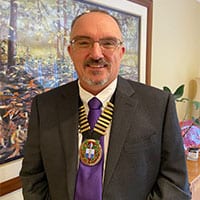
Bill Hedges, Institute of Corrosion President
Email: president@icorr.org
The November technical talk will be on “Lessons Learned from 40 years in Corrosion Protection”, by Alex Garner, Corrosion Services Ltd. This is planned to be held on the 11th at the Lancaster House Hotel, Bayswater, London, with the meeting starting at 18.00.
The presentation will focus will be on the highs, with brief mentions of the lows, of a 40-year career in corrosion protection, including CP, material selection, coatings and insulation, for a wide variety of onshore and offshore facilities. The journey will start in 1980 and cover technical and social challenges in office and site -based work in Europe, Middle East, Asia, Canada, South America, and Australia. as well as the corrosion protection peers encountered over the years, many of which are now friends. The anecdotal guidance delivered in the presentation will highlight the pleasures and technical excellence that can be achieved in this industry and hopefully will not scare too many people away from it.
The branch has decided to go ahead with their annual Christmas luncheon this year.This will take place on 2ndDecember at the usual venue, The Royal Oversees League, Piccadilly, London, for further information, or to book a table, please contact, sjbarke55@gmail.com.
Dr Richard Barker, FiCorr, is the latest in a line of notable Corrosion Scientists to receive the prestigious Kurt Schwabe Award on behalf of the European Federation of Corrosion Committee.
The Kurt Schwabe Prize, established in 2000, honours the late Professor Kurt Schwabe and was initiated by the Hungarian Corrosion Society with support from the ‘Kurt Schwabe Foundation’. Presented once every 3 years, the award, consisting of a certificate and 500 Euros, recognises the scientific and technical contribution of young scientists below the age of 35 in the field of corrosion science. The last UK recipient of the award prior to Dr Barker was Professor Mary Ryan of Imperial College in 2003.
This year, the ICorr committee nominated Dr Barker based on his significant contribution and demonstrable impact, predominantly in the oil and gas industry. Dr Barker is an Associate Professor in Corrosion Science and Engineering in the Institute of Functional Surfaces at the University of Leeds. His research interests lie in the areas of electrochemistry, corrosion science and corrosion engineering, particularly in the context of asset integrity and flow assurance in the energy and low carbon abatement sectors. His expertise encompasses numerical modelling, unique/custom system design for the observation of corrosion phenomena, development of in-situ methods for real-time interface characterisation during corrosion processes, and understanding corrosion behaviour in extreme environments (high temperature/pressure, strong acids and toxic gases).
Dr Barker received the award at the opening ceremony of the Eurocorr conference on the 20th September and delivered a plenary talk on the opening day.
COMSOL is a global provider of simulation software for product design, engineering, and research in technical enterprises, labs, and universities. COMSOL Multiphysics® is a software environment for the modelling and simulation of any physics-based system with the ability to account for multi-physics phenomena. Optional add-on modules add discipline-specific tools for mechanical, fluid, electromagnetics, and chemical simulations, as well as CAD interoperability. Simulation experts can use COMSOL Server™ and COMSOL Compiler™ to deploy simulation applications to design teams, manufacturing departments, test laboratories, and customers worldwide.
Most corrosion occurs due to electrochemical reaction processes taking place underwater and in wet or humid environments. Modelling corrosion allows engineers and scientists to investigate these processes, gain an understanding of the extent to which corrosion could occur over the lifetime of a structure, and implement preventative measures to inhibit electrochemical corrosion, in order to protect their structures. The Corrosion Module, an add-on to COMSOL Multiphysics®, can be used to simulate corrosion at the microscale in order to investigate the fundamental mechanisms, and at larger scales to determine how to protect massive or long-ranging structures from corroding.
The Trustees and Council of the Institute would like to invite you all to the 2021 Annual General Meeting (AGM) to be held on Thursday 22nd of November 2021 at the National Conference Centre & The National Motorcycle Museum in conjunction with the Midlands Branch meeting, including technical presentations by corrosion experts from across UK.
National Conference Centre & The National Motorcycle Museum, Coventry Road, Bickenhill, Solihull, West Midlands B92 0EJ
Please confirm attendance (for lunch numbers and remote access to the AGM) or apology for absence by email to admin@icorr.org.
09h00-10h00
Arrive and registration
09h00-10h00
Midland Branch Meeting
Institute of Corrosion presentations of current ICorr training courses
Chris Spence – CP Richard Edwards – CP certification Kevin Harold – ICATS and certification John Fletcher – ICorr Surface Treatment Courses
10h45-11h00
Comfort break
11h00 – 12h00
Communication and Digitisation in the Corrosion Industry
Speakers
Ian Sotherton – Omniflex Dr Prafull Sharma – CorrosionRADAR Jack Cornes – HausBots
12h00-13h30
Lunch and access to the museum
13h30-14h45
AGM Agenda
Apologies for absence
Minutes of the previous AGM November 2020
President’s report
Treasurer’s report
Elections
Any other business The Trustees and members of Council will be available before the meeting to answer any questions you may have regarding the Institute and its future. Again, as in the case of 2020, the Institute’s accounts, and the minutes for the previous AGM, will be available via the ICorr website (www.icorr.org).Please examine them, and the website in general, as we would appreciate your feedback. This year the AGM will also be live streamed via Zoom or Teams meeting, please confirm your attendance as detailed below to receive further instruct ions for remote access on the day.
We use cookies to optimize our website and our service.
Functional
Always active
The technical storage or access is strictly necessary for the legitimate purpose of enabling the use of a specific service explicitly requested by the subscriber or user, or for the sole purpose of carrying out the transmission of a communication over an electronic communications network.
Preferences
The technical storage or access is necessary for the legitimate purpose of storing preferences that are not requested by the subscriber or user.
Statistics
The technical storage or access that is used exclusively for statistical purposes.The technical storage or access that is used exclusively for anonymous statistical purposes. Without a subpoena, voluntary compliance on the part of your Internet Service Provider, or additional records from a third party, information stored or retrieved for this purpose alone cannot usually be used to identify you.
Marketing
The technical storage or access is required to create user profiles to send advertising, or to track the user on a website or across several websites for similar marketing purposes.